When you click on links to various merchants on this site and make a purchase, this can result in this site earning a commission. Affiliate programs and affiliations include, but are not limited to, the eBay Partner Network.
Document Overview
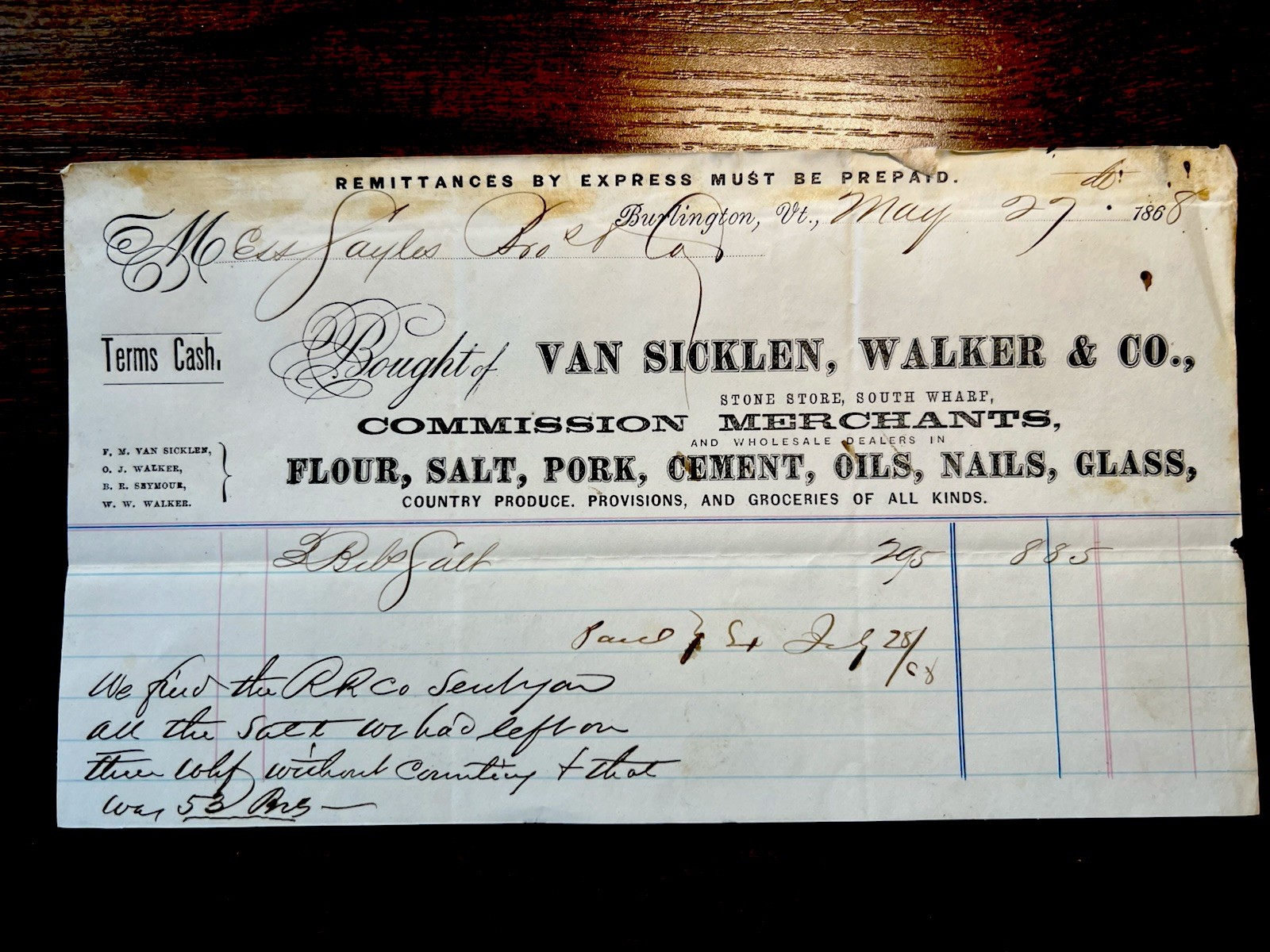
📜 Offered is an ORIGINAL MAY 27, 1868 COMMERCIAL BILLHEAD from DWIGHT, VAN SICKLEN, WALKER & CO., commission merchants and wholesale dealers operating from Stone Store, South Wharf.
🧂 The handwritten transaction concerns 3 BARRELS OF SALT totaling $8.85, with an accompanying handwritten message specifically discussing the R.R. Co. (railroad company), salt left on hand, and the company’s wharf.
The document is addressed to Messrs. Taylor Bros., Burlington, N.J., giving this piece a particularly nice combination of 1860s grocery/provision trade, railroad freight and waterfront commerce.
Document Details / Itemization
🧾 The printed billhead reads prominently:
DWIGHT, VAN SICKLEN, WALKER & CO.
COMMISSION MERCHANTS
STONE STORE, SOUTH WHARF
The firm advertises itself as wholesale dealers in:
* 🌾 FLOUR
* 🧂 SALT
* 🐖 PORK
* 🧱 CEMENT
* 🛢️ OILS
* 🔨 NAILS
* 🪟 GLASS
* 🌾 COUNTRY PRODUCE
* 📦 PROVISIONS
* 🛒 GROCERIES OF ALL KINDS
💵 The billhead states “Terms Cash.”
📨 Across the upper edge is the printed instruction:
“REMITTANCES BY EXPRESS MUST BE PREPAID.”
The four names printed alongside the company heading are:
F. M. VAN SICKLEN
O. J. WALKER
B. R. SEYMOUR
W. W. WALKER
Handwritten transaction
✍️ The bill is dated:
May 27, 1868
and addressed to:
Messrs. Taylor Bros.
Burlington, N.J.
The important merchandise entry is:
🧂 3 BARRELS OF SALT — $8.85 TOTAL
That works out to $2.95 per barrel, which is internally consistent:
3 × $2.95 = $8.85
Handwritten message
🚂 The lower handwritten note discusses the shipment and the railroad company. Reading cautiously from the two enlarged photographs, the important content is:
“We find the R.R. Co. sends you
all the Salt on hand left on
their wharf without counting & that
was 3 Bbls—”
So the 3 Bbls notation in the written message corresponds directly with the $8.85 salt transaction.
That is an important connection: this isn’t merely a bill with three barrels written on it. The accompanying note actually explains that the railroad company sent the remaining salt from its wharf without counting it, with the quantity established as three barrels.
Historical Context
🚂 This little document captures the mechanics of American commerce during the POST-CIVIL WAR era remarkably well. Goods did not simply travel from merchant to customer—they passed through transportation networks involving wholesalers, railroads, freight facilities and waterfront wharves.
⚓ Here, the merchant specifically references an “R.R. Co.” and salt remaining on “their wharf.” That gives us a small contemporary record of how bulk merchandise was being handled and accounted for in 1868.
🧂 Salt was an important bulk commodity in nineteenth-century America, used extensively in food preparation and preservation as well as commercial curing. This transaction records three barrels for $8.85, or $2.95 per barrel, providing an unusually specific surviving period price.
Why This Stands Out
✨ The handwritten combination is what makes this one:
3 BARRELS SALT — $8.85 — R.R. CO. — WHARF — 1868
🧮 Better still, the figures reconcile correctly. The three barrels at $2.95 each produce the recorded $8.85, giving the listing a concrete historical commodity price rather than an isolated handwritten number.
🚂 The railroad language adds another collecting category. The manuscript isn’t railroad letterhead, but it directly documents a railroad company’s handling of commercial freight.
⚓ The reference to salt left on the company’s wharf adds a waterfront/shipping dimension, while the destination of Burlington, New Jersey provides strong local-history interest.
🏢 Visually, the billhead is also excellent, with large decorative typography advertising flour, salt, pork, cement, oils, nails, glass, country produce, provisions and groceries.
Condition
📜 Original 1868 commercial document with expected period handling and storage wear. Visible characteristics include original folds, toning, scattered staining/foxing, edge and corner wear, and more pronounced discoloration along portions of the upper edge.
The ornate printed company heading remains bold, and—most importantly—the handwritten 3 Bbls / $8.85 transaction and railroad-wharf message remain present and readable.
Please examine all photographs closely for the complete condition.