When you click on links to various merchants on this site and make a purchase, this can result in this site earning a commission. Affiliate programs and affiliations include, but are not limited to, the eBay Partner Network.
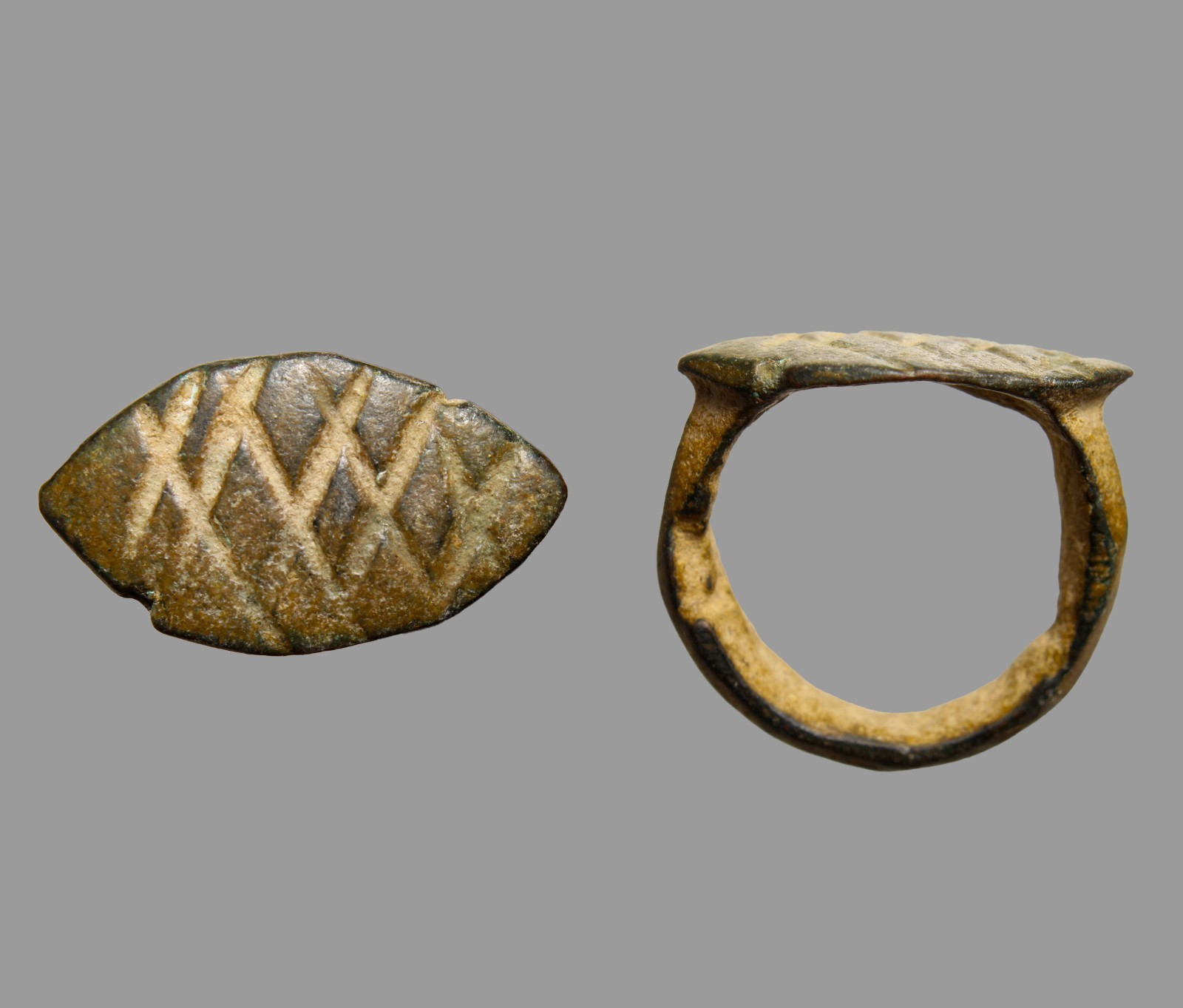
Ancient Roman Egypt Bronze Esoteric / Occult Lattice Amulet Ring (US Size 3 — c. 1st–3rd Century AD)
Authenticity & Guarantee
Item Specifications & Exact Dimensions
Object: Cast Bronze Amuletic / Esoteric Ring with Hand-Engraved Geometric Lattice Bezel
Culture / Period: Roman Egypt / Greco-Roman Period
Date Range: Circa 1st Century AD – 3rd Century AD (c. 30 BC – 300 AD)
Ring Size: US Size 3 (approx. 14.1 mm internal diameter) — engineered for pinky wear, child wear, or suspension as a neck pendant
Material: Cast Bronze (Copper Alloy)
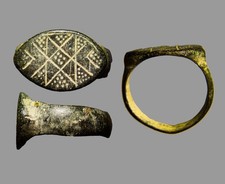
Form & Architecture: Pointed lozenge / almond-shaped flat bezel matrix mounted on a slender rounded hoop; bezel face displays deeply incised criss-cross lattice work forming a series of interlocking protective diamond cartouches; engineered as a personal apotropaic charm (phylakterion)
Condition: Exceptional, complete ancient condition. Crisp incised geometric detailing, solid complete hoop, preserved under a rich dark charcoal-olive bronze patina with creamy pale earthen burial encrustations highlighting the engraved grooves. Free of modern restoration or tooling.
HISTORICAL CONTEXT & TYPOLOGICAL LORE
Greco-Roman Egypt & Esoteric Amulet Traditions
In Ptolemaic and Roman Egypt, personal jewelry was saturated with esoteric symbolism and magic. Beyond figurative depictions of deities, geometric patterns—such as lattices, nets, and repeating diamonds—were imbued with sacred apotropaic energy (pneuma). Rings of this type served as active protective amulets (phylakteria) designed to guard the wearer against spiritual harm, illness, and the evil eye (baskania).
Lattice Symbolism & Occult Net Matrices
The interlocking diamond net pattern deeply incised into the bezel represents a protective cosmic web or binding net, a motif frequently invoked in the Greek Magical Papyri (PGM) of Roman Egypt. Sacred nets were believed to entangle and neutralize malevolent forces before they could reach the wearer. Because of its compact US Size 3 gauge, this ring was worn on a pinky finger, by a youth, or suspended on a leather cord resting over the chest as a talismanic pendant.
Typological Analysis & Exact Classification
Comparable Archaeological Examples & Museum Accession Numbers
Petrie Museum of Egyptian Archaeology (UC12760): Roman period bronze ring with engraved lozenge bezel displaying geometric lattice work.
British Museum (Accession No. 1917,0501.748): Greco-Roman Egypt bronze amuletic ring with incised geometric net motif.
5-3