When you click on links to various merchants on this site and make a purchase, this can result in this site earning a commission. Affiliate programs and affiliations include, but are not limited to, the eBay Partner Network.
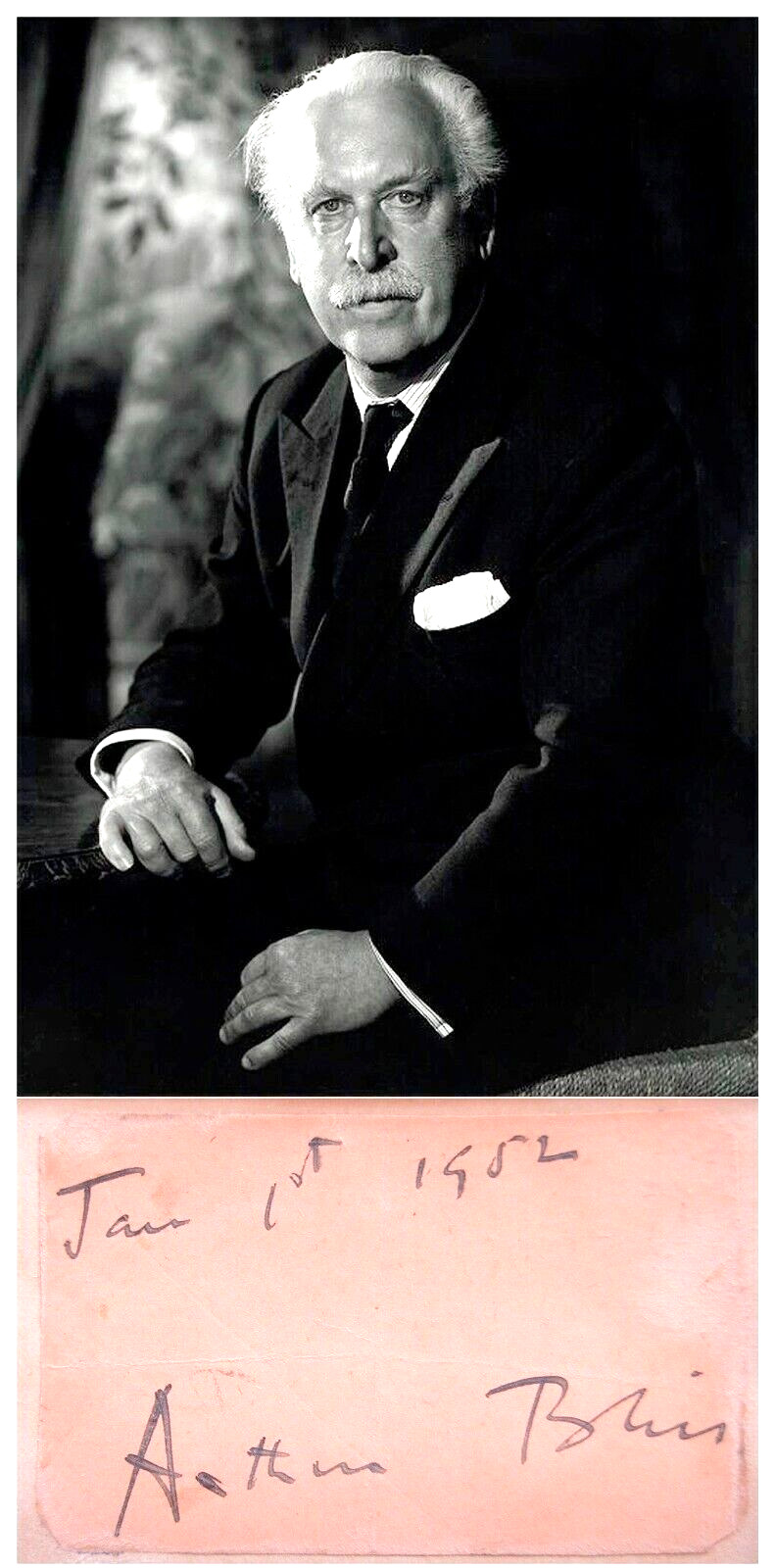
DESCRIPTION : Up for sale is sNICELY HAND SIGNEDoriginal AUTOGRAPH ( With a fountain pen ) of the acclaimed composer and conductor ARTHUR BLISS which is beautifuly and professionaly matted beneath a vintage reproduction artistic PHOTO . The AUTOGRAPH is dated by BLISS\' hand 1952. The original hand signed AUTOGRAPH ( Autogramme - Signature ) and the reproduction PHOTO are nicely matted together , Suitable for immediate framing or display . (An image of a suggested framing is presented - The frame is not a part of thissale - An excellent framing - Buyer\'s choice - is possible for extra $ 100 ).The size of the decorative mat is around12.5 x 7.5\" .The size of the reproduction photo is around 7x 5\" . The size of the original hand signed autograph - signature is around2.0x 3.0 \" . Very goodcondition of the original hand signed autograph, The reproduction photo and the decorative mat. (Pls look at scan for accurate AS IS images )Authenticityguaranteed.Will be sent inside a protective rigidpackaging .
PAYMENTS : Payment method accepted : Paypal& All credit cards.
SHIPPMENT :SHIPP worldwide via registered airmail is $ 35 .Will be sent inside a protectivepackaging. Handling around 5-10 days afterpayment.
Sir Arthur Edward Drummond BlissCHKCVO(2 August 1891– 27 March 1975) was an English composer and conductor.Bliss\'s musical training was cut short by the First World War, in which he served with distinction in the army. In the post-war years he quickly became known as an unconventional and modernist composer, but within the decade he began to display a more traditional and romantic side in his music. In the 1920s and 1930s he composed extensively not only for the concert hall, but also for films and ballet.In the Second World War, Bliss returned to England from the US to work for theBBCand became its director of music. After the war he resumed his work as a composer, and was appointedMaster of the Queen\'s Music.In Bliss\'s later years, his work was respected but was thought old-fashioned, and it was eclipsed by the music of younger colleagues such asWilliam WaltonandBenjamin Britten. Since his death, his compositions have been well represented in recordings, and many of his better-known works remain in the repertoire of British orchestras.Contents1 Biography1.1 Early years1.2 Early compositions1.3 1940s1.4 Later years2 Music2.1 Early works2.2 Mature works3 Honours, legacy and reputation4 See also5 Notes and references6 Sources7 External links7.1 VideosBiography[edit]Early years[edit]Diverse influences on the young Bliss:ElgarandStravinsky(top);Vaughan Williams(lower left) andRavelBliss was born inBarnes, a London suburb, the eldest of three sons of Francis Edward Bliss (1847–1930), a businessman fromMassachusetts, and his second wife, Agnes KennardnéeDavis (1858–1895).[1]Agnes Bliss died in 1895, and the boys were brought up by their father, who instilled in them a love for the arts.[2]Bliss was educated at Bilton Grange preparatory school,RugbyandPembroke College, Cambridge, where he studiedclassics, but also took lessons in music fromCharles Wood.[1]Other influences on him during his Cambridge days wereEdward Elgar, whose music made a lasting impression on him, andE.J. Dent.[3]Bliss graduated in classics and music in 1913 and then studied at theRoyal College of Musicin London for a year.[1]At the RCM he found his composition tutor,Sir Charles Stanford, of little help to him,[2][n 1]but found inspiration fromRalph Vaughan WilliamsandGustav Holstand his fellow-students,Herbert Howells,Eugene GoossensandArthur Benjamin.[5]In his brief time at the college he got to know the music of theSecond Viennese Schooland the repertory ofDiaghilev\'sBallets Russes, with music by modern composers such asDebussy,RavelandStravinsky.[2]When the First World War broke out, Bliss joined the army, and fought in France as an officer in theRoyal Fusiliersuntil 1917 and then in theGrenadier Guardsfor the rest of the war. His bravery earned him amention in despatches, and he was twice wounded and once gassed.[2][5]His younger brother Kennard was killed in the war, and his death affected Bliss deeply. The music scholarByron Adamswrites, \"Despite the apparent heartiness and equilibrium of the composer\'s public persona, the emotional wounds inflicted by the war were deep and lasting.\"[6]In 1918, Bliss converted toRoman Catholicism.[1]Early compositions[edit]Bliss, caricatured in 1921 by F. SanchaAlthough he had begun composing while still a schoolboy, Bliss later suppressed all hisjuvenilia, and, with the single exception of his 1916Pastoralfor clarinet and piano, reckoned the 1918 workMadam Noyas his first official composition.[2]With the return of peace, his career took off rapidly as a composer of what were, for British audiences, startlingly new pieces, often for unusual ensembles, strongly influenced by Ravel, Stravinsky and the young French composers ofLes Six.[1]Among these are a concerto for wordless tenor voice, piano and strings (1920),[n 2]andRoutfor wordless soprano and chamber ensemble (subsequently revised for orchestra), which received a double encore at its first performance.[n 3]In 1919, he arranged incidental music from Elizabethan sources forAs You Like ItatStratford-on-Avon, and conducted a series of Sunday concerts atLyric Theatre, Hammersmith, where he also conducted Pergolesi\'s operaLa serva padrona.[7]Viola Tree\'s production ofThe Tempestat theAldwych Theatrein 1921, interspersed incidental music byThomas ArneandArthur Sullivan, with new music by Bliss for an ensemble of male voices, piano, trumpet, trombone, gongs and five percussionists dispersed through the theatre.[8]The Timeswrote that \"Bliss was acquiring a reputation as a tearaway\" by the time he was commissioned, through Elgar\'s influence, to write a large-scale symphonic work (A Colour Symphony) for theThree Choirs Festivalof 1922.[5]The work was well received; inThe Manchester Guardian,Samuel Langfordcalled Bliss \"far and away the cleverest writer among the English composers of our time\";[9]The Timespraised it highly (though doubting if much was gained by the designation of the four movements as purple, red, blue and green) and commented that the symphony confirmed Bliss\'s transition from youthful experimenter to serious composer.[10]After the third performance of the work, at theQueen\'s HallunderSir Henry Wood,The Timeswrote, \"Continually changing patterns scintillate … till one is hypnotised by the ingenuity of the thing.\"[11]Elgar, who attended the first performance, complained that the work was \"disconcertingly modern.\"[12]In 1923 Bliss\'s father, who had remarried, decided to retire in the US. He and his wife settled inCalifornia. Bliss went with them and remained there for two years, working as a conductor, lecturer, pianist and occasional critic.[5]While there he met Gertrude \"Trudy\" Hoffmann (1904–2008), youngest daughter ofRalphandGertrude Hoffmann. They were married in 1925. The marriage was happy and lasted for the rest of Bliss\'s life; there were two daughters. Soon after the marriage, Bliss and his wife moved to England.[1]Bliss in 1932 byMark GertlerFrom the mid-1920s onwards Bliss moved more into the established English musical tradition, leaving behind the influence of Stravinsky and the French modernists, and in the words of the criticFrank Howes, \"after early enthusiastic flirtations with aggressive modernism admitted to a romantic heart and [has] given rein to its less and less inhibited promptings\"[13]He received two major commissions from American orchestras, theIntroduction and Allegro(1926) for thePhiladelphia OrchestraandLeopold StokowskiandHymn to Apollo(1926) for theBoston SymphonyandPierre Monteux.[1]Bliss began the 1930s withPastoral(1930). In the same year he wroteMorning Heroes, a work for narrator, chorus and orchestra, written in the hope of exorcising the spectre of the First World War: \"Although the war had been over for more than ten years, I was still troubled by frequent nightmares; they all took the same form. I was still there in the trenches with a few men; we knew the armistice had been signed, but we had been forgotten; so had a section of the Germans opposite. It was as though we were both doomed to fight on till extinction. I used to wake with horror.\"[14]During the decade Bliss wrote chamber works for leading soloists including a Clarinet Quintet forFrederick Thurston(1932) and a Viola Sonata forLionel Tertis(1933). In 1935, in the words of theGrove Dictionary of Music and Musicians, \"he firmly established his position as Elgar\'s natural successor with the Romantic, expansive and richly scored Music for Strings.\"[3]Two dramatic works from this decade remain well known, the music forAlexander Korda\'s 1936 film ofH. G. Wells\'sThings to Come,[5]and a ballet score to his own scenario based on a chess game. Choreographed byNinette de Valois,Checkmatewas still in the repertoire of theRoyal Balletin 2011.[15]By the late 1930s, Bliss was no longer viewed as a modernist; the works of his juniorsWilliam Waltonand the youthfulBenjamin Brittenwere increasingly prominent, and Bliss\'s music began to seem old-fashioned.[16][17]His last large-scale work of the 1930s was hisPiano Concerto, composed for the pianistSolomon, who gave the world premiere at theWorld\'s Fairin New York in June 1939. Bliss and his family attended the performance and then stayed on in the US for a holiday. While they were there, the Second World War broke out. Bliss initially stayed in America, teaching at theUniversity of California, Berkeley. He felt impelled to return to England to do what he could for the war effort, and in 1941, leaving his wife and children in California, he made the hazardous Atlantic crossing.[1]1940s[edit]At first, Bliss found little useful work to do in England. He joined theBBC\'s overseas music service in May 1941,[18]but was plainly under-employed. He suggested toSir Adrian Boult, who was at that time both the chief conductor of theBBC Symphony Orchestraand the BBC\'s director of music, that Boult should step down in his favour from the latter post.[19]Bliss wrote to his wife: \"I want more power as I have a lot to give which my comparatively minor post does not allow me to use fully.\"[20]Boult agreed to the proposal, which freed him to concentrate on conducting.[20][n 4]Bliss served as director of music at the BBC from 1942 to 1944, laying the foundations for the launch of theThird Programmeafter the war.[1]During the war, he also served on the music committee of theBritish Counciltogether with Vaughan Williams and William Walton.[22]In 1944, when Bliss\'s family returned from the US, he resigned from the BBC and returned to composing, having written nothing since his String Quartet in 1941.[23]He composed more film music, and two ballets,Miracle in the Gorbals(1944),[24]andAdam Zero(1946).[25]In 1948, Bliss turned his attention to opera, withThe Olympians. He and the novelist and playwrightJ. B. Priestleyhad been friends for many years, and they agreed to collaborate on an opera, despite their lack of any operatic experience. Priestley\'s libretto was based on a legend that \"the pagan deities, robbed of their divinity, became a troupe of itinerant players, wandering down the centuries\".[26]The opera portrays the confusion that results when the actors unexpectedly find themselves restored to deity.[n 5]The opera opened the 1949–50Covent Gardenseason. It was directed byPeter Brook, with choreography byFrederick Ashton. The doyen of English music critics,Ernest Newman,[29]praised it highly: \"here is a composer with real talent for opera ... in Mr. Priestley he has been fortunate enough to find an EnglishBoito\", but generally it received a polite rather than a rapturous reception.[30]Priestley attributed this to the failure of the conductor,Karl Ranklto learn the music or to cooperate with Brook, and to lack of rehearsal of the last act.[26]The critics attributed it to Priestley\'s inexperience as an opera librettist, and to the occasional lack of \"the soaring tune for the human voice\" in Bliss\'s music.[28]After the Covent Garden run of ten performances,[30]the company presented the work inManchester,[31]but did not revive it in subsequent years; it received a concert performance and broadcast in 1972.[32]Later years[edit]In 1950, Bliss wasknighted.[23]After the death ofSir Arnold Baxhe was appointedMaster of the Queen\'s Musicin 1953, to the relief of Walton, who feared he would be asked to take the post.[33]InThe Times, Howes commented, \"The duties of a Master of the Queen\'s Music are what he chooses to make of them, but they include the composition of ceremonial and occasional music\".[13]Bliss, who composed quickly and with facility, was able to discharge the many duties of the post, providing music as required for state occasions, from the birth of a child to the Queen, to the funeral ofWinston Churchill, to the investiture of thePrince of Wales.[3][34][35]Howes commended Bliss\'sProcessionalfor the 1953 coronation, andA Song of Welcome, Bliss\'s first officialpièce d\'occasion.[13]In 1956, Bliss headed the first delegation by British musicians to the Soviet Union since the end of the Second World War. The party included the violinistAlfredo Campoli, the oboistLéon Goossens, the sopranoJennifer Vyvyan, the conductorClarence Raybouldand the pianistGerald Moore.[36]Bliss returned to Moscow in 1958, as a member of the jury of theInternational Tchaikovsky Competition, with fellow jurors includingEmil GilelsandSviatoslav Richter.[37]Coventry Cathedralfor which Bliss composedThe BeatitudesIn addition to his official functions, Bliss continued to compose steadily throughout the 1950s. His works from that decade include his Second String Quartet (1950); a scena,The Enchantress(1951), for thecontraltoKathleen Ferrier; a Piano Sonata (1952); and a Violin Concerto (1955), for Campoli. The orchestralMeditations on a Theme by John Blow(1955) was a particularly deep-felt work, and Bliss regarded it highly among his output.[1]In 1959–60 he collaborated with the librettistChristopher Hassallon an opera for television, based on the scriptural story of Tobias and the Angel . It won praise for the way in which Bliss and Hassall had understood and adapted to the more intimate medium of television,[38]though some critics thought Bliss\'s music competent but unremarkable.[39]In 1961, Bliss and Hassall collaborated on acantata,The Beatitudes, commissioned for the opening of the newCoventry Cathedral. Reviews were friendly,[40]but the work has rarely been performed since, and has been eclipsed by another choral work written for Coventry at the same time,Britten\'sWar Requiem.[n 6]Bliss followed this with two further large-scale choral works,Mary of Magdala(1962) andThe Golden Cantata(1963).[3]Throughout his life, Bliss was vigilant on the state of music in Britain, about which he had written extensively since the 1920s.[42]In 1969 he publicly censured the BBC for its plan to cut its classical music budget and disband several of its orchestras. He was delegated by his colleagues Walton, Britten,Peter Maxwell DaviesandRichard Rodney Bennettto make a strong protest toWilliam Glock, the BBC\'s controller of music.[n 7]Bliss continued to compose into his eighth and ninth decades, in which his works included the Cello Concerto (1970) forMstislav Rostropovich, theMetamorphic Variationsfor orchestra (1972),[3]and a final cantata,Shield of Faith(1974), for soprano, baritone, chorus and organ, celebrating 500 years ofSt. George\'s Chapel, Windsor Castle, setting poems chosen from each of the five centuries of the chapel\'s existence.[44]Bliss died at his London home in 1975 at the age of 83.[5]His wife Trudy outlived him by 33 years, dying in 2008 at the age of 104.Music[edit]See also:List of compositions by Arthur BlissEarly works[edit]The musicologist Christopher Palmer was censorious of those who sought to characterise Bliss\'s music as \"an early tendency toenfant terribilismeyielding very quickly to a compromise with the Establishment and a perpetuating of the Elgar tradition\".[17]Nonetheless, as a young man Bliss was certainly regarded asavant garde.Madam Noy, a \"witchery\" song, was first performed in June 1920. The lyric is by an anonymous author, and the setting is for soprano with flute, clarinet, bassoon, harp, viola, and bass. In a 1923 study of Bliss, Edwin Evans wrote that the piquant instrumental background to the gruesome story established the direction that Bliss was to take. The second Chamber Rhapsody (1919) is \"an idyllic work for soprano, tenor, flute, cor anglais, and bass, the two voices vocalising on \'Ah\' throughout, and being placed as instruments in the ensemble.\"[7]Bliss contrasted the pastoral tone of that work withRout(1920) an uproarious piece for soprano and instrumental ensemble; \" the music conveys an impression such as one might gather at an open window at carnival time … the singer is given a series of meaningless syllables chosen for their phonetic effect\".[7]In his next work,Conversationsfor violin, viola, cello, flute and oboe (1921), Bliss chose a deliberately prosaic subject. It consists of five sections, entitled \"Committee Meeting,\" \"In the Wood,\" \"In the Ball-room,\" \"Soliloquy,\" and \"In the Tube at Oxford Circus.\" Evans wrote of this work that although the instrumentation is ingenious, \"much of [the] interest ispolyphonic, especially in the first and last numbers.\"[7]Bliss followed these works with three compositions for larger forces, a Concerto (1920) and Two Orchestral Studies (1920). The Concerto, for piano, voice and orchestra, was experimental, and Bliss later revised it, removing the vocal part. TheMelée Fantasque(1921) showed Bliss\'s skill in writing glittering orchestration.[8]Mature works[edit]Of Bliss\'s early works,Routis occasionally performed, and has been recorded, but the first of his works to enter the repertoire (at least in the UK) is theColour Symphony. Each of the four movements represents a colour: \"purple, the colour of amethysts, pageantry, royalty, and death; red, the colour of rubies, wine, revelry, furnaces, courage, and magic; blue, the colour of sapphires, deep water, skies, loyalty, and melancholy; and green, the colour of emeralds, hope, joy, youth, spring, and victory.\" The first and third are slow movements, the second a scherzo, and the fourth fugal, described by the Bliss specialist Andrew Burn as \"a compositional tour de force, a superbly constructed double fugue, the initial subject slow and angular for strings, gradually becoming an Elgarian ceremonial march, the second a bubbling theme for winds.\"[45]Burn observes that in three works written soon after his marriage, the Oboe Quintet (1927),Pastoral(1929) andSerenade(1929), \"Bliss\'s voice assumed the mantle of maturity … all are imbued with a quality of contentment reflecting his serenity.\"[2]Of the works of Bliss\'s maturity, Burn comments that many of them were inspired by external stimuli. Some by the performers for whom they were written, such as the concertos forpiano(1938), violin (1955) and cello (1970); some by literary and theatrical partners, such as the film music, ballets, cantatas andThe Olympians; some by painters, such as theSerenadeand theMetamorphic Variations; some by classical literature, such asHymn to Apollo(1926),The Enchantress, andPastoral.[2]Of Bliss\'s works after the Second World War, his opera,The Olympiansis generally considered a failure. The idiom was judged to be old-fashioned. A contemporary critic, in a broadly favourable review, wrote, \"Bliss has wisely cleared his idiom of modern harmonic astringency. He uses quite a lot of common chords and progressions; in fact, he has gone back to the harmony of the musical gods. The result, inevitably, is a certain air of reminiscence.\"[46]Among the late works, the Cello Concerto is one of the more frequently played. When its dedicatee, Rostropovich, gave the first performance at the 1970Aldeburgh Festival, Britten, who conducted the performance, regarded it as a major work and persuaded Bliss to change its title from \"Concertino\" to \"Concerto\". It is an approachable piece of which Bliss said \"There are no problems for the listener – only for the soloist\".[47]Both Palmer and Burn comment on a sinister vein that sometimes breaks out in Bliss\'s music, in passages such as the Interlude \"Through the valley of the shadow of Death\" inThe Meditations on a Theme of John Blow, and the orchestral introduction toThe Beatitudes. In Burn\'s words, such moments can be profoundly disquieting.[2][17]Palmer comments that the musical forerunner of such passages is probably \"the extraordinary spectral march-like irruption\" in the Scherzo of Elgar\'sSecond Symphony.[17]In a centenary assessment of Bliss\'s music, Burn singles out for mention \"the youthful vigour ofA Colour Symphony\", \"the poignant humanity ofMorning Heroes\", \"the romantic lyricism of the Clarinet Quintet\", \"the drama ofCheckmate,Miracle in the GorbalsandThings to Come\", and \"the spiritual probing of theMeditations on a Theme of John BlowandShield of Faith.\"[2]Other works of Bliss classed by Palmer as among the finest are theIntroduction and Allegro, theMusic for Strings, the Oboe Quintet,A Knot of Riddlesandthe Golden Cantata.[17]Honours, legacy and reputation[edit]In addition to hisknighthood, Bliss was appointedKCVO(1969) andCH(1971).[23]He received honorary degrees from the universities andLondon, as well as fromPrinceton University.[23]TheLondon Symphony Orchestraappointed him its honorary President in 1958.[n 8]In 1963, he received the Gold Medal of theRoyal Philharmonic Society.[23]Bliss\'s archive is kept atCambridge University Library. There is an Arthur Bliss Road in Newport, an Arthur Bliss Gardens in Cheltenham and a block of flats, Sir Arthur Bliss Court, inMitcham, South London.The Arthur Bliss Society was founded in 2003 to further the knowledge and appreciation of Bliss\'s music. The society\'s website includes listings of forthcoming performances of Bliss\'s works; in March 2011 the following works were listed as scheduled for performance in the UK and U.S.:Ceremonial Prelude; Clarinet Quartet (2 performances); Four Songs for Voice, Violin and Piano;Music for Strings;Pastoral (Lie strewn the white flocks);Royal Fanfares;Seven American Poems; String Quartet No. 2 (5 performances);Things to ComeSuite (2 performances);Things to ComeMarch.[49]Many of Bliss\'s works have been recorded. He was a capable conductor, and was in charge of some of the recordings. The Library of Cambridge University maintains a complete Bliss discography. In March 2011 it contained details of 281 recordings: 120 orchestral, 56 chamber and instrumental, 58 choral and vocal, and 47 stage and screen works. Among the works that have received multiple recordings areA Colour Symphony(6 recordings); the Cello Concerto (6); the Piano Concerto (6);Music for Strings(7); the Oboe Quintet (7); the Viola Sonata (The violin sonata was first recorded in 2010) (7); andCheckmate(complete ballet and ballet suite (9)).[50]On receiving the Gold Medal of the Royal Philharmonic Society in 1963, Bliss said, \"I don\'t claim to have done more than light a small taper at the shrine of music. I do not upbraid Fate for not having given me greater gifts. Endeavour has been the joy\".[51]A hundred years after Bliss\'s birth, Byron Adams wrote,Of the smaller stars that shone in the ample firmament of twentieth-century English music, the light that coruscated with the greatest brilliance was Sir Arthur Bliss.[6]*****Born in London in 1891, educated at Rugby, Cambridge and the Royal College of Music, Arthur Bliss composed only a handful of film scores but some of them are very notable, especially his first - forThings to Come(d. William Cameron Menzies, 1936). This was an immediate success and performed as a concert suite at the Promenade Concerts.Bliss firmly believed that film music should be able to stand alone in this way, and at least two of his other scores were publicly performed: those forConquest of the Air(d. Alexander Esway, Zoltan Korda, John Monk Saunders, Alexander Shaw, Donald Taylor, 1940), which included a twelve-minute suite, andMen of Two Worlds(d. Thorold Dickinson, 1946), matching the film\'s lofty aspirations.Wounded during World War I, he spent time in the US in the \'20s, was knighted in 1950, appointed Master of the Queen\'s Musick in 1953, and awarded CH in 1971. He also composed ballets, opera and much chamber music. *****Arthur Bliss1891 - 1975SNAPSHOTBIOGRAPHYEnglishArthur Bliss studied at Cambridge and withStanfordat the Royal College of Music * After First World War, works showed influence ofStravinskyand Les Six, attracting some notoriety * In 1920s style broadened into moreElgarian vein, with such works asA Colour Symphonyestablishing him as a major figure * Collaborated with Ninette de Valois onCheckmateand with Robert Helpmann on two further ballets * In 1935 composed the first great film score for Korda\'s version of H.G.Wells\'sThings to Come* Many popular works for chorus and for brass band * During Second World War was Director of Music at BBC, laying foundations for the future Third Programme and Radio 3 * Appointed Master of the Queen\'s Music in 1953Works by Arthur Bliss include:A Colour Symphony(1921-22, rev.1932) for orchestraIntroduction and Allegro(1926, rev.1937) for orchestraConquest of the Air: Concert Suite(1937) for orchestraSeven American Poems(1940) for low voice and piano\"...the foundation of all music is emotion...called into being by the sudden awareness of actual beauty seen, or by the vision of beauty vividly apprehended...If I were to define my musical goal, it would be to try for an emotion truly and clearly felt, and caught forever in a formal perfection.\" — Sir Arthur Bliss ***Sir Arthur BlissEnglish composerPrintCiteShareMoreWRITTEN BYThe Editors of Encyclopaedia BritannicaEncyclopaedia Britannica\'s editors oversee subject areas in which they have extensive knowledge, whether from years of experience gained by working on that content or via study for an advanced degree....Last Updated:Mar 23, 2021See Article HistoryAlternative Title:Arthur Edward Drummond BlissTEST YOUR KNOWLEDGEAntonyms and Synonyms QuizTypes of Chemical Reactions QuizTest Your Geography Knowledge with This Capital Cities QuizWorld Capitals QuizSir Arthur Bliss, original name in fullArthur Edward Drummond Bliss, (bornAugust2, 1891, London—died March 27, 1975, London), one of the leading English composers of the first half of the 20th century, noted both for his early, experimental works and for his later, more subjectivecompositions.Bliss studied underRalph Vaughan WilliamsandGustav Holst. Up to the early 1920s, hismusicwas frequently experimental,e.g.,Rhapsody(1919), for solo voices and chamber ensemble, in which the voice plays an instrumental role, singing vocalises (meaningless syllables), andA Colour Symphony(1922, revised 1932), whose four movements are intended to suggest the colours purple, red, blue, and green. Later, although he never abandoned experimentation, he began composing in classical forms,e.g., the quintets for oboe and strings and for clarinet and strings, thePiano Concerto, and theConversationsfor chamber orchestra. He composed the scores for three films, includingThings to Come(1935; after H.G. Wells). Other works include the television operaTobias and the Angel(1960) and his choralsymphonyMorning Heroes(1930). His ballets areCheckmate(1937; choreographed by Ninette de Valois),Miracle in the Gorbals(1944; choreographed by Robert Helpmann), andAdam Zero(1946; Helpmann). His lastcomposition, a choral work calledShield of Faith,was performed initially a few weeks after his death, at the 500th anniversary celebration atSt. George’sChapel, Windsor. Bliss was knighted in 1950 and in 1953 became Master of the Queen’s Musick. ***ARTHUR BLISS(1891 - 1975)Arthur Bliss, having been knighted in 1950, was Master of the Queen’s Music in Great Britain from 1953 until his death. After a period in which he embraced a more radical approach to composition, he eventually followed the late-Romantic tradition of English music established by Elgar. In accordance with the perceived duties of his official position, he wrote various ceremonial pieces, in addition to music for the concert hall, theatre and cinema.Film MusicFamiliar music by Bliss includes excerpts from his film score for HG Wells’sThings to Comeand the patriotic marchWelcome the Queen, also written for a film.Stage WorksThe balletsCheckmate(an allegorical game of chess, with choreography by Ninette de Valois),Miracle in the Gorbals(a morality play set in the slums of Glasgow, with choreography by Robert Helpmann) andAdam Zero(another Helpmann production, of 1946) made a strong impression on ballet audiences. Bliss was less successful with his operaThe Olympians, a collaboration with JB Priestley, but his television opera of 1960,Tobias and the Angel, was well received.Choral and Orchestral MusicBliss enjoyed a reputation as a very competent conductor, and was therefore familiar with orchestral music both as conductor and composer. His compositions includeA Colour Symphony(movements taking various hues), a Piano Concerto for Solomon, a Violin Concerto for Campoli, and, in 1970, a Cello Concerto for Rostropovich. His moving choral and orchestral workMorning Heroeswas written in memory of his brother and all who had fallen in the Great War, in which he had also served. It makes use of melodrama, an orator speaking the chosen texts.Chamber MusicBliss’s chamber music ranges from string quartets to works with wind instruments. In particular he wrote a Clarinet Quintet, an Oboe Quintet,Conversationsfor wind instruments and string trio, a Viola Sonata and a Piano Quartet, all of which contribute usefully to chamber-music repertoire. **** 4995 folder186