When you click on links to various merchants on this site and make a purchase, this can result in this site earning a commission. Affiliate programs and affiliations include, but are not limited to, the eBay Partner Network.
2 1936 newspapers THE ARAB REVOLT n PALESTINE BEGINS against JEWISH IMMIGRATION
Lot of two (2) 1936 newspapers - THE ARAB REVOLT in PALESTINE BEGINS against JEWISH IMMIGRATION & British rule- inv # 9L-508
Please visit our store for THOUSANDS MORE HISTORICAL NEWSPAPERS for SALE or at sale
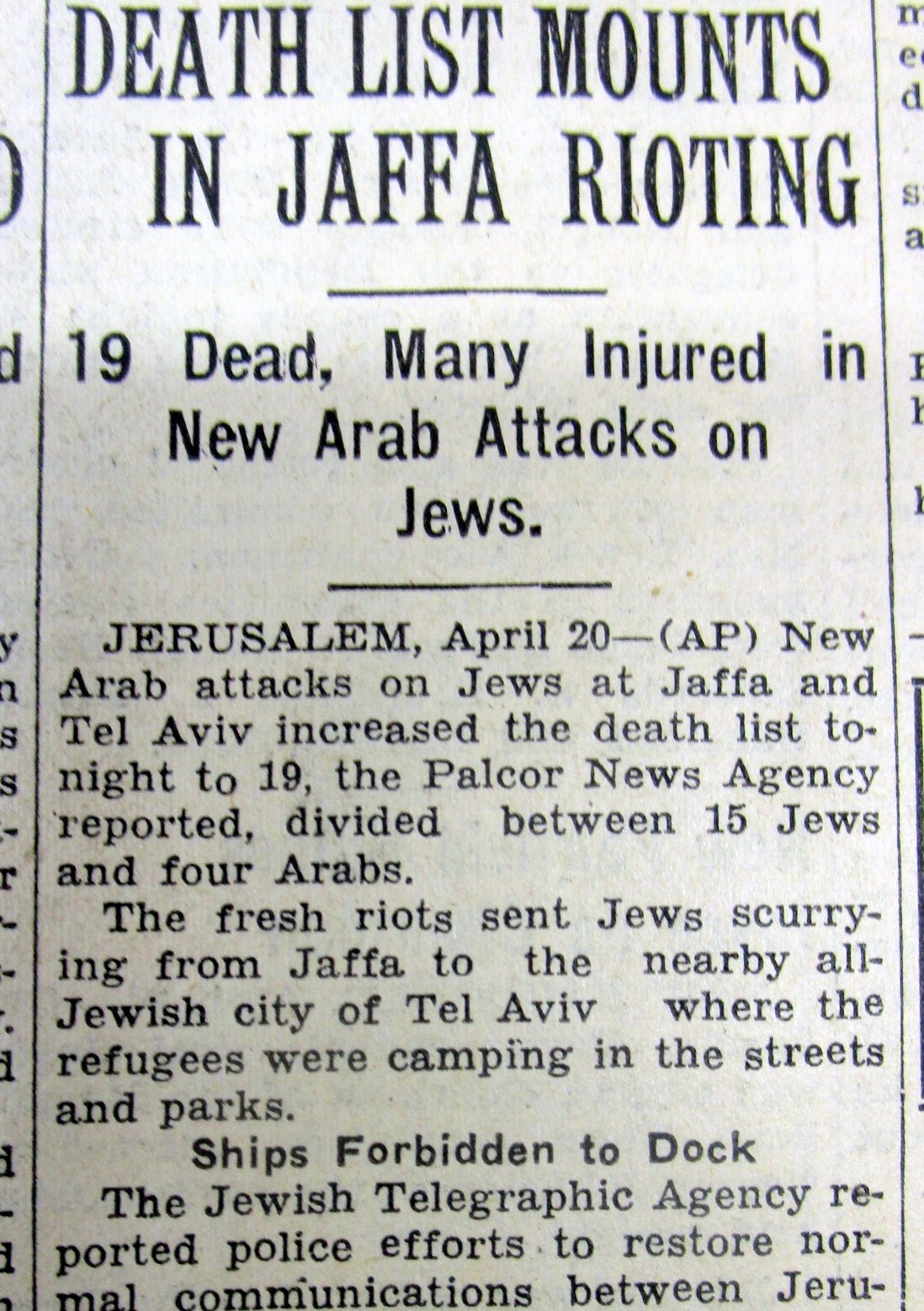
SEE PHOTO(s) - Lot of two (2) COMPLETE (CT) datedAugust 20 and 21, 1936. These 2 original newspapers contain prominent front page headings with detailed coverage of the BEGINNING of THE 1936-1939 ARAB REVOLT in PALESTINE against British rule and Jewish immigration.
The 1936 Palestine riots marked the beginning of the 1936–1939 Arab revolt in Palestine, a nationalist uprising by Palestinian Arabs against British colonial rule and mass Jewish immigration.
Key Events and Causes
- Trigger: The unrest erupted in mid-April 1936 following retaliatory killings between Arabs and Jews after the death of followers of the slain anti-colonial preacher Sheikh Izz al-Din al-Qassam.
- The Jaffa Riots: Violent clashes broke out in Jaffa riots (April 1936) on April 19, 1936, leading to multiple deaths and significant property destruction.
- General Strike: The Arab general strike began in Nablus and spread nationwide, lasting for over six months until October 1936.
- Arab Higher Committee: Formed under the leadership of Haj Amin al-Husseini, the committee coordinated political demands for national independence, an end to Jewish immigration, and a halt to land sales.
- British Response: Britain suppressed the revolt and dispatched the Peel Commission, which in 1937 recommended partitioning Palestine into separate Arab and Jewish states.
Apopular uprisingbyPalestinian ArabsinMandatory Palestineagainst the British administration, known as theGreat Revolt,and later theGreat Palestinian Revoltor thePalestinian Revolution,lasted from 1936 until 1939. The movement sought independence fromBritish colonial ruleand the end of British support forZionism, includingJewish immigrationand land sales to Jews.
The uprising occurred during a peak in the influx ofEuropean Jewishimmigrants,and with the growing plight of the ruralfellahinrendered landless, who as they moved to metropolitan centres to escape their abject poverty found themselves socially marginalized.Since theBattle of Tel Haiin 1920, Jews and Arabs had been involved in a cycle of attacks and counter-attacks, and the immediate spark for the uprising was themurder of two Jewsby aQassamite band, and the retaliatory killing by Jewish gunmen of two Arab labourers, incidents which triggered a flare-up of violence across Palestine.A month into the disturbances,Amin al-Husseini, president of theArab Higher CommitteeandMufti of Jerusalem, declared 16 May 1936 as "Palestine Day" and called for ageneral strike.David Ben-Gurion, leader of theYishuv, described Arab causes as fear of growing Jewish economic power, opposition to mass Jewish immigration and fear of the British identification withZionism.
The general strike lasted from April to October 1936. The revolt is often analysed in terms of two distinct phases.The first phase began as spontaneous popular resistance, which was seized on by the urban bourgeois Arab Higher Committee, giving the movement an organized shape that was focused mainly on strikes and other forms of political protest, in order to secure a political result.By October 1936, this phase had been defeated by the Britishcivil administrationusing a combination ofpolitical concessions, international diplomacy (involving the rulers ofIraq,Saudi Arabia,TransjordanandYemen)and the threat ofmartial law.The second phase, which began late in 1937, was a peasant-led resistance movement provoked by British repression in 1936in which increasingly British forces were targeted as the army itself increasingly targeted the villages it thought supportive of the revolt.During this phase, the rebellion was brutally suppressed by theBritish Armyand thePalestine Police Forceusing repressive measures that were intended to intimidate the whole population and undermine popular support for the revolt.A more dominant role on the Arab side was taken by theNashashibi clan, whoseNDP partyquickly withdrew from the rebelArab Higher Committee, led by the radicalfactionof Amin al-Husseini, and instead sided with the British – dispatching "Fasail al-Salam" (the "Peace Bands") in coordination with the British Army against nationalist and Jihadist Arab "Fasail" units (literally "bands").
According to official British figures covering the whole revolt, the army and police killed more than 2,000 Arabs in combat, 108 werehanged, and 961 died because of what they described as "gang and terrorist activities".In an analysis of the British statistics,Walid Khalidiestimates 19,792 casualties for the Arabs, with 5,032 dead:3,832 killed by the British and 1,200 dead due to intracommunal terrorism, and 14,760 wounded.By one estimate, ten percent of the adult malePalestinian Arabpopulation between 20 and 60 was killed, wounded, imprisoned or exiled.Estimates of the number ofPalestinian Jewskilled are up to several hundred.
The Arab revolt in Mandatory Palestine was unsuccessful, and its consequences affected the outcome of the1948 Palestine war.It caused the British Mandate to give crucial support to pre-state Zionist militias like theHaganah, whereas on the Palestinian Arab side, the revolt forced the main Palestinian Arab leader of the period, al-Husseini, into exile.
Very good condition. This listing includes the2 complete entire original newspapers, NOT just a clipping or a page of them. STEPHEN A. GOLDMAN HISTORICAL NEWSPAPERS stands behind all of the items that we sell with a no questions asked, money back guarantee. Every item we sell is an original newspaper printed on the date indicated at the beginning of its description. U.S. buyers payUSPS media mail postage.International postage is quoted when we are informed as to where the package is to be sent. We do combine postage (to reduce postage costs) for multiple purchases sent in the same package. We list thousands of rare newspapers with dates from 1570 through 2004 on each week. This is truly SIX CENTURIES OF HISTORY that YOU CAN OWN!
Stephen A. Goldman Historical Newspapers has been in the business of buying and selling historical newspapers for over 50 years. Dr. Goldman is a consultant to the Freedom Forum Newseum and a member of the American Antiquarian Society. You can buy with confidence from us, knowing that we stand behind all of our historical items with a 100% money back guarantee. Let our 50+ years of experience work for YOU ! We have hundreds of thousands of historical newspapers (and their very early precursors) for sale.
Stephen A. Goldman Historical Newspapershas been in the business of buying and selling historical newspapers for over 50 years. We are located in the charming Maryland Eastern Shore town of OXFORD, Maryland.
Dr. Goldman is a consultant to the Freedom Forum Newseum and a member of the American Antiquarian Society. You can buy with confidence from us, knowing that we stand behind all of our historical items with a 100% money back guarantee. Let our 50+ years of experience work for YOU ! We have hundreds of thousands of historical newspapers (and their very early precursors) for sale.
We invite customer requestsforhistorical newspapers that are not yetlocated in our extensive listing ofitems. With an inventory of nearlya million historical newspapers (and their early precursors) we arelikely have just the one YOU are searching for.
WE ARE ALSO ACTIVE BUYERS OF HISTORICAL NEWSPAPERS, including large and small personal collections, bound volumes, significant individual issues, or deaccessions from libraries and historical societies. IF YOU WANT TO SELL, WE WANT TO BUY !!!
Powered by SixBit's eCommerce Solution