When you click on links to various merchants on this site and make a purchase, this can result in this site earning a commission. Affiliate programs and affiliations include, but are not limited to, the eBay Partner Network.
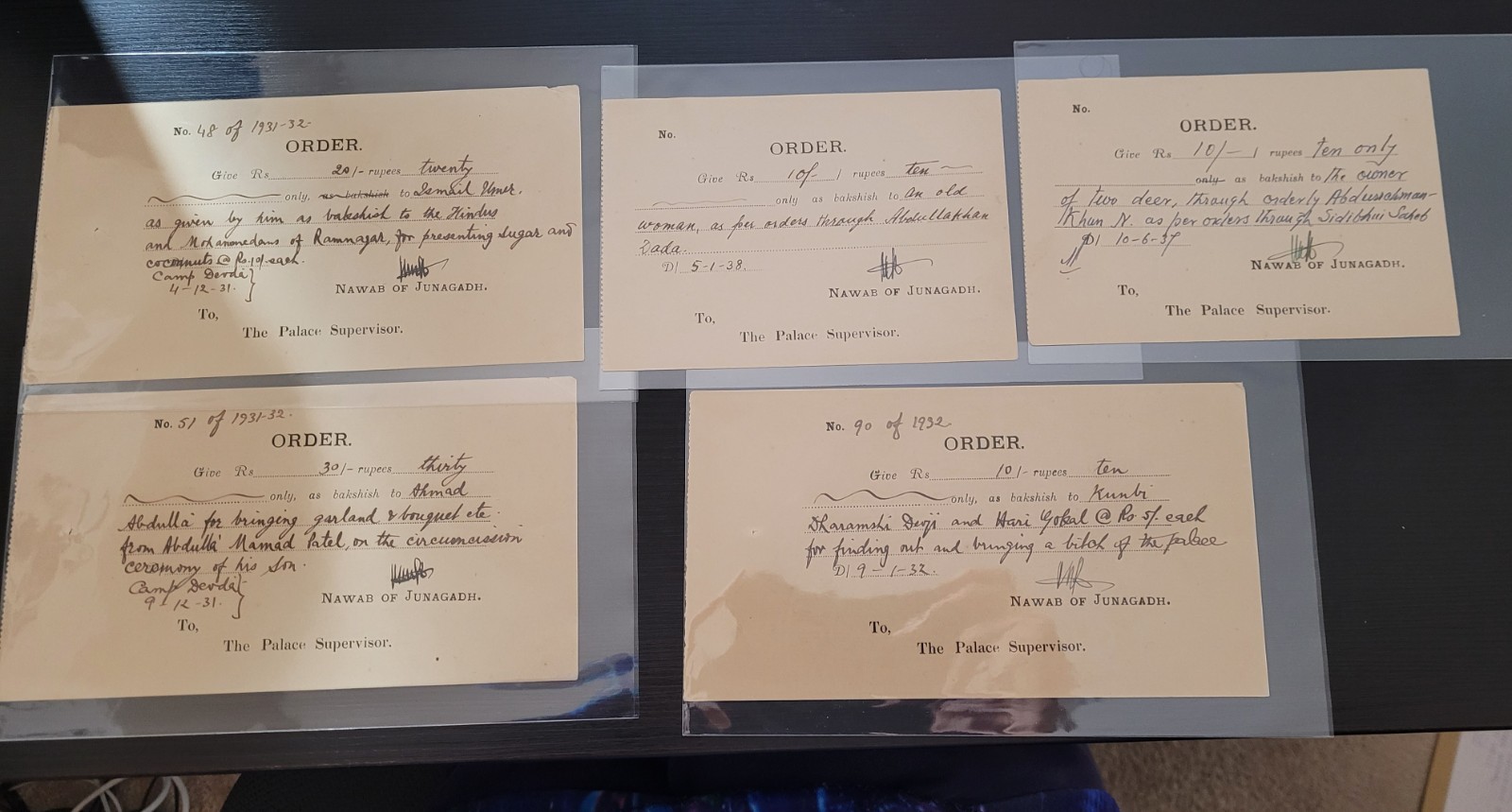
5 Rare Nawab of Junagadh Signed Bakshish Orders 1930s India Princely State Autog
Full Text Transcription of All 5 SlipsSlip 1 (Top Left)
Header: No. 48 of 1931–32. ORDER.
Body: Give Rs. 20- rupees twenty only, as bakshish to Ismail Umer, as given by him as bakshish to the Hindus and Mohammedans of Ramnagar, for presenting sugar and coconuts at Rs. 10- each. Camp Derdi 4-12-31.
Sign-off / Signature: NAWAB OF JUNAGADH. (Includes palace stamp/signature initials).
Recipient: To, The Palace Supervisor.
Slip 2 (Bottom Left)
Header: No. 51 of 1931–32. ORDER.
Body: Give Rs. 30- rupees thirty only, as bakshish to Ahmad Abdulla for bringing garland & bouquet etc. from Abdulla Mamad Patel, on the circumcision ceremony of his son. Camp Derdi 912–31.
Sign-off / Signature: NAWAB OF JUNAGADH. (Includes initials).
Recipient: To, The Palace Supervisor.
Slip 3 (Top Middle)
Header: No. [Blank] ORDER.
Body: Give Rs. 10/- rupees ten only as bakshish to an old woman, as per orders through Abdullakhan Dada. D/ 5-1-38.
Sign-off / Signature: NAWAB OF JUNAGADH. (Includes initials).
Recipient: To, The Palace Supervisor.
Slip 4 (Bottom Right)
Header: No. 90 of 1932. ORDER.
Body: Give Rs. 10- rupees ten only, as bakshish to Kunbi Dharamshi Devji and Hari Gokal Rs. 5- each for finding out and bringing a bitch of the palace. D/ 9-1-32.
Sign-off / Signature: NAWAB OF JUNAGADH. (Includes initials).
Recipient: To, The Palace Supervisor.
Slip 5 (Top Right)
Header: No. [Blank] ORDER.
Body: Give Rs. 10- rupees ten only as bakshish to the owner of two deer, through orderly Abduschman Khan N. as per orders through Sidibhai Saheb. D 10-637.
Sign-off / Signature: NAWAB OF JUNAGADH. (Includes initials).
Recipient: To, The Palace Supervisor.
History of the Item
These documents originate from the Princely State of Junagadh, a historical self-governing state in India during the British Raj, ruled by the Nawabs of Junagadh prior to its integration into India in 1947.
These rare, handwritten "Bakshish" (gift/reward) financial order slips were issued directly under the authority of the Nawab's administration. Directed to The Palace Supervisor, each slip authorized monetary rewards (ranging from 10 to 30 rupees) for various royal, ceremonial, and everyday palace affairs. They offer a fascinating, intimate look into early 20th-century royal Indian administration—recording unique events such as rewards for returning lost palace animals, ceremonial garlands for a circumcision celebration, gifts for religious communities (Hindus and Mohammedans) at Camp Derdi, and compensation for local villagers.
The Nawab of Junagadh was the Muslim ruler of the princely state of Junagadh in Gujarat, India, during the British Raj. The dynasty was founded in the 18th century by the Babi dynasty. The last ruling monarch was Muhammad Mahabat Khanji III, famous for his extreme wealth, love for hundreds of dogs, and a controversial 1947 decision to join Pakistan.History and 1947 Accession CrisisPartition choice: When India became free in August 1947, Mahabat Khan III chose to accede his state to Pakistan, even though most people who lived there were Hindu.Public revolt: The Hindu citizens revolted against the choice, and Indian forces stepped in to restore order.Fleeing to Pakistan: The Nawab escaped to Karachi, and a public vote later integrated Junagadh into India.
ndia and Pakistan’s territorial conflict over Kashmir (“Jammu and Kashmir” officially) is well known, as are the complications that it creates for cartographers. Maps produced in India must portray all of the disputed area as Indian land, while Pakistani maps show it as part of Pakistan. Outside observers who try to remain impartial usually divide these two countries at the actual line of control, depicting the areas under Indian administration as part of India and those under Pakistani administration as part of Pakistan. Careful maps note that the boundary line is disputed. If one does not indicate the conflicted nature of the division, controversy can ensue. As we have discovered at GeoCurrents, maps that do not include Pakistani-controlled Gilgit-Baltistan and Azad Kashmir as parts of India can arouse the ire of Indian readers.
Northern Pakistan MapThe new edition (2012) of the Atlas of Islamic Republic of Pakistan is an interesting source to examine the Pakistani position on this issue. The atlas has official status; its copyright is marked as “Government of Pakistan,” it was printed by the Survey of Pakistan, and it was published under the direction of Surveyor-General of Pakistan. Not surprisingly, its maps portray Kashmir as part of Pakistan, but they do mark most of this area as “Disputed Territory,” further specifying that its eastern border with China remains “undefined.” The Atlas does, however, oddly exclude Gilgit from the disputed zone. It also never marks the actual line of control that separates Indian-administered from Pakistani-administered territory.
Junagadh MapThe truly peculiar feature of the atlas, however, is not its portrayal of Kashmir, but rather that of the Indian state of Gujarat. All maps of Pakistan in the atlas depict a sizable section of western Gujarat as an integral, non-disputed part of Pakistan, whereas its world political map seemingly classifies this same region as if it were an independent country. The area in question is the former princely state of Junagadh. In the imagination of the cartographer, “Junagadh and Manavadar” retains its former complex territory, with numerous exclaves and enclaves, that in actuality vanished shortly after the end of British India. Such fractionated territoriality reflects its heritage as an autonomous statelet that had been under the suzerainty of the British Raj during colonial time. After partition, Junagadh became part of the Republic of India, but evidently that incorporation is still viewed as illegitimate in some World Political Map JunagadhPakistani governmental circles. The map in question also portrays the city of Diu as remaining under Portuguese control, whereas in actuality it was annexed by India in 1961.
The Junagadh controversy goes back to 1947-1948 and the emergence of India and Pakistan as independent states. At the time, the rulers of the “princely states” were given some leeway in regard to which country their territories would join. Problems emerged in several princely states, especially those in which the ruler followed a different religion from that followed by the minority of his subjects. Whereas Kashmir at the time was ruled by a Hindu but had a clear Muslim majority, the situation in Junagadh was reversed. During the partition process, the Nawab of Junagadh tied to join his state to Pakistan, much to the displeasure of both his subjects and the British viceroy, Lord Mountbatten. India was also infuriated, and responded with a blockade of the territory. As explained in the Wikipedia:
Eventually, [India’s Deputy Prime Minister Vallabhbhai] Patel ordered the forcible annexation of Junagadh’s three principalities. Junagadh’s state government, facing financial collapse and lacking forces with which to resist Indian force, invited the Government of India to take control. A plebiscite was conducted in December, in which approximately 99% of the people chose India over Pakistan.
…..
Nehru [subsequently] sent a telegram to Liaquat Ali Khan about the Indian take-over of Junagadh. Khan sent a return telegram to Nehru stating that Junagadh was Pakistani territory, and nobody except the Pakistan government was authorised to invite anybody to Junagadh. He also accused the Indian Government of naked aggression on Pakistan’s territory and of violating international law. The Government of Pakistan strongly opposed the Indian occupation.
As evidenced by the Atlas of Islamic Republic of Pakistan, the government of Pakistan has never accepted India’s annexation of the territory, which did proceed in a highly irregular manner. (In fact, as reported to me by by Munis Faruqui, “the Pakistan government still issues a very limited number of car license plates emblazoned with the name “Junagadh,(presumably to members of the former royal family.”) But its also seems clear that a sizable majority of Junagadh’s people wanted union with India, although the 99-percent pro-India vote does make me rather suspicious of the plebiscite.
Gujarat Princely States MapAnother complicating factor was the extraordinarily complex and essentially feudal nature of the political geography of India’s princely states, especially those in Gujarat for a superb map, reproduced here at a reduced scale). Manavadar, for example, formed a separate territory under the vassalage Junagadh, which in turn was something of a vassal of the much more populous state of Baroda, which had been ruled by a Hindu Maharaja. According to some sources, such subordination meant that their rulers had no right to choose between India and Pakistan. As outlined in a different Wikipedia article:
On 14 September 1947, following the independence of the new Dominions of India and Pakistan, the Khan Sahib Ghulam Moinuddin Khanji acceded the state of Manavadar to the Dominion of Pakistan though the state had no such right to do so being a vassal of Junagarh. This act was done at the same time as his master, the Nawab of Junagadh who himself had no right, being a vassal of Baroda State. Indian police forces were subsequently sent into Manavadar on 22 October 1947, and the Khan Sahib was placed under house arrest at Songadh.
In a fascinating and informative article, Sandeep Bhardwaj refers to the accession of Junagadh to India as a “farce of history.” As he notes:
Junagadh itself contained dozens of petty estates and sheikhdoms within it. In fact the situation was so confusing that it took the Government of India several weeks just to figure out the correct borders before they could formulate a military plan. Moreover, the government lawyers couldn’t figure out whether these tiny sheikhdoms were legally independent or under the suzerainty of Junagadh even after the accession. But Junagadh was an important state, with a population of 700,000, 80% of them Hindus and, predictably, ruled by a Muslim prince.
The Nawab of Junagadh was an eccentric character, famously obsessed with dogs. He was said to have owned 800 of them, each with its individual human attendant. When two of his favourite dogs mated, he is said to have spent Rs. 20-30 lakhs in “wedding” celebrations, and proclaimed the day as State holiday. It is no surprise that the actual governing of the Junagadh was carried out by his dewan (Chief Minister). In the last months of British India his dewan was a Muslim League politician named Shah Nawaz Bhutto (father of future Pakistani Prime Minister Zulfikar and grandfather to Benazir Bhutto).
1911 - 1959 Colonel H.H. Shri Diwan Nawab Sir Muhammad Mahabat Khanji III Rasul Khanji, Nawab Sahib of Junagadh, GCIE (1.1.1931), KCSI (1.1.1926). b. at Junagadh, 2nd August 1900, youngest son of H.H. Shri Diwan Nawab Sir Muhammad Rasul Khanji Mahabat Khanji, Nawab Sahib of Junagadh, GCSI, by his wife, H.H. Nawab Ayesha Bi Maji Sahiba, educ. Mayo Coll, Ajmer, Rajputana. Became Heir Apparent on the death of his elder brother. Succeeded on the death of his father 22nd January 1911. Installed on the musnaid on the same day at Junagadh. Reigned under a Council of Regency until he came of age and was invested with full ruling powers, 31st March 1920. Granted a permanent salute of 13-guns, 1st January 1918. He acceded to the Dominion of Pakistan, 14th September 1947 (formally accepted by the Governor-General of Pakistan, 15th September 1947). As a consequence of threats to his safety, the Nawab was forced to leave for Pakistan with his family on 24th October. Indian troops then invaded, occupied the state and appointed its own administrator, 9th November 1947. Following a referendum arranged by the Government of India on 20th February 1948, the state was merged with Saurashtra on 20th February 1949. Cmsnd as Hon Capt British Army 19/6/1937, prom Hon Maj 21/7/1942, and Hon Col 15/10/1946, Col-in-Chief Mahabat Khanji Infantry 1/2/1924. Hon Vice-Presdt Indian Red Cross Soc. Mbr Western India Turf Club, Poona Club, Willingdon Sports Club, etc. Rcvd: Delhi Durbar gold medal (1911), Silver Jubilee (1935), Coron (1937 & 1953), and Pakistan Independence (1948) medals, the Order of the Great Leader 1st class (Nishan-i-Quaid-i-Azam NQA). m. (first) at Bhopal, 3rd April 1921 (nikah) and at Junagadh, 7th April 1921 (zifaf), H.H. Munawwar Jahan Begum Sahiba [Senior Begum] (d. at Dilawar Manzil, Karachi, Pakistan, 1957, bur. there), great granddaughter of General H.H. Nasir ud-Daula, Nawab Baqi Muhammad Khan Bahadur, Umrao Dulha, Nusrat Jang, sometime C-in-C Bhopal State Forces, and daughter of Ali Janab, Sardar Mian Sa’adat Muhammad Khan, by his first wife, a daughter of Sardar Wilayat ‘Ali Khan, of the Jalalabadi clan. m. (second) 27th April 1923 (div. May 1945), H.H. Bibi Shri Amna Bibi Sahiba [Junagadhwala Begum] (d. at Karachi, Pakistan, 1985), daughter of Kartalia, a descendant of an Abyssinian slave, by his Kolhi wife. m. (third) at Veravel, 30th October 1923, H.H. Bibi Shri Aman Bibi Sahiba [Kutiana Begum] (b. at Kutiana, 1911; d. at the Noor Manzil, Karachi, Sind, Pakistan, 31st January 1975, bur. there at PECHS Cemetery), sister of his fifth wife, from the family of the jagirdar of Kutiana. m. (fourth) 8th July 1925 (nikah), H.H. Bibi Shri Moti Bibi Sahiba, of Junagadh. m. (fifth) 9th November 1932, H.H. Bibi Shri Dadiba Sahiba [Mahabhatpura Begum], sister of his third wife, from the family of the jagirdar of Kutiana. m. (sixth) at Junagadh, 26th July 1945, H.H. Saida Sultana Begum Sahiba [Huzur Begum Sahiba], daughter of a tazimi sardar of the state. He d. at Junagadh House, Karachi, Sind, Pakistan 7th November 1959 (bur. there at PECHS Cemetery), having had issue, ten sons and ten daughters:
1) H.H. Shri Diwan Nawab Muhammad Dilawar Khanji Mahabat Khanji, Nawab Sahib of Junagadh (s/o Munawar Jahan) - see below.
2) Nawabzada Muhammad Himmat Khanji Mahabat Khanji Sahib. b. 16th February 1924 (s/o Amna Bibi), educ. Haileybury Imperial Service Coll, Hertford, UK.
3) Nawabzada Muhammad Shamsher Khanji Mahabat Khanji Sahib. b. 2nd July 1924 (s/o Aman Bibi). He d. 4th August 1926.
4) Nawabzada Muhammad Iqbal Khanji Mahabat Khanji Sahib. b. 28th August 1925 (s/o Aman Bibi). He d. 20th June 1926.
5) Nawabzada Muhammad Sakhawat Khanji Mahabat Khanji Sahib. b. at Amna Mahal, Junagadh, 18th November 1931 (s/o Amna Bibi). He d. 2nd December 1935.
6) Nawabzada Muhammad Raza Khanji Mahabat Khanji Sahib. b. at Junagadh, 29th September 1933 (s/o Dadiba). m. at Flag Staff House, Karachi, 1959, … He d. at Karachi, 16th January 1980, having had issue, a son:
a) Khan Shri Ghulam Muhammad Mahabat Razakhanji Babi [Sahibzada Ghulam Muhammad Khan]. m. Sahibzadi Shah Bano Begum.
7) Nawabzada Muhammad Yusuf Khanji Mahabat Khanji Sahib. b. at Amna Mahal, Junagadh, before 1941 (s/o Amna Bibi). m. Bima Shri Umaid Jahan Bakhte Sahiba (b. at Batwa; d. at Karachi, Pakistan), daughter of Haji Sher ‘Ali Khan, of Batwa, by his wife, Bima Shri Sultan Bakhte. He d. 29th June 1999, having had issue, a son:
a) Khan Shri ... Yusufkhanji. m. Jabeen Begum. He had issue, two sons.
8) Nawabzada Sadiq Muhammad Khanji Mahabat Khanji Sahib. b. 3rd April 1943 (s/o Dadiba).
9) Nawabzada Shaharyar Muhammad Khanji Mahabat Khanji Sahib (s/o Saida Sultana).
10) Nawabzada Said 'Ali Khanji Mahabat Khanji Mahabat Khanji Sahib (s/o Saida Sultana).
1) Nawabzadi Bima Shri Taj Bakhte Sahiba [Burrey Raja] (d/o Munawar Jahan). m. Sardar Shakir Muhammad. She d. at Karachi, Pakistan, Feb-Jun. 1987, having had issue, seven children.
2) Nawabzadi Bima Shri Umrao Bakhte Sahiba [Chotey Raja] (d/o Munawar Jahan). m. Sahibzada Sardar Afzal Muhammad Khan, son of Sardar Rauf Muhammad Khan Sahib, of Bhopal, by his second wife. She d. at Karachi, Pakistan, 22nd February 1962, having had issue, an only son – see India (Bhopal).
3) Nawabzadi Bima Shri Inayat Bakhte Sahiba [Bima Shri Inayat Begum Sahiba, of Bantva]. b. at Junagadh, 17th September 1927 (d/o Aman Bibi). m. at Junagadh, 11th November 1945, Khan Shri Ghulam Mohi ud-din Khanji Sherkhanji Babi Babi, Darbar Sahib of Bantva (b. at Bantva, 11th May 1922; d. at Karachi, Sind, Pakistan, 24th July 2009, bur. there at PECHS Cemetery), eldest son of Khan Shri Sher Khanji Sherbulandkhanji Babi, Darbar Sahib of Bantva, by his wife, Bima Shri Husain Bakhte Sahiba, younger daughter of Nawab Shri Muhammad Manowar Khan Zorawar Khan Babi, Nawab Sahib of Balasinor. She d. at Karachi, Sind, Pakistan, 7th April 2000, bur. there at PECHS Cemetery), having had issue, three sons and one daughter – see India Non-Salute (Bantva).
4) Nawabzadi Bima Shri Raheb Bakhte Sahiba. Copyright© Christopher Buyers
5) Nawabzadi Bima Shri Unrao Bakhte Sahiba.
6) Nawabzadi Bima Shri Kulsum Bakhte Sahiba. b. 1st January 1932 (d/o Saida Sultana). m. ... Farooqi. She d. 11th November 1998, having had issue, four children.
7) Nawabzadi Bima Shri Kishwar Sultan Bakhte Sahiba.b. at Junagadh, 11th March 19XX (d/o Aman Bibi).
8) Nawabzadi Bima Shri Noor Bakhte Sahiba (d/o Aman Bibi). m. at Junagadh, July 1945, Kumar Shri Ghulam Moin ud-din Khanji Babi Sahib, Khan Sahib of Sardargarh (b. 11th June 1919), son of Khan Shri Hussain Yawar Khanji Babi Sahib, Khan Sahib of Sardargarh, by his first wife, Bibi Shri Amir Bakhte Sahiba, daughter of Khan Shri Sultan Muhammad Khanji, a bhayad of Junagadh state - see India - Non-salute (Sardargarh).
9) Nawabzadi Bima Shri Zohra Bakhte Sahiba (d/o Daduba). She d. 2005.
10) Nawabzadi Bima Shri Rahat Sultana Bakhte Sahiba (d/o Amna Bibi).
Copyright© Christopher Buyers
[1959 - 1989] Colonel H.H. Shri Diwan Nawab Al-Haj Muhammad Dilawar Khanji Mahabat Khanji, Nawab Sahib of Junagadh. b. at Junagadh, 23rd June 1922, eldest son of Colonel H.H. Shri Diwan Nawab Sir Muhammad Mahabat Khanji III Rasul Khanji, Nawab Sahib of Junagadh, GCIE, KCSI, by his first wife, H.H. Munawar Jahan Begum Sahiba, educ. Haileybury Imperial Service Coll, Hertford, UK. Became Heir Apparent with the title of Wali Ahad Bahadur at birth. Officer-in-Charge State Motor Dept. 1946-1947. Left for Pakistan together with his father and his family, 24th October 1947. Succeeded on the death of his father, as Head of the Royal House of Junagadh, 7th November 1959 (officially recognised by the Government of Pakistan). Governor of Sind 1976-1977. Hon Col Junagadh State Forces and Hon Col Pakistam Army. Rcvd: the Order of the Great Leader 2nd class (HQA) (1963), PMA, PMM, 1939-45 British War (1945), Silver Jubilee (1935), Coron (1937 & 1953), Pakistan Independence (1950), and Pakistan Republic (1956) medals, King Abdul Aziz Decoration 2nd class of Saudi Arabia, etc. m. (first) at Junagadh, 30th November 1945, Shahzadi Shafiq Jahan Begum Sahiba, daughter of Sharafat 'Ali Khan [Shafqat Miyan Durrani?], of Bhopal and great-granddaughter of General H.H. Nasir ud-Daula, Nawab Baqi Muhammad Khan Bahadur, Umrao Dulha, Nusrat Jang, sometime C-in-C Bhopal State Forces. m. (second) at Karachi, Pakistan, 1949, H.H. Nawab Shah Begum Sahiba (b, at Bhopal, 9th March 1933), née Sahibzadi Mussarat Jahan Begum, granted the personal name of Shah Begum 1957, daughter of Sardar Rauf Muhammad Khan, of Bhopal, by his wife, Nawabzadi Najm uz-Zaman Begum Sahiba, younger daughter of Nawab Muhammad Haidar 'Ali Khan Bahadur, Firuz Jung, Nawab of Basoda. He d. at Karachi, Sind, Pakistan, 30th August 1989 (bur. there at PECHS Cemetery), having had issue, three sons and one daughter, by his second wife:
1) H.H. Diwan Shri Nawab Muhammad Jahangir Khanji Dilawar Khanji, Nawab Sahib of Junagadh (s/o Shah Begum) - see below.
2) Nawabzada Muhammad Alamgir Khanji Dilawar Khanji Sahib. b. at Karachi, Pakistan, 18th February 1960 (s/o Shah Begum), educ. in Switzerland, Franklin & Marshall Coll, Lancaster, Pennsylvania (B. Intnl. Affairs & Econ. 1982), and Montclair State Coll, New Jersey, USA. Management Trainee with Deutsche Bank in Karachi 1985, served in Singapore and Karachi until 1987, worked in Corporate Banking (Credit & Marketing) until 1995, CEO Dilawar Knit (Pvt.) Ltd since 1992, Group Vice-Presdt (Karachi Area Four) Prime Commercial Bank Ltd. 1995, General Mngr Pulse Global Hom Video (Pvt) Ltd, etc. m. (first) at Karachi, Pakistan, 1983 (div.), ... Begum. m. (second) at Karachi, 1991, Fevziye Begum, daughter of Admiral Fasih Bokhari, sometime Chief of Naval Staff (CNS), Pakistan Navy, by his wife, Zeba Begum. He had issue, one son by his first and two daughters by his second wife:
a) Sahibzada Hamza Khanji Alamgir Khanji. b. at Karachi, Pakistan, 27th April 1985 (s/o the first wife), educ. American Sch, Karachi, Sind, Pakistan, and Toronto Univ, Toronto, Ontario, Canada.
a) Sahibzadi Bima Shri Anum Bakhte. b. at Karachi, Pakistan, 1992 (d/o Fevziye Begum), educ. Jesus & Mary Convent Sch, Karachi, Sind, Pakistan.
b) Sahibzadi Bima Shri Iman Bakhte. b. at Karachi, Pakistan, 1994 (d/o Fevziye Begum), educ. Karachi Grammar Sch, Karachi, Sind, Pakistan.
3) Nawabzada Muhammad Zahir Khanji Dilawar Khanji Sahib. b. at Karachi, Pakistan, 9th February 1964 (s/o Shah Begum), educ. Aitchison Coll, and Hailey Coll of Commerce, Univ of the Punjab, Lahore. m. 2004, ... He has issue, one daughter.
1) Nawabzadi Bima Shri Shah Aliya Bakhte Sahiba [Nawabzadi Aliya Dilawar Khanji]. b. at Karachi, Pakistan, 5th November 1974 (d/o Shah Begum), educ. Jseus & Mary Convent, Karachi, and Karachi Univ (BA, MA). Assist Cmsnr 1st class & Magistrate Sind 1995-1996, joined Federal Public Service Cmsn as Assist Collector of Customs 1999, now Assist Collector of Customs at Jinnah International Airport. m. (first) at Karachi, Pakistan, 4th February 1997 (div. there 18th September 1998) Usman Abdullah, son of Rahim Abdullah, from a family of Karachi industrialists, by his wife, Phool Bibi , daughter of Dr Murtaza Khan, sometime Chief Surgeon of Junagadh State, by his wife, Edith Begum, a German lady. m. (second) February 2008, Mian Muhammad Shaheryar, son of Muhammad ‘Ali, a Punjabi landlord descended from ‘Ali Ahmad Sabir, a spiritual leader of the 17th century. She had issue, one daughter by her first husband:
a) Sahibzadi Bima Shri Falah Bakhte Khanji. b. at Karachi, Pakistan, 1997 (d/o Usman), educ. Jesus & Mary Convent, Karachi, and in Montreaux, Switzerland.
Copyright© Christopher Buyers
Copyright© Christopher Buyers
Copyright© Christopher Buyers
Copyright© Christopher Buyers
Copyright© Christopher Buyers
Copyright© Christopher Buyers
Copyright© Christopher Buyers
[1989] H.H. Shri Diwan Nawab Muhammad Jahangir Khanji Bahadur Babi, Nawab Sahib of Junagadh. b. at Karachi, 6th August 1955, eldest son of H.H. Shri Diwan Nawab Muhammad Dilawar Khanji Bahadur Babi, Nawab Sahib of Junagadh, by his second wife, H.H. Nawab Shah Begum Sahiba, educ. Jesus & Mary Convent, Karachi, Burn Hall, Abbottabad, Aiglon Coll, Chesières-Villars, and Gstaad International Sch (GIS), Ahorn, Gstaad, Switzerland, and Karachi Univ (BA), Karachi Sind, Pakistan. Succeeded on the death of his father, as Head of the Royal House of Junagadh, 30th August 1989 (officially recognised by the Government of Pakistan). Installed at Junagadh House, Karachi, 9th October 1991. Snr Advisor on Cultural Heritage & Archaeology to the Chief Minister of Sind. Chair Nawab of Junagadh Fndn. Presdt Junagadh State Muslim Fed 1986-1989 and since 2011. Hon Governor United Nations Assoc of Pakistan (UNAP). Mbr Friends of Thar Cttee, Sky Club of Switzerland, etc. m. H.H. Nawab Sarah Begum Sahiba, daughter of Naushid ‘Ali Khan, of Malerkotla. He has issue, one son and one daughter:
1) Nawabzada ‘Ali Murtaza Khanji Jahangir Khanji Sahib, educ. St Michael’s High Sch, Army Public Sch and Intermediate Coll, Pano Akil Cantt, and Bahria Univ, Karachi, Sindh. Owner-operator of the Ruby Kennel Club of Pakistan since 2011.
1) Nawabzadi Bima Shri Durr-e-Mariam Bakhte Sahiba, educ. Jesus & Mary Convent Sch, Karachi, and Virginia International Univ, Fairfax, Virginia, USA.
unagadh (pronunciationⓘ) is the city and headquarters of Junagadh district in the Indian state of Gujarat. Located at the foot of the Girnar hills, 355 kilometres (221 mi) southwest of Ahmedabad and Gandhinagar (the state capital), it is the seventh largest city in the state.
Literally translated, Junagadh means "Old Fort".[3] It was a part of Saurashtra state and later Bombay state. In 1960, in consequence of the Maha Gujarat movement, it became part of the newly formed Gujarat state.[4]
Etymology
The name Junagadh is derived from the Sanskrit words jīrṇa (old) and garh (fort), meaning "old fort".[5][3] The name refers to the ancient fortifications located at the foot of Mount Girnar. In historical records, the city has been referred to by names such as Girivraja and Ujjayanta, reflecting its antiquity and religious significance.[6]
History
icon
This section may need to be rewritten to comply with Wikipedia's quality standards. Relevant discussion may be found on the talk page. You can help. The talk page may contain suggestions. (November 2017)
Early history
Ashoka's Rock Edict at Girnar, Junagadh
An early structure, Uparkot Fort, is located on a plateau in the middle of town. It was originally built in 319 BCE during the Mauryan dynasty by Chandragupta.[7][citation needed] The fort remained in use until the 6th century, after which it was abandoned for approximately 300 years. It was later rediscovered by the Chudasama ruler Graharipu in 976 CE.[8] The fort was subsequently besieged 16 times over a 1000-year period. One unsuccessful siege lasted twelve years.
Within 2 kilometres (1.2 mi) of Uparkot Fort is an inscription with fourteen Edicts of Ashoka on a large boulder.[9] The inscriptions are in Brahmi script in a language similar to Pali and date from 250 BCE. On the same rock there is a later inscription in Sanskrit, which was added around 150 CE by Mahakshatrap Rudradaman I, the Saka (Scythian) ruler of Malwa, and a member of the Western Kshatrapas dynasty,[10] and which has been described as "the earliest known Sanskrit inscription of any extent".[11] Another inscription dates from about 450 CE and refers to Skandagupta, the last Gupta emperor. Old rock-cut Buddhist caves in this area, dating from well before 500 CE, have stone carvings and floral work. There are also the Khapra Kodia Caves north of the fort, and the Bava Pyara Caves south of the fort. The Bava Pyara caves contain artworks of both Buddhism and Jainism.
The Maitraka dynasty ruled Gujarat from 475 to 767 CE. The founder of the dynasty, General Bhatarka, military governor of Saurashtra peninsula under the Gupta Empire, established himself as the independent ruler of Gujarat around the last quarter of the 5th century.[12]
Chudasama dynasty
Main article: Chudasama dynasty
The early history of the Chudasama dynasty – which ruled Saurashtra from Junagadh – is almost lost. Bardic legends vary significantly in the names, order, and number of early rulers, making them unreliable as historical sources. According to tradition, the dynasty is said to have been founded in the late 9th century by Chudachandra. Subsequent rulers such as Graharipu, Navaghana, and Khengara, were in conflict with the Chaulukya rulers Mularaja and Jayasimha Siddharaja; and Saurashtra was briefly governed by Chaulukya governors during this period. These events are recorded in contemporary and later Jain chronicles.
In 1350, Junagadh was conquered by Muhammad bin Tughluq with the help and forces of Koli chieftain Jesaji (Jesing) from Ra Khengar.[13]
After the end of the rule of the Chaulukyas and their successors, the Vaghela dynasty, in Gujarat, the Chudasamas ruled independently, or as vassals of successor states, the Delhi Sultanate and the Gujarat Sultanate. Mandalika I was the first Chudasama ruler known from inscriptions, and during his reign, Gujarat was invaded by the Khalji dynasty of Delhi. The last king of the dynasty, Mandalika III, was defeated and forcibly converted to Islam in 1472 by Gujarat Sultan Mahmud Begada, who annexed the state.[14][15]
The Uparkot Fort of Junagadh was occupied by the Chudasamas during the reign of Graharipu. It is said to have been later rebuilt by Navaghana, who had transferred his capital from Vamanasthali to Junagadh. He is also credited with construction of the stepwells Navghan Kuvo and Adi Kadi Vav in the fort. His descendant Khengara is attributed with building a stepwell, Ra Khengar Vav, on the way to Vanthali from Junagadh.[16][17]
Gujarat sultanate
Main article: Gujarat Sultanate
Photograph of a bazaar at Junagadh in Gujarat, taken by F. Nelson in the 1890s.
Sultan Mahmud Begada changed the name of Junagadh to Mustafabad and built the fortifications around the town and the mosque in Uparkot Fort.
Under the Gujarat Sultanate, Junagadh was governed by an official, styled thanadar (commander), appointed directly by Ahmedabad. This official collected the tribute and revenue of the crown domain. The first thanadar was Tatar Khan, an adopted son of the Sultan and after him Mirza Khalil, the eldest son of the Sultan who afterwards succeeded him under the title of Sultan Muzaffar. Prince Khalil during his tenure of office founded the village called Khalilpur. The Sultan also installed Bhupatsingh, the son of the last Chudasama king, Mandalika III, in Junagadh as a jagirdar (feudal lord). The jagir allotted to Bhupatsingh was the Sil Bagasra Chovisi; and his descendants were known as Raizada. They continued to rule there. Bhupatsingh was succeeded by his son Khengar.[18]
After the accession of Sultan Muzafar, and indeed during the latter part of Sultan Mahmud's reign, the seat of government was moved from Junagadh to Diu owing to the importance of that island as a naval station and to check the ravages of the Portuguese. Tatarkhan Ghori was left at Junagadh by Malik Eiaz who himself resided at Diu. After the disgrace and death of Malik Eiaz, Tatarkhan Ghori became independent at Junagadh; and after the death of Sultan Bahadur, the Ghori family reigned independently at Junagadh, though still owing a nominal allegiance to the successive Sultans at Ahmadabad. This state of affairs continued until the first conquest of Gujarat by the Mughal emperor Akbar, when Aminkhan Ghori had succeeded his father Tatarkhan at Junagadh.[18]
When the Portuguese took over the ports of Diu and Daman in the 16th century, a fifteen-foot cannon, made in Egypt in 1531, was abandoned by a Turkish admiral opposing the Portuguese forces at Diu, which is now at Uparkot Fort.
Under the Mughal Empire
Ghori rule
In 1525, Khengar was succeeded by his son Noghan. Tatarkhan Ghori had now become almost independent. In his time Jam Raval conquered Halar and built Navanagar. In 1551, Noghan was succeeded by his son Shrisingh, who lived till 1586. During this time, Tatarkhan Ghori died and was succeeded by his son Aminkhan Ghori. In his time, Akbar conquered Gujarat, although Sorath remained independent under the Ghori rule. The exact date of Tatarkhan Ghori's death is not known; but from the mention of Aminkhan as his successor, it must have been from about 1570 to 1575. On the return of Emperor Akbar to Agra in 1573, after the defeat and death of Muhammad Husain Mirzah and Ikhtiyar ul Mulk, he gave orders that Sorath should be conquered from Aminkhan Ghori. Vazir Khan attempted it but was unequal to the task. Great confusion existed now in Sorath. The Moghal conquest of Gujarat, the collapse of the power of the Gujarat Sultans, the encroachments of the Jam, and the assumption of independence by the Ghori all augmented the confusion afterwards increased by the escape of Sultan Muzaffar in 1583 and subsequent partisan warfare.[18]
During these disturbances Amin Khan Ghori and his son Daulat Khan Ghori espoused the cause of Muzafar, as did the Jam and Loma Khuman of Kherdi. The exact date of Amin Khan Ghori's death is not known but it was about 1589–90. Raizada Khengar also warmly espoused Mnzafar's side. After the siege and capture of Junagadh in 1591–92 by Naurang Khan, Syad Kasim, and Gnjar Khan; Khengar was dismissed to his estate of Sil Bagasra, and the Raizada ceased to rule at Junagadh. Daulat Khan Ghori died of his wounds during the siege, and henceforth Junagadh became the seat of the imperial faujdars (garrison commanders) of Sorath in subordination to the imperial viceroy at Ahmedabad.[18]
Imperial rule
The first faujdar of Junagad was Naurang Khan and, next, Syad Kasim. The most famous were (1) Mirzah Isa Tarkhan (2) Kutb ud din Kheshgi, and (3) Sardarkhan. Of these Mirzah Isa Tarkhan ruled Sorath from about 1633–34 to 1642, when he was appointed viceroy of Gujarat. On this occasion he left his son Inayat Ullah as faujdar at Junagadh while he himself conducted the government of Gujarat from its capital, Ahmedabad. In Mirzah Isa Tarkhan's time the fortifications of Junagadh were entirely repaired. Kutb ud din was another faujdar, and his tenure of office lasted from about 1653 to 1666. In about 1664, he conquered Navanagar and annexed it to the imperial domain. Sardarkhan also distinguished himself as faujdar of Sorath, both by the firmness of his rule and by his construction (1681, AH 1092) of the Sardar Baug (palace) and excavation of the Sardar Talav (main gate). He built a mausoleum for himself in the Sardar Baug, but he died at Thatta, in Sindh, and is said to have been buried there and not at Junagadh. He was faujdar from about 1666 to 1686, but in 1670 he went for a short time to Idar and was replaced by Syad Dilerkhan. The last of the faujdar s was Sherkhan Babi, who became independent and assumed the title of Nawab Bahadur Khan.[18]
Junagadh state
Main articles: Junagadh State and Nawab of Junagarh
Junagadh Nawabs and state officials, 19th century.
Tomb of Mahabat Khan
In 1730, Mohammad Sher Khan Babi, who owed allegiance to the Mughal governor of Gujarat Subah, founded the state of Junagadh by declaring independence after the invasion by the Maratha Gaekwad dynasty. Babi founded the Babi Dynasty of Junagadh State. His descendants, the Babi Nawabs of Junagadh—who were Babi or Babai pashtuns from Afghanistan—conquered large territories in southern Saurashtra and ruled for the next two centuries, first as tributaries of Marathas, and later under the suzerainty of the British, who granted the honor of a 13-gun salute.[19]
1730–1758 – Mohammad Bahadur Khanji or Mohammad Sher khan Babi[20][21]
1758–1774 – Mohammad Mahabat Khanji I
1774–1811 – Mohammad Hamid Khanji I
1811–1840 – Mohammad Bahadur Khanji II
1840–1851 – Mohammad Hamid Khanji II
1851–1882 – Mohammad Mahabat Khanji II
1882–1892 – Mohammad Bahadur Khanji III
1892–1911 – Mohammad Rasul Khanji
1911–1948 – Mohammad Mahabat Khanji III
British period
Flag of Junagadh, during the British period.
In 1807, Junagadh State became a British protectorate. The East India Company took control of the state by 1818, but the Saurashtra area was never directly administered by the British,[citation needed] who instead divided the territory into more than one hundred princely states, which remained in existence until 1947.[citation needed] The present old-town, developed during the 19th and 20th centuries, constituted one of those princely states.[citation needed]
The Shri Swaminarayan Mandir temple in Junagadh was constructed on land presented by Jinabhai (Hemantsingh) Darbar of Panchala, and dedicated on 1 May 1828. Swaminarayan appointed Gunatitanand Swami as the first mahant (religious and administrative head of a temple), who served in this role and preached there for over 40 years.[22][23]
Accession by India
Main article: Annexation of Junagadh
During the period just before the independence and partition of India and Pakistan in 1947, the 562 princely states that had existed outside British India, but under British suzerainty, were given the choice of acceding to either India or Pakistan. Although the states were theoretically free to choose, Earl Mountbatten stated that "geographic compulsions" meant that most of them would choose India. Mountbatten took the position that only states that shared a common border with Pakistan should choose to accede to it, but he had no power to impose this point of view on the states.
On 15 September 1947, Nawab Mohammad Mahabat Khanji III of Junagadh – which, although located at the south-western end of Gujarat, had no common border with Pakistan – chose to accede to Pakistan, ignoring Mountbatten's views and arguing that Junagadh could access Pakistan by sea. The rulers of two states that were subject to the suzerainty of Junagadh — Mangrol and Babariawad — reacted by declaring their independence from Junagadh and acceding to India. In response, the nawab's forces militarily occupied the two states. Rulers of other neighbouring states reacted angrily, sent troops to the Junagadh frontier, and appealed to the government of India for assistance. A group of Junagadhis, led by Samaldas Gandhi, formed a government-in-exile, the Aarzi Hukumat ("temporary government").[24]
India asserted that Junagadh was not contiguous to Pakistan and, believing that if Junagadh was permitted to accede to Pakistan communal tension already simmering in Gujarat would worsen, refused to accept the nawab's accession to Pakistan. The Indian government pointed out that the state was 96% Hindu, and called for a plebiscite to decide the question of accession. India cut off supplies of fuel and coal to Junagadh, severed air and postal links, sent troops to the frontier, and occupied the principalities of Mangrol and Babariawad, which had acceded to India.[25]
Pakistan agreed to discuss a plebiscite, subject to the withdrawal of Indian troops, a condition India rejected. On 26 October, the nawab and his family fled to Pakistan following clashes between Junagadhi and Indian troops.
On 7 November, Junagadh's court, facing collapse, invited the government of India to take over the state's administration. The Dewan of Junagadh, Sir Shah Nawaz Bhutto, the father of Zulfiqar Ali Bhutto, decided to invite the Government of India to intervene and wrote a letter to Mr. Buch, the regional commissioner of Saurashtra in the government of India to this effect.[26]
The government of India rejected the protests of Pakistan and accepted the invitation of the dewan to intervene.[27] A plebiscite was conducted in February 1948, but it was not internationally monitored. Pakistan's claims were based on the logic of the Kashmir annexation, and not on the plebiscite, which went almost unanimously in favour of accession to India.[28] Junagadh became a part of the Indian state of Saurashtra until 1 November 1956, when Saurashtra became part of Bombay state. In 1960, Bombay state was split into the linguistic states of Maharashtra and Gujarat, in which Junagadh was located.
In 2020, Pakistan's government has maintained and revived its territorial claim on Junagadh, along with Manavadar and Sir Creek in Gujarat, on its official political map.[29][30]
Timelines
Ruling dynasties
Various Rulers[31] Time Period[32]
Maurya Dynasty ruled over Junagadh in 319 BC
Kalinga Dynasty ruled over Junagadh in 185 BC
Greeks ruled over Junagadh in 73–70 BC
Shaka (Scythians) ruled over Junagadh 100–275 AD
Kshatrapa ruled over Junagadh 276–455 AD
Gupta ruled over Junagadh 456–770 AD
The Chinese Traveller Hu-en-Tsang visited Junagadh 640 AD
Chudasama ruled over Junagadh 875–1472 AD
Turkic Rulers Mohammed Begada, Khalil Khan 1472–1572 AD
Mughals ruled over Junagadh 1573–1730 AD
Nawabs of Junagadh Khanji (Babi Pathan) ruled over 1730–1949
Accession to India
15 Aug 1947 Accedes to Pakistan.
15 Sep 1947 Accession to Pakistan accepted.
9 Nov 1947 Occupied by India.
10 Nov 1947 Rescinds accession to Pakistan, accedes to India.
24 Feb 1948 Referendum approves accession to India.
25 Feb 1948 Accession to India in effect.
Geography
View of Junagadh
View of Girnar Hills from Damodar Kund.
Junagadh city is located at 21.52°N 70.47°E at the foot of Mount Girnar, with the Arabian sea to the southwest, Rajkot to the north, and Amreli to the east. It has an average elevation of 107 metres (351 ft).
Junagadh city has two rivers, the Sonrakh and the Kalwo, which is polluted from city sewers. The city has several lakes: Narsinh Mehta Sarovar, Damodarji, Sudarshan Lake, etc. Willingdon Dam, Hasnapur Dam, and Anandpur Weir are the main water sources for the city. Groundwater supply is widely available in the city, with wells throughout.
Junagadh's soil is similar to that of the rest of Junagadh district. It is deep- to medium-black coastal alluvium,[33] due to its proximity to the sea, long shoreline, and nearby mountain ridge. Because of many fault lines in the vicinity, Junagadh is in a seismically active zone. Junagadh lies in a Seismic Zone III region,[34] which means earthquakes up to magnitude 6.5 on the Richter-scale may be expected.
Climate
Junagadh has a tropical wet and dry climate (Köppen Aw), with two distinct seasons: a dry season from October to May, and a wet season from June to September. The close proximity of the Arabian Sea and the Gulf of Cambay affect the climate. In the summer months, temperatures range from 28 to 38 °C (82.4 to 100.4 °F). In the winter, they range from 10 to 25 °C (50 to 77 °F).[35] From June to September the city is affected by the Southwest monsoon. Rainfall averages 800 to 1,200 millimetres (31 to 47 in) annually. The greatest annual rainfall of 2,790 millimetres (110 in) was recorded in 1983, and the lowest total of 146 millimetres (5.7 in) in 1987.[36]
Climate data for Junagadh
Month Jan Feb Mar Apr May Jun Jul Aug Sep Oct Nov Dec Year
Mean daily maximum °C (°F) 27.2
(81.0) 28.3
(82.9) 31.4
(88.5) 32.7
(90.9) 33.4
(92.1) 32.9
(91.2) 30
(86) 29.3
(84.7) 30.1
(86.2) 32.5
(90.5) 31.6
(88.9) 28.7
(83.7) 30.7
(87.2)
Mean daily minimum °C (°F) 13.1
(55.6) 14.7
(58.5) 18.1
(64.6) 21.6
(70.9) 25.2
(77.4) 26.5
(79.7) 25.7
(78.3) 24.7
(76.5) 23.9
(75.0) 21.9
(71.4) 18.3
(64.9) 14.9
(58.8) 20.7
(69.3)
Average precipitation mm (inches) 0
(0) 0
(0) 2
(0.1) 1
(0.0) 33
(1.3) 118
(4.6) 372
(14.6) 291
(11.5) 116
(4.6) 19
(0.7) 5
(0.2) 1
(0.0) 958
(37.6)
As of the 2011 census, Junagadh municipality had a population of 319,462.[2] The municipality had a sex ratio of 955 females per 1,000 males and 9% of the population were under six years old.[2] The effective literacy rate was 88%; male literacy was 92.46% and female literacy was 83.38%.[2]
Junagadh has relatively low to medium housing and land costs in comparison to cities like Rajkot. The city is rapidly expanding, and available land inside the city limits is now limited. Total area under slums is 19.5 square kilometres (7.5 sq mi) (14.5% of the total municipal area) and the total slum population accounts for around 25% of the total population.[38]
Religions in Junagadh[39]
Religion Percent
Hinduism
82.31%
Islam
16.46%
Jainism
0.67%
Others
0.56%
Others include Christianity, Sikhism, Zoroastianism and Buddhism
The religions represented in Junagadh includes Hindus, Muslims, Jains, Christians, and Buddhists. Among these Hindus are the majority and Muslims are the largest minority group. Jains and Christians are present in considerable numbers. Sikhs and Parsis are very few in number. There are Tibetan migrants who practice Buddhism. The main language group is Gujarati. Others are Hindi and Sindhi. A small community of African origin, known as "Siddis", resides in and around the Gir Sanctuary, but some of them have moved to the city. There are around 8816[40] Siddi in the state and 65% of them reside in Junagadh.[41] Swaminarayan Hinduism is also widely followed in the city. There are two Swaminarayan temples in the city: the old temple is managed by the Vadtal diocese and the new temple is managed by Bochasanwasi Shri Akshar Purushottam Swaminarayan Sanstha.[42]
The city is divided into the main city, which is centered on Mahatma Gandhi (M.G.) Road and Kalwa Chowk; Gandhigram; Zanzarda Road; Talaw Darwaza; the bus stand; Sakkar Baug; Timbawadi; Joshipara; and Girnar Taleti. The city is administered by the Junagadh Municipal Corporation.
The politics of Junagadh city has always been closely contested between the Indian National Congress (INC) and the Bharatiya Janta Party (BJP). Other national parties are the Bahujan Samaj Party (BSP), the Communist Party of India, and the Nationalist Congress Party. Regional parties active in Junagadh are the Mahagujarat Janta Party, the Samata Party, and the Republic Party of India. Junagadh has 194,196 registered voters, of which 100,050 are male and 94,146 female.
Junagadh has one state-assembly constituency. The BJP won this seat in the 2007 election, with 52.36% of the 118,888 votes cast, with the next largest vote being 26.32% for the INC candidate.[43] Election for the state assembly is held every 5 years.
Junagadh Municipal Corporation
The Junagadh Municipal Corporation (JuMC) has 17 wards and total of 51 seats. In the 2009 municipal elections the INC won 26 seats, BJP 21 seats, BSP 3 seats and 1 went to an independent. While the majority of the seats went to the INC, the BJP candidates received more votes: 134,739, or 45.62% of the total, the INC receiving 120,533, 40.81%.[44] The Mayor, Deputy Mayor has terms of 2 and a half years.
Utilities
Junagadh's population of 452000 requires 30 million litres (6,600,000 imp gal; 7,900,000 US gal) of water per day, which is supplied through 25,000 tap connections to three major surface water sources, namely Aanandpur Weir, Hasanapur Dam, and Wellingdon Dam, as well as to 32 wells. Junagadh has more than 1000 hand pumps and 200 stand posts situated throughout the city drawing from groundwater sources.
In January 2004, Junagadh city increased its area from 13.47 square kilometres (5.20 sq mi) to 57 square kilometres (22 sq mi) by annexing eight grampanchayats and one municipality. The newly acquired area has its own groundwater supply system of bore wells.[45]
The city generates approximately 150 tonnes (150 long tons; 170 short tons) of solid waste daily, which is within the recommended limit, of 400 grams (14 oz) per capita, per day, for domestic waste. The waste is collected by deploying 400 wheel barrows (six containers) as per supreme court guidelines and Municipal Solid Wastes (MSW) rule 2000. The municipal council has set up 800 community bins for solid waste collection.[46] It covers 90% of city area. Junagadh's drainage system is 62 kilometres (39 mi) long but it serves only 67% of the total area and 60% of the population.[47]
The Paschim Gujarat Vij Company Ltd. (P.G.V.C.L.), a state-run electricity company, provides electric power. Telecom service is provided mainly by Bharat Sanchar Nigam Limited (B.S.N.L.); other service providers include Reliance and Tata. Cell-phone coverage is extensive and the main service providers are Vodafone, B.S.N.L., Airtel, Idea, and Tata Docomo. B.S.N.L. also provides broadband service.
The city has a good network of street lights. There is a total of 12,545 tube lights and 1523 central sodium street lights. A Solar power project has been approved for Narsinh Mehta Sarovar.[48]
Junagadh is connected by a network of road and rail links that serve both local and long-distance travel.
Road
Junagadh lies on National Highway 8D (NH 8D), which connects the city with regional centres such as Rajkot and Veraval. The Junagadh City Bypass on NH 8D allows through-traffic to avoid the city centre, and local roads link Junagadh to nearby towns and tourist destinations including Mount Girnar.
Rail
The city is served by Junagadh Junction railway station, which is part of the Western Railway zone of Indian Railways on the Rajkot–Somnath line. The station has multiple platforms and handles passenger and express services connecting Junagadh with Rajkot, Ahmedabad, Veraval and other destinations.
Air
Junagadh does not have a major commercial airport within the city limits. The nearest major airport with regular scheduled services is Rajkot Airport, located approximately 100 km from Junagadh. Regional air services are also available at Keshod Airport in Junagadh district, which has limited connectivity.
Local transport
Within the city, rickshaws and auto-rickshaws are common modes of urban transportation. Additionally, the Girnar ropeway provides aerial access between Bhavnath Taleti and parts of Mount Girnar, serving both tourists and pilgrims.
Ropeway
Girnar ropeway is a ropeway on Mount Girnar in Junagadh district, Gujarat, India. First proposed in 1983, the construction started only in September 2018 due to government approval delays and litigation. The construction and operation is managed by Usha Breco Limited. It was inaugurated on 24 October 2020.[49]
Economy
Due to its mountainous geography and forest reserves, Junagadh lacks major industries or plants. The main economic sectors are the mineral-based cement industry, agriculture-based industries, and the power sector. The presence of large reserves of limestone makes the cement industry a thriving industrial sector. Major crops produced in the district are wheat, oil seeds, cotton, mangoes, bananas, onions, and brinjal (eggplant). The total production of oilseeds in Junagadh in 2006–07 was 464,400 metric tons,[50] which was the highest in the state. Junagadh is the largest producer of groundnut and garlic in the state, contributing 26% and 34%, respectively, of total production. Junagadh has Asia's largest ground-nut research laboratory.[citation needed] Mangoes and onions are grown in large quantities in the district.[citation needed]
Some of the large-scale industry present in Junagadh are Mother Dairy Fruit & Vegetable Pvt Ltd (popularly known as Junagadh Dairy in the region), Agro Marine Exports, Creative Castings Ltd., and Austin Engineering. With an investment of INR 4,000 crore (US$975.6million), JSW Power Co. had proposed to set up a coal-based power plant at Simar Village, in Junagadh, but due to difficulties in establishing a port there, it has been shifted to the port of Dahej.[51] Under the new government policy of encouraging biotechnology, Junagadh has been identified as an agriculture biotechnology zone. This will boost the establishment of agro-biotech industries in the district.[citation needed]
Junagadh boasts of some of the best tourist destinations in the state, so tourism is considered to be a progressing sector. The state government has sanctioned the development of a Circuit Tourism project at Junagadh.[52]
Education
Junagadh is an education hub where people from nearby towns and villages come to study.
Schools in Junagadh are either municipal schools run by the municipal council or private schools run by trusts or individuals, which in some cases receive financial aid from the government. The schools are affiliated either with the Gujarat Secondary and Higher Secondary Education Board, the Central Board of Secondary Education, or the International General Certificate of Secondary Education. English and Gujarati are the predominant languages of instruction.
The city is home to Junagadh Agricultural University.
Culture
Established in 1863, Junagadh's Sakkarbaug Zoological Garden, also known as the Sakkarbaug Zoo, is around 210 acre (84 hectares) in size. The zoo provides purebred Asiatic lions for the Indian and international critically endangered species captive breeding programs. Currently, it is the only zoo in the country to house African cheetahs. The zoo also has museum of natural history.
Junagadh's many ruling dynasties—such as Babi Nawabs, Vilabhis, Kshatraps, Mauryas, Chudasamas, Gujarat Sultans—and its religious groups have influenced the architectural syles of Junagadh.
Buddhist cave in Uperkot Fort
The Junagadh Buddhist Cave Groups, with their intricately carved gateways, Chaitya halls, sculptured pillars, and sanctums are classic examples of rock-cut architecture. The Chudama Rajputs left specimens of their architectural style in Nabghan Kuvo and Adi Kadi Vav. Religious monuments such as the Jami Masjid remind us of Muslim architectural patterns. The Ashokan edicts is a classic example of old rock engraving styles. The Maqbaras and numerous age-old palaces in Junagadh tell the story of its rich historical and architectural past.[53]
About 2 kilometres (1.2 mi) east of Junagadh and 3 kilometres (1.9 mi) west of the foot of Girnar Hill is an edict of Emperor Ashoka, inscribed on an uneven rock and dating from the 3rd century BC. The Ashokan edicts impart moral instructions on dharma, harmony, tolerance, and peace. The rock has a circumference of seven metres (23 ft), a height of ten metres (33 ft), and bears inscriptions in Brāhmī script etched with an iron pen.[54]
The people of Junagadh celebrate both Western and Indian festivals. Diwali, Maha Shivaratri, Holi, Janmastami, Muharram, Navratri, Christmas, Good Friday, Dussera, Muharram, and Ganesh Chaturthi are some of the popular festivals in the city.[55]
The Shivaratri Mela is organized at the foot of Mount Girnar (Talati) in the month of Maha (9th day of the month of Maagha). The mela lasts for the next five days. About 500,000 people visit Junagadh on this occasion.[56] The Girnar Parikrama is also organized annually. It starts in the month of Kartik and draws 1 to 1.5 million people. People walk the periphery of the Girnar Hills on foot (about 32 kilometres (20 mi)). Muharram is celebrated by Muslims. The sej, which belonged to the peers or gurus of the nawabs, has been taken out; and a fair has been organized. Apart from these religious and national festivals, Junagadh annually celebrates its accession to India on 9 November 1947 as the independence day of the city.[57] 1 May is Gujarat day, to celebrate the formation of Gujarat state on 1 May 1960.[58]
Notable
Bapu Velnath Thakor, Koli saint of the 17th century from Junagadh.[59]
Narsinh Mehta - A Gujarati Poet
Parveen Babi - Indian film actress
Shamaldas Gandhi - Indian revolutionary who fought for Junagadh
Munawar Faruqui - Indian Stand-up comedian
Gujarat (Gujarati: Gujarāt, pronounced [ˈɡudʒəɾaːt] ⓘ) is a state along the western coast of India. Its coastline of about 2,340 km (1,450 mi) is the longest in the country, most of which lies on the Kathiawar peninsula. Gujarat is the fifth-largest Indian state by area, covering some 196,024 km2 (75,685 mi2); and the ninth-most populous state, with a population of 60.4 million in 2011. It is bordered by Rajasthan to the northeast, Dadra and Nagar Haveli and Daman and Diu to the south, Maharashtra to the southeast, Madhya Pradesh to the east, and the Arabian Sea and the Pakistani province of Sindh to the west. Gujarat's capital city is Gandhinagar, while its largest city is Ahmedabad.[14] The Gujaratis are indigenous to the state, and their language, Gujarati, is the state's official language.
Gujarat state encompasses 23 sites of the ancient Indus Valley Civilisation (more than any other state). The most important sites are Lothal (the world's first dry dock), Dholavira (the fifth largest site), and Gola Dhoro (where five uncommon seals were found). Lothal is believed to have been one of the world's first seaports.[15] Gujarat's coastal cities, chiefly Bharuch and Khambhat,[16] served as ports and trading centres during the Maurya and Gupta empires, and during the succession of royal Saka dynasties in the Western Satraps era.[17][18] Along with Bihar, Mizoram and Nagaland, Gujarat is one of four Indian states to prohibit the sale of alcohol.[19] The Gir National Park in Gujarat is home to the only wild population of the Asiatic lion in the world.[20]
Gujarat is regarded as one of the most industrialised states and has a low unemployment rate.[21] The economy of Gujarat is the fourth-largest in India, with a gross state domestic product (GSDP) of ₹33.24 trillion (US$350 billion) and has the country's ninth-highest GSDP per capita of ₹371,000 (US$3,900).[22] Gujarat has the highest exports of all states, accounting for around one-third of national exports.[23] It ranks 21st among Indian states and union territories in human development index.[24] The world's largest data center will also be built in Jamnagar, Gujarat, by Reliance Industries.[25] The state has one of the lowest crime rates, with Ahmedabad, Vadodara and Surat crowned among the five safest cities in India.[26][27]
Etymology
The term Gujarat is originally derived from the Sanskrit word Gurjar-Rashtra, and its literal meaning is "the country of the Gurjars or Gujars".[28][29][30][31][32] In old Sanskrit records and inscriptions, the name of the state is mentioned as Gurjar Mandal and Gurjar-Desh, which means "land of the Gujjars".[1][33][34][35][36] In the 9th or 10th century, its name was changed to Gujarat.[37]
It is generally believed that Gujarat is derived from the Gurjars, who ruled Gujarat in the 8th and 9th centuries CE.[38][39][40] Parts of modern Rajasthan and Gujarat were known as Gurjarat or Gurjarabhumi for centuries before the Mughal period.[41]
History
Main article: History of Gujarat
Ancient history
Gujarat was one of the main central areas of the Indus Valley Civilisation, which was spread across modern-day northern India and Pakistan.[42] It contains ancient metropolitan cities from the Indus Valley Civilisation such as Lothal, Dholavira and Gola Dhoro.[43] The ancient city of Lothal was where India's first port was established.[15] The ancient city of Dholavira is one of the largest and most prominent archaeological sites in India, belonging to the Indus Valley Civilisation. The most recent discovery was Gola Dhoro. Altogether, about fifty Indus Valley settlement ruins have been discovered in Gujarat.[44]
Indus Valley Civilisation
Dholavira, one of the largest cities of Indus Valley Civilisation, with stepwell steps to reach the water level in artificially constructed reservoirs[45]
Archaeological remains of washroom drainage system at Lothal
The ancient history of Gujarat was enriched by the commercial activities of its inhabitants. There is clear historical evidence of trade and commerce ties with Egypt, Bahrain and Sumer in the Persian Gulf during the time period of 1000 to 750 BCE.[44][46] There was a succession of various polities such as the Mauryan dynasty, Satavahana dynasty, Gupta Empire, Gurjara-Pratihara Empire, as well as regional ones such as the Western Satraps, the Kingdom of Valabhi, the Kingdom of Gujarat, the Sultanate of Gujarat, and finally the Kingdom of Baroda.
The early history of Gujarat includes the imperial grandeur of Chandragupta Maurya who conquered a number of earlier states in what is now Gujarat. Pushyagupta, a Vaishya, was appointed the governor of Saurashtra by the Mauryan regime. He ruled Girinagar (modern-day Junagadh) (322 BCE to 294 BCE) and built a dam on the Sudarshan lake. Emperor Ashoka the Great, the grandson of Chandragupta Maurya, not only ordered his edicts engraved in the rock at Junagadh, but also asked Governor Tusherpha to cut canals from the lake where an earlier Indian governor had built a dam. Between the decline of Mauryan power and Saurashtra coming under the sway of the Samprati Mauryas of Ujjain, there was an Indo-Greek defeat in Gujarat of Demetrius. In 16th-century manuscripts, there is an apocryphal story of a merchant of King Gondophares landing in Gujarat with Apostle Thomas. The incident of the cup-bearer torn apart by a lion might indicate that the port city described is in Gujarat.[47][48]
For nearly 300 years from the start of the 1st century CE, Saka rulers played a prominent part in Gujarat's history. The weather-beaten rock at Junagadh gives a glimpse of the ruler Rudradaman I (100 CE) of the Saka satraps known as Western Satraps, or Kshatraps. Mahakshatrap Rudradaman I founded the Kardamaka dynasty which ruled from Anupa on the banks of the Narmada up to the Aparanta region bordering Punjab. In Gujarat, several battles were fought between the Indian dynasties such as the Satavahana dynasty and the Western Satraps. The greatest and the mightiest ruler of the Satavahana dynasty was Gautamiputra Satakarni who defeated the Western Satraps and conquered some parts of Gujarat in the 2nd century CE.[49]
Coin of the Gujaras of Sindh, Chavda dynasty, c. 570–712 CE. Crowned Sasanian-style bust right / Fire altar with ribbons and attendants; star and crescent flanking flames.[50]
The Kshatrapa dynasty was replaced by the Gupta Empire with the conquest of Gujarat by Chandragupta Vikramaditya. Vikramaditya's successor Skandagupta left an inscription (450 CE) on a rock at Junagadh which gives details of the governor's repairs to the embankment surrounding Sudarshan lake after it was damaged by floods. The Anarta and Saurashtra regions were both parts of the Gupta empire. Towards the middle of the 5th century, the Gupta empire went into decline. Senapati Bhatarka, the general of the Guptas, took advantage of the situation and in 470 set up the Kingdom of Valabhi. He shifted his capital from Giringer to Valabhi, near Bhavnagar, on Saurashtra's east coast. The Maitrakas of Vallabhi became very powerful with their rule prevailing over large parts of Gujarat and adjoining Malwa. A university was set up by the Maitrakas, which came to be known far and wide for its scholastic pursuits and was compared with the noted Nalanda University. It was during the rule of Dhruvasena Maitrak that Chinese philosopher-traveler Xuanzang/I Tsing visited in 640 along the Silk Road.[51]
Gujarat was known to the ancient Greeks and was familiar with other Western centres of civilisation through the end of the European Middle Ages. The oldest written record of Gujarat's 2,000-year maritime history is documented in a Greek book titled The Periplus of the Erythraean Sea: Travel and Trade in the Indian Ocean by a Merchant of the First Century.[52][53]
Medieval history
Sun Temple of Modhera, with stepwell surrounding the "kunda" (tank), was built by Bhima I, King of Gujarat in 1026. It is one of the finest examples of stepwell architecture of Gujarat.
In the early 8th century, the Arabs of the Umayyad Caliphate established an empire in the name of the rising religion of Islam, which stretched from Spain in the west to Afghanistan and modern-day Pakistan in the east. Al-Junaid, the successor of Qasim, finally subdued the Hindu resistance within Sindh and established a secure base. The Arab rulers tried to expand their empire southeast, which culminated in the Caliphate campaigns in India fought in 730; they were defeated and expelled west of the Indus river, probably by a coalition of the Indian rulers Nagabhata I of the Gurjara-Pratihara dynasty, Vikramaditya II of the Chalukya dynasty and Bappa Rawal of the Guhila dynasty. After this victory, the Arab invaders were driven out of Gujarat. General Pulakeshin, a Chalukya prince of Lata, received the title Avanijanashraya (refuge of the people of the earth) and honorific of "Repeller of the unrepellable" by the Chalukya emperor Vikramaditya II for his victory at the battle at Navsari, where the Arab troops suffered a crushing defeat.[54]
In the late 8th century, the Kannauj Triangle period started. The three major Indian dynasties – the northwestern Indian Gurjara-Pratihara dynasty, the southern Indian Rashtrakuta dynasty and the eastern Indian Pala Empire – dominated India from the 8th to 10th centuries. During this period the northern part of Gujarat was ruled by the northern Indian Gurjara-Pratihara dynasty and the southern part of Gujarat was ruled by the southern Indian Rashtrakuta dynasty.[55] However, the earliest epigraphical records of the Gurjars of Broach attest that the royal bloodline of the Gurjara-Pratihara dynasty of Dadda I, II and III (650–750) ruled south Gujarat.[56] Southern Gujarat was ruled by the Indian Rashtrakuta dynasty until it was captured by the Indian ruler Tailapa II of the Western Chalukya Empire.[57]
Zoroastrians from Greater Iran migrated to the western borders of India (Gujarat and Sindh) during the 8th or 10th century,[58] to avoid persecution by Muslim invaders who were in the process of conquering Iran. The descendants of those Zoroastrian refugees came to be known as the Parsi.[59][60][61][62]
Subsequently, Lāṭa in southern Gujarat was ruled by the Rashtrakuta dynasty until it was captured by the Western Chalukya ruler Tailapa II.[57][63]
The Chaulukya dynasty[64] ruled the Kingdom of Gujarat from 960 to 1243. Gujarat was a major center of Indian Ocean trade, and their capital at Anhilwara (Patan) was one of the largest cities in India, with a population estimated at 100,000 in the year 1000. Under the rule of Subhatvarman (1194–1209 CE), a Parmara ruler in central India, Jainism faced hardships as a result of the ruler's animosity towards the religion.[65] Subhatavarman attacked Gujarat and plundered large number of Jain temples in Dabhoi and Cambay in 11th century.[66] Subhatavarman, during his campaigns in Lata, destroyed numerous Jain temples.[65] After 1243, the Solankis lost control of Gujarat to their feudatories, of whom the Vaghela chiefs of Dholka came to rule the Kingdom of Gujarat. In 1292, the Vaghelas became tributaries of the Yadava dynasty of Devagiri in the Deccan. Karandev of the Vaghela dynasty was the last Hindu ruler of Gujarat. He was defeated and overthrown by the superior forces of Alauddin Khalji from Delhi in 1297. With his defeat, Gujarat became part of the Delhi Sultanate, and the Rajput hold over Gujarat would never be restored.
Fragments of printed cotton from Gujarat have been discovered in Egypt, providing evidence for medieval trade in the western Indian Ocean. These fragments represent the Indian cotton traded in Egypt during the Fatimid, Ayyuoffer and Mamluk periods, from the 10th to 16th centuries. Similar cotton was also traded as far east as Indonesia.[67]
Muslim rule
Muhammad ibn Qasim's conquest of Sindh (711–715 CE).
Desert areas (Registan Desert and Thar Desert)
Zunbils
Kingdom of Sindh (c. 632–712 CE)
Kingdom of Valabhi (c. 475 – c. 776 CE)
Islamic conquests (1197–1614)
The Mughal Emperor Akbar triumphantly enters Surat.
After the Ghoris had assumed a position of Muslim supremacy over North India, Qutbuddin Aibak attempted to conquer Gujarat and annexe it to his empire in 1197, but failed in his ambitions.[68] An independent Muslim community continued to flourish in Gujarat for the next hundred years, championed by Arab merchants settling along the western coast. From 1297 to 1300, Alauddin Khalji, the Turko-Afghan Sultan of Delhi, destroyed the Hindu metropolis of Anhilwara and incorporated Gujarat into the Delhi Sultanate. After Timur sacked Delhi at the end of the 14th century, weakening the Sultanate, Gujarat's Muslim Khatri governor Zafar Khan Muzaffar (Muzaffar Shah I) asserted his independence, and his son, Sultan Ahmed Shah (ruled 1411–1442), established Ahmedabad as the capital. Khambhat eclipsed Bharuch as Gujarat's most important trade port. Gujarat's relations with Egypt, which was then the premier Arab power in the Middle East, remained friendly over the next century and the Egyptian scholar, Badruddin-ad-Damamimi, spent several years in Gujarat in the shade of the Sultan before proceeding to the Bahmani Sultanate on the Deccan Plateau.[69][70]
Shah e Alam, a famous Sufi saint of the Chishti order who was the descendant of Makhdoom Jahaniyan Jahangasht from Bukhara, soon arrived in a group that included Arab theologian Ibn Suwaid, several Sayyid Sufi members of the Aydarus family of Tarim in Yemen,[71] Iberian court interpreter Ali al-Andalusi from Granada,[72] and the Arab jurist Bahraq from Hadramaut who was appointed a tutor of the prince.[73] Among the illustrious names who arrived during the reign of Mahmud Begada was the philosopher Haibatullah Shah Mir from Shiraz, and the scholar intellectual Abu Fazl Ghazaruni from Persia[74][75] who tutored and adopted Abu'l-Fazl ibn Mubarak, author of the Akbarnama.[76] Later, a close alliance between the Ottoman Turks and Gujarati sultans to effectively safeguard Jeddah and the Red Sea trade from Portuguese imperialism, encouraged the existence of powerful Rumi elites within the kingdom who took the post of viziers in Gujarat keen to maintain ties with the Ottoman state.[77][78][79][80][81]
Humayun also briefly occupied the province in 1536, but fled due to the threat Bahadur Shah, the Gujarat king, imposed.[82] The Sultanate of Gujarat remained independent until 1572, when the Mughal emperor Akbar conquered it and annexed it to the Mughal Empire.[83]
The Surat port (the only Indian port facing west) then became the principal port of India during Mughal rule, gaining widespread international repute. The city of Surat, famous for its exports of silk and diamonds, had reached a par with contemporary Venice and Beijing, great mercantile cities of Europe and Asia,[84] and earned the distinguished title, Bab al-Makkah (Gate of Mecca).[17][18]
Drawn by the religious renaissance taking place under Akbar, Mohammed Ghaus moved to Gujarat and established spiritual centers for the Shattari Sufi order from Iran, founding the Ek Toda Mosque and producing such devotees as Wajihuddin Alvi of Ahmedabad whose many successors moved to Bijapur during the height of the Adil Shahi dynasty.[85] At the same time, Zoroastrian high priest Azar Kayvan who was a native of Fars, immigrated to Gujarat founding the Zoroastrian school of illuminationists which attracted key Shi'ite Muslim admirers of the Safavid philosophical revival from Isfahan.
Early 14th-century Maghrebi adventurer, Ibn Battuta, who famously visited India with his entourage, recalls in his memoirs about Cambay, one of the great emporia of the Indian Ocean that indeed:
Cambay is one of the most beautiful cities as regards the artistic architecture of its houses and the construction of its mosques. The reason is that the majority of its inhabitants are foreign merchants, who continually build their beautiful houses and wonderful mosques – an achievement in which they endeavor to surpass each other.
16th-century Portuguese illustration from the Códice Casanatense, depicting inhabitants of Gujarat
Many of these "foreign merchants" were transient visitors, men of South Arabian and Persian Gulf ports, who migrated in and out of Cambay with the rhythm of the monsoons. But others were men with Arab or Persian patronyms whose families had settled in the town generations, even centuries earlier, intermarrying with Gujarati women, and assimilating everyday customs of the Hindu hinterland.[86]
The Age of Discovery heralded the dawn of pioneer Portuguese and Spanish long-distance travel in search of alternative trade routes to "the East Indies", moved by the trade of gold, silver and spices. In 1497, Portuguese explorer Vasco da Gama is said to have discovered the Europe-to-India sea route which changed the course of history, thanks to Kutchi sailor Kanji Malam, who showed him the route from the East African coasts of Mozambique sailing onwards to Calicut off the Malabar coast in India.[87][88][89] Later, the Gujarat Sultanate allied with the Ottomans and Egyptian Mamluks naval fleets led by governor-generals Malik Ayyaz and Amir Husain Al-Kurdi, vanquished the Portuguese in the 1508 Battle of Chaul resulting in the first Portuguese defeat at sea in the Indian Ocean.[90]
To 16th-century European observers, Gujarat was a fabulously wealthy country. The customs revenue of Gujarat alone in the early 1570s was nearly three times the total revenue of the whole Portuguese Empire in Asia in 1586–87, when it was at its height.[91] Indeed, when the British arrived on the coast of Gujarat, houses in Surat already had windows of Venetian glass imported from Constantinople through the Ottoman Empire.[92] In 1514, the Portuguese explorer Duarte Barbosa described the cosmopolitan atmosphere of Rander known otherwise as City of Mosques in Surat province, which gained the fame and reputation of illustrious Islamic scholars, Sufi-saints, merchants and intellectuals from all over the world:[93]
Ranel (Rander) is a good town of the Moors, built of very pretty houses and squares. It is a rich and agreeable place ... the Moors of the town trade with Malacca, Bengal, Tawasery (Tannasserim), Pegu, Martaban, and Sumatra in all sort of spices, drugs, silks, musk, benzoin and porcelain. They possess very large and fine ships and those who wish Chinese articles will find them there very completely. The Moors of this place are white and well dressed and very rich they have pretty wives, and in the furniture of these houses have china vases of many kinds, kept in glass cupboards well arranged. Their women are not secluded like other Moors, but go about the city in the day time, attending to their business with their faces uncovered as in other parts.
The conquest of the Kingdom of Gujarat marked a significant event of Akbar's reign. Being the major trade gateway and departure harbour of pilgrim ships to Mecca, it gave the Mughal Empire free access to the Arabian sea and control over the rich commerce that passed through its ports. The territory and income of the empire were vastly increased.[94]
The Sultanate of Gujarat and the merchants
A Zoroastrian Agiary in Udvada, Gujarat
For the best part of two centuries, the independent Khatri Sultanate of Gujarat was the cynosure of its neighbours on account of its wealth and prosperity, which had long made the Gujarati merchant a familiar figure in the ports of the Indian Ocean.[69][95] Gujaratis, including Hindus and Muslims as well as the enterprising Parsi class of Zoroastrians, had been specialising in the organisation of overseas trade for many centuries, and had moved into various branches of commerce such as commodity trade, brokerage, money-changing, money-lending and banking.[96]
By the 17th century, Chavuse and Baghdadi Jews had assimilated into the social world of the Surat province, later on their descendants would give rise to the Sassoons of Bombay and the Ezras of Calcutta, and other influential Indian-Jewish figures who went on to play a philanthropical role in the commercial development of 19th-century British Crown Colony of Shanghai.[97] Spearheaded by Khoja, Bohra, Bhatiya shahbandars and Moorish nakhudas who dominated sea navigation and shipping, Gujarat's transactions with the outside world had created the legacy of an international transoceanic empire which had a vast commercial network of permanent agents stationed at all the great port cities across the Indian Ocean. These networks extended to the Philippines in the east, East Africa in the west, and via maritime and the inland caravan route to Russia in the north.[98]
Tomé Pires, a Portuguese official at Malacca, wrote of conditions during the reigns of Mahmud I and Mozaffar II:
Cambay stretches out two arms; with her right arm she reaches toward Aden and with the other towards Malacca[99]
He also described Gujarat's active trade with Goa, the Deccan Plateau and the Malabar. His contemporary, Duarte Barbosa, describing Gujarat's maritime trade, recorded the import of horses from the Middle East and elephants from Malabar, and lists exports which included muslins, chintzes and silks, carnelian, ginger and other spices, aromatics, opium, indigo and other substances for dyeing, cereals and legumes.[100] Persia was the destination for many of these commodities, and they were partly paid for in horses and pearls taken from Hormuz.[101] The latter item, in particular, led Sultan Sikandar Lodi of Delhi, according to Ali-Muhammad Khan, author of the Mirat-i-Ahmadi, to complain that the
support of the throne of Delhi is wheat and barley but the foundation of the realm of Gujarat is coral and pearls[102]
Hence, the sultans of Gujarat possessed ample means to sustain lavish patronage of religion and the arts, to build madrasas and ḵānaqāhs, and to provide douceurs for the literati, mainly poets and historians, whose presence and praise enhanced the fame of the dynasty.[103]
Jama Masjid, Ahmedabad
Even at the time of Tomé Pires' travel to the East Indies in the early 16th century, Gujarati merchants had earned an international reputation for their commercial acumen and this encouraged the visit of merchants from Cairo, Armenia, Abyssinia, Khorasan, Shiraz, Turkestan and Guilans from Aden and Hormuz.[104] Pires noted in his Suma Orientale:[105]
These [people] are [like] Italians in their knowledge of and dealings in merchandise ... they are men who understand merchandise; they are so properly steeped in the sound and harmony of it, that the Gujaratees say that any offence connected with merchandise is pardonable. There are Gujaratees settled everywhere. They work some for some and others for others. They are diligent, quick men in trade. They do their accounts with fingers like ours and with our very writings.
Gujarat in the Mughal Empire
Gujarat was one of the twelve original subahs (imperial top-level provinces) established by Mughal Emperor (Badshah) Akbar, with a seat at Ahmedabad, bordering on Thatta (Sindh), Ajmer, Malwa and later Ahmadnagar subahs.[citation needed]
Aurangzeb, the sixth Mughal Emperor, was born in Dahod, Gujarat. He was the third son and sixth child of Shah Jahan and Mumtaz Mahal.[106] At the time of his birth, his father, Shah Jahan, was then the Subahdar (governor) of Gujarat, and his grandfather, Jehangir, was the Mughal Emperor. Before he became emperor, Aurangzeb was made Subahdar of Gujarat subah as part of his training and was stationed at Ahmedabad.[citation needed]
Aurangzeb had great love for his place of birth. In 1704, he wrote a letter to his eldest son, Muhammad Azam Shah, asking him to be kind and considerate to the people of Dahod as it was his birthplace. Muhammad Azam was then the Subedar (governor) of Gujarat.[1
07]
In his letter, Aurangzeb wrote:[107]
My son of exalted rank, the town of Dahod, one of the dependencies of Gujarat, is the birthplace of this sinner. Please consider a regard for the inhabitants of that town as incumbent on you.
Maratha Empire
When the cracks had started to develop in the edifice of the Mughal Empire in the mid-17th century, the Marathas were consolidating their power in the west, Chatrapati Shivaji, the great Maratha ruler, attacked Surat in southern Gujarat twice first in 1664 and again in 1672.[108] These attacks marked the entry of the Marathas into Gujarat. However, before the Maratha had made inroads into Gujarat, the Europeans had made their presence felt, led by the Portuguese, and followed by the Dutch and the English.
The Peshwas had established sovereignty over parts of Gujarat and collected taxes and tributes through their representatives. Damaji Rao Gaekwad and Kadam Bande divided the Peshwa territory between them,[109] with Damaji establishing the sway of Gaekwad over Gujarat and making Baroda (present day Vadodara in southern Gujarat) his capital. The ensuing internecine war among the Marathas was fully exploited by the British, who interfered in the affairs of both Gaekwads and the Peshwas.
In Saurashtra, as elsewhere, the Marathas were met with resistance.[110] The decline of the Mughal Empire helped form larger peripheral states in Saurashtra, including Junagadh, Jamnagar, Bhavnagar and a few others, which largely resisted the Maratha incursions.[110]
European colonialism (1614–1947)
Territory ceded by the Sultanate of Gujarat to Portugal in 1534 according to the Treaty of Bassein.
In the 1600s, the Dutch, French, English and Portuguese all established bases along the western coast of the region. Portugal was the first European power to arrive in Gujarat, and after the Battle of Diu, acquired several enclaves along the Gujarati coast, including Daman and Diu as well as Dadra and Nagar Haveli. These enclaves were administered by Portuguese India under a single union territory for over 450 years, only to be later incorporated into the Republic of India on 19 December 1961 by military conquest.
The British East India Company established a factory in Surat in 1614 following the commercial treaty made with Mughal Emperor Nuruddin Salim Jahangir, which formed their first base in India, but it was eclipsed by Bombay after the English received it from Portugal in 1668 as part of the marriage treaty of Charles II of England and Catherine of Braganza, daughter of King John IV of Portugal. The state was an early point of contact with the west, and the first British commercial outpost in India was in Gujarat.[111]
17th-century French explorer François Pyrard de Laval, who is remembered for his 10-year sojourn in South Asia, bears witness in his account that the Gujaratis were always prepared to learn workmanship from the Portuguese, and in turn imparted skills to the Portuguese:[112]
I have never seen men of wit so fine and polished as are these Indians: they have nothing barbarous or savage about them, as we are apt to suppose. They are unwilling indeed to adopt the manners and customs of the Portuguese; yet do they regularly learn their manufactures and workmanship, being all very curious and desirous of learning. In fact, the Portuguese take and learn more from them than they from the Portuguese.
Later in the 17th century, Gujarat came under control of the Hindu Maratha Empire that arose, defeating the Muslim Mughals who had dominated the politics of India. Most notably, from 1705 to 1716, Senapati Khanderao Dabhade led the Maratha Empire forces in Baroda. Pilaji Gaekwad, first ruler of Gaekwad dynasty, established the control over Baroda and other parts of Gujarat.
The British East India Company wrested control of much of Gujarat from the Marathas during the Second Anglo-Maratha War in 1802–1803. Many local rulers, notably the Maratha Gaekwad Maharajas of Baroda (Vadodara), made a separate peace with the British and acknowledged British sovereignty in return for retaining local self-rule.
An epidemic in 1812 killed half the population of Gujarat.[113]
Gujarat was placed under the political authority of the Bombay Presidency, with the exception of Baroda State, which had a direct relationship with the Governor-General of India. From 1818 to 1947, most of present-day Gujarat, including Kathiawar, Kutch and northern and eastern Gujarat were divided into hundreds of princely states, but several districts in central and southern Gujarat, namely Ahmedabad, Broach (Bharuch), Kaira (Kheda), Panchmahal and Surat, were governed directly by British officials. In 1819, Sahajanand Swami established the first Swaminarayan Mandir in Kalupur, Ahmedabad.
Princely states of Gujarat in 1924
Princely states of Gujarat in 1924
Bombay Presidency in 1909, northern portion
Bombay Presidency in 1909, northern portion
Mahatma Gandhi picking salt at Dandi beach, South Gujarat, ending the Salt satyagraha on 5 April 1930
Mahatma Gandhi picking salt at Dandi beach, South Gujarat, ending the Salt satyagraha on 5 April 1930
Foundational Swaminarayan Mandir, est. 1819
Foundational Swaminarayan Mandir, est. 1819
Gujarat (including Saurashtra and Kutch) in Bombay state pre-bifurcation in 1960
Gujarat High Court in Ahmedabad
Gandhinagar Capital railway station
Initially there was confusion over whether Junagadh would join India or Pakistan. This was resolved in 1947 with a plebiscite for full union with India following the next year.[114]
After Indian independence and the partition of India in 1947, the new Indian government grouped the former princely states of Gujarat into three larger units; Saurashtra, which included the former princely states on the Kathiawad peninsula, Kutch, and Bombay state, which included the former British districts of Bombay Presidency together with most of Baroda State and the other former princely states of eastern Gujarat. Bombay state was enlarged to include Kutch, Saurashtra (Kathiawar) and parts of Hyderabad state and Madhya Pradesh in central India. The new state had a mostly Gujarati-speaking north and a Marathi-speaking south. Agitation by Gujarati nationalists, the Mahagujarat Movement, and Marathi nationalists, the Samyukta Maharashtra, for their own states led to the split of Bombay state on linguistic lines; on 1 May 1960, it became the new states of Gujarat and Maharashtra. In 1969 riots, at least 660 died and properties worth millions were destroyed.[115][116]
The first capital of Gujarat was Ahmedabad. The capital of Gujarat was moved to Gandhinagar in 1970. Nav Nirman Andolan was a socio-political movement of 1974. It was a students' and middle class people's movement against economic crisis and corruption in public life. This was the first and last successful agitation after the Independence of India that ousted an elected government.[117][118][119]
Gujarat has emerged as an important industrial hub in India. In Western India Surat was among the strongest industrial clusters in the 1970s. Between 1971 and 1981 diamond cutting was established as industry in Surat. At the same time the production of artificial silk and a substantial petrochemical industry became a fixture in Surat.[120]
The Morvi dam failure, in 1979, resulted in the death of thousands of people and large economic loss.[121] In the 1980s, a reservation policy was introduced in the country, which led to anti-reservation protests in 1981 and 1985. The protests witnessed violent clashes between people belonging to various castes.[122]
The 2001 Gujarat earthquake was located about 9 km south-southwest of the village of Chobari in the Bhachau taluka of Kutch District. This magnitude 7.7 shock killed around 20,000 people (including at least 18 in South-eastern Pakistan), injured another 167,000 and destroyed nearly 400,000 homes.[123]
In February 2002, the Godhra train burning led to statewide riots, resulting in the deaths of 1,044 people – 790 Muslims and 254 Hindus, and hundreds missing still unaccounted for.[124] The Swaminarayan Akshardham in Gandhinagar was attacked by two terrorists in September 2002, killing 32 people and injuring more than 80 others. National Security Guards intervened to end the siege killing both terrorists.[125] On 26 July 2008 a series of 17 bomb blasts rocked Ahmedabad, killing and injuring several people.[126]
Geography
Main article: Geography of Gujarat
See also: Climate of Gujarat and List of rivers of Gujarat
Physical map of Gujarat
Sardar Sarovar Dam, Gujarat
Gujarat borders the Tharparkar, Badin and Thatta districts of Pakistan's Sindh province to the northwest, is bounded by the Arabian Sea to the southwest, the state of Rajasthan to the northeast, Madhya Pradesh to the east, and by Maharashtra, the Union Territory of Dadra and Nagar Haveli and Daman and Diu to the south. Historically, the north was known as Anarta, the Kathiawar peninsula, "Saurastra", and the south as "Lata".[127] Gujarat was also known as Pratichya and Varuna.[128] The Arabian Sea makes up the state's western coast. The capital, Gandhinagar is a planned city. Gujarat has an area of 75,686 sq mi (196,030 km2) with the longest coastline (24% of Indian sea coast) 1,600 km (990 mi), dotted with 41 ports: one major, 11 intermediate and 29 minor.
The Narmada is the largest river in Gujarat followed by the Tapi. The Sabarmati has the longest course through the state. The Sardar Sarovar Project is built on Narmada, one of the major rivers of peninsular India where it is one of only three major rivers that run from east to west – the others being the Tapi and the Mahi. It is about 1,312 km (815 mi) long. Several riverfront embankments have been built on the Sabarmati River.
The eastern borders have fringes of low mountains of India, the Aravalli, Sahyadri (Western Ghats), Vindhya and Saputara. Apart from this the Gir hills, Barda, Jessore and Chotila together make up a large minority of Gujarat. Girnar is the tallest peak and Saputara is the only hill-station (hilltop resort) in the state.
Rann of Kutch
Main article: Rann of Kutch
Rann (રણ) is Gujarati for desert. The Rann of Kutch is a seasonally marshy saline clay desert in the Thar Desert biogeographic region between the Pakistani province of Sindh and the rest of the state of Gujarat; it commences 8 km (5.0 mi) from the village of Kharaghoda, Surendranagar District.
The colourful Rann Utsav Festival is held annually in the Rann of Kutch.
The colourful Rann Utsav Festival is held annually in the Rann of Kutch.
People enjoying Raan Utsav at Dhordo, Kutch
People enjoying Raan Utsav at Dhordo, Kutch
Camel ride in the Rann of Kutch
Camel ride in the Rann of Kutch
Greater flamingo at the Rann of Kutch
Greater flamingo at the Rann of Kutch
Flora and fauna
Main articles: Fauna of Gujarat and List of national parks and wildlife sanctuaries of Gujarat, India
Prehistoric fauna
Indroda Dinosaur and Fossil Park, Gandhinagar
In the early 1980s, palaeontologists found dinosaur egg hatcheries and fossils of at least 13 species in Balasinor. The most important find was that of a carnivorous abelisaurid dinosaur named Rajasurus narmadensis which lived in the Late Cretaceous period.[129][130] A notable discovery in the village of Dholi Dungri was that of Sanajeh indicus, a primitive madtsoiid snake that likely preyed on sauropod dinosaur hatchlings and embryos.[130][131]
Extant species
As of 2023, Gujarat has 15,016.64 km2 of forest cover, which is about 7.65% of its geographical area. The total recorded forest area in the state is 21,870.35 km2 (11.14%).[132] Among the districts, the Dangs has the largest area under forest cover. Gujarat has four national parks and 21 sanctuaries. It is the only home of Asiatic lions and, outside Africa, is the only present natural habitat of lions.[133] Gir Forest National Park in the southwest part of the state covers part of the lions' habitat. Indian leopards are also found in the state. They are spread across the large plains of Saurashtra and the mountains of South Gujarat. Other national parks include Vansda National Park, Blackbuck National Park, Velavadar, and Narara Marine National Park, Gulf of Kutchh, Jamnagar. Wildlife sanctuaries include Wild Ass Wildlife Sanctuary, Nal Sarovar Bird Sanctuary, Porbandar Bird Sanctuary, Kutch Desert Wildlife Sanctuary, Kutch Bustard Sanctuary, Narayan Sarovar Sanctuary, Jessore Sloth Bear Sanctuary, Anjal, Balaram-Ambaji, Barda, Jambughoda, Khavda, Paniya, Purna, Rampura, Ratan Mahal, and Surpaneshwar.
In February 2019, a Bengal tiger claimed to be from Ratapani in Madhya Pradesh was spotted in the area of Lunavada in Mahisagar district, in the eastern part of the state,[134][135] before being found dead later that month, likely from starvation.[136]
A family of Asiatic lions, which live in and around Gir National Park
A family of Asiatic lions, which live in and around Gir National Park
Greater flamingos at the Nal Sarovar Bird Sanctuary
Greater flamingos at the Nal Sarovar Bird Sanctuary
Striped hyena at the Gir National Park
Striped hyena at the Gir National Park
Population
Historical population
Year Pop. ±%
1901 9,094,748 —
1911 9,803,587 +7.8%
1921 10,174,989 +3.8%
1931 11,489,828 +12.9%
1941 13,701,551 +19.2%
1951 16,263,000 +18.7%
1961 20,633,000 +26.9%
1971 26,697,000 +29.4%
1981 34,086,000 +27.7%
1991 41,310,000 +21.2%
2001 50,671,000 +22.7%
2011 60,383,628 +19.2%
Source: Census of India[137]
The population of Gujarat was 60,439,692 (31,491,260 males and 28,948,432 females) according to the 2011 census data.[138] The population density is 308 persons per square kilometre (800 persons/mi2), lower than other Indian states. As per the census of 2011, the state has a sex ratio of 918 females for every 1000 males, one of the lowest (ranked 24) among the 29 states in India.
Social groups
Main article: Gujarati people
While Gujarati speakers constitute a majority of Gujarat's population, the metropolitan areas of Ahmedabad, Vadodara and Surat are cosmopolitan, with numerous other ethnic and language groups. Marwaris compose large minorities of economic migrants; smaller communities of people from the other states of India have also migrated to Gujarat for employment. Luso-Indians, Gurjars, Anglo-Indians, Jews and Parsis also live in the areas.[139] Sindhi presence is traditionally important here following the Partition of India in 1947.[140] The Koli forms the largest caste-cluster, comprising 24% of the total population of the state.[141][142]
Language
Languages spoken by district
Gujarati
40–50%
50–60%
60–70%
70–80%
80–90%
90–100%
Bhil languages
50–60%
Gujarati written in Gujarati script
Languages of Gujarat (2011)
Gujarati (86.0%)
Hindi (7.06%)
Sindhi (1.96%)
Marathi (1.52%)
Bhili (1.37%)
Urdu (0.79%)
Odia (0.30%)
Khandeshi (0.25%)
Bengali (0.13%)
Telugu (0.12%)
Others (0.52%)
Main languages
Gujarati is the official language of the state of Gujarat. An Indo-Aryan language, it is spoken natively by 86% of the state's population, or 52 million people (as of 2011). Hindi is the second-most frequently spoken language in the state, being spoken by more than 6% of the population. Marathi also is spoken in urban areas.[143] 1.9% speak Sindhi, 1.5% Marathi, 1.4% Bhili, 0.79% Urdu, 0.30% Odia. In Kutch region people speak the Kutchi and Sindhi languages and Memoni is spoken in Kathiawar by Sindhi Memons. Almost 88% of the Gujarati Muslims speak Gujarati as their mother tongue and the remaining 12% speak Urdu.
In rural areas among the tribals, various Bhil dialects are spoken by approximately 1.37% of the population. In the northeast part of the state Bhili is spoken, in the central part of the state Bhili, Bhilali, and Vasava are spoken, while in the southeast part of the state Dangi, Varli, Chodri, and Dhodia (which are related to Marathi) are spoken.
Other languages
Apart from this, Khandeshi (0.25%), Bengali (0.13%), Telugu (0.12%), and Gujari (0.006%). Others spoken languages (0.51%) are Kannada, Malayalam, Marwari, Odia, Punjabi, and, Tamil, mostly spoke by number of economic migrants from other states of India who are seeking employment.[144]
Three language formula
Under the three-language formula,[145] the languages taught in schools are:
First language: Gujarati/Hindi/English
Second language: Gujarati/English
Third language: Hindi
Religion
Religion in Gujarat (2011)[146]
Hinduism (88.6%)
Islam (9.67%)
Jainism (0.96%)
Christianity (0.52%)
Sikhism (0.10%)
Buddhism (0.05%)
Others (0.03%)
Not stated (0.10%)
According to 2011 census, the religious makeup in Gujarat was 88.57% Hindu, 9.67% Muslim, 0.96% Jain, 0.52% Christian, 0.10% Sikh, 0.05% Buddhist and 0.03% others. Around 0.1% did not state any religion.[146] Hinduism is the majority religion, and is over 93% in rural areas. Muslims are the biggest minority in the state accounting for 9.7% of the population. Gujarat has the third-largest population of Jains in India, following Maharashtra and Rajasthan, almost all of whom live in urban areas like Vadodara, Ahmedabad and Surat.[147]
Fiscal health index
Gujarat ranked fifth in the Fiscal Health Index (FHI) 2025, with a score of 50.5.[148]
Governance and administration
Main articles: Politics of Gujarat, Government of Gujarat, Gujarat Legislative Assembly, Districts of Gujarat, Cities of Gujarat, and Talukas of Gujarat
See also: Chief Ministers of Gujarat and Gujarat Council of Ministers
Legislative Assembly and seat of Gujarat government located in Gandhinagar, the capital of Gujarat State.
Gujarat is governed by a Legislative Assembly of 182 members. Members of the Legislative Assembly are elected on the basis of adult suffrage from one of 182 constituencies, of which 13 are reserved for scheduled castes and 27 for scheduled tribes. The term of office for a member of the Legislative Assembly is five years. The Legislative Assembly elects a speaker who presides over the meetings of the legislature. A governor is appointed by the President of India, and is to address the state legislature after every general election and the commencement of each year's first session of the Legislative Assembly. The leader of the majority party or coalition in the legislature (Chief Minister) or his or her designee acts as the Leader of the Legislative Assembly. The Governor is the constitutional head of the state, while the Gujarat Council of Ministers, headed by the Chief Minister, exercises executive authority and functions as the de facto government.[149]
After the independence of India in 1947, the Indian National Congress (INC) ruled the Bombay State (which included present-day Gujarat and Maharashtra). Congress continued to govern Gujarat after the state's creation in 1960.
During and after India's State of Emergency of 1975–1977, public support for the INC eroded, but it continued to hold government until 1995 with the brief rule of nine months by Janata Morcha. In the 1995 Assembly elections, the Congress lost to the Bharatiya Janata Party (BJP) led by Keshubhai Patel who became the Chief Minister. His government lasted only two years. The fall of that government was provoked by a split in the BJP led by Shankersinh Vaghela. BJP again won election in 1998 with clear majority. In 2001, following the loss of two assembly seats in by-elections, Keshubhai Patel resigned and yielded power to Narendra Modi. BJP retained a majority in the 2002 election, and Narendra Modi remained as Chief Minister. On 1 June 2007, Narendra Modi became the longest serving Chief Minister of Gujarat.[150][151][152] BJP retained the power in subsequent elections in 2007 and 2012 and Narendra Modi continued as the chief minister. After Narendra Modi became the prime minister of India in 2014, Anandiben Patel became the first female chief minister of the state. Vijay Rupani took over as chief minister and Nitin Patel as deputy chief minister on 7 August 2016 after Anandiben Patel resigned earlier on 3 August. Bhupendrabhai Patel became chief minister in September 2021 after the resignation of Vijay Rupani.
The incumbent chief secretary of Gujarat is Raj Kumar[153] and director general of police (DGP) is KLN Rao.[154]
Gujarat has 34 districts, listed below:
Ahmedabad
Surat
Bharuch
Dang
Navsari
Tapi
Valsad
Narmada
Vadodara
Anand
Chhota Udaipur
Dahod
Kheda
Mahisagar
Panchmahal
Aravalli
Mehsana
Patan
Rajkot
Jamnagar
Amreli
Bhavnagar
Botad
Devbhoomi Dwarka
Gir Somnath
Junagadh
Morbi
Porbandar
Kachchh
Vav-Tharad
Largest cities or towns in Gujarat
As of the 2011 Census
Rank Name District Pop. Rank Name District Pop.
1 Ahmedabad Ahmedabad 6,357,693 11 Morbi Morbi 210,451
2 Surat Surat 5,935,000 12 Anand Anand 209,410
3 Vadodara Vadodara 4,065,771 13 Mehsana Mehsana 190,753
4 Rajkot Rajkot 1,390,640 14 Surendranagar Dudhrej Surendranagar 177,851
5 Bhavnagar Bhavnagar 605,882 15 Veraval Gir Somnath 171,121
6 Jamnagar Jamnagar 479,920 16 Navsari Navsari 171,109
7 Junagadh Junagadh 319,462 17 Bharuch Bharuch 169,007
8 Gandhinagar Gandhinagar 292,167 18 Vapi Valsad 163,630
9 Gandhidham Kutch 248,705 19 Porbandar Porbandar 152,760
10 Nadiad Kheda 225,071 20 Bhuj Kutch 148,834
For administrative purposes, Gujarat is structurally divided into districts (Zilas), prants (subdivisions), talukas, and villages, primarily to facilitate land revenue administration. The state is divided into 34 districts, 122 prants, 265 talukas and 18,584 revenue villages.[155][156][157]
There are 17 municipal corporations and 152 municipalities for urban governance, and 33 district panchayats, 247 taluka panchayats, and 16,778 gram panchayats for rural governance. Elections to these local bodies are held every five years for their members and councils.[158] [159][160][161]
India
Gujarat
Districts
Prant
(Subdivisions) Municipal Corporations
(Mahanagar Palika) Municipalities
(Nagar Palika) Town Council
(Nagar Panchayat)
Taluka
(Tehsil) Wards
Economy
Main article: Economy of Gujarat
Mundra Port, Kutch
Gujarat is the most industrialised state in India and has the highest industrial output when compared to other states in the country.[162] It has the highest exports of any Indian state, accounting for 30.7% of all Indian exports in 2024–2025.[163] It leads in diverse industrial sectors such as chemicals, petrochemicals, dairy, drugs and pharmaceuticals, cement and ceramics, gems and jewellery, textiles and engineering.[164] It has the highest electricity production capacity[165] and maritime port cargo volume[166] among all states in India. Major agricultural produce of the state includes cotton, groundnuts (peanuts), dates, sugar cane, milk and milk products. Industrial products include cement and petrol.[167] Gujarat is ranked number one in the pharmaceutical industry in India, with a 33% share in drug manufacturing and 28% share in drug exports. The state has 130 USFDA certified drug manufacturing facilities. Ahmedabad and Vadodara are considered as pharmaceutical hubs, as there are many big and small pharmaceutical companies established in these cities.[168]
Gujarat has the longest coastline in India (1600 km), and its ports (both private and public sector) handle around 40% of India's ocean cargo, with Mundra Port located in Gulf of Kutch being the largest port of India by cargo handled (144 million tons) due to its favourable location on the westernmost part of India and closeness to global shipping lanes. Gujarat also contributes around 20% share in India's industrial production and merchandise exports. According to a 2009 report on economic freedom by the Cato Institute, Gujarat is the most free state in India (the second one being Tamil Nadu).[169] Reliance Industries operates the oil refinery at Jamnagar, which is the world's largest grass-roots refinery at a single location. The world's largest shipbreaking yard is in Gujarat near Bhavnagar at Alang. India's only Liquid Chemical Port Terminal at Dahej, developed by Gujarat Chemical Port Terminal Co Ltd. Gujarat has two of the three liquefied natural gas (LNG) terminals in the country (Dahej and Hazira). Two more LNG terminals are proposed, at Pipavav and Mundra.[citation needed]
According to most recent data, Gujarat is considered the fourth richest state in India.[170]
Gujarat has 85% village connectivity with all‐weather roads.[171] Nearly 100% of Gujarat's 18,000 villages have been connected to the electrical grid for 24-hour power to households and eight hours of power to farms, through the Jyotigram Yojana.[172] As of 2015, Gujarat ranks first nationwide in gas-based thermal electricity generation with a national market share of over 8%, and second nationwide in nuclear electricity generation with national market share of over 1%.[173]
The state registered 12.8% agricultural growth in the last five years against the national average of 2%.[174]
Gujarat records highest decadal agricultural growth rate of 10.97%. Over 20% of the S&P CNX 500 conglomerates have corporate offices in Gujarat.[175] As per RBI report[which?], in year 2006–07, 26% of total bank finance in India was in Gujarat.[citation needed]
According to a 2012 survey report of the Chandigarh Labour Bureau, Gujarat had the lowest unemployment rate of 1% against the national average of 3.8%.[176]
Legatum Institute's Global Prosperity Index 2012 recognised Gujarat as one of the two highest-scoring among all states of India on matters of social capital.[177] The state ranks 15th alongside Germany in a list of 142 nations worldwide: higher than several developed nations.[178]
Tallest building in Gujarat: GIFT One
The tallest tower in Gujarat, GIFT One was inaugurated on 10 January 2013. One other tower called GIFT Two has been finished and more towers are planned.[179] Narendra Modi Stadium, the largest overall stadium in the world by capacity, is located in Gujarat. The Sardar Vallabhbhai Patel Sports Enclave, the largest of its kind in India, is under construction in Ahmedabad and will help host the 2030 Commonwealth Games.
Industrial growth
Gujarat's major cities include Ahmedabad, Surat, Vadodara, Rajkot, Jamnagar and Bhavnagar. In 2010, Forbes' list of the world's fastest growing cities included Ahmedabad at number 3 after Chengdu and Chongqing from China.[180][181] The state is rich in calcite, gypsum, manganese, lignite, bauxite, limestone, agate, feldspar, and quartz sand, and successful mining of these minerals is done in their specified areas. Jamnagar is the hub for manufacturing brass parts. Gujarat produces about 98% of India's required amount of soda ash, and gives the country about 78% of the national requirement of salt. It is one of India's most prosperous states, having a per-capita GDP significantly above India's average.Mehsana, Kalol, Khambhat, and Ankleshwar are today known for their oil and natural gas production. Dhuvaran has a thermal power station, which uses coal, oil, and gas. Also, on the Gulf of Khambhat, 50 km (31 mi) southeast of Bhavnagar, is the Alang Ship Recycling Yard (the world's largest). MG Motor India manufactures its cars at Halol near Vadodara, The world's least expensive car, the Tata Nano, was manufactured in Sanand near Ahmedabad. Surat, a city by the Gulf of Khambhat, is a hub of the global diamond trade. In 2003, 92% of the world's diamonds were cut and polished in Surat.[182] The diamond industry employs 500,000 people in Gujarat.[183]
At an investor's summit entitled "Vibrant Gujarat Global Investor Summit", arranged between 11 and 13 January 2015, at Mahatma Mandir, Gandhinagar, the state government signed 21000 Memoranda of Understanding for Special Economic Zones worth a total of ₹ 2.5 million crores (short scale).[184] However, most of the investment was from domestic industry.[185] In the fourth Vibrant Gujarat Global Investors' Summit held at Science City, Ahmedabad, in January 2009, there were 600 foreign delegates. In all, 8668 MOUs worth ₹ 12500 billion were signed, estimated to create 2.5 million new job opportunities in the state.[186] In 2011, Vibrant Gujarat Global Investors' Summit MOUs worth ₹ 21 trillion (US$ 463 billion) were signed.
Gujarat is a state with surplus electricity.[187] The Kakrapar Atomic Power Station is a nuclear power station run by NPCIL that lies in the proximity of the city of Surat. According to the official sources, against demand of 40,793 million units during the nine months since April 2010, Gujarat produced 43,848 million units. Gujarat sold surplus power to 12 states: Rajasthan, Tamil Nadu, Uttar Pradesh, Maharashtra, Andhra Pradesh, Delhi, Haryana, Karnataka, Chhattisgarh, Uttarakhand, Madhya Pradesh, and West Bengal.[188]
Shown here is the Tata Nano, the world's least expensive car. The Tata Nano was manufactured in Sanand, Gujarat.
Shown here is the Tata Nano, the world's least expensive car.[189] The Tata Nano was manufactured in Sanand, Gujarat.
Surat is one of the fastest growing cities in the world.
Surat is one of the fastest growing cities in the world.
Alang shipbreaking yard
Alang shipbreaking yard
Energy
See also: Solar power in Gujarat
Astonfield's 11.5 MW solar plant in Gujarat
As of May 2024, the peak power requirement of state is 25,088 MW.[190] As of March 2024, total installed power generation capacity is 52,945.13 MW. Of this 23,643.41 MW belongs to thermal power generation capacity while 27,461.72 MW (51.87%) belongs to renewable energy generation capacity including 1990 MW Hydropower. The rest 1840 MW is nuclear power generation capacity.[191] The renewable energy installed capacity includes 11,823 MW wind power and 14,182 MW solar power totalling 26,005 MW, as of June 2024.[192] Total rooftop solar power installation capacity of state is 3455.90 MW, as of April 2024.[193]
Traditional farming
The total geographical area of Gujarat is 19,602,400 hectares, of which crops take up 10,630,700 hectares.[verification needed][194] The three main sources of growth in Gujarat's agriculture are from cotton production, the rapid growth of high-value foods such as livestock, fruits and vegetables, and from wheat production, which saw an annual average growth rate of 28% between 2000 and 2008 (According to the International Food Policy Research Institute).[195] Other major produce includes bajra, groundnut, cotton, rice, maize, wheat, mustard, sesame, pigeon pea, green gram, sugarcane, mango, banana, sapota, lime, guava, tomato, potato, onion, cumin, garlic, isabgol and fennel. Whilst, in recent times, Gujarat has seen a high average annual growth of 9% in the agricultural sector, the rest of India has an annual growth rate of around 3%. This success was lauded by former President of India, APJ Abdul Kalam.[196]
The strengths of Gujarat's agricultural success have been attributed to diversified crops and cropping pattern; climatic diversity (eight climatic zones for agriculture); the existence of four agricultural universities in the state, which promote research in agricultural efficiency and sustainability;[197] co-operatives; adoption of hi-tech agriculture such as tissue culture, green houses and shed-net houses; agriculture export zones; strong marketing infrastructure, which includes cold storage, processing units, logistic hubs and consultancy facilities.[198]
Gujarat is the main producer of tobacco, cotton, and groundnuts in India. Other major food crops produced are rice, wheat, jowar, bajra, maize, tur, and gram. The state has an agricultural economy; the total crop area amounts to more than one-half of the total land area.[199]
Animal husbandry and dairying have played vital roles in the rural economy of Gujarat. Dairy farming, primarily concerned with milk production, functions on a co-operative basis and has more than a million members. Gujarat is the largest producer of milk in India. The Amul milk co-operative federation is well known all over India, and it is Asia's biggest dairy.[200] Among the livestock raised are, buffaloes and other cattle, sheep, and goats. As per the results of livestock census 1997, there were 20.97 million head of livestock in Gujarat State. In the estimates of the survey of major livestock products, during the year 2002–03, Gujarat produced 6.09 million tonnes of milk, 385 million eggs and 2.71 million kg of wool. Gujarat also contributes inputs to the textiles, oil, and soap industries.
The adoption of cooperatives in Gujarat is widely attributed to much of the success in the agricultural sector, particularly sugar and dairy cooperatives. Cooperative farming has been a component of India's strategy for agricultural development since 1951. While the success of these was mixed throughout the country, their positive impact on the states of Maharashtra and Gujarat have been the most significant. In 1995 alone, the two states had more registered cooperatives than any other region in the country. Out of these, the agricultural cooperatives have received much attention. Many have focused on subsidies and credit to farmers and rather than collective gathering, they have focused on facilitating collective processing and marketing of produce. However, while they have led to increased productivity, their effect on equity in the region has been questioned, because membership in agricultural cooperatives has tended to favour landowners while limiting the entry of landless agricultural labourers.[201] An example of co-operative success in Gujarat can be illustrated through dairy co-operatives, with the particular example of Amul (Anand Milk Union Limited).
Amul plant at Anand
Amul was formed as a dairy cooperative in 1946,[202] in the city of Anand, Gujarat. The cooperative, Gujarat Cooperative Milk Marketing Federation Ltd. (GCMMF), is jointly owned by around 2.6 million milk producers in Gujarat. Amul has been seen as one of the best examples of cooperative achievement and success in a developing economy and the Amul pattern of growth has been taken as a model for rural development, particularly in the agricultural sector of developing economies. The company stirred the White Revolution of India (also known as Operation Flood), the world's biggest dairy development program, and made the milk-deficient nation of India the largest milk producer in the world, in 2010.[203] The "Amul Model" aims to stop the exploitation by middlemen and encourage freedom of movement since the farmers are in control of procurement, processing and packaging of the milk and milk products.[204] The company is worth 2.5 billion US dollars (as of 2012).[205]
70% of Gujarat's area is classified as semi-arid to arid climatically, thus the demand on water from various economic activities puts a strain on the supply.[206] Of the total gross irrigated area, 16–17% is irrigated by government-owned canals and 83–84% by privately owned tube wells and other wells extracting groundwater, which is the predominant source of irrigation and water supply to the agricultural areas. As a result, Gujarat has faced problems with groundwater depletion, especially after demand for water increased in the 1960s. As access to electricity in rural areas increased, submersible electric pumps became more popular in the 1980s and 1990s. However, the Gujarat Electricity Board switched to flat tariff rates linked to the horsepower of pumps, which increased tubewell irrigation again and decreased the use of electric pumps. By the 1990s, groundwater abstraction rates exceeded groundwater recharge rate in many districts, while only 37.5% of all districts has "safe" recharge rates. Groundwater maintenance and preventing unnecessary loss of the available water supplies is now an issue faced by the state.[207] The Sardar Sarovar Project, a debated dam project in the Narmada valley consisting of a network of canals, has significantly increased irrigation in the region. However, its impact on communities who were displaced is still a contested issue. In 2012 Gujarat began an experiment to reduce water loss due to evaporation in canals and to increase sustainability in the area, by constructing solar panels over the canals. In a one megawatt (MW) solar power project set up at Chandrasan, Gujarat uses solar panels fixed over a 750-metre stretch of an irrigation canal. Unlike many solar power projects, this one does not take up large amounts of land since the panels are constructed over the canals, and not on additional land. This results in lower upfront costs since land does not need to be acquired, cleared or modified to set up the panels. The Chandrasan project is projected to save 9 million litres of water per year.[208]
The Government of Gujarat, to improve soil management and introduce farmers to new technology, started on a project which involved giving every farmer a Soil Health Card. This acts like a ration card, providing permanent identification for the status of cultivated land, as well as farmers' names, account numbers, survey numbers, soil fertility status and general fertiliser dose. Samples of land from each village are taken and analysed by the Gujarat Narmada Valley Fertiliser Corporation, State Fertiliser Corporation and Indian Farmers Fertilisers Co-operative. 1,200,000 soil test data from the villages was collected as of 2008, from farmer's field villages have gone into a database. Assistance and advice for this project was given by local agricultural universities and crop and soil-specific data was added to the database. This allows the soil test data to be interpreted and recommendations or adjustments made in terms of fertiliser requirements, which are also added to the database.[209]
Culture
Main article: Culture of Gujarat
Literature
Main article: Gujarati literature
Idol of Hemchandra Acharya at a Jain temple in New Jersey, regarded as the father of Gujarati language.
The city of Patan was renowned for its collection of ancient Jain manuscripts and as a royal capital of Jain learning,[210] which has drawn the admiration of many scholars. British Indologist and Sanskritist Peter Peterson described the collection as follows:
I know of no town in India and only a few in the world which can boast of so great a store documents of venerable antiquity. They would be the pride and jealously guarded treasure of any University Library in Europe.[211]
The history of Gujarati literature may be traced back to 1000 CE. Well-known laureates of Gujarati literature include Hemchandracharya, Narsinh Mehta, Mirabai, Akho, Premanand Bhatt, Shamal Bhatt, Dayaram, Dalpatram, Narmad, Govardhanram Tripathi, Mahatma Gandhi, K. M. Munshi, Umashankar Joshi, Suresh Joshi, Swaminarayan, Pannalal Patel and Rajendra Shah.[212]
Kavi Kant, Zaverchand Meghani and Kalapi are famous Gujarati poets.[citation needed]
Gujarat Vidhya Sabha, Gujarat Sahitya Sabha, and Gujarati Sahitya Parishad are Ahmedabad based literary institutions promoting the spread of Gujarati literature. Saraswatichandra is a landmark novel by Govardhanram Tripathi. Writers like Aanand Shankar Dhruv, Ashvini Bhatt, Balwantray Thakore, Bhaven Kachhi, Bhagwatikumar Sharma, Chandrakant Bakshi, Gunvant Shah, Harindra Dave, Harkisan Mehta, Jay Vasavada, Jyotindra Dave, Kanti Bhatt, Kavi Nanalal, Khabardar, Sundaram, Makarand Dave, Ramesh Parekh, Suresh Dalal, Tarak Mehta, Vinod Bhatt, Dhruv Bhatt and Varsha Adalja have influenced Gujarati thinkers.[citation needed]
Depiction of Shrimad Rajchandra writing Atma Siddhi in single sitting of 1.5 hrs, one of the longest Gujarati poems based on Jain philosophy.
A notable contribution to Gujarati literature came from the Swaminarayan paramhanso, like Brahmanand Swami, Premanand, with prose like Vachanamrut and poetry in the form of bhajans.[213]
Shrimad Rajchandra Vachnamrut and Shri Atma Siddhi Shastra, written in 19th century by Jain philosopher and poet Shrimad Rajchandra (Mahatma Gandhi's guru) are very well known.[214][215]
Gujarati theatre owes a lot to Bhavai. Bhavai is a folk musical performance of stage plays. Ketan Mehta and Sanjay Leela Bhansali explored artistic use of bhavai in films such as Bhavni Bhavai, Oh Darling! Yeh Hai India and Hum Dil De Chuke Sanam. Dayro (gathering) involves singing and conversation reflecting on human nature.[citation needed]
Mumbai theatre veteran, Alyque Padamsee, best known in the English-speaking world for playing Muhammad Ali Jinnah in Sir Richard Attenborough's Gandhi, was from a traditional Gujarati-Kutchi family from Kathiawar.[216]
Cuisine
Main article: Gujarati cuisine
Gujarati thali
Gujarati food is primarily vegetarian. The typical Gujarati thali consists of rotli or bhakhari or thepala or rotlo, dal or kadhi, khichdi, Bhat and shak. Athanu (Indian pickle) and chhundo are used as condiments. The four major regions of Gujarat all bring their own styles to Gujarati food. Many Gujarati dishes are distinctively sweet, salty, and spicy at the same time. In the Saurashtra region & Kutch region chhash (buttermilk) is believed to be a must-have in their daily food.[citation needed]
Cinema
Main article: Gujarati cinema
The Gujarati film industry dates back to 1932, when the first Gujarati film, Narsinh Mehta, was released.[217][218][219] After flourishing through the 1960s to 1980s, the industry saw a decline. The industry is revived in recent times. The film industry has produced more than one thousand films since its inception.[220] The Government of Gujarat announced a 100% entertainment tax exemption for Gujarati films in 2005[221] and a policy of incentives in 2016.[222]
Music
Main article: Music of Gujarat
Gujarati folk music, known as Sugam Sangeet, is a hereditary profession of the Barot community. Gadhvi and Charan communities have contributed heavily in modern times. The omnipresent instruments in Gujarati folk music include wind instruments, such as turi, bungal, and pava, string instruments, such as the ravan hattho, ektaro, and jantar and percussion instruments, such as the manjira and zanz pot drum.[223]
Festivals
Garba during Navaratri in Ahmedabad
Garba during Navaratri in Ahmedabad
Navratri Garba at Ambaji Mata Temple
Navratri Garba at Ambaji Mata Temple
Tourists playing Dandiya Raas
Tourists playing Dandiya Raas
International Kite Festival, Ahmedabad
International Kite Festival, Ahmedabad
The folk traditions of Gujarat include bhavai and raas-garba. Bhavai is a folk theatre; it is partly entertainment and partly ritual, and is dedicated to Amba. The raas-garba is a folk dance done as a celebration of Navratri by Gujarati people. The folk costume of this dance is chaniya choli for women and kedia for men. Different styles and steps of garba include dodhiyu, simple five, simple seven, popatiyu, trikoniya (hand movement which forms an imagery triangle), lehree, tran taali, butterfly, hudo, two claps and many more. Sheri garba is one of the oldest form of garba where all the women wear red patola sari and sing along while dancing. It is a very graceful form of garba.[224]
Makar Sankranti is a festival where people of Gujarat fly kites. In Gujarat, from December through to Makar Sankranti, people start enjoying kite flying. Undhiyu, a special dish made of various vegetables, is a must-have of Gujarati people on Makar Sankranti. Surat is especially well known for the strong string which is made by applying glass powder on the row thread to provide it a cutting edge.[225]
Apart from Navratri and Makar Sankranti (Uttarayana), Diwali, Holi, Janmashtami, Raksha Bandhan, Dusshera, Rama Navami, Mahavir Janma Kalyanak, Eid, Tazia, Paryushan, Bhavnath fair, and others are also celebrated.
Diffusion of culture
Due to close proximity to the Arabian Sea, Gujarat has developed a mercantile ethos which maintained a cultural tradition of seafaring, long-distance trade, and overseas contacts with the outside world since ancient times, and the diffusion of culture through Gujarati diaspora was a logical outcome of such a tradition. During the pre-modern period, various European sources have observed that these merchants formed diaspora communities outside of Gujarat, and in many parts of the world, such as the Persian Gulf, Middle East, Horn of Africa, Hong Kong, Indonesia, and Philippines.[226] long before the internal rise of the Maratha dynasty, and the British Raj colonial occupation.[227]
Early 1st-century Western historians such as Strabo and Dio Cassius are testament to Gujarati people's role in the spread of Buddhism in the Mediterranean, when it was recorded that the sramana monk Zarmanochegas (Ζαρμανοχηγὰς) of Barygaza met Nicholas of Damascus in Antioch while Augustus ruled the Roman Empire, and shortly thereafter proceeded to Athens where died by setting himself on fire to demonstrate his faith.[228][229] A tomb to the sramana, was still visible in the time of Plutarch,[230] which bore the mention "ΖΑΡΜΑΝΟΧΗΓΑΣ ΙΝΔΟΣ ΑΠΟ ΒΑΡΓΟΣΗΣ" ("The sramana master from Barygaza in India").[231]
The progenitor of the Sinhala language is believed to have been Prince Vijaya, son of King Simhabahu, who ruled Simhapura (modern-day Sihor near Bhavnagar).[232] Prince Vijaya was banished by his father for his lawlessness and set forth with a band of adventurers. This tradition was followed by other Gujaratis. For example, in the Ajanta frescoes, a Gujarati prince is shown entering Sri Lanka.[233]
Many Indians migrated to Indonesia and the Philippines, most of them Gujaratis. King Aji Saka, who is said to have come to Java in Indonesia in year 1 of the Saka calendar, is believed by some to have been a king of Gujarat.[234] The first Indian settlements in the Philippines and Java Island of Indonesia are believed to have been established with the coming of Prince Dhruvavijaya of Gujarat, with 5000 traders.[234] Some stories propose a Brahmin named Tritresta was the first to bring Gujarati migrants with him to Java, so some scholars equate him with Aji Saka.[235] A Gujarati ship has been depicted in a sculpture at Borabudur, Java.[233]
Tourism
Main article: Tourism in Gujarat
Saputara – a hill station in Gujarat
Gujarat's natural environment includes the Great Rann of Kutch and the hills of Saputara, and it is the sole home of pure Asiatic lions in the world.[236] During the reigns of the sultans, Hindu craftsmanship blended with Islamic architecture, giving rise to the Indo-Saracenic style. Many structures in the state are built in this fashion. It is also the birthplace of Mahatma Gandhi and Sardar Vallabhbhai Patel, figures of India's Independence movement. Amitabh Bachchan is currently the brand ambassador of Gujarat Tourism.[237]
Statue of Unity facing the Sardar Sarovar Dam on the river Narmada in Kevadiya colony
Museums and memorials
Gujarat has a variety of museums on different genres that are run by the state's Department of Museums located at the principal state museum, Baroda Museum & Picture Gallery in Vadodara,[238] which is also the location of the Maharaja Fateh Singh Museum. The Kirti Mandir, Porbandar, Sabarmati Ashram, and Kaba Gandhi No Delo are museums related to Mahatma Gandhi, the former being the place of his birth and the latter two where he lived in his lifetime. Kaba Gandhi No Delo in Rajkot exhibits part of a rare collection of photographs relating to the life of Mahatma Gandhi. Sabarmati Ashram is the place where Gandhi initiated the Dandi March. On 12 March 1930 he vowed that he would not return to the Ashram until India won independence.[239]
The Maharaja Fateh Singh Museum is housed within Lakshmi Vilas Palace, the residence of the erstwhile Maharajas, located in Vadodara.[240]
The Calico Museum of Textiles is managed by the Sarabhai Foundation and is one of the most popular tourist spots in Ahmedabad.[241][citation needed]
The Lakhota Museum at Jamnagar is a palace transformed into museum, which was residence of the Jadeja Rajputs. The collection of the museum includes artefacts spanning from 9th to 18th centuries, pottery from medieval villages nearby and the skeleton of a whale.
Other well-known museums in the state include the Kutch Museum in Bhuj, which is the oldest museum in Gujarat founded in 1877, the Watson Museum of human history and culture in Rajkot,[242] Gujarat Science City and Sardar Vallabhbhai Patel National Memorial in Ahmedabad. In October 2018, the world's tallest statue commemorating the independence leader Sardar Patel was unveiled. At 182 metres tall the Statue of Unity is the newest tourist attraction with over 30,000 visitors every day.[243][244]
Religious sites
Religious sites play a major part in the tourism of Gujarat. Somnath is the first of the twelve Jyotirlingas, and is mentioned in the Rigveda.[citation needed] The Dwarkadhish Temple, Radha Damodar Temple, Junagadh and Dakor are holy pilgrimage sites with temples dedicated to Krishna. The Sun Temple, Modhera is a ticketed monument, handled by the Archaeological Survey of India.[245] Other religious sites in state include Ambaji, Dakor, Shamlaji, Chotila, Becharaji, Mahudi, Shankheshwar etc. The Shatrunjaya Mahatirth of Jainism on Mount Shatrunjaya, Palitana are considered the holiest of all pilgrimage places by the Svetambara and Digambara Jain community.[246] Palitana is the world's only mountain with more than 900 temples.[247] Girnar Mahatirth is another major pilgrimage destination for Jains.[248][249][250]
Ambaji Mata Temple, Ambaji
Ambaji Mata Temple, Ambaji
Hutheesing Temple, Ahmedabad
Hutheesing Temple, Ahmedabad
Shatrunjaya Mahatirth, Palitana
Shatrunjaya Mahatirth, Palitana
Gurudwara Govinddham, Ahmedabad
Gurudwara Govinddham, Ahmedabad
Magen Abraham Jewish Synagogue, Ahmedabad
Magen Abraham Jewish Synagogue, Ahmedabad
Fairs
Tarnetar Fair, Tarnetar
A man in traditional costumes during Tarnetar fair
A five-day festival is held during Maha Shivaratri at the fort of Girnar, Junagadh, known as the Bhavanth Mahadev Fair (Gujarati: ભવનાથ નો મેળો). The Kutch Festival or Rann Festival (Gujarati: કચ્છ or રણ ઉત્સવ) is a festival celebrated at Kutch during Mahashivratri. The Modhra Dance Festival is a festival for classical dance, arranged by the Government of Gujarat's Cultural Department, to promote tourism in state and to keep traditions and culture alive.[251]
The Ambaji Fair is held in the Hindu month of Bhadrapad (around August–September) at Ambaji, during a time which is particularly suitable for farmers, when the busy monsoon season is about to end. The Bhadrapad fair is held at Ambaji which is in the Danta Taluka of Banaskantha district, near the Gujarat-Rajasthan border. The walk from the bus station to the temple is less than one kilometre, under a roofed walkway. Direct buses are available from many places, including Mount Abu (45 km away), Palanpur (65 km away), Ahmedabad and Idar.[citation needed] The Bhadrapad fair is held in the centre of the Ambaji village just outside the temple premises. The village is visited by the largest number of sanghas (pilgrim groups) during the fair. Many of them go there on foot, which is particularly enriching as it happens immediately after the monsoon, when the landscape is rich with greenery, streams are full of sparkling water and the air is fresh. About 1.5 million devotees are known to attend this fair each year from all over the world. Not only Hindus, but some devout Jains and Parsis also attend the functions, while some Muslims attend the fair for trade.[citation needed]
The Tarnetar Fair is held during the first week of Bhadrapad, (September–October according to Gregorian calendar), and mostly serves as a place to find a suitable bride for tribal people from Gujarat. The region is believed to be the place where Arjuna took up the difficult task of piercing the eye of a fish, rotating at the end of a pole, by looking at its reflection in the pond water, to marry Draupadi.[252] Other fairs in Gujarat include Dang Durbar, Shamlaji Fair, Chitra Vichitra Fair, Dhrang Fair and Vautha Fair.[citation needed]
The Government of Gujarat has banned alcohol since 1960.[253] In 2024, the Gujarat police seized around 82 lakh bottles of Indian-made foreign liquor, amounting to ₹144 crore.[254] Gujarat government collected the Best State Award for 'Citizen Security' by IBN7 Diamond States on 24 December 2012.[255]
Statue of Mahatma Gandhi in Sabarmati Ashram, Ahmedabad
Statue of Mahatma Gandhi in Sabarmati Ashram, Ahmedabad
Shrimad Rajchandra Spiritual Centre, Valsad
Shrimad Rajchandra Spiritual Centre, Valsad
Somnath Temple, Veraval
Somnath Temple, Veraval
Dwarkadhish Temple, Dwarka
Dwarkadhish Temple, Dwarka
Radha Damodar Temple, Junagadh
Radha Damodar Temple, Junagadh
Transport
Air
Sardar Vallabhbhai Patel International Airport, Ahmedabad
Surat International Airport
Rajkot International Airport
Vadodara International Airport
Main article: List of airports in Gujarat
Map
Wikimedia | © OpenStreetMap
Airports in Gujarat
There are four international airports (Ahmedabad, Surat, Rajkot Int'l, Vadodara), eight domestic airports (Bhavnagar, Bhuj, Jamnagar, Kandla, Porbandar, Rajkot, Amreli, Keshod), two private airports (Mundra, Mithapur) and three military bases (Bhuj, Jamnagar, Naliya) in Gujarat. Three more airports (Dholera, Ankleshwar, Deesa) are under construction. There are two infrequently used airports situated at Mandvi and Mehsana; the latter serving as a flying school. Gujarat State Aviation Infrastructure Company Limited (GUJSAIL) has been established by the Government of Gujarat to foster development of aviation infrastructure in the state.[256]
These airports are operated and owned by either the Airports Authority of India, Indian Air Force, Government of Gujarat or private companies.[257][258]
Rail
Main pages: Railway stations in Gujarat and Indian Railways
Further information: Mumbai-Ahmedabad high-speed rail corridor
Gujarat comes under the Western Railway Zone of the Indian Railways. Ahmedabad Junction Railway Station is the most important, centrally located and biggest railway station in Gujarat which connects to all important cities of Gujarat and India. Vadodara Junction Railway Station is the busiest railway station junction in Gujarat and the fifth busiest railway station in India. Surat Railway Station, Rajkot Junction Railway Station, and Sabarmati Junction Railway Station are the other busy and well connected railway stations in the state. Other important railway stations are Mahesana Junction, Palanpur Junction, Bhavnagar Terminus, Nadiad Junction, Valsad Railway Station, Bharuch Junction, Gandhidham Junction, Anand Junction, Godhra Junction Railway Station, etc.
Indian Railways is planning a dedicated rail freight route Delhi–Mumbai passing through the state of Gujarat.
India's first high speed rail line is set to run from Ahmedabad, the largest city in Gujarat to Mumbai, the financial hub of India, with a top speed of 320 km/h (200 mph).
67.87 km (42.17 mi) long four corridors of Ahmedabad Metro, a metro rail system for Ahmedabad and Gandhinagar is currently operational. The construction started on 14 March 2015.[259][260] Two corridors of Surat Metro with a combined length of 40.35 km (25.07 mi) are under construction since 18 January 2021.[261] The project is expected to be completed by December 2026.[262]
Sea
Main article: List of ports and harbours of Gujarat
Map
Wikimedia | © OpenStreetMap
Operational Ports and harbours of Gujarat
Gujarat State has the longest sea coastline of 1214 km in India. Mundra Port is the largest port as well as the highest capacity port in India, and it is also the largest container port by volume in the country. It is India's first private port owned and operated by Adani Ports & SEZ. Kandla Port, owned by the central government and operated by Deendayal Port Authority, is one of the largest and busiest ports serving Western India. It has the third-highest cargo capacity in India. Other important ports in Gujarat are the Port of Navlakhi, Port of Magdalla, Port Pipavav, Bedi Port, Port of Porbandar, Port of Veraval and the privately. The state also has Dahej–Ghogha Sea Connect, a Ro-Ro ferry service.[263]
Road
Main articles: List of National Highways in Gujarat and List of state highways in Gujarat
Bus terminal in Vadodara
Ahmedabad BRTS
Gujarat State Road Transport Corporation (GSRTC) is the primary body responsible for providing the bus services within the state of Gujarat and also with the neighbouring states. It is a public transport corporation providing bus services and public transit within Gujarat and to the other states in India. Apart from this, there are a number of services provided by GSRTC.
Mofussil Services – connects major cities, smaller towns and villages within Gujarat.[250]
Intercity Bus Services – connects major cities – Ahmedabad, Mehsana, Surat, Veraval, Vapi, Vadodara, Rajkot, Bharuch etc.[250]
Interstate Bus Services – connects various cities of Gujarat with the neighbouring states of Madhya Pradesh, Maharashtra and Rajasthan.[250]
City Services – GSRTC provides city bus services at Surat, Vadodara, Vapi, Gandhinagar and Ahmedabad, within the state of Gujarat.[250]
Parcel Services – service used for transporting goods.[250]
Apart from this, the GSRTC provides special bus services for festivals, industrial zones, schools, colleges and pilgrim places also buses are given on contract basis to the public for certain special occasions.[250]
There are also city buses in cities like Ahmedabad (AMTS and Ahmedabad BRTS), Surat (Surat BRTS), Bhavnagar (BMC CITY BUS), Vadodara (Vinayak Logistics), Gandhinagar (VTCOS), Mehsana (Mehsana Municipal Bus Service), Rajkot (RMTS and Rajkot BRTS), Anand (VTCOS), Bharuch (Gurukrupa) etc.
Auto rickshaws are common mode of transport in Gujarat. The Government of Gujarat is promoting bicycles to reduce pollution by the way of initiative taken by free cycle rides for commuters.
Education and research
Main article: Education in Gujarat
See also: List of institutions of higher education in Gujarat
The Gujarat Secondary and Higher Secondary Education Board (GSHSEB) are in charge of the schools run by the Government of Gujarat. However, most of the private schools in Gujarat are affiliated to the Central Board of Secondary Education (CBSE) and Council for the Indian School Certificate Examinations (CISCE) board. Gujarat has 30 state universities.[264][265]
The Maharaja Sayajirao University of Baroda, Vadodara, is a premier university of Gujarat. It is one of the oldest universities of Gujarat and provides education in Faculty of Fine Arts, Engineering, Arts, Journalism, Education, Law, Social Work, Medicine, Science and Performing Arts. Originally known as the Baroda College of Science (established 1881), it became a university in 1949 after the independence of the country and later renamed after its benefactor Maharaja Sayajirao Gaekwad III, the former ruler of Baroda State.[266]
Gujarat National Law University, founded in 2004, located in the capital city Gandhinagar, was ranked 3rd best law school in India.[267]
Institutes for Engineering and Research in the area include IIT Gandhinagar, Gujarat Technological University, Indian Institute of Information Technology Vadodara (IIITV), Institute of Infrastructure Technology Research and Management (IITRAM), Dhirubhai Ambani Institute of Information and Communication Technology (DA-IICT) also in Gandhinagar, Sardar Vallabhbhai National Institute of Technology (SVNIT) and P P Savani University in Surat, Pandit Deendayal Petroleum University (PDPU) in Gandhinagar, Nirma University in Ahmedabad, M.S. University in Vadodara, Marwadi Education Foundation's Group of Institutions (MEFGI) in Rajkot and Birla Vishwakarma Mahavidyalaya (BVM) in Vallabh Vidyanagar (a suburb in Anand district).[268]
MICA, Mudra Institute of Communications Ahmedabad, is a residential institute dedicated to marketing and communication.[269]
Institute of Rural Management Anand (IRMA), a part of Tribhuvan Sahkari University, is one of the leading sectoral institution in rural management. IRMA is a unique institution in the sense that it provides professional education to train managers for rural management.[270]
The National Institute of Design (NID) in Ahmedabad and Gandhinagar is a multi-disciplinary institution in the field of design education and research.[271] Centre for Environmental Planning & Technology University (CEPT) is a planning and architectural school providing various technical and professional courses.[272]
Gujarat University, Kadi Sarva Vishwavidyalaya, Sardar Patel University, Ahmedabad University, Saurashtra University, Veer Narmad South Gujarat University, Dharmsinh Desai University and Hemchandracharya North Gujarat University are also among reputed universities, affiliating many reputed colleges.[273]
Indian Institute of Management, Ahmedabad
Indian Institute of Management, Ahmedabad
The Gujarat National Law University, Gandhinagar
The Gujarat National Law University, Gandhinagar
Campus at Dhirubhai Ambani Institute of Information and Communication Technology, Gandhinagar
Campus at Dhirubhai Ambani Institute of Information and Communication Technology, Gandhinagar
The clock tower in Gujarat University, Ahmedabad
The clock tower in Gujarat University, Ahmedabad
Kala Bhavan, Maharaja Sayajirao University of Baroda, Vadodara
Kala Bhavan, Maharaja Sayajirao University of Baroda, Vadodara
Research
Rocket model at Science City, Ahmedabad
The Space Applications Centre (SAC) is an institution for space research and satellite communication in Ahmedabad, India, under the aegis of the Indian Space Research Organisation (ISRO). Vikram Sarabhai, a renowned scientist, industrialist, and visionary Gujarati, played an important role in it. He also founded Physical Research Laboratory, a research institute encompasses Astrophysics, Solar System, and cosmic radiation. He also envisioned Indian Institute of Management Ahmedabad, one of the internationally reputed management research institute that is located in Gujarat's commercial capital Ahmedabad and is the top ranked management institutes in the country.[274][275]
Central Salt and Marine Chemicals Research Institute has been established under Council of Scientific and Industrial Research Government of India at Bhavnagar. It was inaugurated by Late Pandit Jawaharlal Nehru, the first Prime Minister of India on 10 April 1954, with a view to carry out research on marine salt, and salt from inland lakes and sub-soil brine. It is working on reverse osmosis, electro membrane process, salt and marine chemicals, analytical science, marine biotechnology, and other related fields. The Gujarat National Law University situated at Gandhinagar is the 5th Best Law School currently in India.
Gujarat Science City,[276] is a government initiative to draw more students towards education in science, which hosts India's first IMAX 3D theatre, an energy park, a hall of science, an amphitheatre, and dancing musical fountains among others. Institute of Management under Nirma University is constantly ranked among the top MBA colleges in India. International Institute of Management and Technical Studies affiliated with Gujarat Knowledge Society, European Association for Distance Learning, Association of Indian Management Schools and Ahmedabad Textile Industry's Research Association has performed globally for its higher education certification courses for working professionals. IIMT STUDIES also launched GET SET GO programme in 2013 in affiliation with Gujarat Technological University and Gujarat Knowledge Society, Department of Technical Education- Government of Gujarat.[277][278][279][280][281] B.K. School of Business Management is ranked sixth in financial management. K. S. School of Business Management is also an MBA college in Gujarat University providing a five-year integrated MBA course. Shanti Business School in Ahmedabad is a business school offering a post-graduate diploma in management through a corporate citizenship initiative.
The Institute of Seismological Research (ISR) was established by the Science and Technology Department, Government of Gujarat, in 2003 and is registered as a society. ISR campus is at Raisan, Gandhinagar, on the banks of Sabarmati river. Aims and objectives include assigning optimum seismic factors for buildings in different regions and long-term assessment of potential. The ISR is the only institute in India fully dedicated to seismological research and is planned to be developed into a premier international institute in few years time.[citation needed]
Notable people
See also: List of people from Gujarat
Notable people of Gujarat
Mahatma Gandhi
Vallabhbhai Patel
Jamsetji Tata
Vikram Sarabhai
Narendra Modi (Incumbent PM Of India)
Gautam Adani, founder and chairman of Adani Group; from Ahmedabad, Gujarat
Lal Krishna Advani, ex-president of BJP and Deputy Prime Minister of India (1999–2004)
Dhirubhai Ambani, founder of Reliance Industries; from Chorvad, Gujarat[282]
Jasprit Bumrah, Indian bowler who plays for Indian National Cricket team (all formats), from Ahmedabad.
Morarji Desai, 4th Prime Minister of India (1977–1979); from Valsad
Urvashi Dholakia, Television & Bollywood actress
Balkrishna Vithaldas Doshi, Architect, Pritzker Architecture Prize laureate
Dadudan Gadhvi (Kavi DadBapu), poet, singer and lyricist of Gujarati Cinema, Padmashri title given in 2021
Mahatma Gandhi, spearheaded the Indian independence movement against British colonial rule; Gujarati[283]
Ravindra Jadeja, Indian all-rounder & part of the Indian U-19 cricket team, from Navagam Ghed
Sanjeev Kumar a Versatility Bollywood actor, Born in Surat
Shri Gopinathji Maharaj, family founder
Narendra Modi, 14th and current Prime Minister of India; from Vadnagar, Gujarat[284]
Asha Parekh influential actress in Hindi cinema, she was born in Ahmedabad
Urjit Patel, former Governor of Reserve Bank of India; from Kheda district, Gujarat
Vallabhbhai Patel, Independent India's first Deputy Prime Minister and Home Minister; from Karamsad
Falguni Pathak, a female singer and performing artist born & brought up in Vadodara, who currently resides in Mumbai
Azim Premji, software magnate and chairman of Wipro Limited; ethnically Gujarati[285]
Cheteshwar Pujara, Indian batter who plays fior Indian National Cricket Test team, from Rajkot.
Shrimad Rajchandra, poet, philosopher and reformer best known as the spiritual guru of Mahatma Gandhi[286]
Paresh Rawal, Indian film actor and politician of Gujarati origin born in Mumbai
Vikram Sarabhai, "father of the Indian space programme"; from Ahmedabad[287]
Dayananda Saraswati is an Indian philosopher, social leader and founder of the Arya Samaj, Born in Tankara
Amit Shah, 31st and Current Home Minister of India, former Minister of State, Government of Gujarat; born in Mumbai[288]
Jamsetji Tata, pioneer industrialist, founder of the Tata Group; from a Parsi family of Navsari[289]
Shyamji Krishna Varma, an Indian revolutionary fighter, an Indian patriot, lawyer and journalist From Kutch
Organised crime
This section is an excerpt from Organised crime in India § Organised crime in Gujarat.edit
The Gujarati Underworld holds ties with United Arab Emirates, South Africa, and East Africa Mafia. Activities include Bootlegging, Maritime Smuggling, and Illegal Mining[290][291]. Despite Gujarat’s strict prohibition laws, organized crime networks drive a pervasive bootlegging industry through inter-state smuggling.[292][293] The devastating human toll of this illegal trade was highlighted by the 2022 Gujarat alcohol poisoning, in which at least 42 people died and more than 97 were hospitalized after consuming spurious liquor made with stolen toxic methyl alcohol in the Botad district. Operatives linked to the Gujarat underworld have engaged in maritime smuggling and bootlegging networks, facilitating the illicit transit of contraband—such as narcotics and illegal liquor—between the coastal state of Gujarat and East African hubs including Tanzania.[294] Abdul Latif was an Indian gangster and bootlegger based in Gujarat state of India, and was one of the most notorious criminals from the state. He was also an associate of Dawood Ibrahim, and wanted in the 1993 Mumbai blasts case. D-Company used South Africa as an operational base to conspire with local associates, attempt recruitment, and orchestrate targeted assassinations linked to the 2002 Gujarat riots in India.[295]
Sister states