When you click on links to various merchants on this site and make a purchase, this can result in this site earning a commission. Affiliate programs and affiliations include, but are not limited to, the eBay Partner Network.
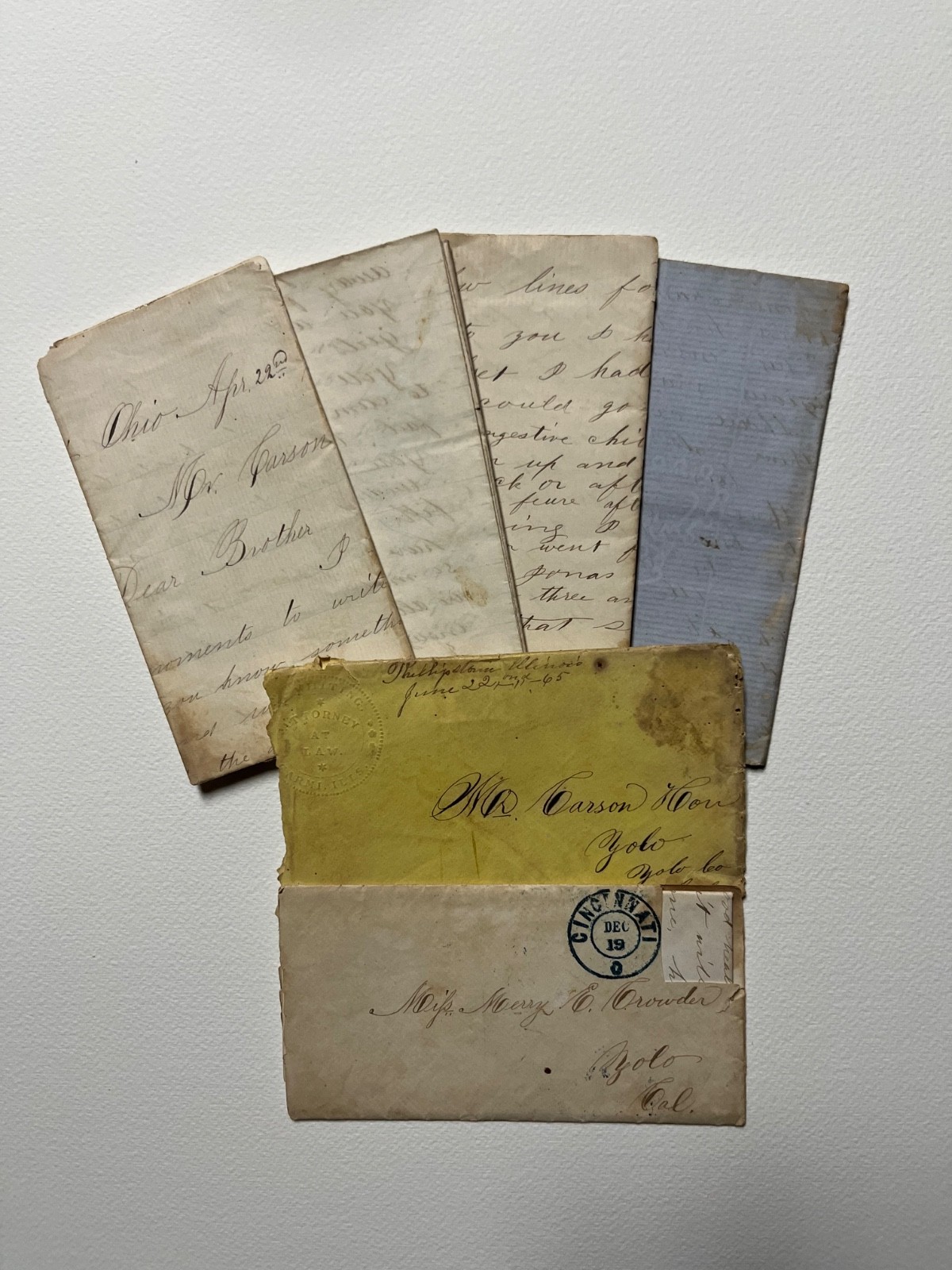
Up for sale is a collection of 6 historical letters dating from 1857 to 1865.The letters mention everyday life in southern Illinois, westward migration, the Civil War home front, agriculture, medicine, courtship, and family relationships.
The contents of these civil war era letterstalk about the war, scarlet fever, typhoid, a regiment, and someone getting their finger shot off, and the love of a father wanting their son to return home.
The six letters document;
- The California Gold Rush and long-distance family correspondence.
- Life in rural White County, Illinois.
- Agriculture, crop prices, and economic conditions.
- Epidemics including scarlet fever and typhoid fever.
- Civil War enlistment, home-front experiences, and demographic change.
- Alternative medical education and nineteenth-century treatments.
- Courtship, marriage, and family expectations.
- The enduring emotional ties between a migrant son in California and his family in Illinois.
Here’s a summary of each.
Letter 1
June 20, 1857 – Phillipstown, White County, Illinois
From: Daniel and Lucinda Hon
To: Carson Hon in California
Summary
This letter was written while Carson was living in California during the Gold Rush era. Daniel reports that the family is generally healthy but tells Carson of the death of Albert from scarlet fever on April 13. He mentions that Amanda and Eliza are doing well and describes the year’s poor agricultural conditions, noting that army worms have damaged the grass crop.
Daniel asks Carson to describe California, including distances between towns and the country in general, showing how little people in Illinois knew about the West. The letter also reports local news, including that Lewis Graves had become mentally ill over a religious matter and had been committed to the asylum in Jacksonville, Illinois.
Historical significance
- Contemporary account of an Illinois family corresponding with a son during the California Gold Rush.
- Firsthand evidence of scarlet fever mortality.
- Mentions an outbreak of army worms affecting crops.
- Insight into rural curiosity about California.
- Rare reference to treatment of mental illness through institutionalization.
A published historical account (from White County, Illinois historical notes) includes a recollection from Mrs. Carson Hon (Mary Ellen Crowder Hon) stating:
- Her father and relatives went to California during the Gold Rush (1849)
- The family traveled west in a wagon train
- And most importantly:
“In 1854 Carson Hon of Phillipstown, White County, came out there and worked part-time on the farm and part-time mining in the mountains.”
What this confirms
This is a direct historical link, not speculation:
- ✔ Carson Hon is tied to Phillipstown, White County, Illinois
- ✔ He is explicitly placed in California during the Gold Rush era
- ✔ He is described as mining in the mountains (not just hearing about it)
- ✔ The timeline matches the tail end of the Gold Rush / early post–Gold Rush mining period (1854)
And in another letter you will see a letter addressed to Mary Crowder.
Letter 2
April 6, 1862 – Phillipstown, White County, Illinois
From: Daniel Hon (with Lucinda)
To: Carson Hon
Summary
Daniel describes farming conditions, prices for crops and livestock, and the work being done by members of the Hon family. Wheat, corn, oats, pork, and cattle prices are given, providing an excellent snapshot of the wartime rural economy.
He discusses attempts by Martin, Edward Clifford, and others to organize a volunteer military company, although they failed to recruit enough men. Daniel notes that many local men continue leaving for the army.
The most personal section urges Carson to return home, settle down, marry, and remain near family. Daniel reflects on his age (over fifty-six) and declining health, comparing himself to an old oak tree that will eventually fall.
Historical significance
- Excellent documentation of Civil War-era farm economics.
- Evidence of local recruitment efforts for Union service.
- Description of community religious meetings.
- Settlement of the Illinois Barrens.
- Reveals family expectations regarding marriage, migration, and filial duty.
Letter 3
February 5, 1863 – Phillipstown (“Egypt”), Illinois
From: Daniel and Lucinda Hon
To: Carson Hon
Summary
Daniel jokingly refers to southern Illinois as “Egypt,” a common regional nickname. He apologizes for not writing sooner because gathering corn left his hands sore and because he had previously had one of his fingers shot off, making writing difficult.
He reports that Martin has been ill and unable to serve in the military for nearly two months. Daniel again urges Carson to come home, reminding him that for several years he has promised to return but has never done so.
Daniel points out that because so many young men have gone to war or have died, there are many unmarried women remaining in Illinois, suggesting it would be an excellent time for Carson to return, marry, and settle permanently.
Historical significance
- Rare firsthand mention of Daniel Hon having lost a finger in a shooting accident.
- Illustrates the impact of the Civil War on civilian communities.
- Documents demographic changes caused by military enlistment.
- Early use of “Egypt” to describe southern Illinois.
- Strong evidence of the emotional strain migration placed on families.
Enclosed Letter (1863)
From: “John Carson,” a soldier
Summary
The final page contains a separate military letter apparently enclosed with Daniel’s correspondence. The writer describes suffering from severe illness, receiving treatment from Dr. Jones while on furlough, and worrying about returning to his regiment after his authorized leave had expired. He notes that his regiment had moved from Harrisonburg to Staunton, Virginia, and doubts he will be fit for duty before spring.
The "27th": He writes that his"...furlough has run out for I have not been to the27thnor had my time of absence renewed..."This refers to his military assignment, specifically the27th Regiment(either Union or Confederate, though the locations strongly align with the heavy Confederate presence in the Shenandoah Valley campaigns).
The "Regiment": He repeatedly utilizes military terminology, explicitly stating,"...I do not know what they will do with me when I get to theRegiment..."and later noting that"...theRegimenthas left Harrisonstown and gone to Staunton."
"Able for Duty": He concludes his health update by telling his father,"...you may say that I will not be able fordutybefore some time in the spring..."which was standard 19th-century military phrasing for a soldier's readiness to return to active service.
Historical significance
- Firsthand description of illness in a Civil War camp.
- Shows the importance of furloughs and military medical care.
- Demonstrates the uncertainty soldiers faced regarding prolonged absences due to sickness.
- Likely represents a separate family letter preserved with the Hon correspondence rather than one written by Carson Hon.
Letter 4
April 22, 1864 – Cincinnati, Ohio
From: Martin V. Coon
To: Carson Hon
Summary
Martin reports that he is studying medicine under Dr. Curtis in Cincinnati and is already treating patients under supervision. He explains his philosophy of medicine, emphasizing natural remedies and criticizing conventional (“mineral”) medicine.
A lengthy medical prescription prepared by Dr. Curtis follows, recommending herbal medicines, steam baths, diet, exercise, electricity, and avoidance of drugs such as mercury, opium, and bloodletting.
Historical significance
- Outstanding example of mid-19th-century alternative medical practice.
- Describes medical education through apprenticeship.
- Documents Thomsonian/Eclectic medical beliefs.
- Reveals contemporary debates between traditional and alternative medicine.
Letter 5
December 18, 1864 – Cincinnati, Ohio
From: Martin V. Coon
To: Mary E. Crowder
Summary
Martin replies warmly to Mary Crowder, describing his medical studies and explaining that caring for patients prevented him from attending church that Sunday. The letter suggests a growing relationship between Mary and Carson.
He includes family news from Illinois, reporting outbreaks of typhoid fever among relatives and the recent deaths of George W. Brown and Mary Ann Brown. Carson’s father is reported to be improving after illness.
Historical significance
- Documents widespread typhoid fever during the Civil War.
- Illustrates the daily work of a medical student.
- Provides evidence of Carson’s developing relationship with Mary Crowder, whom he would later marry.
Letter 6
August 16, 1865 – Phillipstown, Illinois
From: Daniel Hon (with C. Hon and Martin V. Hon)
To: Carson Hon
Summary
Daniel reports that the family is healthy and encourages Carson to return permanently to Illinois while land remains inexpensive. He describes crop conditions, births within the family, and extensive improvements taking place in Phillipstown, including construction of new houses, a grist mill, and a sawmill.
He also reports rumors of thousands of Confederate soldiers across the river in Kentucky and fears that raids may threaten the community.
A short note from Martin provides local social news, livestock numbers, business developments, and several marriages and courtships among neighbors.
Historical significance
- Rich description of the wars affect on economic recovery.
- Documents growth and development of Phillipstown.
- Records local fears of Confederate activity along the Ohio River.
- Valuable snapshot of community life, courtship, business, and agriculture.
- Demonstrates the continuing effort by Daniel to persuade Carson to return home after more than a decade in California.
As a collection, they provide a remarkably detailed picture of one Midwestern family’s experiences during one of the most transformative decades in American history.
If you have any questions, or a preferred shipping method please reach out. Thank you for looking.