When you click on links to various merchants on this site and make a purchase, this can result in this site earning a commission. Affiliate programs and affiliations include, but are not limited to, the eBay Partner Network.
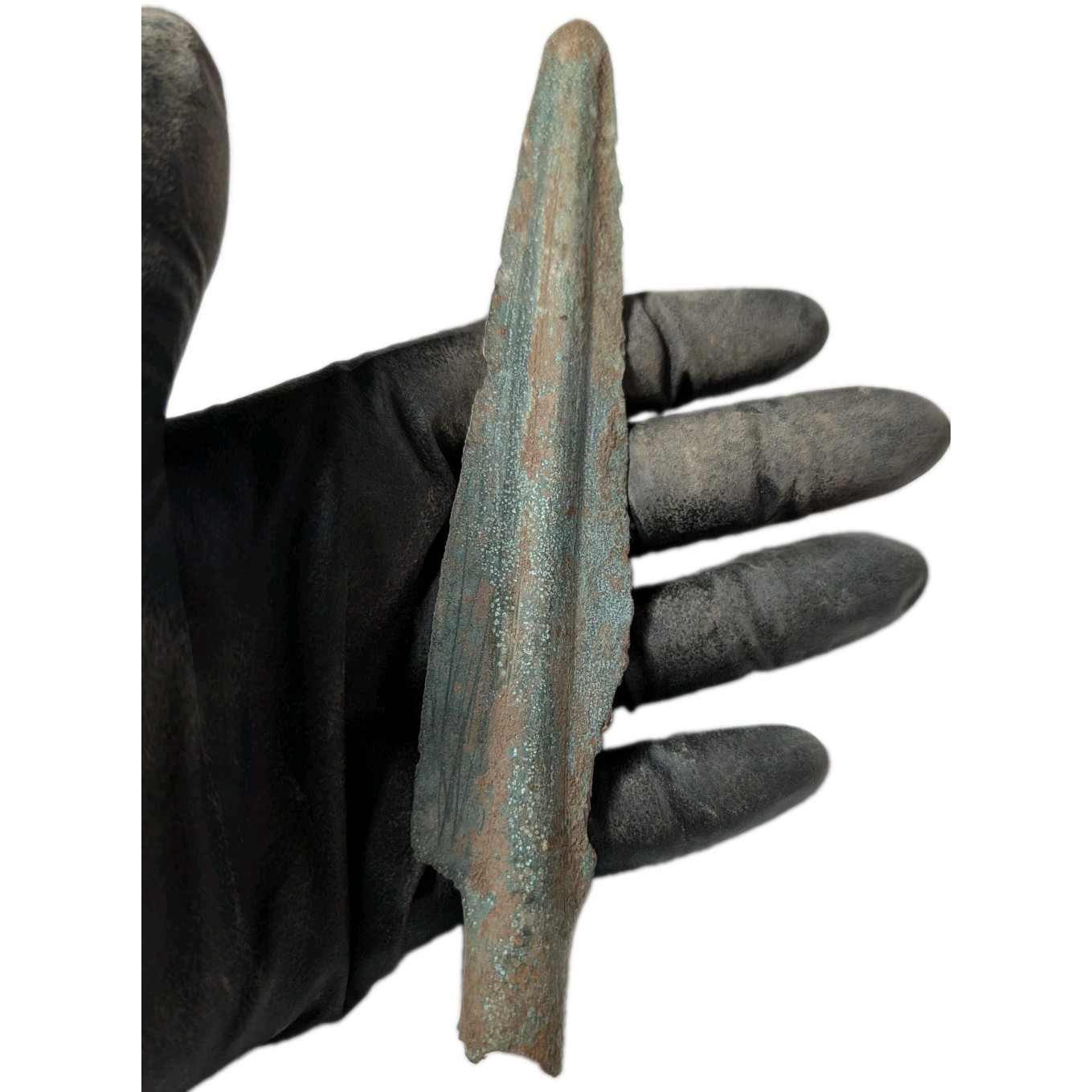
Ancient Greek Hellenistic Bronze Socketed Spearhead (~14 cm)
Authenticity & Guarantee
Item Specifications
Object: Cast Bronze Socketed Spearhead / Javelin Tip / Lance Point
Culture / Period: Hellenistic Greek / Classical Period
Date Range: Circa 4th Century BC – 2nd Century BC (c. 330 BC – 146 BC)
Dimensions: ~12.5 cm – 14.0 cm length (Heavy Cast Blade and Hollow Socket)
Material: Heavy Cast Bronze (Copper Alloy)
Form & Architecture: Tapering leaf-shaped (foliate) double-edged blade featuring a high-relief central structural midrib running down to a hollow conical mounting socket engineered to receive a wooden haft; socket base hollowed to receive a wooden shaft pin
Condition: Exceptional, complete archaeological state. Intact blade profile, unbroken socket ring, preserved under a rich, authentic dusty-blue to malachite-green cuprite patina with sandy desert burial encrustations.
Historical Context & Hellenistic Warfare Lore
Armaments of the Hellenistic Phalanx & Hoplite Class
During the Classical and Hellenistic periods (c. 4th–2nd century BC), socketed bronze spearheads (dory / xyston tips) were the primary offensive weapons carried by Greek heavy infantry (hoplites) and Macedonian cavalry. Engineered for maximum armor penetration, these cast bronze blades featured reinforced raised midribs that absorbed the massive impact force of a spear thrust against bronze shields (aspides) and iron breastplates (Ref: Snodgrass, Arms and Armor of the Greeks, Johns Hopkins University Press, 1998; Connolly, Greece and Rome at War, Greenhill Books, 1998).
Conical Socket Metallurgy
The hollow conical socket at the base was cast using investment piece-molds. Once cast, the weapon smith fitted a tapered ash-wood shaft into the socket, securing it with resin or a cross-pin to ensure the blade would not detach during heavy combat or phalanx maneuvers.
Typological Analysis & Exact Classification
Exact Typological Classification
Comparable Archaeological Examples & Museum Accession Numbers
British Museum (Accession No. 1868,0620.37): Classical Greek / Hellenistic socketed bronze spearhead with central midrib.
Metropolitan Museum of Art (Accession No. 96.18.52): 4th–3rd century BC Greek bronze leaf-shaped spearhead.
Ashmolean Museum (Accession No. AN1967.828): Hellenistic bronze lance point from the Eastern Mediterranean.
A2