When you click on links to various merchants on this site and make a purchase, this can result in this site earning a commission. Affiliate programs and affiliations include, but are not limited to, the eBay Partner Network.
A little bottle from the era when “pain relief” came with a side of mystery…
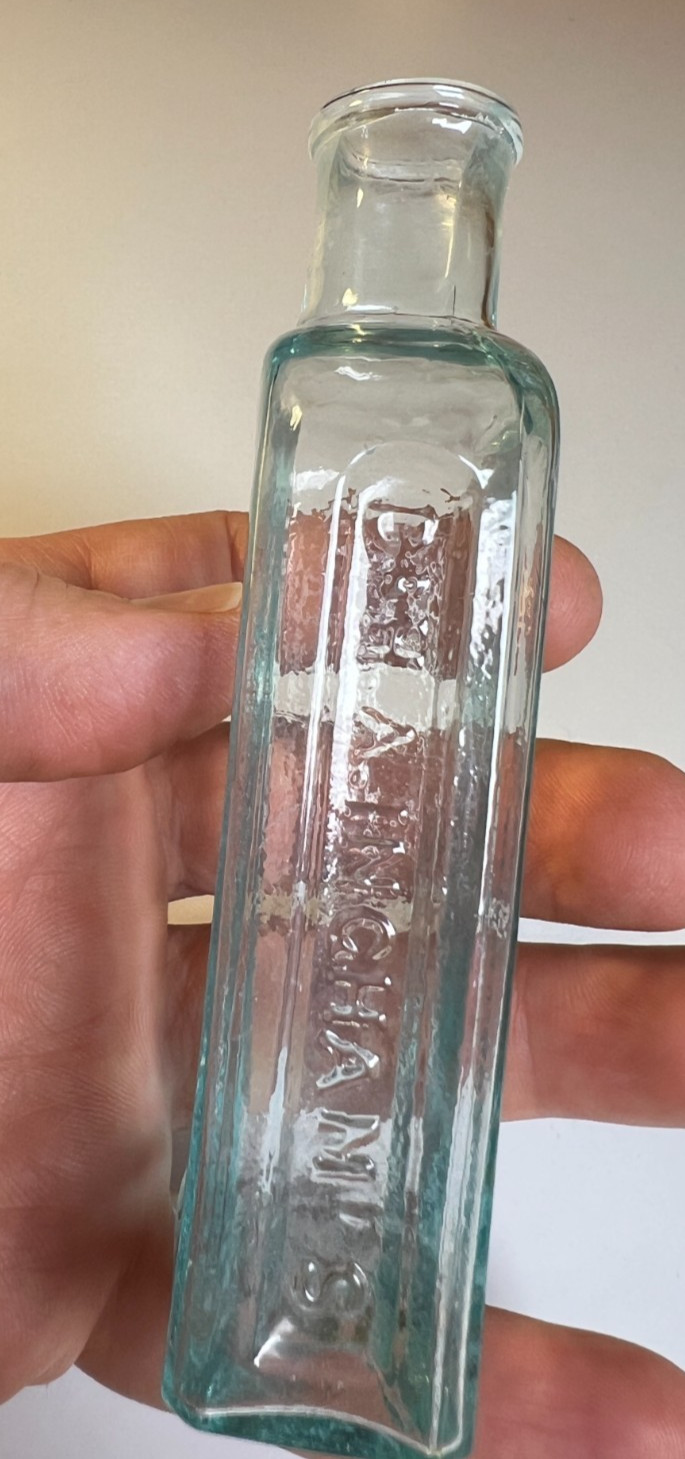
This sharp, compact aqua rectangle is a true mid-19th century survivor—an embossed “DR H.A. INGHAM’S NERVINE PAIN EXTRACT” medicine, glowing with that unmistakable early glass color and character. It’s the kind of piece that sat on a wooden apothecary shelf while gas lamps flickered and railroads were just beginning to stitch the country together.
Precise Date
c. 1848–1855
- Open pontil scar → pre–mid 1850s
- Rolled lip → earlier hand-finished technique
- Embossed proprietary medicine → booming right in this window
This lands squarely in the pre–Civil War patent medicine explosion.
City & State (most likely attribution)
While not heavily documented, bottles of this type and embossing style strongly point to Northeast production—likely New York City or Boston, MA, where:
- Small proprietary medicine makers thrived
- Glasshouses supplied short-run embossed bottles
- Distribution networks (ships + rail) were rapidly expanding
The Maker – Dr. H.A. Ingham
Unlike the mega-brands, Ingham appears to have been a smaller-scale or regional patent medicine proprietor.
That actually helps you:
- Shorter production runs
- Less survival over time
- More “local doctor turned entrepreneur” vibe
These were often real physicians—or at least convincingly dressed like one in advertising.
What was inside?
“Nervine Pain Extract” is basically 1800s code for:
- Alcohol (often strong)
- Opium or morphine derivatives
- Camphor, peppermint, herbal extracts
Used for:
- Nerve pain
- Headaches
- Anxiety / “nervous conditions”
- Sleep issues
In modern terms:
Somewhere between a sedative, a painkiller… and a very convincing placebo.
How it was marketed
Mid-1800s patent medicine marketing was bold, relentless, and occasionally… imaginative.
Expect claims like:
- “Soothes the nerves instantly”
- “Restores vitality and calm”
- “A remedy for all pains internal and external”
Sold through:
- Newspapers
- Traveling salesmen
- General stores & apothecaries
And no prescription needed—just belief and a few cents.
Life During the Period (late 1840s–early 1850s)
Technology:
- Railroads expanding rapidly
- Telegraph just introduced (1844) → instant communication for the first time
- Hand-blown glass still standard
Medicine:
- No FDA, no regulation
- Germ theory not yet accepted
- Bleeding, tonics, and opiates common
Politics:
- Rising tension leading toward the Civil War
- Expansion westward
- Industrial growth in northern cities
What was happening in NYC/Boston in this decade?
New York City:
- Population boom from immigration (especially Irish famine refugees)
- 1853: Crystal Palace Exhibition showcasing industrial progress
- Rapid urban growth—crowded, chaotic, full of opportunity
Boston:
- Hub of abolitionist movement
- 1850: Fugitive Slave Act protests
- Strong publishing and medical communities
This bottle would have been sold right in the middle of that energy—on a counter surrounded by newspapers, debate, and the smell of coal smoke.
Condition
- Bright, clean, beautiful aqua color
- Strong, crisp embossing
- No chips, or exterior damage
- Light internal neck stain
- Very faint internal heat-check/flash line over shoulder (only visible under strong light)
Overall: Excellent display condition with honest early glass character.