When you click on links to various merchants on this site and make a purchase, this can result in this site earning a commission. Affiliate programs and affiliations include, but are not limited to, the eBay Partner Network.
Description
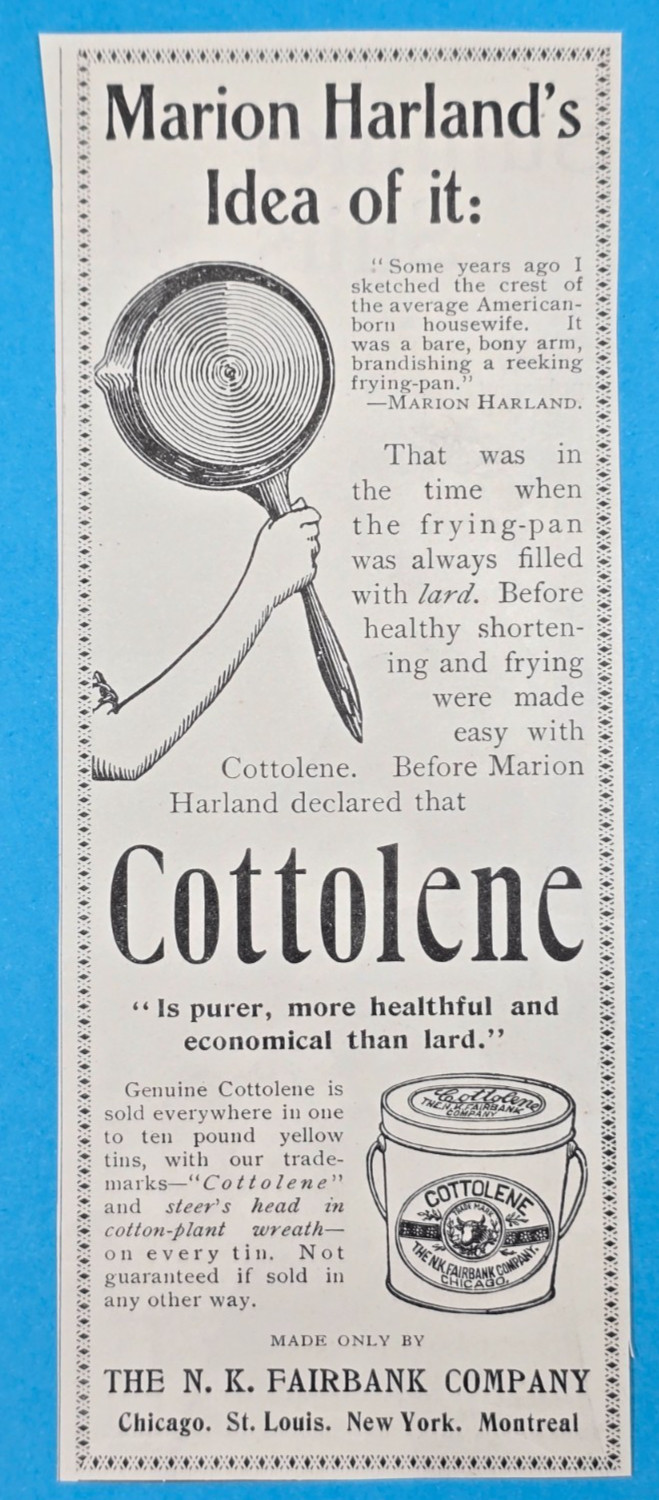
This is an original Antique 1898 magazine ad, approximately 6” x 2.5”, promoting Cottolene, an early vegetable-based cooking shortening produced by The N.K. Fairbank Company. The advertisement features a testimonial from noted author and food writer Marion Harland, a major figure in 19th-century American domestic culture.
All printed text from the ad (exact reproduction):
Marion Harland’s Idea of it:
“Some years ago I sketched the crest of the average American-born housewife. It was a bare, bony arm, brandishing a reeking frying-pan.” — Marion Harland.
That was in the time when the frying-pan was always filled with lard. Before healthy shortening and frying were made easy with Cottolene. Before Marion Harland declared that
Cottolene
“Is purer, more healthful and economical than lard.”
Genuine Cottolene is sold everywhere in one to ten pound yellow tins, with our trademarks—“Cottolene” and steer’s head in cotton-plant wreath—on every tin. Not guaranteed if sold in any other way.
Made Only By
THE N.K. FAIRBANK COMPANY Chicago. St. Louis. New York. Montreal.
This ad captures a pivotal moment in American culinary history, marking the shift away from traditional lard frying to emerging vegetable shortenings.
Fun Facts
• Cottolene, introduced in 1868, was the first commercially successful vegetable shortening in the United States and helped launch an entirely new market for alternative cooking fats.
• It was marketed heavily to American housewives through well-known domestic writers like Marion Harland, whose endorsement appears in this ad.
• N.K. Fairbank Company, once a major Chicago-based manufacturer of soaps, oils, and shortenings, eventually became part of the companies that preceded what later evolved into portions of the Procter & Gamble and Armour food-product empires.
• Cottolene was eventually replaced in popularity by Crisco, introduced in 1911, which dominated the shortening market for decades.
Categories
• Antique (100+ years old)
• 1890s Food & Cooking Advertising
• Early American Shortening & Lard Alternatives
• Chicago Manufacturing History
• Marion Harland Collectibles
• Culinary & Domestic History
• Vegetable Oil Product Advertising
• Original Print Magazine Ads
Condition
• Original 1898 print
• Strong and clean typography
• Light age wear from extraction
• No major tears, stains, or handwriting noted
AI-Assisted Description Notice
This description was created with AI assistance and may contain errors. Please review the photos and message with any questions.