When you click on links to various merchants on this site and make a purchase, this can result in this site earning a commission. Affiliate programs and affiliations include, but are not limited to, the eBay Partner Network.
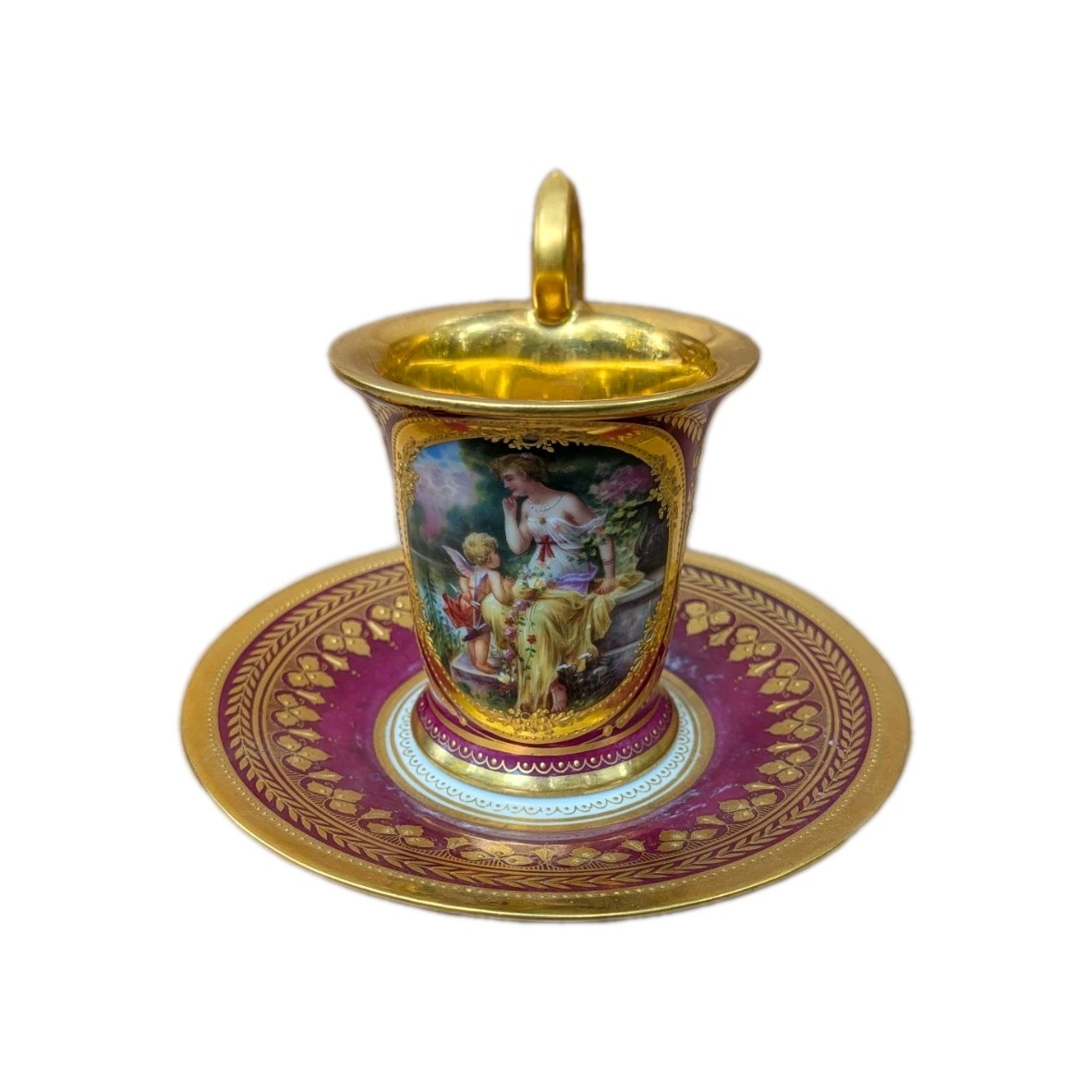
Antique 19th C Royal Vienna Style Porcelain Demitasse Cup Saucer Angel Cherub #2
Fantastic and beautiful demitasse cup and saucer set. All hand painting with the finest details. Burgundy base, gold raised decoration and colorful medallion paintings.
There were Rosenthal blanks decorated by the Royal Vienna factory. For these we will say Royal Vienna style because although they are fine craftsmanship I was not there when they were decorated.
Please see Q & A for your reading enjoyment.
Cups have very little wear if any. Saucers do have some wear as shown.
Also they are more beautiful in person than the photos.
Cups apprx 3.5\" to the top of the handle x 2.5\" across the cup.
Saucers apprx 4.75\" across
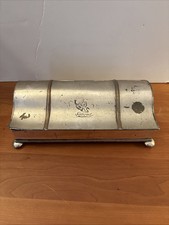
Hallmarks as shown.
Q: Why were porcelain makers blanks marks covered with a gold flower?
The reason porcelain marks were covered with gold was typically to hide the original manufacturer\'s identity and pass the work off as the decorator\'s own. This was common practice for decorating studios, particularly in 19th-century Dresden, which bought blank porcelain from other factories and then added their own marks over the gilded-over originals.
The practice in 19th-century Dresden
Decorator studios: In the mid-to-late 19th century, Dresden was a center for porcelain decorating, with many independent studios like those of Richard Klemm, Donath & Co., and Helena Wolfsohn.
Buying blanks: These studios did not manufacture the porcelain themselves; instead, they purchased finished, unmarked, or marked \"blanks\" from various porcelain factories.
Applying new marks: The decorators would then apply their own hand-painted embellishments and fire the piece again. To obscure the factory\'s mark, they would cover it with gold leaf or a gold luster glaze before adding their own decorator\'s mark.
Why covering the mark was beneficial
This practice helped the decorating studios in several ways:
Claiming ownership: It allowed the decorators to create their own brand identity and claim the final, often intricate, design as their own work without acknowledging the original factory.
Avoiding attribution: It prevented buyers from knowing where the blank porcelain was sourced, maintaining the studio\'s reputation and business secrets.
Enhancing the piece: The use of gold itself was a valuable, artistic, and fashionable embellishment that added to the porcelain\'s luxury and design.
Q: Did Royal Vienna use other porcelain makers blanks?
Yes, both the original Imperial and Royal Porcelain Manufactory of Vienna (the authentic \"Royal Vienna\") and the later decorators working in the \"Royal Vienna\" style used blanks from other manufacturers.
Blanks used by the original factory
The original factory was in operation from 1744 to 1864. It was the first to use the \"beehive\" or Bindenschild mark. During periods of decline in the 1820s, the factory began producing cheaper wares. Some of its own molds and undecorated fired blanks were bought by other manufacturers, including Herend.
Blanks used for \"Royal Vienna\" style porcelain
The term \"Royal Vienna\" can be misleading. It most often refers to a style of porcelain painting popular in the late 19th and early 20th centuries, not a single manufacturer. Dozens of decorating studios in Germany and Austria produced items in this style, and they frequently used blanks from other makers. The most common manufacturers of these blanks include:
Hutschenreuther: This factory supplied blanks for a large portion of the \"Royal Vienna\" style plates. They can often be identified by a faint, impressed shield or circle mark.
KPM Berlin: Some blanks were purchased from KPM and marked with a blue underglaze scepter.
Rosenthal: Other blanks came from Rosenthal. Decorators sometimes covered Rosenthal\'s original green mark with a decorative gold flower and added a blue beehive mark.