When you click on links to various merchants on this site and make a purchase, this can result in this site earning a commission. Affiliate programs and affiliations include, but are not limited to, the eBay Partner Network.
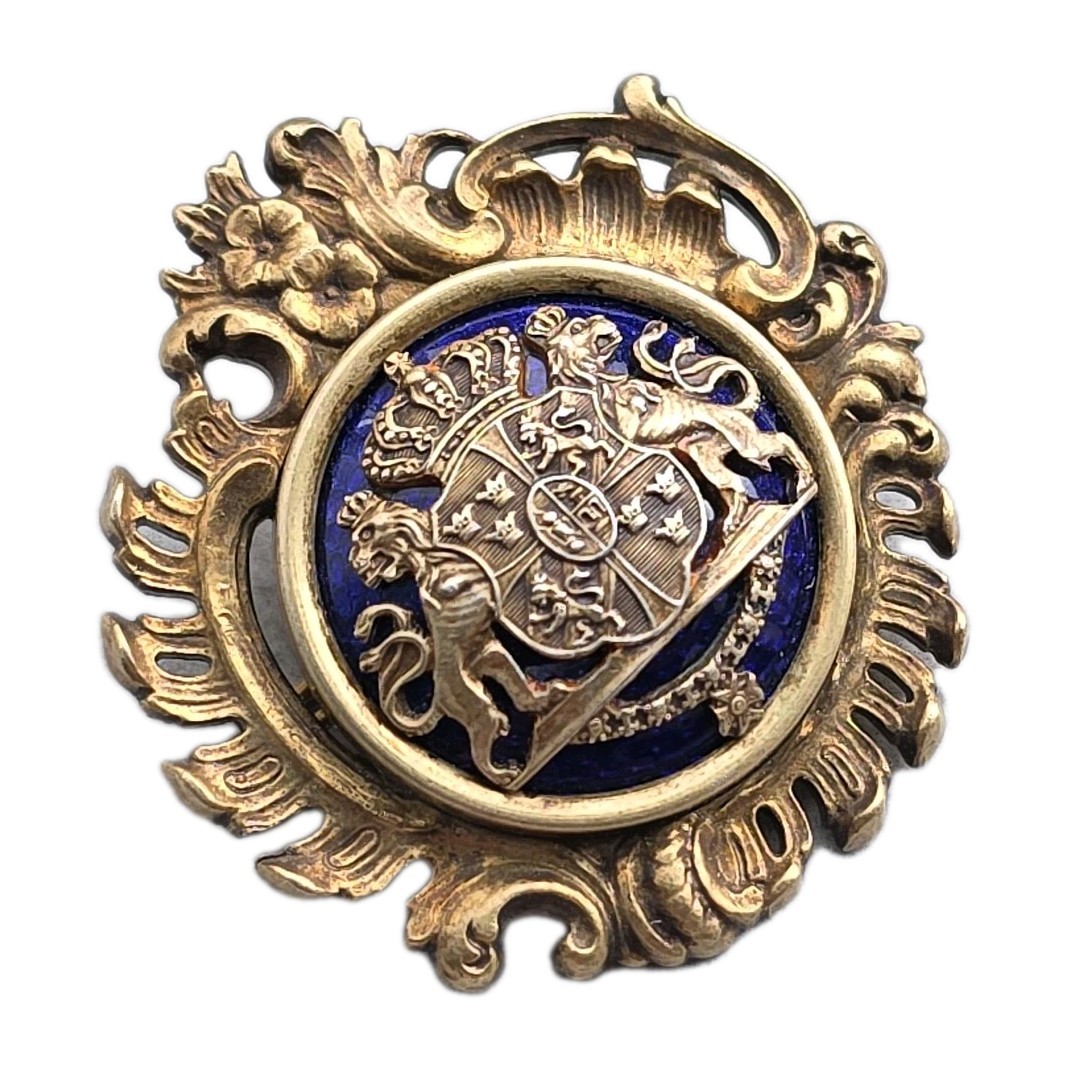
For your consideration is an original Swedish royal heraldic brooch, assayed in Stockholm in 1948 and manufactured by Sporrong & Co., one of Swedens foremost producers of medals, insignia, heraldic badges, and ceremonial objects during the twentieth century. The brooch measures approximately 32 mm in diameter and weighs 26.77 grams. Executed in gilt silver and enriched with enamel over a finely modeled relief ground, the composition presents the Greater Royal Arms of Sweden enclosed within an ornate rococo-inspired cartouche.
The heraldic device represents the Bernadotte-era Greater Royal Arms in use during the reign of King Gustaf V (19071950). The quartered shield displays the Three Crowns of Sweden in the first and fourth quarters and the Folkung lion over diagonal bends in the second and third, with the dynastic inescutcheon of the House of Bernadotte positioned centrally. The shield is supported by two crowned lions rampant and surmounted by the Swedish royal crown. The elaborate treatment and precise heraldic detailing reflect the high standards associated with Sporrongs production of official and ceremonial insignia during the period.
The reverse bears the characteristic Swedish hallmark sequence, including the Three Crowns national control mark, the Stockholm city mark, the date code X8 for 1948, and the registered makers mark S&CO for Sporrong & Co. Comparable documented Sporrong objects of 1948 in the collections of the Swedish History Museum carry the same maker, Stockholm, national control, and X8 date markings, securely establishing the manufacture and dating of the present piece.
Substantial for its approximately 32 mm format, the brooch weighs 26.77 grams and is considerably more substantial than comparable base-metal heraldic badges. Hallmarked gilt-silver examples are materially more desirable than later or inexpensive brass versions, particularly when retaining strong enamel and sharply defined heraldic detail. In the absence of documentary evidence establishing a specific royal presentation or court recipient, the piece is most accurately described as a finely executed Swedish royal heraldic brooch manufactured by Sporrong & Co. in Stockholm in 1948, during the final years of the reign of Gustaf V.