When you click on links to various merchants on this site and make a purchase, this can result in this site earning a commission. Affiliate programs and affiliations include, but are not limited to, the eBay Partner Network.
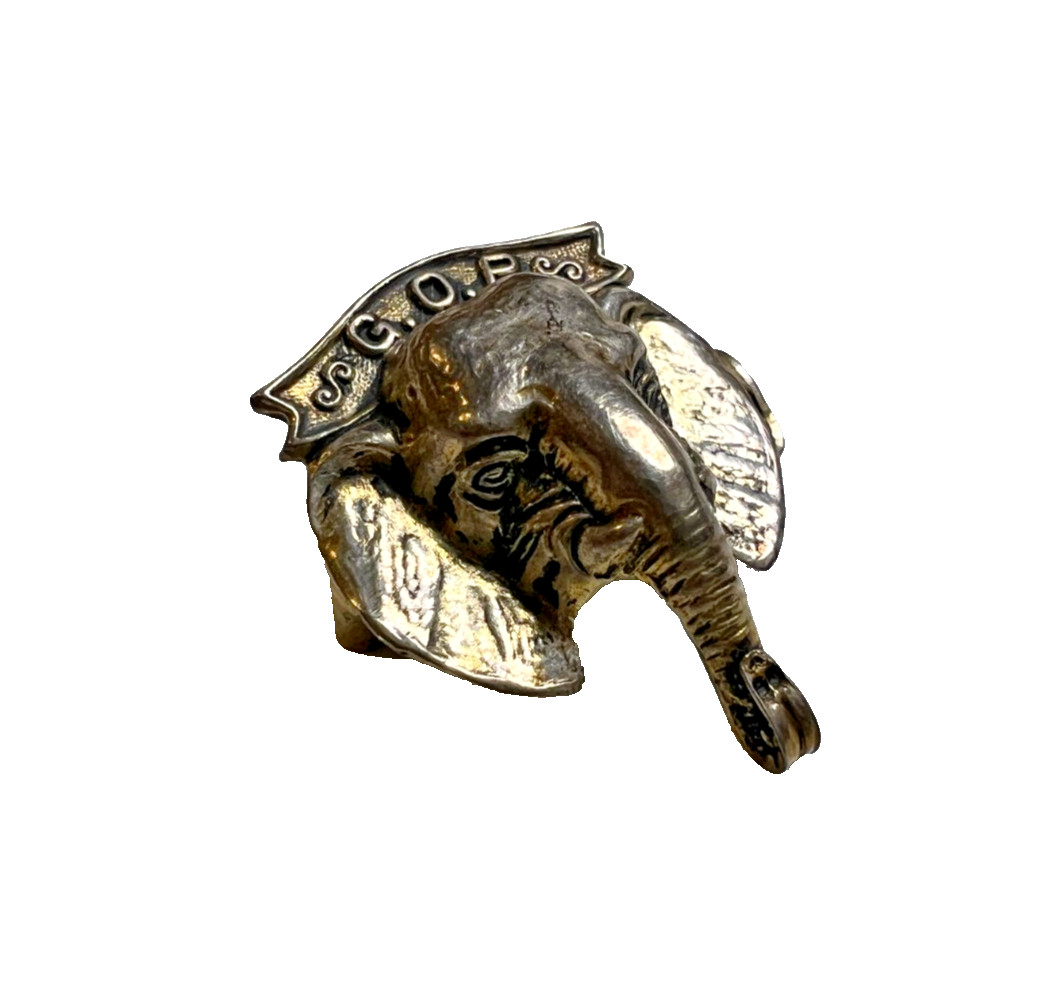
Antique Sterling GOP Elephant Lapel Pin c.1900–1925 – Republican Party Political Jewelry
Before it was a slogan, before it was a red map on cable news, before it was even fully settled what “modern America” would look like, the Republican Party was already calling itself the Grand Old Party—and doing so with a mix of pride, irony, and history baked right in.
The GOP was born in the 1850s, forged quickly and deliberately out of opposition to the expansion of slavery. It was a coalition party from day one—former Whigs, Free-Soilers, abolitionists, industrial reformers—united less by tradition than by urgency. When Abraham Lincoln was elected in 1860, the party was barely six years old. By the time the Civil War ended, it had already reshaped the nation. Calling itself the “Grand Old Party” was partly tongue-in-cheek at first—a young party claiming moral seniority—but by the late 19th century, the name stuck. The Republicans had preserved the Union, ended slavery, driven westward expansion, and presided over explosive industrial growth. “Old,” in this sense, meant established, proven, victorious.
And then came the elephant.
The Republican elephant emerged in the 1870s, popularized by political cartoons that depicted the party as strong, stubborn, sometimes reckless—but undeniably powerful. By the turn of the 20th century, the elephant was no longer satire. It was identity. Wearing it was a statement.
This sterling silver lapel pin belongs squarely in that moment.
The years this pin was worn
Based on its solid sterling construction, high-relief sculpting, and early pinback hardware, this piece dates most convincingly to the Progressive Era, roughly 1900–1925—a time when American politics was loud, personal, and worn literally on one’s sleeve.
During those years, Republican presidential candidates included:
Theodore Roosevelt, champion of trust-busting, conservation, and reform
William Howard Taft, representing institutional conservatism and the judiciary
Charles Evans Hughes, a reformist technocrat
Warren G. Harding, promising a “return to normalcy” after World War I
Party politics were not abstract. They were debated in newspapers, argued in saloons and parlors, shouted at conventions, and signaled visually through pins like this one.
What life looked like when this pin was new
This was an America in motion.
Cities were dense and smoky, lit by gas lamps and early electricity. Streetcars clanged past men in stiff collars and women in long skirts. A pocket watch was essential; an automobile was still a novelty. Telephones existed, but most communication came by letter or newspaper—thick with political editorials, cartoons, and endorsements.
Medicine was advancing but still precarious. Germ theory was accepted, but antibiotics did not exist. Surgery was improving, anesthesia was real, but recovery was uncertain. A political pin like this might be worn by someone who had lived through smallpox outbreaks, tuberculosis scares, and the influenza pandemic of 1918.
Technology was thrilling and unsettling. Electricity was spreading. Radios were just beginning to enter homes near the end of this pin’s likely life. Motion pictures were silent, factories were roaring, and machines were transforming labor at a pace that frightened as many people as it inspired.
And politics? Politics was personal.
Voters identified strongly with parties. Loyalty was worn proudly. A sterling silver GOP pin was not a disposable campaign trinket—it was a signal of belonging, status, and conviction. Sterling cost real money. This pin would have been worn by a party organizer, convention delegate, professional man, or well-to-do supporter—someone who expected to keep it, not throw it away after Election Day.
Why sterling matters
Most political pins were made of base metal. Sterling silver pins were premium objects, produced by jewelry-capable manufacturers and sold to those who wanted durability, respectability, and permanence. The weight, the deep sculptural relief of the elephant’s head, the oxidized recesses contrasting with bright high points—all of this reflects intentional craftsmanship rather than mass novelty production.
The elephant’s trunk curls into a loop, the ears are deeply undercut, and the banner reading G.O.P. is crisp and formal. This is not cartoonish. It is dignified. Confident. Self-assured—much like the party saw itself at the height of American industrial power.
The object as a survivor
This pin has lived through world wars, economic collapse, technological revolutions, and political realignments. The wear you see is not damage—it is history. Brightened edges where fabric rubbed. Darkened recesses where oxidation settled over decades. Hardware that predates safety clutches and modern locking backs.
It has outlived the men who wore it, the campaigns it represented, and the world that made it necessary.
Today, it stands as a compact artifact from an era when politics was debated face-to-face, read in ink, and worn with quiet confidence on a lapel.
A small elephant—but one carrying the full weight of early 20th-century America.