When you click on links to various merchants on this site and make a purchase, this can result in this site earning a commission. Affiliate programs and affiliations include, but are not limited to, the eBay Partner Network.
This is one of those bottles where the glassblower clearly said: “Make it look medicinal… but also like an 1850s cathedral had a child with a pie-crust.”
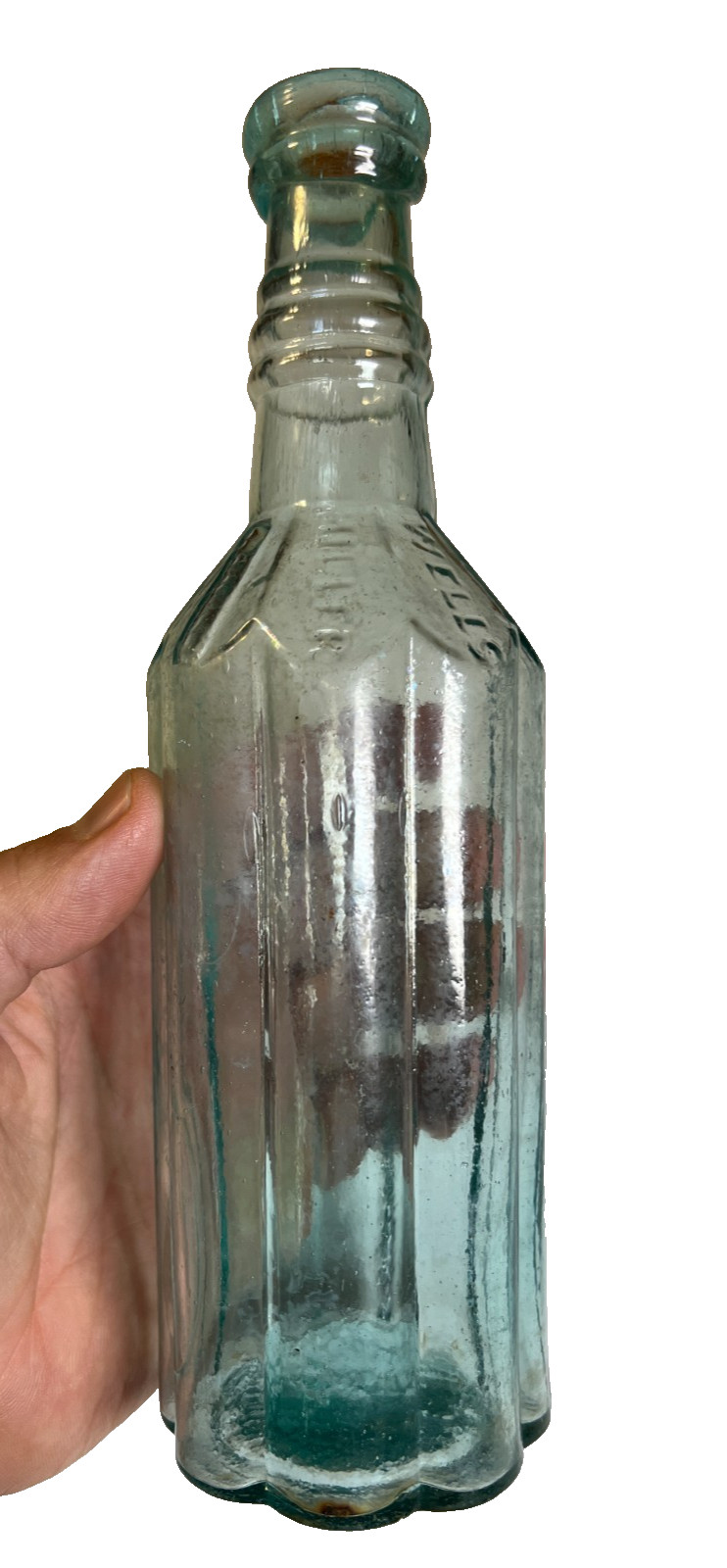
This is a WELLS & MILLER (often seen as MILLER & WELLS) cathedral panel, multi-lobed medicine bottle, American, most likely 1848–1860, blown in a two-piece mold with a hand-applied drippy double-ring top.
This exact design is part of the early period of American proprietary medicines experimenting with architectural panel bodies (cathedral window vertical arches), which were used to visually separate them from generic apothecary cylinders.
Early American Miller & Wells cathedral-panel medicine bottle, blown circa 1848–1860 in a two-piece mold with a remarkably crude applied double-ring top. This is the taller 8.25” example in clean blue-green aqua glass, full of character: seed bubbles throughout, one large lens-bubble in the wall, soft shoulder haze, and faint early tool marks from the neck finishing.
The body features the classic Gothic / cathedral arched panels that defined the earliest era of proprietary American medicines, made to visually stand apart from generic apothecary cylinders. These forms pre-date machine bottle production and have a loyal collector base for their architectural style and hand-made presence.
The lip is thick, uneven, and distinctly hand-finished, with the look of glass that was still soft when the tool was lifted — a feature sought out by collectors of true pre-machine American glass. Base interior shows two small brown spots, likely historical rust transfers from contents or storage hardware.
Condition
No chips, cracks, or impact stars
Soft haze on shoulders from long burial/storage
Light hairline scratches appropriate to age
Large trapped bubble with excellent window clarity
Embossing clear and strong
Rust transfers dots at the base (see finger point pics)
Measurements
A clean, honest survivor of early American medicinal glass with all the character you want: bubbles, crude neck tooling, asymmetry, and that unmistakable architectural body. A beautiful display bottle with presence.
The scalloped cathedral base — eight or ten-lobed with tall narrow panels — is classic American peppersauce.
Medicines borrowed the vertical panels sometimes, but the lobed, flower-like base is overwhelmingly associated with:
Medicine bottles did not need lobes.
Sauces did — stability + visual elegance.
Imagine a bottle on a 1850s table — the lobes look like a flower sitting on the cloth.
The Neck Design
Double-ring or triple-ring tooling at the shoulder above the transition is a closure cue.
This style was:
Medicine mouths of this era were more often:
single collar
straight-finished lip
blob/inward roll
But pepper sauce needed:
flow control (narrow neck)
secure travel (restaurant supply shipping)
a place to anchor a twine wrap
That sexy, saggy applied lip you have is perfect for it.
The Time Period
1848–1860s is the golden age of American peppersauce bottles.
Why?
import tariffs on British goods
rise of American glasshouses
exploding restaurant culture
rail/canal networks meant condiments traveled
These fancy bottles were status — the Le Creuset of condiments.
Medicine didn’t need the showmanship.
Peppersauce was the show on the table.
Ingredients (in THIS case)
So, instead of herbal bitters, your bottle would’ve contained:
Typical 1850s American Peppersauce Recipe
AND occasionally:
The sauce was:
Think:Tabasco’s great-great-grandfather before fermentation became the thing.
WHAT LIFE WAS LIKE (in sauce terms)
Let me set the scene again, but now from the perspective of a condiment importer, not a medicine doctor:
It’s 1854.
Yorkers are obsessed with everything British:
Ships arrive with:
American merchants see the craze and say:
“Why import it? Let’s make our own.”
Thus: Wells & Miller
They create a line of sauces for hotels:
pepper sauce
table sauce
“Oriental” sauces
pickled fruits
Restaurants were exploding because:
railroads meant travel
urbanization meant dining outside the home
immigrants brought flavors
wealthy Americans wanted to show off
And nothing said modern, global, sophisticated like pepper sauce on fish or meats.
So your bottle was:
filled in a New York warehouse
packed with straw in a wooden crate
rolled onto a horse cart
delivered to restaurants, hotels, saloons
opened at a table lit by whale-oil lamps
Somebody in 1855 just hit their steak with your sauce.
That’s the vibe.
TECHNOLOGY, POLITICS, AND WHY SAUCE MATTERED
Just a quick snapshot of the world your bottle sat in:
Technology
No refrigeration → pickling & vinegar ruled
Steam engines powering ships/factories
Telegraph shrinking the country
Gas lamps in city streets
Sewing machines just invented
Photography brand new
Politics
U.S. heading toward Civil War
Slavery vs abolition fights tearing Congress apart
New York = center of immigration
Tammany Hall machine politics
Nativism rising (Know-Nothing Party)
Economic inequality intense
Daily Life
A bottle of pepper sauce was modern, worldly, cosmopolitan.
It was the globalization of flavor before the word existed.
Your bottle is a symbol of that exact cultural moment.