When you click on links to various merchants on this site and make a purchase, this can result in this site earning a commission. Affiliate programs and affiliations include, but are not limited to, the eBay Partner Network.
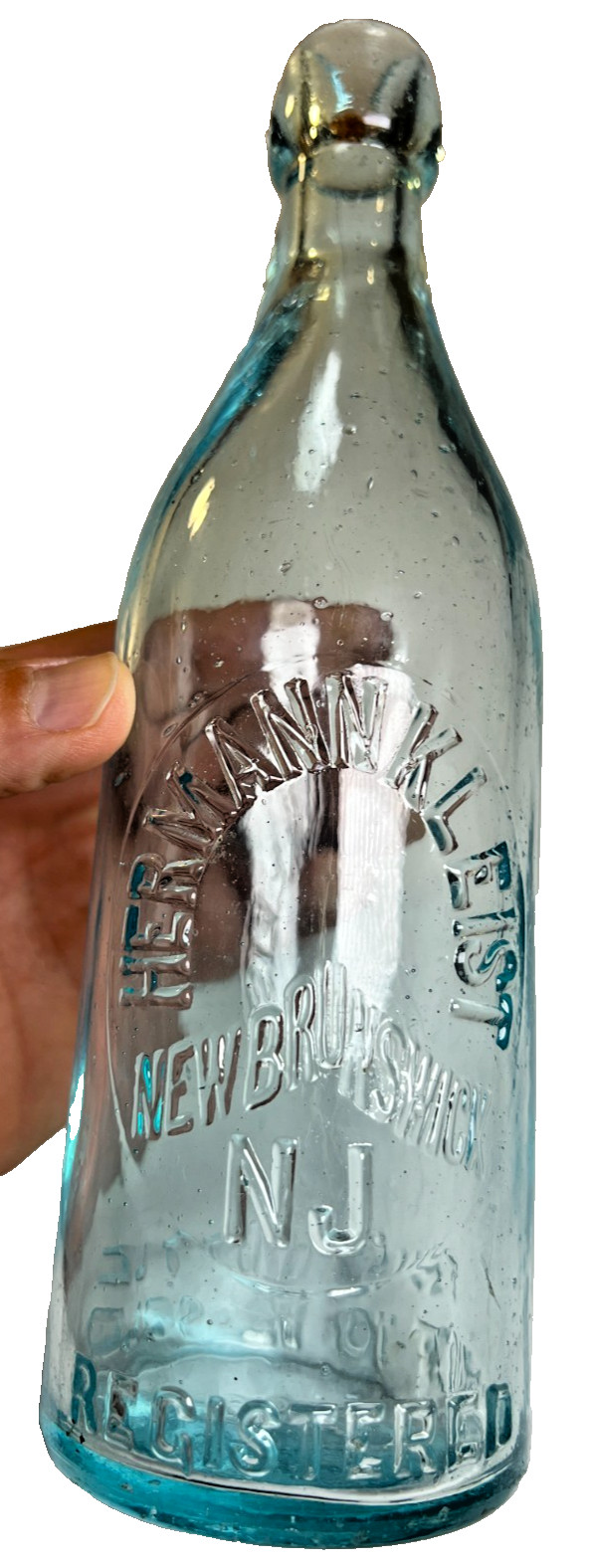
Fantastic c.1890s Hermann Kleist \"Registered\" bottle from New Brunswick, New Jersey — a beautifully crude, strongly embossed late-19th-century aqua bottle with an applied blob top, wonderfully twisted neck, loads of tiny seed bubbles, and exceptionally clean glass.
This is an especially handsome example of a Hermann Kleist / New Brunswick, N.J. returnable commercial bottle dating to approximately the 1890–1895 period. Hermann Kleist is a documented New Brunswick bottler whose bottles are known among New Jersey collectors, with this large blob-top style representing the late Victorian era of reusable beer and carbonated-beverage bottles.
The front is boldly embossed:
HERMANN KLEIST
NEW BRUNSWICK
N.J.
REGISTERED
The enormous arched HERMANN KLEIST embossing is particularly impressive, with tall, deeply molded letters wrapping around the upper body. REGISTERED is prominently embossed around the heel.
A True Returnable Bottle
The word REGISTERED is an important piece of 19th-century bottling history.
Unlike today\'s disposable beverage containers, bottles such as this were valuable commercial property. Bottlers commissioned bottles bearing their names, distributed them to customers, saloons, hotels, grocers and other dealers, and expected the empties to be returned.
They were then washed, refilled, corked and placed back into circulation.
The prominent owner\'s name and REGISTERED marking discouraged other bottlers from appropriating the container and helped identify it as Kleist\'s property.
In other words, approximately 130 years ago Hermann Kleist wanted this bottle back.
Fortunately for today\'s collectors, somebody apparently forgot!
Beautifully Crude Applied Blob Top
One of the most appealing features is the bottle\'s large applied blob finish.
This predates the fully automated bottle-making era. The bottle body was mold formed, while the mouth was completed separately while the glass remained hot and workable.
The result is exactly the sort of character collectors love in early bottles.
The applied finish is visibly irregular, and immediately beneath it is a wonderfully distorted, twisting neck. Viewed from different angles, the neck appears almost to spiral as it rises toward the blob.
This twisting and waviness occurred during manufacture and is not damage. It is part of the hand-worked nature of the bottle and gives this particular example considerably more personality than a perfectly straight, uniform bottle.
Gorgeous Aqua Glass
The glass is a beautiful icy blue-aqua, with the color becoming particularly rich and intense through the heavy glass at the heel and base.
Held to the light, the bottle is loaded with tiny seed bubbles, small air bubbles and other natural manufacturing irregularities.
These bubbles are scattered throughout the body and neck and provide terrific visual character. The combination of bubbly glass, waviness, neck distortion and strong aqua coloration leaves absolutely no mistaking this for a later machine-made bottle.
The glass has that unmistakable lively character collectors associate with good late-19th-century bottles.
Z & R N.Y. Base Mark
The underside carries an intriguing \"Z & R / N.Y.\" style manufacturer\'s mark.
This appears to represent the glass manufacturer or bottle supplier rather than Hermann Kleist himself. Kleist was the New Brunswick proprietor whose name appears prominently on the bottle, while the container was apparently manufactured for him by an outside bottle/glass concern associated with New York.
The mark is an interesting additional feature for collectors of early American glass and regional bottling history.
Hermann Kleist — New Brunswick, New Jersey
Hermann Kleist is a documented name among collectors of New Brunswick, New Jersey blob-top bottles.
These heavy bottles belonged to the era when locally bottled beverages were a truly local business. Rather than beverages being shipped nationwide from a handful of giant bottling plants, towns and cities supported individual bottlers who maintained their own inventories of embossed returnable bottles.
New Brunswick was particularly well positioned for this trade. Located on the Raritan River between New York and Philadelphia, the city was already an important commercial and transportation center by the late 19th century.
Kleist\'s boldly personalized bottle served several purposes simultaneously: container, advertisement, property marker and reusable commercial asset.
Life in the 1890s
This bottle comes from a fascinating transitional period in American history.
When Hermann Kleist was using bottles like this in New Brunswick, America was rapidly becoming an industrial and increasingly modern society — but everyday life would still seem remarkably different to us.
Electric lighting was spreading but was by no means universal. Telephones existed but remained far from commonplace in ordinary homes. Horse-drawn wagons still dominated city streets, and automobiles were only beginning their experimental infancy.
Railroads were the great arteries of American commerce, allowing businesses in cities such as New Brunswick to obtain ingredients, bottles and equipment and distribute their products throughout the surrounding region.
Medicine was undergoing equally dramatic changes. Germ theory was gaining acceptance, antiseptic surgical techniques were improving, and public-health officials were becoming increasingly concerned with sanitation and clean drinking water. At the same time, patent medicines of dubious composition remained enormously popular.
The reusable bottle system represented both thrift and necessity. Glass containers required substantial labor and fuel to manufacture, making them far too valuable simply to discard after one use.
This Hermann Kleist bottle is therefore more than an attractive piece of aqua glass — it is a surviving artifact of the local commercial economy of Victorian New Jersey.
Size
Approximately 9 inches tall.
Condition
Exceptionally clean example.
The bottle is bright, clean, shiny and sparkling, with beautiful clarity.
No chips.
No cracks.
No stains.
No haze.
No meaningful case wear.
The glass retains wonderful brilliance and is remarkably clean for a bottle originally manufactured as a returnable commercial container.
There are numerous tiny seed bubbles, air bubbles, waviness, irregularities and twisting within the glass, all of which are original manufacturing characteristics rather than later damage.
The applied blob top displays excellent period character, and the dramatic twisting through the neck is especially attractive.
Embossing is very strong and easy to read, including the large arched HERMANN KLEIST name, NEW BRUNSWICK / N.J. and REGISTERED around the heel.
The combination of condition, brilliant aqua color, heavy embossing, bubbly glass, applied blob finish and dramatically twisted neck makes this a considerably more attractive example than the typical dug or case-worn survivor.