When you click on links to various merchants on this site and make a purchase, this can result in this site earning a commission. Affiliate programs and affiliations include, but are not limited to, the eBay Partner Network.
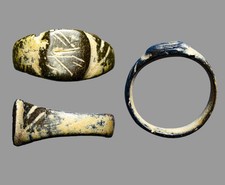
Premium Christian Roman Bronze \"Wounds of Christ\" Magic Ring (4th–6th Century AD) Size 5.5 Authentic
Authenticity NoticeThis artifact is certified authentic and will be accompanied by a Certificate of Authenticity and Provenance.
DetailsObject: Amuletic Christian RingCulture: Byzantine / Late RomanDate: Circa 4th–6th Century ADMaterial: Bronze (Copper-alloy)Form: Large flat oval bezel with five \"Eye\" or \"Dot-in-Circle\" motifsSize: US 5.5Region: Holy Land (Jerusalem Find)
Overview and Magical ContextA rare and powerful early Christian talismanic ring recovered from the vicinity of Jerusalem. This bronze ring features an oval bezel incised with five distinct \"Dot-in-Circle\" motifs. In the esoterica of the Late Roman and Early Byzantine Levant, this specific arrangement—four surrounding one—held a dual protective meaning. Primarily, it represents the Five Wounds of Christ (the Stigmata), serving as a constant devotional reminder of the Passion and a plea for divine mercy.
Magic-wise, the \"Dot-in-Circle\" is one of the oldest apotropaic symbols, functioning as an \"Eye\" to reflect the gaze of the Evil Eye (Malocchio) back upon itself. By combining the holy number five with these defensive ocular symbols, the ring acted as a spiritual shield for the wearer, intended to ward off disease, demonic influence, and misfortune. Such rings were highly valued personal items in the Christian communities of the Holy Land during the pilgrimage era.
Authenticity CheckThe artifact displays a superb, stable archaeological patina with a deep ebony-green surface and localized areas of authentic earthen mineralization. The internal band shows smooth, natural wear consistent with centuries of ancient use. The incised \"Eyes\" contain compacted archaeological soil and mineralized corrosion products. The transition from the tapered band to the bezel is seamless, indicating a high-quality ancient casting. No evidence of modern tool marks, machine-polishing, or artificial chemical staining.
Comparable Examples
The British Museum, London: Accession No. 1923,0716.48 (Early Christian bronze rings with dot-in-circle motifs).
The Israel Museum, Jerusalem: Collection of Byzantine-period amulets and personal jewelry from Jerusalem excavations.
The Met, New York: Accession No. 17.190.1633 (Late Roman/Byzantine bronze rings featuring geometric protective symbols).
Further Reading
Finney, Paul Corby – The Invisible God: The Earliest Christians on Art: Regarding the development of symbolic shorthand in early Christian personal objects.
Vikan, Gary – Byzantine Pilgrimage Art: For context on the amuletic nature of jewelry found in the Holy Land.
7-6