When you click on links to various merchants on this site and make a purchase, this can result in this site earning a commission. Affiliate programs and affiliations include, but are not limited to, the eBay Partner Network.
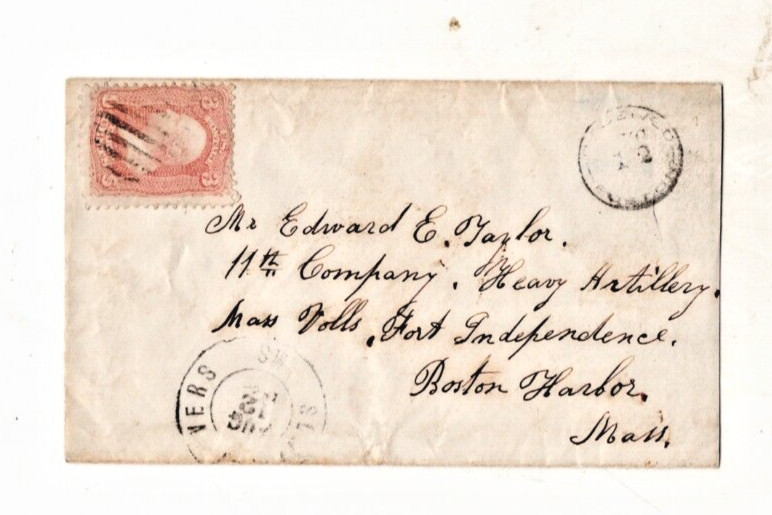
DANVERS MASS. (ESSEX COUNTY) TO "EDWARD E. TAYLOR MASS. VOLUNTEERSFORT INDEPENDENCE BOSTON HARBOR, MASS"
VERY SCARCE COVER SENT TO THIS BOSTON HARBOR FORT.TODAY IT IS A TOURIST ATTRACTION.
EDGAR ALLAN POE SERVED THERE IN 1827, WHERE HE WAS INSPIRED TO WRITECASK OF AMONTILLADO.(HIS FIRST BOOK WAS PUBLISHED IN BOSTON IN 1827, "TAMERLANE AND OTHERSTORIES)
THERE IS NO LETTER WITH THIS COVER.11th Company, Massachusetts Heavy ArtilleryOctober 20, 1863Organized for garrison of forts in Boston Harbor. Ordered to Washington, D.C., and garrison duty in the Defenses of that cityattached to3rd Brigade, Hardin’s Division, 22nd Corps, Dept. of Washington.August, 1864Assigned to3rd Heavy Artilleryas Company G
FORT INDEPENDENCE
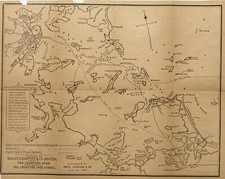
Existing structure[Fort Independence map in 1883 study for a plan of Pleasure BayFort Independence[19]
Work on the present fort began in 1833 under thethird system of US fortifications, supervised by ColonelSylvanus Thayer, one of the nation's leading military engineers of the time. The new fort had walls 30 feet (9.1m) high and 5.5 feet (1.7m) thick and was constructed primarily out of granite fromRockport, Massachusetts. It was substantially complete by 1848, although repairs and other work continued until 1861. At the height of its strength during theAmerican Civil War, it mounted 96 cannon, some of which were 15-inchRodman gunscapable of firing a 450-pound shot more than 3 miles (4.8km).[20][21]A small part of Castle William's brick structure remains in the rear portion of the present fort, but is covered up by subsequent stonework.[9]
Flag claimed to have flown over Fort Independence in the late 18th century.
At the start of the Civil War in 1861, Fort Independence was garrisoned by the Fourth Battalion Massachusetts Volunteer Militia. The battalion set the fort in order and were trained in infantry and artillery drill, eventually forming the nucleus of the24th Regiment Massachusetts Volunteer Infantry. At least two other infantry regiments were trained at Fort Independence during the Civil War—the11th Massachusettsand the13th Massachusetts.[22]
Following the Civil War, Fort Independence gradually fell out of use, as its importance was reduced by the largerFort Warrenwhich had also been constructed under the direction of Sylvanus Thayer. In the 1880s, landscape architectFrederick Law Olmsteddesigned a series of parkways and parks in Boston known as theEmerald Necklace. Olmsted had originally envisioned a parkway to be known as theDorchesterwaythat would connect Castle Island (via a new earthen causeway) to the rest of the Emerald Necklace. The Dorchesterway was never realized, although Boston did undertake a large-scale project in the 1890s to create a park-like environment around Fort Independence. In 1890, the Federal government ceded Castle Island (excluding the fort) to the Commonwealth of Massachusetts. The city of Boston commenced filling the marshes separating Castle Island fromSouth Bostonin 1890 with the intention of creating green space and promenades. The process was finished in the 1920s and Castle Island ceased to be an island. The Federal government ceded the fort to the city of Boston in 1908.[23]
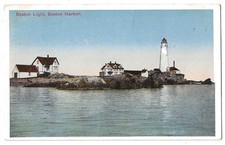
Castle Island and Fort Independence commanding the approach to modern Boston Harbor
The Federal government briefly reclaimed Castle Island in 1898 during theSpanish American War, but it was quickly returned to the city of Boston in 1899. The military again took control of Fort Independence duringWorld War IandWorld War II, and anti-aircraft guns were added. During World War I, the fort was used primarily as a depot for small arms ammunition. During World War II, the Navy used it as adegaussingstation for de-magnetizing the hulls of ships. At the close of both conflicts, the fort was promptly returned to the city of Boston.[24]
In 1962, the Federal government permanently deeded Castle Island and Fort Independence to the Commonwealth of Massachusetts.[23]It is now overseen by theMassachusetts Department of Conservation and Recreationand the non-profit Castle Island Association. Over the course of its history, a shot was never fired in anger from Fort Independence.[2]
Edgar Allan Poe and a duel
A monument outside the west battery of the fort marks the grave of Lieutenant Robert F. Massie who was killed in a sword duel with Lieutenant Gustavus Drane on December 25, 1817. According to folkloristEdward Rowe Snow, Massie was so popular with the soldiers stationed at Fort Independence that they walled up his killer within a vault in the fort. Edgar Allan Poe was serving with the1st United States Artillery Regimentat Fort Independence in 1827, and he purportedly was inspired by the story to write "The Cask of Amontillado".[25]
The legend, however, is not entirely accurate. The duel did take place, but Lieutenant Drane was not murdered by the fort's soldiers. He continued in his military career, was promoted to the rank of captain, and died on active duty in 1846. AfterWorld War II, Lieutenant Massie's remains were moved to theFort Devens Cemeterynear the town ofAyer, Massachusetts.[26]
Cultural References
Fort Independence shares its location with "The Castle" inFallout 4byBethesda Game Studios. This game location, as with many in the Fallout universe, is inspired by its real-life counterpart. The size and layout of The Castle is not an exact replica of Fort Independence.