When you click on links to various merchants on this site and make a purchase, this can result in this site earning a commission. Affiliate programs and affiliations include, but are not limited to, the eBay Partner Network.
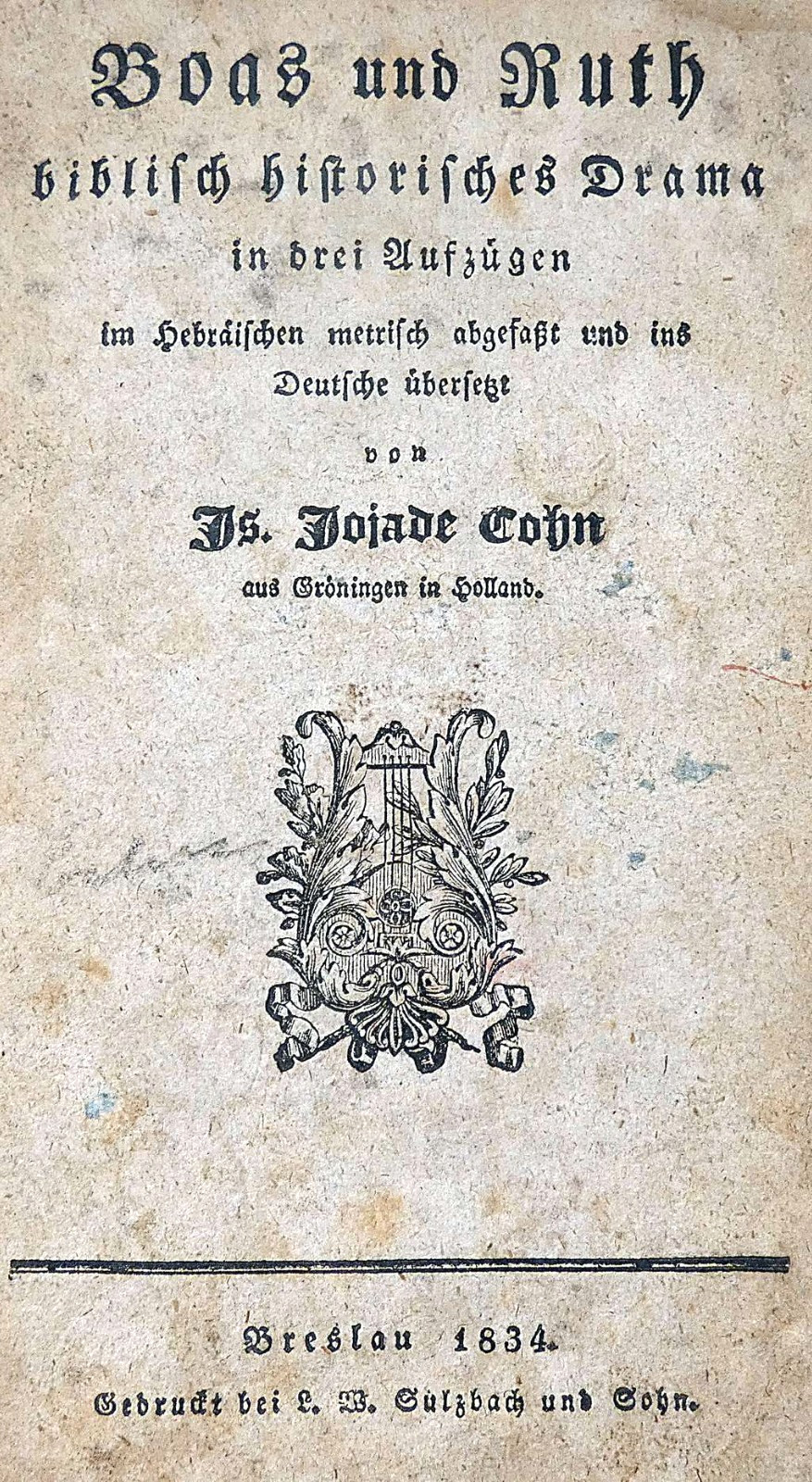
\"Boaz and Ruth” Biblisch Historisches Drama in drei Aufzuegen von Yitzhak ben Yehoyada Hacohen,
1834, in German and Hebrew
Boaz and Ruth: in three parts, connected in Hebrew and in German.
Breslau: printed by Lebeel Sulzbach und Sohn, 1834, 156 pp.
Half leather hard cover, 18 x 11 cm. From the library of a rabbi – his cachet
Condition: front cover detached; cover worn, rubbed; spine damaged; aged darkened paper;
Tear to last page; light damping to upper edge of last pages.
Weight: 210 gr.
Biblical Historical Drama in Three Acts refers to a play that tells the story of Ruth and Boaz from the Old Testament, a biblical story often staged as a drama. The drama is likely divided into three acts and dramatizes the biblical narrative of the Book of Ruth.
The biblical story: Ruth, a Moabite woman, accompanies her mother-in-law Naomi back to Bethlehem after Judah. There she meets Boaz, a wealthy relative of her deceased husband.
Plot in three acts:
Act 1: The arrival of Ruth and Naomi in Bethlehem and Ruth\'s encounter with Boaz.
Act 2: Ruth and Boaz\'s relationship develops, and they decide to marry according to the law of \"kinsman-redeemer\" to perpetuate the deceased\'s name.
Act 3: The wedding of Boaz and Ruth, the birth of Obed, and the family\'s inclusion in King David\'s genealogy.
The Drama: The story of Boaz and Ruth is a \"biblical historical\" narrative and is called a \"drama\" because it presents a series of personal and family conflicts, challenges, and divine interventions that lead to a positive outcome for all involved
Yitzhak ben Yehoyada Hacohen was born in the Posen district, in the city of Lissa, then Prussia. He later moved his residence to the city of Groningen, Netherlands, where he lived and worked from 1820 until his death. Yitzhak ben Yehoyada Hacohen served as a Hebrew teacher in private schools, and among his students was the renowned Dutch-Jewish painter, Joseph Israels. Hacohen apparently took an active part in the life of the community in Groningen, and in 1821 he initiated and founded the \"Maggid Mishnah\" association, an association of lovers of the Hebrew language, similar to that of the \"Koltet\" society that operated in Amsterdam. In 1831, he published a pamphlet in Hebrew in Amsterdam containing a hymn in honor of Emperor Wilhelm I and the royal dynasty of the House of Orania. The poem deals with the war that broke out between the Netherlands and Belgium. In 1834, his biblical play \"Beaz and Ruth\" was published in Hebrew, accompanied by a German translation. In 1846, a Dutch translation of the play was published in Groningen.