When you click on links to various merchants on this site and make a purchase, this can result in this site earning a commission. Affiliate programs and affiliations include, but are not limited to, the eBay Partner Network.
An original 5.5x3" antique photo (NOT a modern reprint) from the estate of a vintage automobile photo and postcard collector. This was part of a huge collection of antique photos.
Photo Overview
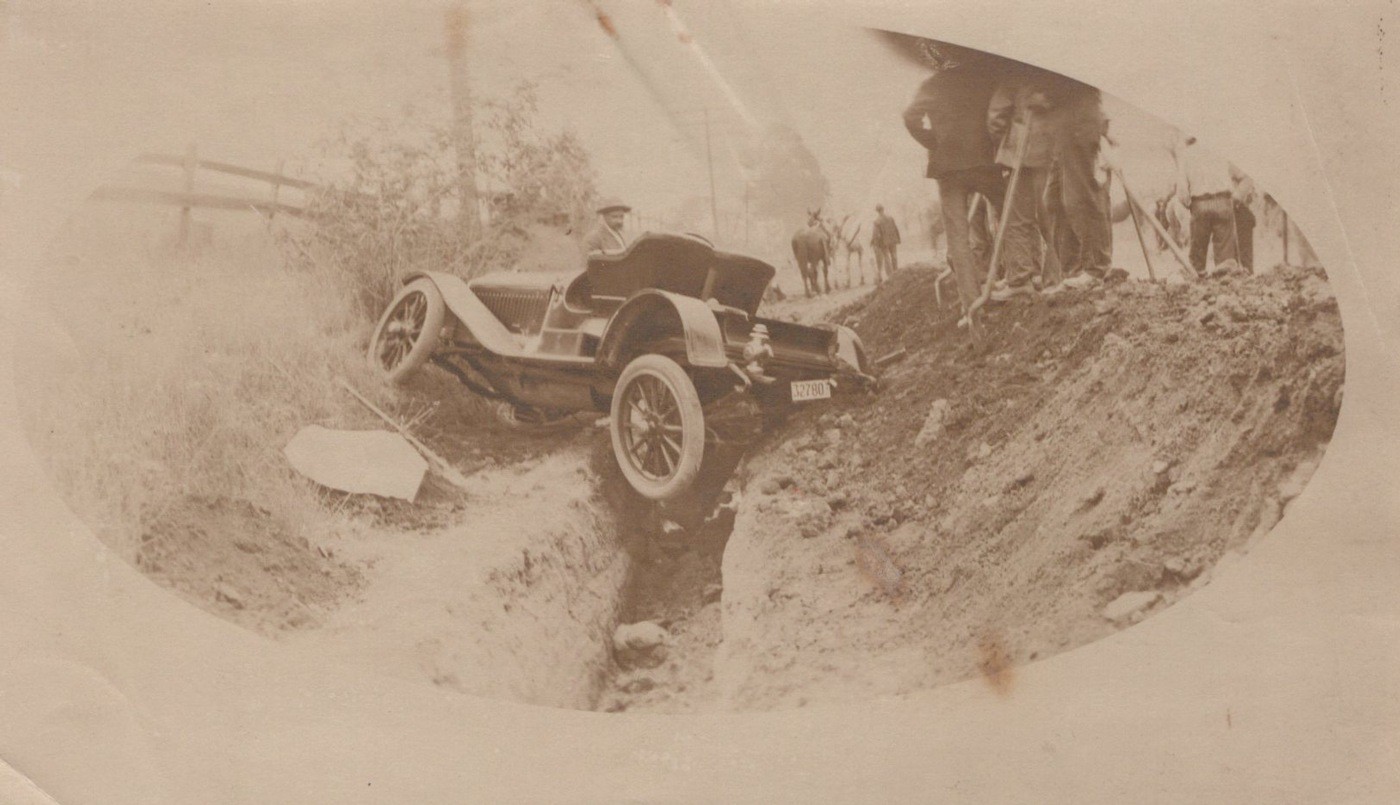
An early automobile crash captured on an antique real photograph from the 1910s. A Brass Era two-seat roadster has gone nose-first into a deep, freshly dug trench on a rural dirt road, its front wheels hanging in the cut and its rear wheels perched on the edge. The car's driver, wearing a cap, still sits behind the wheel, while a group of workmen holding shovels stands on the mound of excavated dirt at right. A team of horses or mules and another worker wait on the road in the background, likely ready to haul the car back out.
The car is an open runabout or roadster with wooden-spoke artillery wheels, sweeping full fenders, a flat-front radiator, a low bucket-style seat and a rear deck, with a rear license plate mounted below. Its styling is typical of American roadsters built about 1910 to 1913, with lines consistent with popular light cars of the era such as the Hupmobile Model 20, Buick runabouts and E-M-F or Flanders models. The image is printed with a soft oval vignette and warm sepia tone. It is a fine piece of early motoring and road-building history, from the estate of a vintage automobile photo and postcard collector.
Historical Notes
Trenches like this one were usually dug by hand crews for new water mains, sewer lines or drainage culverts, which were spreading quickly into small towns and rural roads in the 1910s. With few warning signs, no streetlights and drivers who were often new to the wheel, mishaps like this were common, and a horse or mule team was the standard way to pull a stranded car free. Scenes like this fed directly into the Good Roads movement, which led to the Federal Aid Road Act of 1916, the first major federal funding for improved highways. Within a decade, the dirt lanes and open ditches seen here were giving way to graded, paved and signed roads. The light roadsters of this era were soon pushed aside by the inexpensive Ford Model T and later closed cars. Surviving examples like this one are now prized at Brass Era car shows and museums.
Print analysis
This is an original gelatin silver photograph with warm sepia toning, printed with an oval vignette mask in a style typical of the 1905-1920 period. The automobile styling, clothing and the use of a horse team for recovery all date the scene to about 1910-1915. The print's toning, paper surface and aging are consistent with a print made at the time the photo was taken, making this a Type 1 original.
Condition
All photos and postcards we sell are in fair to excellent vintage condition. Please see photos for any tears, folds, smudges, or other age damage that may be present.