When you click on links to various merchants on this site and make a purchase, this can result in this site earning a commission. Affiliate programs and affiliations include, but are not limited to, the eBay Partner Network.
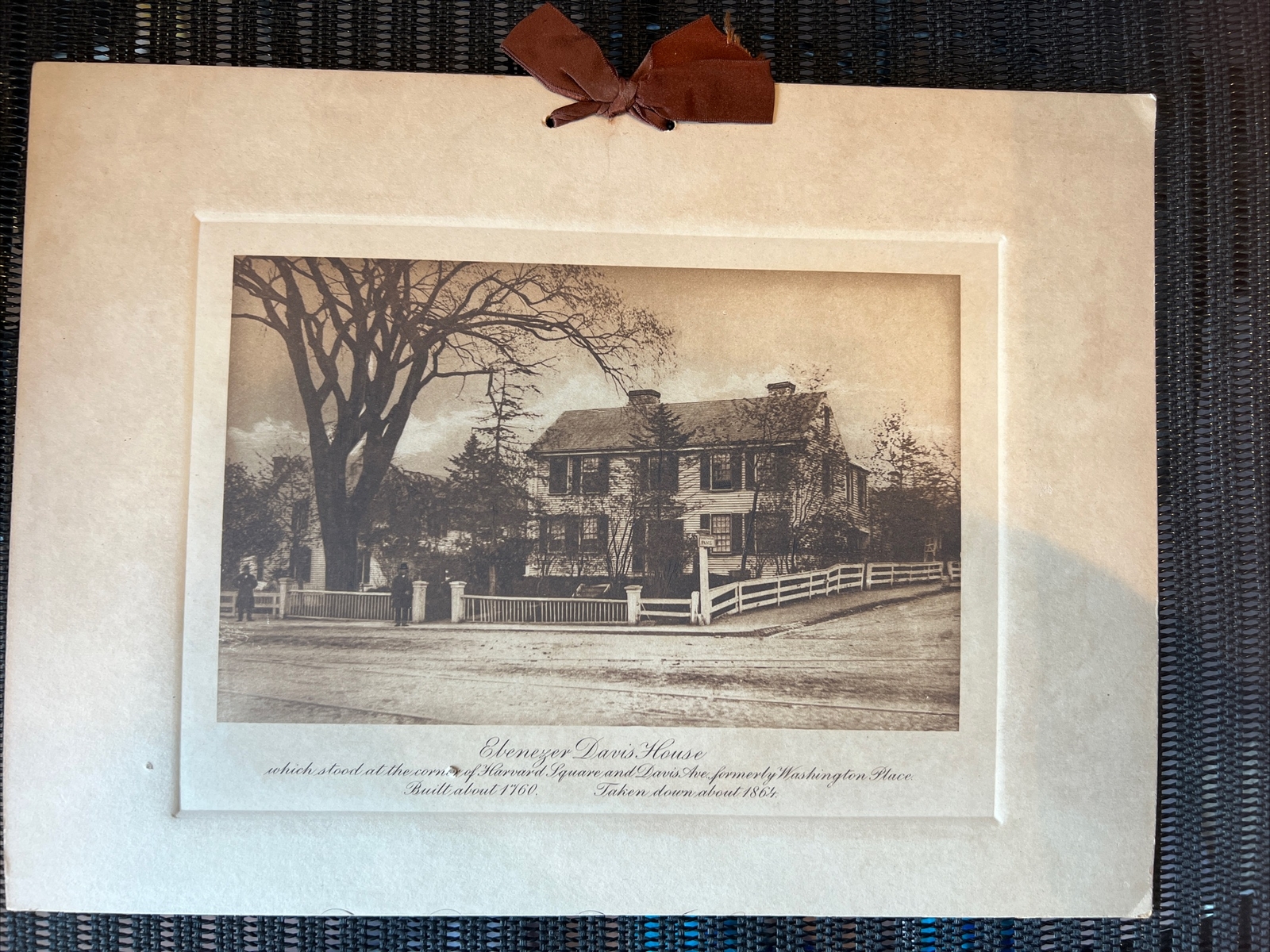
Very old (circa Civil War) print of a photo on matte \"frame\" with decorative original brown ribbon at the top and a small gold color metal ring for hanging
The entire thing measures approx 11x8\" - the photo part approx 7x4.25\" or 7x5.5\" with the description below it
\"Ebenezer Davis House which stood at the corner of Harvard Square and Davis Ave, formerly Washington Place - Built around 1760 - Taken down about 1864\"
Below is some additional detail about the house and this man/family. There are records of his letters to GeorgeWashington during the Revolutionary War available online as well. The last 2 pics (of Ebenezer & companion text) is for backgroundinfo purposes - the sale is for the House item alone
*Because there were several Davis houses in this neighborhood, a distinction should be made. The Ebenezer Davis house was a late seventeenth century gambrel structure which once stood on the easterly side of Harvard Square between Kent Street and Andem Place. The Benjamin Davis house was built circa 1760 in the Federal style by Ebenezer Davis for his son Benjamin Davis. Finally, the Davis Mansion was constructed in 1875 for John Panter-undoubtedly sonamed because the Davis family had owned the property previously and figured prominently in the Town’s early history.
When Ebenezer Davis Sr was born on 1 June 1676, in Concord, Middlesex, Massachusetts Bay Colony, British Colonial America, his father, Simon Davis, was 41 and his mother, Mary Blood, was 35. He married Dinah Brown on 14 February 1700, in Chelmsford, Middlesex, Massachusetts Bay Colony, British Colonial America. They were the parents of at least 5 sons and 3 daughters. He died on 31 March 1753, in Harvard, Worcester, Massachusetts Bay Colony, British Colonial America, at the age of 76.
Ebenezer Davis (1754–1799) was born in New Hampshire and moved to Massachusetts as a child. He was among the minutemen who responded to the Lexington alarm in 1775 and thereafter served as an officer with Massachusetts troops in the Continental army, rising to the rank of lieutenant. After the war he settled in Portland, Maine, where he served as a militia officer.