When you click on links to various merchants on this site and make a purchase, this can result in this site earning a commission. Affiliate programs and affiliations include, but are not limited to, the eBay Partner Network.
These are simply the best posters available…you will be thrilledwith the image quality, vivid colors, fine paper, and unique subjects!
OUR POSTERS ARE SIZED FOR STANDARD OFF-THE-SHELF FRAMES, WITH NOCUSTOM FRAMING REQUIRED, PROVIDING HUGE COST SAVINGS!
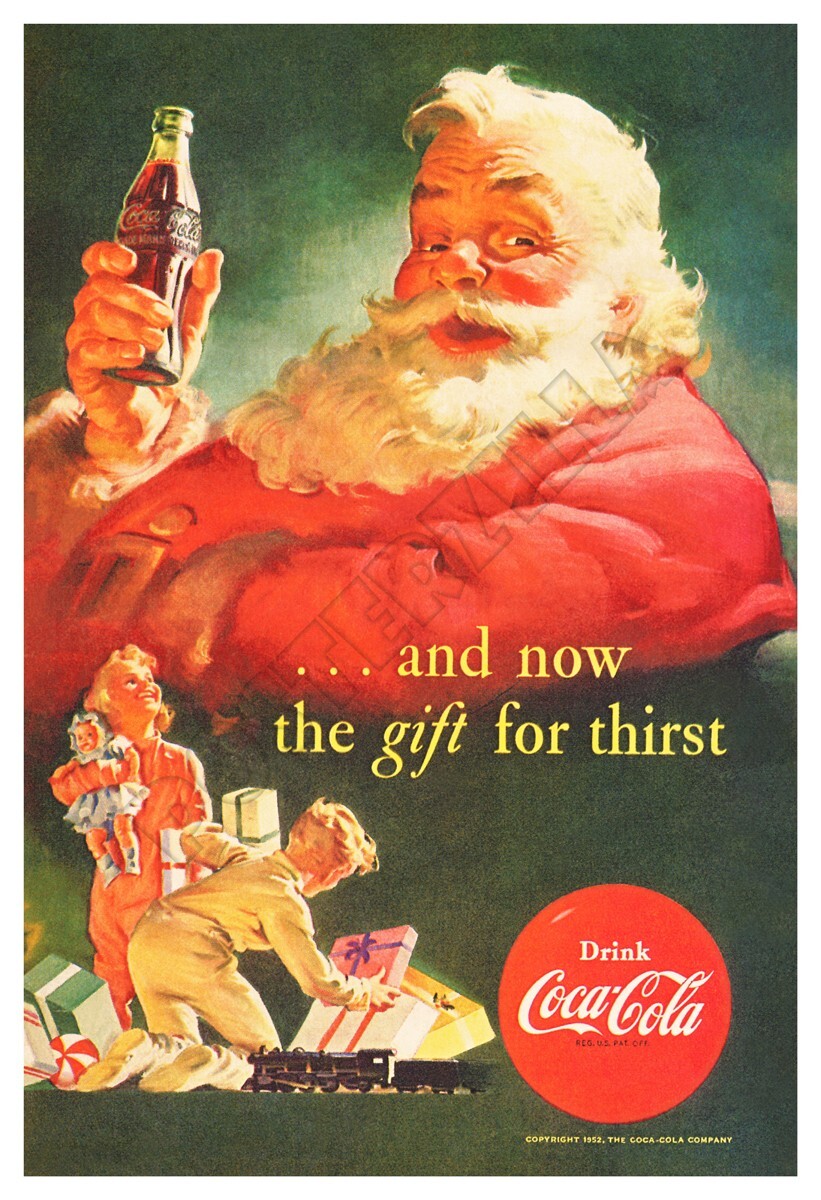
Thisbeautifulposter has been re-mastered from a 1952 Coca Cola Christmas advertisement featuringjolly old Saint Nick and children opening their Christmas presents.
The vibrant colors anddetail of this classic image have been painstakingly brought back to life topreserve a great piece of history.
The high-resolution image is printedon heavy archival photo paper, on a large-format, professional giclée processprinter. The poster is shipped in a rigid cardboard tube, and is ready forframing.
The 13\"x19\"format is an excellent image size that looks great as a stand-alone piece ofart, or as a grouped visual statement. These posters requirenocutting, trimming, or custom framing, and a wide variety ofthese frames are readily available at your local craft or hobbyretailer, and online.
A great vintage printfor your home, shop, or business!
COCA COLA ADVERTISING HISTORY
Coca-Cola\'sadvertising has significantly affected American culture, and it is frequentlycredited with inventing the modern image of Santa Claus as an old man in ared-and-white suit. Although the company did start using the red-and-whiteSanta image in the 1930s, with its winter advertising campaigns illustrated byHaddon Sundblom, the motif was already common.
Coca-Colawas not the first soft drink company to use the modern image of Santa Claus inits advertising: White Rock Beverages used Santa in advertisements for itsginger ale in 1923, after first using him to sell mineral water in 1915. BeforeSanta Claus, Coca-Cola relied on images of smartly dressed young women to sellits beverages. Coca-Cola\'s first such advertisement appeared in 1895, featuringthe young Bostonian actress Hilda Clark as its spokeswoman.
1941 sawthe first use of the nickname \"Coke\" as an official trademark for theproduct, with a series of advertisements informing consumers that \"Cokemeans Coca-Cola\". In 1971, a song from a Coca-Cola commercial called\"I’d Like to Teach the World to Sing\", produced by Billy Davis,became a hit single.
Coke\'sadvertising is pervasive, as one of Woodruff\'s stated goals was to ensure thateveryone on Earth drank Coca-Cola as their preferred beverage. This isespecially true in southern areas of the United States, such as Atlanta, whereCoke was born.
SomeCoca-Cola television commercials between 1960 through 1986 were written andproduced by former Atlanta radio veteran Don Naylor (WGST 1936–1950, WAGA1951–1959) during his career as a producer for the McCann Erickson advertisingagency. Many of these early television commercials for Coca-Cola featured moviestars, sports heroes, and popular singers.
During the1980s, Pepsi-Cola ran a series of television advertisements showing peopleparticipating in taste tests demonstrating that, according to the commercials,\"fifty percent of the participants who said they preferred Coke actuallychose the Pepsi.\" Statisticians pointed out the problematic nature of a50/50 result: most likely, the taste tests showed that in blind tests, mostpeople cannot tell the difference between Pepsi and Coke. Coca-Cola ran ads tocombat Pepsi\'s ads in an incident sometimes referred to as the cola wars; oneof Coke\'s ads compared the so-called Pepsi challenge to two chimpanzeesdeciding which tennis ball was furrier. Thereafter, Coca-Cola regained itsleadership in the market.
Selena wasa spokesperson for Coca-Cola from 1989 until the time of her death. She filmedthree commercials for the company. During 1994, to commemorate her five yearswith the company, Coca-Cola issued special Selena coke bottles.
TheCoca-Cola Company purchased Columbia Pictures in 1982, and began insertingCoke-product images into many of its films. After a few early successes duringCoca-Cola\'s ownership, Columbia began to under-perform, and the studio was soldto Sony in 1989.
Coca-Colahas gone through a number of different advertising slogans in its long history,including \"The pause that refreshes\", \"I had like to buy theworld a Coke\", and \"Coke is it\".
In 2006,Coca-Cola introduced My Coke Rewards, a customer loyalty campaign whereconsumers earn points by entering codes from specially marked packages ofCoca-Cola products into a website. These points can be redeemed for variousprizes or sweepstakes entries.
InAustralia in 2011, Coca-Cola began the \"share a Coke\" campaign, wherethe Coca-Cola logo was replaced on the bottles and replaced with first names.Coca-Cola used the 150 most popular names in Australia to print on the bottles.The campaign was paired with a website page, Facebook page, and an online\"share a virtual Coke\". The same campaign was introduced toCoca-Cola, Diet Coke & Coke Zero bottles and cans in the UK in 2013.
Coca-Colahas also advertised its product to be consumed as a breakfast beverage, insteadof coffee or tea for the morning caffeine.