

|
Site Categories |
|
Featured Items |

Poodle, Spaghetti Trim, Ucagco


|
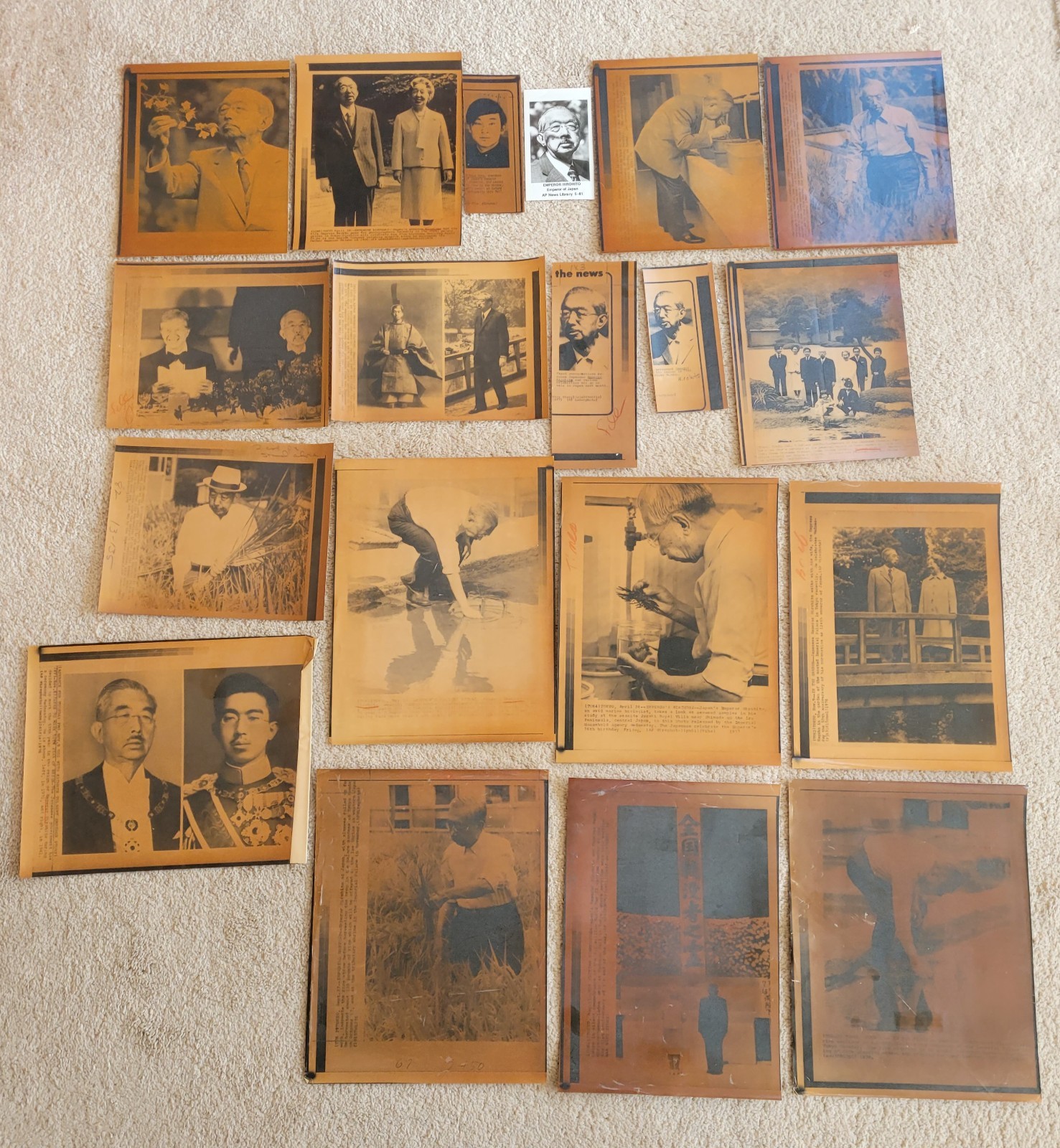
HUGE Emperor Hirohito Empress 1975 USA Visit Wirephoto Lot Tyvek Laserpoto 70+ For Sale

When you click on links to various merchants on this site and make a purchase, this can result in this site earning a commission. Affiliate programs and affiliations include, but are not limited to, the eBay Partner Network.

HUGE Emperor Hirohito Empress 1975 USA Visit Wirephoto Lot Tyvek Laserpoto 70+:
$555.00
Based on the unique appearance of these images—particularly the sepia-toned, translucent quality of the first batch—you are likely looking at Laserphotos (also known as Wirephotos) printed on Tyvek or a similar synthetic heat-sensitive paper. Other photos are printed on paper (double sided same image) (not photography paper) Unlike traditional silver gelatin photos, these were transmitted via telephone lines or satellites and printed by a receiver using a laser or thermal process. The \"plastic\" feel and the fact that the text is part of the image rather than a physical paper caption are hallmarks of 1970s wire-service technology.
Massive Historical Archive: Emperor Hirohito & Empress Nagako 1975 U.S. State Visit This is a rare, comprehensive collection of over 70 press photos documenting the historic 1975 visit of Emperor Hirohito and Empress Nagako to the United States. This lot includes a significant number of Laserphotos printed on Tyvek/synthetic paper, characterized by their durability and unique sepia/orange hue, as well as standard newsprint wirephotos. Historical Significance The 1975 visit was the first official state visit to the U.S. by a reigning Japanese Emperor. It served as a vital symbol of the post-WWII reconciliation between the two nations. The photos capture the Emperor meeting with President Gerald Ford, visiting Disneyland (where he famously met Mickey Mouse), and engaging in his personal passion for marine biology and botany. Notable Figures & Locations Pictured: Emperor Hirohito (Showa): 124th Emperor of Japan. Empress Nagako: Consort to Hirohito. President Gerald Ford & Betty Ford: Pictured at White House State Dinners. Vice President Nelson Rockefeller. Mickey Mouse at Disneyland: Iconic shots of the Emperor at the park. Locations: San Francisco (Golden Gate Bridge), Washington D.C., Los Angeles, and various scientific of Key Photos [Photo 1000288780 - Departure]: [Photo 1000288777 - Marine Biology]: [Photo 1000288778 - State Dinner]: [Photo 1000288777 - Disneyland]: Item Condition & Specs Quantity: 70+ pieces (including duplicates and various sizes). Medium: Includes Laserphotos (Tyvek/Synthetic) and standard wire-service newsprint. Backs: Most backs are blank, as the captions are integrated into the front of the image via the wire transmission process. Condition: Vintage condition. Some curling to the synthetic photos (typical for this medium) and edge wear on newsprint versions.
Keywords: Showa Era, Imperial Japan, Diplomatic History, JAL, White House, Vintage Photojournalism, 1970s, Collectible Photography.
Emperor Shōwa (昭和天皇, Shōwa Tennō; 29 April 1901 – 7 January 1989),[a] known colloquially by his personal name Hirohito[b], was the 124th emperor of Japan according to the traditional order of succession, reigning from 1926 until his death in 1989. He remains the longest-reigning emperor in Japanese history and one of the longest-reigning monarchs in the world. As emperor during the Shōwa era, Hirohito presided over the rise of Japanese militarism, the Second Sino-Japanese War, the Asia-Pacific theater of World War II, and the nation\'s postwar economic miracle.Hirohito was born during the reign of his paternal grandfather, Emperor Meiji, as the first child of Crown Prince Yoshihito and Crown Princess Sadako (later Emperor Taishō and Empress Teimei). When Emperor Meiji died in 1912, Hirohito\'s father ascended the Chrysanthemum Throne, and Hirohito was proclaimed Crown Prince of Japan in 1916, making him the heir apparent. In 1921, he made an official visit to six European countries, marking the first time a Japanese crown prince had traveled abroad. Due to his father\'s ill health, Hirohito became Sesshō of Japan (regent) that same year. In 1924, he married Princess Nagako Kuni, with whom he later had seven children: Shigeko, Sachiko, Kazuko, Atsuko, Akihito, Masahito and Takako. He became emperor upon his father\'s death in 1926.As Japan\'s head of state, Emperor Hirohito oversaw the rise of militarism in Japanese politics. In 1931, he raised no objection when Japan\'s Kwantung Army staged the Mukden incident as a pretext for the invasion of Manchuria. Following the onset of the Second Sino-Japanese War in 1937, tensions steadily grew between Japan and the United States. After Hirohito formally sanctioned his government\'s decision to go to war against the U.S. and its allies on 1 December 1941, Japan entered World War II upon its military\'s attack on Pearl Harbor as well as its invasion of American and European colonies in Asia and the Pacific. After the atomic bombings of Hiroshima and Nagasaki and the Soviet invasion of Japanese-occupied Manchuria, Hirohito called upon the Imperial Japanese Armed Forces (IJAF) to surrender in a radio broadcast on 15 August 1945. The extent of his involvement in military decision-making and his wartime culpability remains a subject of historical debate.Following Japan\'s surrender, Emperor Hirohito was never prosecuted for war crimes at the International Military Tribunal for the Far East (IMTFE), even though the war had been waged in his name. After the surrender, Japan came under Allied occupation, administered primarily by the United States. The Supreme Commander for the Allied Powers, U.S. General Douglas MacArthur, believed that a cooperative emperor would facilitate a peaceful occupation and support U.S. postwar objectives. MacArthur therefore excluded any evidence from the tribunal that could have incriminated Hirohito or other members of the Imperial House of Japan. In 1946, Hirohito was pressured by the Allies to renounce his divinity. Under Japan\'s new constitution, drafted by U.S. officials and enacted in 1947, his role as emperor was redefined as \"the symbol of the State and of the unity of the People\". Upon his death in January 1989, he was succeeded by his eldest son, Akihito, beginning the Heisei era.
Early life and education
Hirohito as an infant in 1902Hirohito was born on 29 April 1901 at Tōgū Palace in Aoyama, Tokyo during the reign of his grandfather, Emperor Meiji,[2] the first son of 21-year-old Crown Prince Yoshihito (the future Emperor Taishō) and 16-year-old Crown Princess Sadako, the future Empress Teimei.[3] He was the grandson of Emperor Meiji and Yanagiwara Naruko. His childhood title was Prince Michi.Ten weeks after he was born, Hirohito was removed from the court and placed in the care of Count Kawamura Sumiyoshi, who raised him as his grandchild. At the age of 3, Hirohito and his brother Yasuhito were returned to court when Kawamura died – first to the imperial mansion in Numazu, Shizuoka, then back to the Aoyama Palace.[4]In 1908, he began elementary studies at the Gakushūin (Peers School).[5] Emperor Mutsuhito then appointed General Nogi Maresuke to be the Gakushūin\'s tenth president as well as in charge of educating his grandson.[6] After Nogi\'s death, his education was led by Fleet Admiral Togo Heihachiro and Naval Captain Ogasawara Naganari, who would later become his major opponents with regards to his national defense policy.[7]
Emperor Taishō\'s four sons in 1921: Hirohito, Takahito, Nobuhito, and YasuhitoDuring 1912, at the age of 11, Hirohito was commissioned into the Imperial Japanese Army as a Second Lieutenant and in the Imperial Japanese Navy as an Ensign. He was also bestowed with the Grand Cordon of the Order of the Chrysanthemum.[8] When his grandfather, Emperor Meiji died on 30 July 1912, Yoshihito assumed the throne and his eldest son, Hirohito became heir apparent.Shiratori Kurakichi, one of his middle-school instructors, was one of the personalities who deeply influenced the life of Hirohito. Kurakichi was a trained historian from Germany, imbibing the positivist historiographic trend by Leopold von Ranke. He was the one who inculcated in the mind of the young Hirohito that there is a connection between the divine origin of the imperial line and the aspiration of linking it to the myth of the racial superiority and homogeneity of the Japanese. The emperors were often a driving force in the modernization of their country. He taught Hirohito that the Empire of Japan was created and governed through diplomatic actions (taking into accounts the interests of other nations benevolently and justly).[9]
Crown PrinceOn 2 November 1916, Hirohito was formally proclaimed crown prince and heir apparent. An investiture ceremony was not required to confirm this status.[10]
Overseas travel
Prince Hirohito and British prime minister David Lloyd George, 1921From 3 March to 3 September 1921 (Taisho 10), the Crown Prince made official visits to the United Kingdom, France, the Netherlands, Belgium, Italy, Vatican City and Malta (then a protectorate of the British Empire). This was the first visit to Europe by the Crown Prince.[c] Despite strong opposition in Japan, this was realized by the efforts of elder Japanese statesmen (Genrō) such as Yamagata Aritomo and Saionji Kinmochi.The departure of Prince Hirohito was widely reported in newspapers. The Japanese battleship Katori was used, and departed from Yokohama, sailed to Naha, Hong Kong, Singapore, Colombo, Suez, Cairo, and Gibraltar. In April, Hirohito was present in Malta for the opening of the Maltese Parliament.[11] After sailing for two months, the Katori arrived in Portsmouth on 9 May, on the same day reaching the British capital, London. Hirohito was welcomed in the UK as a partner of the Anglo-Japanese Alliance and met with King George V and Prime Minister David Lloyd George.
Hirohito watches a boat race at Oxford University in 1921That evening, a banquet was held at Buckingham Palace, where Hirohito met with George V and Prince Arthur of Connaught. George V said that he treated his father like Hirohito,[clarification needed] who was nervous in an unfamiliar foreign country, and that relieved his tension. The next day, he met Prince Edward (the future Edward VIII) at Windsor Castle, and a banquet was held every day thereafter. He toured the British Museum, the Tower of London, the Bank of England, Lloyd\'s Marine Insurance, Oxford University, Army University, and the Naval War College. He also enjoyed theater at the New Oxford Theatre and the Delhi Theatre.[12]At the University of Cambridge, he listened to Professor Joseph Robson Tanner\'s lecture on \"Relationship between the British Royal Family and its People\", and was awarded an honorary doctorate degree.[13][14] He visited Edinburgh, Scotland, from 19 to 20 May, and was also awarded an Honorary Doctor of Laws at the University of Edinburgh. He stayed at the residence of John Stewart-Murray, 8th Duke of Atholl, for three days. On his stay with Stuart-Murray, the prince was quoted as saying, \"The rise of Bolsheviks won\'t happen if you live a simple life like Duke Athol.\"[13]In Italy, he met with King Vittorio Emanuele III and others, attended official international banquets, and visited places such as the fierce battlefields of World War I.
RegencyAfter returning to Japan, Hirohito became Regent of Japan (Sesshō) on 25 November 1921, in place of his ailing father, who was affected by mental illness.[15][16] In 1923 he was promoted to the rank of Lieutenant-Colonel in the army and Commander in the navy, and army Colonel and Navy Captain in 1925.
Visit to colonial TaiwanOver 12 days in April 1923, Hirohito visited Taiwan, which had been a Japanese colony since 1895.[17] This was a voyage his father, the then Crown Prince Yoshihito had planned in 1911 but never completed.[18]It was widely reported in Taiwanese newspapers that famous high-end restaurants served typical Chinese luxury dishes for the Prince, such as swallow\'s nest and shark fin, as Taiwanese cuisine. This was the first time an Emperor or a Crown Prince had ever eaten the local cuisine of a colony, or had foreign dishes other than Western cuisine abroad, thus exceptional preparations were required: The eight chefs and other cooking staff were purified for a week (through fasting and ritual bathing) before the cooking of the feast could begin. This tasting of \"Taiwanese cuisine\" of the Prince Regent should be understood[attribution needed] as part of an integration ceremony of incorporating the colony into the empire, which can be seen as the context and purpose of Hirohito\'s Taiwanese visit.[19]
Cavalry welcome Prince Hirohito in Taipei, in front of the Office of the Governor-GeneralHaving visited several sites outside of Taipei, Hirohito returned to the capital on the 24th and on 25 April, just one day before his departure, he visited the Beitou hotspring district of Taipei and its oldest facility. The original structure had been built in 1913 in the style of a traditional Japanese bathhouse. However, in anticipation of Hirohito\'s visit an additional residential wing was added to the earlier building, this time in the style of an Edwardian country house. The new building was subsequently opened to the public and was deemed the largest public bathhouse in the Japanese Empire.[20][18] Crown Prince Hirohito was a student of science, and he had heard that Beitou Creek was one of only two hot springs in the world that contained a rare radioactive mineral. So, he decided to walk into the creek to investigate.Naturally, concerned for a royal family member\'s safety, his entourage scurried around, seeking flat rocks to use as stepping stones. After that, these stones were carefully mounted and given the official name: “His Imperial Highness Crown Prince of Japan\'s Stepping Stones for River Crossing,” with a stele alongside to tell the story.[21]Crown Prince Hirohito handed his Imperial Notice to Governor-General Den Kenjiro and departed from Keelung on 26 April 1923.[18]
Earthquake and assassination attempt
Further information: Assassination attempts on Hirohito
Prince Hirohito and his wife, Princess Nagako, in 1924The Great Kantō earthquake devastated Tokyo on 1 September 1923, killing some 100,000 people and leveling vast areas. The city could be rebuilt drawing on the then massive timber reserves of Taiwan. In the aftermath of the tragic disaster, the military authorities saw an opportunity to annihilate the communist movement in Japan. During the Kantō Massacre, an estimated 6000 people, mainly ethnic Koreans, were annihilated. The backlash culminated in an assassination attempt by Daisuke Nanba on the Prince Regent on 27 December 1923 in the so-called Toranomon incident, but the attempt failed.[22][18] During interrogation, the failed assassin claimed to be a communist and was executed.[23]
MarriagePrince Hirohito married his distant cousin Princess Nagako Kuni, the eldest daughter of Prince Kuniyoshi Kuni, on 26 January 1924. They had two sons and five daughters[24] (see Issue).The daughters who lived to adulthood left the imperial family as a result of the American reforms of the Japanese imperial household in October 1947 (in the case of Princess Shigeko) or under the terms of the Imperial Household Law at the moment of their subsequent marriages (in the cases of Princesses Kazuko, Atsuko, and Takako).
Early reign and World War II
Part of a series flag Japan portal
icon Politics portal vteAccession
Ceremony of the Enthronement of Emperor Shōwa in Shishinden HallOn 25 December 1926, Yoshihito died and Hirohito became emperor. The Crown Prince was said to have received the succession (senso).[25] The Taishō era\'s end and the Shōwa era\'s beginning were proclaimed. The deceased Emperor was posthumously renamed Emperor Taishō within days. Following Japanese custom, the new Emperor was never referred to by his given name but rather was referred to simply as \"His Majesty the Emperor\" which may be shortened to \"His Majesty.\" In writing, the Emperor was also referred to formally as \"The Reigning Emperor.\"
Emperor Hirohito after his enthronement ceremony in 1928, dressed in sokutaiIn November 1928, Hirohito\'s accession was confirmed in ceremonies (sokui)[25] which are conventionally identified as \"enthronement\" and \"coronation\" (Shōwa no tairei-shiki); but this formal event would have been more accurately described as a public confirmation that he possessed the Japanese Imperial Regalia,[26] also called the Three Sacred Treasures, which have been handed down through the centuries.[27] However, his enthronement events were planned and staged under the economic conditions of a recession whereas the 55th Imperial Diet unanimously passed $7,360,000 for the festivities.[28]
Early reignThe first part of Hirohito\'s reign took place against a background of financial crisis and increasing military power within the government through both legal and extralegal means. The Imperial Japanese Army and Imperial Japanese Navy held veto power over the formation of cabinets since 1900. Between 1921 and 1944, there were 64 separate incidents of political violence.Hirohito narrowly escaped assassination by a hand grenade thrown by a Korean independence activist, Lee Bong-chang, in Tokyo on 9 January 1932, in the Sakuradamon Incident.Another notable case was the assassination of moderate Prime Minister Inukai Tsuyoshi in 1932, marking the end of civilian control of the military. The February 26 incident, an attempted coup d\'état, followed in February 1936. It was carried out by junior Army officers of the Kōdōha faction who had the sympathy of many high-ranking officers including Yasuhito, Prince Chichibu, one of Hirohito\'s brothers. This revolt was occasioned by a loss of political support by the militarist faction in Diet elections. The coup resulted in the murders of several high government and Army officials.When Chief Aide-de-camp Shigeru Honjō informed him of the revolt, Hirohito immediately ordered that it be put down and referred to the officers as \"rebels\" (bōto). Shortly thereafter, he ordered Army Minister Yoshiyuki Kawashima to suppress the rebellion within the hour. He asked for reports from Honjō every 30 minutes. The next day, when told by Honjō that the high command had made little progress in quashing the rebels, the Emperor told him \"I Myself, will lead the Konoe Division and subdue them.\" The rebellion was suppressed following his orders on 29 February.[29]
Second Sino-Japanese War
Further information: Second Sino-Japanese WarBeginning from the Mukden Incident in 1931 in which Japan staged a false flag operation and made a false accusation against Chinese dissidents as a pretext to invade Manchuria, Japan occupied Chinese territories and established puppet governments. Such aggression was recommended to Hirohito by his chiefs of staff and prime minister Fumimaro Konoe; Hirohito did not voice objection to the invasion of China.[30][page needed][31][32][33]A diary by chamberlain Kuraji Ogura says that he was reluctant to start war against China in 1937 because they had underestimated China\'s military strength and Japan should be cautious in its strategy. In this regard, Ogura writes that Hirohito stated \"once you start (a war), it cannot easily be stopped in the middle ... What\'s important is when to end the war\" and \"one should be cautious in starting a war, but once begun, it should be carried out thoroughly.\"[34]
The Emperor on his favorite white horse, Shirayuki (lit. \'white-snow\'), in 1935Nonetheless, according to Herbert Bix, Hirohito\'s main concern seems to have been the possibility of an attack by the Soviet Union given his questions to his chief of staff, Prince Kan\'in Kotohito, and army minister, Hajime Sugiyama, about the time it could take to crush Chinese resistance and how could they prepare for the eventuality of a Soviet incursion. Based on Bix\'s findings, Hirohito was displeased by Prince Kan\'in\'s evasive responses about the substance of such contingency plans but nevertheless still approved the decision to move troops to North China.[35]According to Akira Fujiwara, Hirohito endorsed the policy of qualifying the invasion of China as an \"incident\" instead of a \"war\"; therefore, he did not issue any notice to observe international law in this conflict (unlike what his predecessors did in previous conflicts officially recognized by Japan as wars), and the Deputy Minister of the Japanese Army instructed the chief of staff of Japanese China Garrison Army on 5 August not to use the term \"prisoners of war\" for Chinese captives. This instruction led to the removal of the constraints of international law on the treatment of Chinese prisoners.[36] The works of Yoshiaki Yoshimi and Seiya Matsuno show that Hirohito also authorized, by specific orders (rinsanmei), the use of chemical weapons against the Chinese.[37]Later in his life, Hirohito looked back on his decision to give the go-ahead to wage a \'defensive\' war against China and opined that his foremost priority was not to wage war with China but to prepare for a war with the Soviet Union, as his army had reassured him that the China war would end within three months, but that decision of his had haunted him since he forgot that the Japanese forces in China were drastically fewer than that of the Chinese, hence the shortsightedness of his perspective was evident.[38]On 1 December 1937, Hirohito had given formal instruction to General Iwane Matsui to capture and occupy the enemy capital of Nanking. He was very eager to fight this battle since he and his council firmly believed that all it would take is a one huge blow to bring forth the surrender of Chiang Kai-shek.[39] He even gave an Imperial Rescript to Iwane when he returned to Tokyo a year later, despite the brutality that his officers had inflicted on the Chinese populace in Nanking; thus Hirohito had seemingly turned a blind eye to and condoned these monstrosities.During the invasion of Wuhan, from August to October 1938, Hirohito authorized the use of chemical weapons on 375 separate occasions,[40] despite the resolution adopted by the League of Nations on 14 May condemning Japanese use of chemical weapons.
Pacific War
icon
This section needs additional citations for verification. Please help improve this article by adding citations to reliable sources in this section. Unsourced material may be challenged and removed. (November 2019) (Learn how and when to remove this message)
Political-military map of the Asia-Pacific region in 1939
PreparationsIn July 1939, Hirohito quarrelled with his brother, Prince Chichibu, over whether to support the Anti-Comintern Pact, and reprimanded the army minister, Seishirō Itagaki.[41] But after the success of the Wehrmacht in Europe, Hirohito consented to the alliance. On 27 September 1940, ostensibly under Hirohito\'s leadership, Japan became a contracting partner of the Tripartite Pact with Germany and Italy forming the Axis powers.The objectives to be obtained were clearly defined: a free hand to continue with the conquest of China and Southeast Asia, no increase in U.S. or British military forces in the region, and cooperation by the West \"in the acquisition of goods needed by our Empire.\"[42]On 5 September, Prime Minister Konoe informally submitted a draft of the decision to Hirohito, just one day in advance of the Imperial Conference at which it would be formally implemented. On this evening, Hirohito had a meeting with the chief of staff of the army, Sugiyama, chief of staff of the navy, Osami Nagano, and Prime Minister Konoe. Hirohito questioned Sugiyama about the chances of success of an open war with the Occident. As Sugiyama answered positively, Hirohito scolded him: —At the time of the China Incident, the army told me that we could achieve peace immediately after dealing them one blow with three divisions ... but you can\'t still beat Chiang Kai-shek even today! Sugiyama, you were army minister at that time.
—China is a vast area with many ways in and ways out, and we met unexpectedly big difficulties ...
—You say the interior of China is huge; isn\'t the Pacific Ocean even bigger than China? ... Didn\'t I caution you each time about those matters? Sugiyama, are you lying to me?[43]Chief of Naval General Staff Admiral Nagano, a former Navy Minister and vastly experienced, later told a trusted colleague, \"I have never seen the Emperor reprimand us in such a manner, his face turning red and raising his voice.\"[44][45]
Emperor Hirohito riding Shirayuki during an Army inspection on 8 January 1938Nevertheless, all speakers at the Imperial Conference were united in favor of war rather than diplomacy.[46] Baron Yoshimichi Hara, President of the Imperial Council and Hirohito\'s representative, then questioned them closely, producing replies to the effect that war would be considered only as a last resort from some, and silence from others.On 8 October, Sugiyama signed a 47-page report to the Emperor (sōjōan) outlining in minute detail plans for the advance into Southeast Asia. During the third week of October, Sugiyama gave Hirohito a 51-page document, \"Materials in Reply to the Throne,\" about the operational outlook for the war.[47]As war preparations continued, Prime Minister Fumimaro Konoe found himself increasingly isolated, and he resigned on 16 October. He justified himself to his chief cabinet secretary, Kenji Tomita, by stating: Of course His Majesty is a pacifist, and there is no doubt he wished to avoid war. When I told him that to initiate war was a mistake, he agreed. But the next day, he would tell me: \"You were worried about it yesterday, but you do not have to worry so much.\" Thus, gradually, he began to lean toward war. And the next time I met him, he leaned even more toward. In short, I felt the Emperor was telling me: my prime minister does not understand military matters, I know much more. In short, the Emperor had absorbed the view of the army and navy high commands.[48]The army and the navy recommended the appointment of Prince Naruhiko Higashikuni, one of Hirohito\'s uncles, as prime minister. According to the Shōwa \"Monologue\", written after the war, Hirohito then said that if the war were to begin while a member of the imperial house was prime minister, the imperial house would have to carry the responsibility and he was opposed to this.[49] Instead, Hirohito chose the hard-line General Hideki Tōjō, who was known for his devotion to the imperial institution, and asked him to make a policy review of what had been sanctioned by the Imperial Conferences.
The Emperor as head of the Imperial General Headquarters on 29 April 1943On 2 November Tōjō, Sugiyama, and Nagano reported to Hirohito that the review of eleven points had been in vain. Emperor Hirohito gave his consent to the war and then asked: \"Are you going to provide justification for the war?\"[50][51] The decision for war against the United States was presented for approval to Hirohito by General Tōjō, Naval Minister Admiral Shigetarō Shimada, and Japanese Foreign Minister Shigenori Tōgō.[52]On 3 November, Nagano explained in detail the plan of the attack on Pearl Harbor to Hirohito.[53] On 5 November Emperor Hirohito approved in imperial conference the operations plan for a war against the Western world and had many meetings with the military and Tōjō until the end of the month.[54] He initially showed hesitance towards engaging in war, but eventually approved the decision to strike Pearl Harbor despite opposition from certain advisors.[55] In the period leading up to Pearl Harbor, he expanded his control over military matters and participated in the Conference of Military Councillors, which was considered unusual of him. Additionally, he sought additional information regarding the attack plans.[55] An aide reported that he openly showed joy upon learning of the success of the surprise attacks.[55]On 25 November Henry L. Stimson, United States Secretary of War, noted in his diary that he had discussed with U.S. President Franklin D. Roosevelt the severe likelihood that Japan was about to launch a surprise attack and that the question had been \"how we should maneuver them [the Japanese] into the position of firing the first shot without allowing too much danger to ourselves.\"On the following day, 26 November 1941, U.S. Secretary of State Cordell Hull presented the Japanese ambassador with the Hull note, which as one of its conditions demanded the complete withdrawal of all Japanese troops from French Indochina and China. Japanese Prime Minister Hideki Tojo said to his cabinet, \"This is an ultimatum.\" On 1 December an Imperial Conference sanctioned the \"War against the United States, United Kingdom and the Kingdom of the Netherlands.\"[56]
War: advance and retreatOn 8 December (7 December in Hawaii), 1941, Japanese forces launched the Pacific War with a series of surprise attacks. U.S. territories were targeted during the attack on Pearl Harbor, and the invasion of Batan Island and aerial attack on Clark Field in the Commonwealth of the Philippines. British Empire territories were attacked in the Battle of Hong Kong and the invasion of Malaya.With the nation fully committed to the war, Hirohito took a keen interest in military progress and sought to boost morale. According to Akira Yamada and Akira Fujiwara, Hirohito made major interventions in some military operations. For example, he pressed Sugiyama four times, on 13 and 21 January and 9 and 26 February, to increase troop strength and launch an attack on Bataan. On 9 February 19 March, and 29 May, Hirohito ordered the Army Chief of staff to examine the possibilities for an attack on Chongqing in China, which led to Operation Gogo.[57]While some authors, like journalists Peter Jennings and Todd Brewster, say that throughout the war, Hirohito was \"outraged\" at Japanese war crimes and the political dysfunction of many societal institutions that proclaimed their loyalty to him, and sometimes spoke up against them,[58] others, such as historians Herbert P. Bix and Mark Felton, as well as the expert on China\'s international relations Michael Tai, point out that Hirohito personally sanctioned the \"Three Alls policy\" (Sankō Sakusen), a scorched earth strategy implemented in China from 1942 to 1945 and which was both directly and indirectly responsible for the deaths of \"more than 2.7 million\" Chinese civilians.[59][60][61]As the tide of war began to turn against Japan (around late 1942 and early 1943), the flow of information to the palace gradually began to bear less and less relation to reality, while others suggest that Hirohito worked closely with Prime Minister Hideki Tojo, continued to be well and accurately briefed by the military, and knew Japan\'s military position precisely right up to the point of surrender. The chief of staff of the General Affairs section of the Prime Minister\'s office, Shuichi Inada, remarked to Tōjō\'s private secretary, Sadao Akamatsu: There has never been a cabinet in which the prime minister, and all the ministers, reported so often to the throne. In order to effect the essence of genuine direct imperial rule and to relieve the concerns of the Emperor, the ministers reported to the throne matters within the scope of their responsibilities as per the prime minister\'s directives ... In times of intense activities, typed drafts were presented to the Emperor with corrections in red. First draft, second draft, final draft and so forth, came as deliberations progressed one after the other and were sanctioned accordingly by the Emperor.[62]Emperor Hirohito with his wife Empress Kōjun and their children on 7 December 1941In the first six months of war, all the major engagements had been victories. Japanese advances were stopped in the summer of 1942 with the Battle of Midway and the landing of the American forces on Guadalcanal and Tulagi in August. Hirohito played an increasingly influential role in the war; in eleven major episodes he was deeply involved in supervising the actual conduct of war operations. Hirohito pressured the High Command to order an early attack on the Philippines in 1941–42, including the fortified Bataan peninsula. He secured the deployment of army air power in the Guadalcanal campaign. Following Japan\'s withdrawal from Guadalcanal he demanded a new offensive in New Guinea, which was duly carried out but failed badly. Unhappy with the navy\'s conduct of the war, he criticized its withdrawal from the central Solomon Islands and demanded naval battles against the Americans for the losses they had inflicted in the Aleutians. The battles were disasters. Finally, it was at his insistence that plans were drafted for the recapture of Saipan and, later, for an offensive in the Battle of Okinawa.[63] With the Army and Navy bitterly feuding, he settled disputes over the allocation of resources. He helped plan military offenses.[64]In September 1944, Hirohito declared that it must be his citizens\' resolve to smash the evil purposes of the Westerners so that their imperial destiny might continue, but all along, it is just a mask for the urgent need of Japan to scratch a victory against the counter-offensive campaign of the Allied Forces.[65]On 18 October 1944, Imperial headquarters had resolved that the Japanese must make a stand in the vicinity of Leyte to prevent the Americans from landing in the Philippines. This view was widely frowned upon by the policymakers from both the army and navy sectors. Hirohito was quoted that he approved of such a stand, as if they won in this campaign, they might finally force the Americans to negotiate. Despite the hopeful outlook, a reality check for the Japanese was coming, as the forces that had been sent to attack Leyte, were also the ones designated to defend the island of Luzon, striking a huge blow to the Japanese military strategy.[66]The media, under tight government control, repeatedly portrayed him as lifting the popular morale even as the Japanese cities came under heavy air attack in 1944–45 and food and housing shortages mounted. Japanese retreats and defeats were celebrated by the media as successes that portended \"Certain Victory.\"[67] Only gradually did it become apparent to the Japanese people that the situation was very grim owing to growing shortages of food, medicine, and fuel as U.S. submarines began wiping out Japanese shipping. Starting in mid 1944, American raids on the major cities of Japan made a mockery of the unending tales of victory. Later that year, with the downfall of Tojo\'s government, two other prime ministers were appointed to continue the war effort, Kuniaki Koiso and Kantarō Suzuki—each with the formal approval of Hirohito. Both were unsuccessful and Japan was nearing disaster.[68]
Surrender
Main article: Surrender of Japan
icon
This section needs additional citations for verification. Please help improve this article by adding citations to reliable sources in this section. Unsourced material may be challenged and removed.
Find sources: \"Hirohito\" – news · newspapers · books · scholar · JSTOR (December 2017) (Learn how and when to remove this message)
Emperor Hirohito on the battleship Musashi, 24 June 1943In early 1945, in the wake of the losses in the Battle of Leyte, Emperor Hirohito began a series of individual meetings with senior government officials to consider the progress of the war. All but ex-Prime Minister Fumimaro Konoe advised continuing the war. Konoe feared a communist revolution even more than defeat in war and urged a negotiated surrender. In February 1945, during the first private audience with Hirohito he had been allowed in three years,[69] Konoe advised Hirohito to begin negotiations to end the war. According to Grand Chamberlain Hisanori Fujita, Hirohito, still looking for a tennozan (a great victory) in order to provide a stronger bargaining position, firmly rejected Konoe\'s recommendation.[70][71]With each passing week victory became less likely. In April, the Soviet Union issued notice that it would not renew its neutrality agreement. Japan\'s ally Germany surrendered in early May 1945. In June, the cabinet reassessed the war strategy, only to decide more firmly than ever on a fight to the last man. This strategy was officially affirmed at a brief Imperial Council meeting, at which, as was normal, Hirohito did not speak.The following day, Lord Keeper of the Privy Seal Kōichi Kido prepared a draft document which summarized the hopeless military situation and proposed a negotiated settlement. Extremists in Japan were also calling for a death-before-dishonor mass suicide, modeled on the \"47 Ronin\" incident. By mid-June 1945, the cabinet had agreed to approach the Soviet Union to act as a mediator for a negotiated surrender but not before Japan\'s bargaining position had been improved by repulse of the anticipated Allied invasion of mainland Japan.On 22 June, Hirohito met with his ministers saying, \"I desire that concrete plans to end the war, unhampered by existing policy, be speedily studied and that efforts be made to implement them.\" The attempt to negotiate a peace via the Soviet Union came to nothing. There was always the threat that extremists would carry out a coup or foment other violence. On 26 July 1945, the Allies issued the Potsdam Declaration demanding unconditional surrender. The Japanese government council, the Big Six, considered that option and recommended to Hirohito that it be accepted only if one to four conditions were agreed upon, including a guarantee of Hirohito\'s continued position in Japanese society.That changed after the atomic bombings of Hiroshima and Nagasaki and the Soviet declaration of war. On 9 August, Emperor Hirohito told Kōichi Kido: \"The Soviet Union has declared war and today began hostilities against us.\"[72] On 10 August, the cabinet drafted an \"Imperial Rescript ending the War\" following Hirohito\'s indications that the declaration did not comprise any demand which prejudiced his prerogatives as a sovereign ruler.On 12 August 1945, Hirohito informed the imperial family of his decision to surrender. One of his uncles, Prince Yasuhiko Asaka, asked whether the war would be continued if the kokutai (national polity) could not be preserved. Hirohito simply replied \"Of course.\"[73] On 14 August, Hirohito made the decision to surrender \"unconditionally\"[74] and the Suzuki government notified the Allies that it had accepted the Potsdam Declaration.On 15 August, a recording of Hirohito\'s surrender speech was broadcast over the radio (the first time Hirohito was heard on the radio by the Japanese people) announcing Japan\'s acceptance of the Potsdam Declaration. During the historic broadcast Hirohito stated: \"Moreover, the enemy has begun to employ a new and most cruel bomb, the power of which to do damage is, indeed, incalculable, taking the toll of many innocent lives. Should we continue to fight, not only would it result in an ultimate collapse and obliteration of the Japanese nation, but also it would lead to the total extinction of human civilization.\" The speech also noted that \"the war situation has developed not necessarily to Japan\'s advantage\" and ordered the Japanese to \"endure the unendurable.\" The speech, using formal, archaic Japanese, was not readily understood by many commoners. According to historian Richard Storry in A History of Modern Japan, Hirohito typically used \"a form of language familiar only to the well-educated\" and to the more traditional samurai families.[75]A faction of the army opposed to the surrender attempted a coup d\'état on the evening of 14 August, prior to the broadcast. They seized the Imperial Palace (the Kyūjō incident), but the physical recording of Hirohito\'s speech was hidden and preserved overnight. The coup failed, and the speech was broadcast the next morning.[76]In his first ever press conference given in Tokyo in 1975, when he was asked what he thought of the bombing of Hiroshima, Hirohito answered: \"It\'s very regrettable that nuclear bombs were dropped and I feel sorry for the citizens of Hiroshima but it couldn\'t be helped because that happened in wartime\" (shikata ga nai, meaning \"it cannot be helped\").[77][78]
Postwar reign
Part of a series on
Conservatism in Abe Asō Fukuda Hara Hashimoto Hatoyama Hiranuma (Kiichirō) Hiranuma (Takeo) Hirohito Hyakuta Inada Inoue Ishiba (Shigeru) Ishiba (Jirō) Ishihara Itō Kamiya Kaneko Katsura Kawamura Kishi Kishida Koike Koizumi (Junichiro) Koizumi (Shinjirō) Mori Makino Nakagawa Nakasone Ōhira Ōkubo Saigō Saionji Suga Sugita Takaichi Tamaki Tojo (Hideki) Tojo (Yuko) Yamagata ideologiesRelated topics Conservatism portal
flag Japan portal vteBlack and White photo of two men
Gaetano Faillace\'s photograph of General MacArthur and Hirohito at Allied General Headquarters in Tokyo, 27 September 1945After the Japanese surrender in August 1945, there was a large amount of pressure that came from both Allied countries and Japanese leftists that demanded Hirohito step down and be indicted as a war criminal.[79] Australia, Britain and 70 percent of the American public wanted Hirohito tried as a Class-A war criminal.[80][81] General Douglas MacArthur did not like the idea, as he thought that an ostensibly cooperating emperor would help establish a peaceful allied occupation regime in Japan.[82][83] MacArthur saw Hirohito as a symbol of the continuity and cohesion of the Japanese people. To avoid the possibility of civil unrest in Japan, any possible evidence that would incriminate Hirohito and his family were excluded from the International Military Tribunal for the Far East.[82] MacArthur created a plan that separated Hirohito from the militarists, retained Hirohito as a constitutional monarch but only as a figurehead, and used Hirohito to retain control over Japan to help achieve American postwar objectives in Japan.[83]As Hirohito appointed his uncle and daughter\'s father-in-law, Prince Naruhiko Higashikuni as the Prime Minister to replace Kantarō Suzuki, who resigned owing to responsibility for the surrender, to assist the American occupation, there were attempts by numerous leaders to have him put on trial for alleged war crimes. Many members of the imperial family, such as Princes Chichibu, Takamatsu, and Higashikuni, pressured Hirohito to abdicate so that one of the Princes could serve as regent until his eldest son, Crown Prince Akihito came of age.[84][incomplete short citation] On 27 February 1946, Hirohito\'s youngest brother, Prince Mikasa, even stood up in the privy council and indirectly urged Hirohito to step down and accept responsibility for Japan\'s defeat. According to Minister of Welfare Ashida\'s diary, \"Everyone seemed to ponder Mikasa\'s words. Never have I seen His Majesty\'s face so pale.\"[85]Before the war crime trials actually convened, the Supreme Commander for the Allied Powers, its International Prosecution Section (IPS) and Japanese officials worked behind the scenes not only to prevent the Imperial family from being indicted, but also to influence the testimony of the defendants to ensure that no one implicated Hirohito. High officials in court circles and the Japanese government collaborated with Allied General Headquarters in compiling lists of prospective war criminals, while the individuals arrested as Class A suspects and incarcerated solemnly vowed to protect their sovereign against any possible taint of war responsibility.[86] Thus, \"months before the Tokyo tribunal commenced, MacArthur\'s highest subordinates were working to attribute ultimate responsibility for Pearl Harbor to Hideki Tōjō\"[87] by allowing \"the major criminal suspects to coordinate their stories so that Hirohito would be spared from indictment.\"[88] According to John W. Dower, \"This successful campaign to absolve Hirohito of war responsibility knew no bounds. Hirohito was not merely presented as being innocent of any formal acts that might make him culpable to indictment as a war criminal, he was turned into an almost saintly figure who did not even bear moral responsibility for the war.\"[89] According to Bix, \"MacArthur\'s truly extraordinary measures to save Hirohito from trial as a war criminal had a lasting and profoundly distorting impact on Japanese understanding of the lost war.\"[90][incomplete short citation]Historian Gary J. Bass presented evidence supporting Hirohito\'s responsibility in the war, noting that had he been prosecuted as some judges and others advocated, a compelling case could have been constructed against him. However, the Americans were apprehensive that removing the emperor from power and subjecting him to trial could trigger widespread chaos and collapse of Japan, given his revered status among the Japanese populace.[91] Additionally, the advent of the Cold War brought about harsh political circumstances. Chiang Kai-shek\'s Chinese nationalists were losing the Chinese Civil War to Mao Zedong\'s Chinese Communist Party, prompting the Truman administration to consider the potential loss of China as an ally and strategic partner. As a result, ensuring Japan\'s strength and stability became imperative for securing a reliable postwar ally.[91]
Imperial statusHirohito was not put on trial, but he was forced[92] to explicitly reject the quasi-official claim that the emperor was arahitogami, or an incarnate divinity. This was motivated by the fact that, according to the Japanese constitution of 1889, the emperor had a divine power over his country. In turn, this provision was derived from the Shinto belief that the Japanese Imperial Family were the descendants of the sun goddess Amaterasu. Hirohito was however persistent in the idea that the Emperor of Japan should be considered a descendant of the gods. In December 1945, he told his vice-grand-chamberlain Michio Kinoshita: \"It is permissible to say that the idea that the Japanese are descendants of the gods is a false conception; but it is absolutely impermissible to call chimerical the idea that the Emperor is a descendant of the gods.\"[93] In any case, the \"renunciation of divinity\" was noted more by foreigners than by Japanese, and seems to have been intended for the consumption of the former.[d] The theory of a constitutional monarchy had already had some proponents in Japan. In 1935, when Tatsukichi Minobe advocated the theory that sovereignty resides in the state, of which the Emperor is just an organ (the tennō kikan setsu), it caused a furor. He was forced to resign from the House of Peers and his post at the Tokyo Imperial University, his books were banned, and an attempt was made on his life.[94] Not until 1946 was the tremendous step made to alter the Emperor\'s title from \"imperial sovereign\" to \"constitutional monarch.\"[95]Although the Emperor had supposedly repudiated claims to divinity, his public position was deliberately left vague, partly because General MacArthur thought him probable to be a useful partner to get the Japanese to accept the occupation and partly owing to behind-the-scenes maneuvering by Shigeru Yoshida to thwart attempts to cast him as a European-style monarch.
Hirohito signing Japan\'s 1947 constitutionNevertheless, Hirohito\'s status as a limited constitutional monarch was formalized with the enactment of the 1947 constitution–officially, an amendment to the Meiji Constitution, but in truth an entirely new document written by the United States. It defined the Emperor as \"the symbol of the state and the unity of the people.\" His role was redefined as entirely ceremonial and representative, without even nominal governmental powers. He was limited to performing matters of state as delineated in the Constitution, and in most cases his actions in that realm were carried out in accordance with the binding instructions of the Cabinet.[96]Following the Iranian Revolution and the end of the short-lived Central African Empire, both in 1979, Hirohito found himself the last monarch in the world to bear any variation of the highest royal title \"emperor.\"
Public figureHe was not only the first reigning Japanese emperor to visit foreign countries, but also the first to meet an American president.[97][98] His status and image became strongly positive in the United States.[99]
Visit to Europe
Emperor Hirohito and Empress Nagako with U.S. President Richard Nixon and First Lady Pat Nixon in Anchorage, 27 September 1971The talks between Emperor Hirohito and President Nixon were not planned at the outset, because initially the stop in the United States was only for refueling to visit Europe. However, the meeting was decided in a hurry at the request of the United States. Although the Japanese side accepted the request, Minister for Foreign Affairs Takeo Fukuda made a public telephone call to the Japanese ambassador to the United States Nobuhiko Ushiba, who promoted talks, saying, \"that will cause me a great deal of trouble. We want to correct the perceptions of the other party.\" At that time, Foreign Minister Fukuda was worried that President Nixon\'s talks with Hirohito would be used to repair the deteriorating Japan–U.S. relations, and he was concerned that the premise of the symbolic emperor system could fluctuate.[100][101]
Emperor Hirohito and Empress Nagako arriving in the Netherlands, 8 October 1971There was an early visit with deep royal exchanges in Denmark and Belgium. In France, Hirohito was warmly welcomed, and reunited with Edward VIII, who had abdicated in 1936 and was virtually in exile, and they chatted for a while. However, protests were held in Britain and the Netherlands by veterans who had served in the South-East Asian theatre of World War II and civilian victims of the brutal occupation there. In the Netherlands, raw eggs and vacuum flasks were thrown. The protest was so severe that Empress Nagako, who accompanied the Emperor, was exhausted. In the United Kingdom, protestors stood in silence and turned their backs when Hirohito\'s carriage passed them while others wore red gloves to symbolize the dead.[102] The satirical magazine Private Eye used a racist double entendre to refer to Hirohito\'s visit (\"nasty Nip in the air\").[103] In West Germany, the Japanese monarch\'s visit was met with hostile far-left protests, participants of which viewed Hirohito as the East Asian equivalent of Adolf Hitler and referred to him as \"Hirohitler\", and prompted a wider comparative discussion of the memory and perception of Axis war crimes. The protests against Hirohito\'s visit also condemned and highlighted what they perceived as mutual Japanese and West German complicity in and enabling of the American war effort against communism in Vietnam.[104]Regarding these protests and opposition, Emperor Hirohito was not surprised to have received a report in advance at a press conference on 12 November after returning to Japan and said that \"I do not think that welcome can be ignored\" from each country.[105] Also, at a press conference following their golden wedding anniversary three years later, along with the Empress, he mentioned this visit to Europe as his most enjoyable memory in 50 years.[105]
Visit to the United States
Empress Nagako, First Lady Betty Ford, Emperor Hirohito, and President Gerald Ford at the White House before a state dinner held in honor of the Japanese head of state for the first time, 2 October 1975In 1975, Hirohito and Nagako visited the United States for 14 days from 30 September to 14 October, at the invitation of President Gerald Ford. The visit was the first such event in US–Japanese history.[e] The United States Army, Navy and Air Force, as well as the Marine Corps and the Coast Guard honored the state visit. Before and after the visit, a series of terrorist attacks in Japan were caused by anti-American left-wing organizations such as the East Asia Anti-Japan Armed Front.After arriving in Williamsburg on 30 September 1975, Emperor Hirohito and Empress Nagako stayed in the United States for two weeks.[106] The official meeting with President Ford occurred on 2 October.[107] On 3 October, Hirohito visited Arlington National Cemetery.[108] On 6 October, Emperor Hirohito and Empress Nagako visited Vice President and Mrs. Rockefeller at their home in Westchester County, New York.[109]In a speech at the White House state dinner, Hirohito read, \"Thanks to the United States for helping to rebuild Japan after the war.\" During his stay in Los Angeles, he visited Disneyland, and a smiling photo next to Mickey Mouse adorned the newspapers, and there was talk about the purchase of a Mickey Mouse watch.[110] Two types of commemorative stamps and stamp sheets were issued on the day of their return to Japan which demonstrated that the visit had been a significant undertaking.[111] This was the last visit of Emperor Shōwa to the United States. The official press conference held by the Emperor and Empress before and after their visit also marked a breakthrough.[citation needed]
Marine biology
Emperor Hirohito in his laboratory, 1950Hirohito was deeply interested in and well-informed about marine biology, and the Tokyo Imperial Palace contained a laboratory from which Hirohito published several papers in the field under his personal name \"Hirohito\".[112] His contributions included the description of several dozen species of Hydrozoa new to science.[113]
Yasukuni ShrineHirohito maintained an official boycott of the Yasukuni Shrine after it was revealed to him that Class-A war criminals had secretly been enshrined after its post-war rededication. This boycott lasted from 1978 until his death and has been continued by his successors, Akihito and Naruhito.[114]On 20 July 2006, Nihon Keizai Shimbun published a front-page article about the discovery of a memorandum detailing the reason that Hirohito stopped visiting Yasukuni. The memorandum, kept by former chief of Imperial Household Agency Tomohiko Tomita, confirms for the first time that the enshrinement of 14 Class-A war criminals in Yasukuni was the reason for the boycott. Tomita recorded in detail the contents of his conversations with Hirohito in his diaries and notebooks. According to the memorandum, in 1988, Hirohito expressed his strong displeasure at the decision made by Yasukuni Shrine to include Class-A war criminals in the list of war dead honored there by saying, \"At some point, Class-A criminals became enshrined, including Matsuoka and Shiratori. I heard Tsukuba acted cautiously.\" Tsukuba is believed to refer to Fujimaro Tsukuba, the former chief Yasukuni priest at the time, who decided not to enshrine the war criminals despite having received in 1966 the list of war dead compiled by the government. \"What\'s on the mind of Matsudaira\'s son, who is the current head priest?\" \"Matsudaira had a strong wish for peace, but the child didn\'t know the parent\'s heart. That\'s why I have not visited the shrine since. This is my heart.\" Matsudaira is believed to refer to Yoshitami Matsudaira, who was the grand steward of the Imperial Household immediately after the end of World War II. His son, Nagayoshi, succeeded Fujimaro Tsukuba as the chief priest of Yasukuni and decided to enshrine the war criminals in 1978.[115]
Death and state funeral
Main article: Death and state funeral of Hirohito
Emperor Shōwa\'s tomb in the Musashi Imperial Graveyard, Hachiōji, TokyoOn 22 September 1987, Hirohito underwent surgery on his pancreas after having digestive problems for several months. The doctors discovered that he had duodenal cancer. Hirohito appeared to be making a full recovery for several months after the surgery. About a year later, however, on 19 September 1988, he collapsed in his palace, and his health worsened over the next several months as he suffered from continuous internal bleeding.The Emperor died at 6:33 am on 7 January 1989 at the age of 87. The announcement from the grand steward of Japan\'s Imperial Household Agency, Shoichi Fujimori, revealed details about his cancer for the first time. Hirohito was survived by his wife, his five surviving children, ten grandchildren, and one great-grandchild.[24]At the time of his death, he was both the oldest and longest-reigning historical Japanese emperor, as well as the longest-reigning living monarch in the world at that time, a distinction which passed to the Prince of Liechtenstein, Franz Joseph II, until his own death in November of the same year.[116]The Emperor was succeeded by his eldest son, Akihito (r. 1989–2019), whose enthronement ceremony was held on 12 November 1990 at the Tokyo Imperial Palace.[117][118]Hirohito\'s death ended the Shōwa era. On the next day, 8 January 1989, a new era began: the Heisei era, effective at midnight the following day. From 7 January until 31 January, Hirohito\'s formal appellation was \"Departed Emperor\" (大行天皇, Taikō-tennō). His definitive posthumous name, Emperor Shōwa (昭和天皇, Shōwa-tennō), was determined on 13 January and formally released on 31 January by Prime Minister Noboru Takeshita.[citation needed]On 24 February, Hirohito\'s state funeral was held at the Shinjuku Gyo-en, and unlike that of his predecessor, it was formal but not conducted in a strictly Shinto manner. A large number of world leaders attended the funeral. Hirohito was buried in the Musashi Imperial Graveyard in Hachiōji, Tokyo alongside his late parents. Following his wife\'s death in 2000, she was buried near him.
Accountability for Japanese war crimesThe issue of Emperor Hirohito\'s war responsibility remains contested.[119] During the war, the Allies frequently depicted Hirohito to equate with Adolf Hitler and Benito Mussolini as the three Axis dictators.[120] According to Bix, U.S. authorities thought that the retention of the emperor would help establish a peaceful allied occupation regime in Japan and they therefore depicted Hirohito as a \"powerless figurehead\" without any implication in wartime policies.[83] Starting with the publication of specific archival records in the 1960s and continuing after Hirohito\'s death in 1989, a growing body of evidence and historical studies started to dispute the theory that he was a powerless figurehead.[120][121][122] In recent years, the debate over the Emperor\'s role in the war has focused on the exact extent of his involvement in political and military affairs (as it is now widely accepted that he had at least some degree of involvement).[123][32]Historian Peter Wetzler said that: \"The debate, however, about Hirohito\'s participation in political and military affairs during the Second World War -whether or not (at first) and to what extent (later)- still continues. It will animate authors for years to come. Now most historians acknowledge that the Emperor was deeply involved, like all nation-state leaders at that time.\"[123]Jennifer Lind, associate professor of government at Dartmouth College and a specialist in Japanese war memory, states that: \"Over the years, these different pieces of evidence have trickled out and historians have amassed this picture of culpability and how he was reflecting on that. This is another piece of the puzzle that very much confirms that the picture that was taking place before, which is that he was extremely culpable, and after the war he was devastated about this.\"[32]As new evidence surfaced over the years, historians concluded that he bore at least some amount of culpability for the war\'s outbreak and the crimes perpetrated by Japan\'s military during that period.[123][32][124]
Evidence for wartime culpability
Historians\' assessments
See also: Chrysanthemum tabooHistorians who point to a higher degree of the Emperor\'s involvement in the war have stated that Hirohito was directly responsible for the atrocities committed by the imperial forces in the Second Sino-Japanese War and in World War II. They have said that he and some members of the imperial family, such as his brother Prince Chichibu, his cousins the princes Takeda and Fushimi, and his uncles the princes Kan\'in, Asaka, and Higashikuni, should have been tried for war crimes.[125][page needed][126][incomplete short citation] In a study published in 1996, historian Mitsuyoshi Himeta said that the Three Alls policy (Sankō Sakusen), a Japanese scorched earth policy adopted in China and sanctioned by Emperor Hirohito himself, was both directly and indirectly responsible for the deaths of \"more than 2.7 million\" Chinese civilians. In Hirohito and the Making of Modern Japan, Herbert P. Bix said the Sankō Sakusen far surpassed Nanking Massacre not only in terms of numbers, but in brutality. According to Bix, \"[t]hese military operations caused death and suffering on a scale incomparably greater than the totally unplanned orgy of killing in Nanking, which later came to symbolize the war\".[127] While the Nanking Massacre was unplanned, Bix said \"Hirohito knew of and approved annihilation campaigns in China that included burning villages thought to harbor guerrillas.\"[128] Likewise, in August 2000, the Los Angeles Times reported that top U.S. government officials were fully aware of the emperor\'s intimate role during the war.[129]According to Yuki Tanaka, Emeritus Research Professor of History at Hiroshima City University, the war records at the Defense Agency National Institute provide evidence that Hirohito was heavily involved in creating war policies.[130] He further stated that Japanese statesmen Kido Kōichi\'s wartime journal undeniably proves that Hirohito had a crucial role in the final decision to wage a war against the Allied nations in December 1941.[130]According to Francis Pike, Hirohito was deeply engaged in military operations and commissioned a war room beneath the Tokyo Imperial Palace to closely monitor Japan\'s military activities.[131] Pike further noted that the extensive resources required for regular updates to the Emperor often drew complaints from military officials.[131] To celebrate significant military victories, he rode his white horse in parades in front of the Imperial Palace.[131]According to Peter Wetzler, he was actively involved in the decision to launch the war as well as in other political and military decisions.[93]Poison gas weapons, such as phosgene, were produced by Unit 731 and authorized by specific orders given by Hirohito himself, transmitted by the chief of staff of the army. Hirohito authorized the use of chemical weapons 375 times during the Battle of Wuhan from August to October 1938.[119] He rewarded Shirō Ishii, who was the head of the medical experimentation unit and Unit 731, with a special service medal.[132]Prince Mikasa, the younger brother of Hirohito, informed the Yomiuri Shimbun that during 1944, he compiled a thorough report detailing the wartime atrocities perpetrated by Japanese soldiers in China.[133] He clarified that he didn\'t directly discuss the report with Hirohito; however, he added that \"when I met with him, I did report on the China situation in bits and pieces.\"[133] Additionally, he recalled showing Hirohito a Chinese-produced film depicting Japanese atrocities.[133]Officially, the imperial constitution, adopted under Emperor Meiji, gave full power to the Emperor. Article 4 prescribed that, \"The Emperor is the head of the Empire, combining in Himself the rights of sovereignty, and exercises them, according to the provisions of the present Constitution.\" Likewise, according to article 6, \"The Emperor gives sanction to laws and orders them to be promulgated and executed,\" and article 11, \"The Emperor has the supreme command of the Army and the Navy.\" The Emperor was thus the leader of the Imperial General Headquarters.[134]According to Bob Tadashi Wakabayashi of York University, Hirohito\'s authority up to 1945 depended on three elements: First, he was a constitutional monarch subject to legal restrictions and binding conventions, as he has so often stressed. Second, he was supreme commander of Japanese armed forces, though his orders were often ignored and sometimes defied. Third, he wielded absolute moral authority in Japan by granting imperial honors that conveyed incontestable prestige and by issuing imperial rescripts that had coercive power greater than law. [¶] In the postwar era, the Japanese Government, some Japanese historians, and Hirohito himself have downplayed or ignored these second and third elements, where were strongest up to 1945; and they have overemphasized the first, which was weakest. Hirohito was no despot. But he did retain \'absolute\' power in the sense of ultimate and final authority to sanction a particular policy decision by agreeing with it, or to force its reformulation or abandonment by disagreeing with it. When he really wanted to put his foot down, he did –– even to the army.\"[135]Wakabayashi further adds: ...as a matter of course, [Hirohito] wanted to keep what his generals conquered -- though he was less greedy than some of them. None of this should surprise us. Hirohito would no more have granted Korea independence or returned Manchuria to China than Roosevelt would have granted Hawaii independence or returned Texas to Mexico.[136]Historians such as Herbert Bix, Akira Fujiwara, Peter Wetzler, and Akira Yamada assert that post-war arguments favoring the view that Hirohito was a mere figurehead overlook the importance of numerous \"behind the chrysanthemum curtain\" meetings where the real decisions were made between the Emperor, his chiefs of staff, and the cabinet. Using primary sources and the monumental work of Shirō Hara as a basis,[f] Fujiwara[137] and Wetzler[138] have produced evidence suggesting that the Emperor actively participated in making political and military decisions and was neither bellicose nor a pacifist but an opportunist who governed in a pluralistic decision-making process. Historian Peter Wetzler states that the emperor was thoroughly informed of military matters, and comensurate with his position and Japanese methods of forming policies, he participated in making political and military decisions as the constitutional emperor of Imperial Japan and head of the imperial house.[139] For his part, American historian Herbert P. Bix maintains that Emperor Hirohito worked through intermediaries to exercise a great deal of control over the military and might have been the prime mover behind most of Japan\'s military aggression during the Shōwa era.[126][page needed]The view promoted by the Imperial Palace and American occupation forces immediately after World War II portrayed Emperor Hirohito as a purely ceremonial figure who behaved strictly according to protocol while remaining at a distance from the decision-making processes. This view was endorsed by Prime Minister Noboru Takeshita in a speech on the day of Hirohito\'s death in which Takeshita asserted that the war \"had broken out against [Hirohito\'s] wishes.\" Takeshita\'s statement provoked outrage in nations in East Asia and Commonwealth nations such as the United Kingdom, Canada, Australia, and New Zealand.[140] According to historian Fujiwara, \"The thesis that the Emperor, as an organ of responsibility, could not reverse cabinet decision is a myth fabricated after the war.\"[141]According to Yinan He, associate professor of international relations at Lehigh University,[142] allied countries and Japanese leftists demanded the emperor to abdicate and be tried as a war criminal.[79] However, conservative Japanese elites concocted jingoistic myths that exonerated the nation\'s ruling class and downplayed Japan\'s wartime culpability.[79] Such revisionist campaigns depicted the Emperor as a peace-seeking diplomat, while blaming the militarists for hijacking the government and leading the country into a disastrous war.[79] This narrative sought to exonerate the Emperor by shifting responsibility onto a small group of military leaders.[79] Furthermore, numerous Japanese conservative elites lobbied the United States to spare the emperor from war crimes investigations and advocated instead for the prosecution of General Hideki Tojo, who held office as prime minister for most of the Pacific War.[79] This narrative also narrowly focuses on the U.S.–Japan conflict, completely ignores the wars Japan waged in Asia, and disregards the atrocities committed by Japanese troops during the war.[79] Japanese elites created the narrative in an attempt to avoid tarnishing the national image and regain the international acceptance of the country.[79]Kentarō Awaya [Wikidata] said that post-war Japanese public opinion supporting protection of the Emperor was influenced by United States propaganda promoting the view that the Emperor together with the Japanese people had been fooled by the military.[143]In the years immediately after Hirohito\'s death, scholars who spoke out against the emperor were threatened and attacked by right-wing extremists. Susan Chira reported, \"Scholars who have spoken out against the late Emperor have received threatening phone calls from Japan\'s extremist right wing.\"[140] One example of actual violence occurred in 1990 when the mayor of Nagasaki, Hitoshi Motoshima, was shot and critically wounded by a member of the ultranationalist group, Seikijuku. A year before, in 1989, Motoshima had broken what was characterized as \"one of [Japan\'s] most sensitive taboos\" by asserting that Emperor Hirohito bore responsibility for World War II.[144]Regarding Hirohito\'s exemption from trial before the International Military Tribunal of the Far East, opinions were not unanimous. Sir William Webb, the president of the tribunal, declared: \"This immunity of the Emperor is contrasted with the part he played in launching the war in the Pacific, is, I think, a matter which the tribunal should take into consideration in imposing the sentences.\"[145] Likewise, the French judge, Henri Bernard, wrote about Hirohito\'s accountability that the declaration of war by Japan \"had a principal author who escaped all prosecution and of whom in any case the present defendants could only be considered accomplices.\"[146]An account from the Vice Interior Minister in 1941, Michio Yuzawa, asserts that Hirohito was \"at ease\" with the attack on Pearl Harbor \"once he had made a decision.\"[147]Since his death in 1989, historians have discovered evidence that prove Hirohito\'s culpability for the war, and that he was not a passive figurehead manipulated by those around him.[79]
Imperial Household sources
Hirohito\'s monologueIn December 1990, the Bungeishunjū published the Showa tenno dokuhaku roku (Dokuhaku roku), which recorded conversations Hirohito held with five Imperial Household Ministry officials between March and April 1946, containing twenty-four sections.[148] The Dokuhaku roku recorded Hirohito speaking retroactively on topics arranged chronologically from 1919 to 1946, right before the Tokyo War Crimes Trials.[148]In Hirohito\'s monologue: It doesn\'t matter much if an incident occurs in Manchuria, as it is rural; however, if something were to happen in the Tientsin-Peking area, Anglo-American intervention would likely worsen and could lead to a clash.[149]While he could justify the aggression of his military in China\'s northeastern provinces, he lacked confidence in Japan\'s capacity to win a war against the United States and Britain. He was also more aware than his military commanders of Japan\'s vulnerability to an economic blockade by Western powers.[149]Japan signed the Tripartite Pact in 1940 and another agreement in December 1941 that forbade Japan from signing a separate peace treaty with the United States.[150] In the Dokuhaku roku, Hirohito said: (In 1941,) we thought we could achieve a draw with the US, or at best win by a six to four margin; but total victory was nearly impossible ... When the war actually began, however, we gained a miraculous victory at Pearl Harbor and our invasions of Malaya and Burma succeeded far quicker than expected. So, if not for this (agreement), we might have achieved peace when we were in an advantageous position.[150]The passage in the Dokuhaku roku refutes the theory that Hirohito wanted an early conclusion to the war owing to his value for peace. Instead, it provides evidence that he desired its end because of Japan\'s early military victories in Pearl Harbor and Southeast Asia.[150]In September 1944, Prime Minister Kuniaki Koiso proposed that a settlement and concessions, such as the return of Hong Kong, should be given to Chiang Kai-shek, so that Japanese troops in China could be diverted to the Pacific War.[151] Hirohito rejected the proposal and did not want to give concessions to China because he feared it would signal Japanese weakness, create defeatism at home, and trigger independence movements in occupied countries.[152]As the war shifted unfavorably for Japan, his sentiments were recorded in the Dokuhaku roku as follows: I hoped to give the enemy one good bashing somewhere, and then seize a chance for peace. Yet I didn\'t want to ask for peace before Germany did because then we would lose trust in the international community for having violated that corollary agreement.[153]As the war front progressed northward, Hirohito persistently hoped for the Japanese military to deliver a \"good bashing\" at some point during the war, which meant securing a decisive victory and then leveraging that success to negotiate the most favorable terms possible for Japan.[154] In the autumn of 1944, he hoped for a victory at Battle of Leyte Gulf, but Japan suffered defeat.[150] On 14 February 1945, Fumimaro Konoe wrote a proposal to Hirohito, urging him to quell extremist elements within the military and end the war.[150] Konoe argued that although surrendering to America might preserve imperial rule, it would not survive a communist revolution he believed was imminent.[150] Hirohito was troubled by the ambiguity surrounding America\'s commitment to upholding imperial rule.[150] He considered the advice of Army Chief of Staff Yoshijirō Umezu, who advocated for continuing the fight to the bitter end, believing that the Americans could be lured into a trap on Taiwan, where they could be defeated.[150] However, the Americans avoided Taiwan.[150] Despite the defeat at the Battle of Okinawa and acknowledging Japan\'s imminent unconditional surrender following this defeat, Hirohito persisted in seeking another battlefield where a \"good bashing\" could be achieved, considering locations such as Yunnan or Burma.[150]In August 1945, Hirohito agreed to the Potsdam Declaration because he thought that the American occupation of Japan would uphold imperial rule in Japan.[148]
Shinobu Kobayashi\'s diaryShinobu Kobayashi was the Emperor\'s chamberlain from April 1974 until June 2000. Kobayashi kept a diary with near-daily remarks of Hirohito for 26 years. It was made public on Wednesday 22 August 2018.[155] According to Takahisa Furukawa, a professor of modern Japanese history at Nihon University, the diary reveals that the emperor \"gravely took responsibility for the war for a long time, and as he got older, that feeling became stronger.\"[32]Jennifer Lind, associate professor of government at Dartmouth College and a specialist in Japanese war memory said: \"Over the years, these different pieces of evidence have trickled out and historians have amassed this picture of culpability and how he was reflecting on that. This is another piece of the puzzle that very much confirms that the picture that was taking place before, which is that he was extremely culpable, and after the war he was devastated about this.\"[32]An entry dated 27 May 1980 said the Emperor wanted to express his regret about the Sino-Japanese war to former Chinese Premier Hua Guofeng who visited at the time, but was stopped by senior members of the Imperial Household Agency owing to fear of backlash from far right groups.[155]An entry dated 7 April 1987 said the Emperor was haunted by discussions of his wartime responsibility and, as a result, was losing his will to live.[155]
Michiji Tajima\'s notesAccording to notebooks by Michiji Tajima, a top Imperial Household Agency official who took office after the war, Emperor Hirohito privately expressed regret about the atrocities that were committed by Japanese troops during the Nanjing Massacre.[128] In addition to feeling remorseful about his own role in the war, he \"fell short by allowing radical elements of the military to drive the conduct of the war.\"[128]
Saburō Hyakutake\'s diaryIn September 2021, 25 diaries, pocket notebooks and memos by Saburō Hyakutake (Emperor Hirohito\'s Grand Chamberlain from 1936 to 1944) deposited by his relatives to the library of the University of Tokyo\'s graduate schools for law and politics became available to the public.[156]Hyakutake\'s diary quotes some of Hirohito\'s ministers and advisers as being worried that the Emperor was getting ahead of them in terms of battle preparations.Thus, Hyakutake quotes Tsuneo Matsudaira, the Imperial Household Minister, saying: \"The Emperor appears to have been prepared for war in the face of the tense times.\" (13 October 1941)[156]Likewise, Koichi Kido, Lord Keeper of the Privy Seal, is quoted as saying: \"I occasionally have to try to stop him from going too far.\" (13 October 1941)[156] \"The Emperor\'s resolve appears to be going too far.\" (20 November 1941)[156] \"I requested the Emperor to say things to give the impression that Japan will exhaust all measures to pursue peace when the Foreign Minister is present.\" (20 November 1941)[156]Seiichi Chadani, professor of modern Japanese history with Shigakukan University who has studied Hirohito\'s actions before and during the war said on the discovery of Hyakutake\'s diary: \"The archives available so far, including his biography compiled by the Imperial Household Agency, contained no detailed descriptions that his aides expressed concerns about Hirohito leaning toward Japan\'s entry into the war.\"[156] \"(Hyakutake\'s diary) is a significant record penned by one of the close aides to the Emperor documenting the process of how Japan\'s leaders led to the war.\"[156]Vice Interior Minister Yuzawa\'s account on Hirohito\'s role in Pearl Harbor raidIn late July 2018, the bookseller Takeo Hatano, an acquaintance of the descendants of Michio Yuzawa (Japanese Vice Interior Minister in 1941), released to Japan\'s Yomiuri Shimbun newspaper a memo by Yuzawa that Hatano had kept for nine years since he received it from Yuzawa\'s family. Hatano said: \"It took me nine years to come forward, as I was afraid of a backlash. But now I hope the memo would help us figure out what really happened during the war, in which 3.1 million people were killed.\"[147]Takahisa Furukawa, expert on wartime history from Nihon University, confirmed the authenticity of the memo, calling it \"the first look at the thinking of Emperor Hirohito and Prime Minister Hideki Tojo on the eve of the Japanese attack on Pearl Harbor.\"[147] Although not definitive, the five-page document supports the perspective that Hirohito holds at least some responsibility for initiating the war.[147]In this document, Yuzawa details a conversation he had with Tojo a few hours before the attack. The Vice Minister quotes Tojo saying: \"The Emperor seemed at ease and unshakable once he had made a decision.\"[147] \"If His Majesty had any regret over negotiations with Britain and the U.S., he would have looked somewhat grim. There was no such indication, which must be a result of his determination. I\'m completely relieved. Given the current conditions, I could say we have practically won already.\"[147]Historian Furukawa concluded from Yuzawa\'s memo: \"Tojo is a bureaucrat who was incapable of making own decisions, so he turned to the Emperor as his supervisor. That\'s why he had to report everything for the Emperor to decide. If the Emperor didn\'t say no, then he would proceed.\"[147]Furukawa further added that the memo supported the view that Hirohito was less opposed to war with the United States than earlier portrayals have indicated.[147] The memo confirmed that during a meeting on December 1, Hirohito approved the government’s decision to abandon diplomacy and maintained this position on the eve of the attack. Yuzawa’s account depicts Tojo as calm and optimistic after completing all the necessary administrative preparations for war. Most importantly, Tojo drew confidence from Hirohito’s final approval, given without any questions or objections.[147]
Chief Military Aide-de-Camp Takeji Nara\'s diaryThe diary of Japanese general Takeji Nara documented Nara\'s interactions with the emperor and described Hirohito\'s reactions to Japan\'s role in instigating the Mukden Incident.[157] Nara\'s diary entries show that Hirohito was well aware of the Mukden Incident and acknowledged that Japanese General Kanji Ishiwara was its instigator. However, once the emperor justified that the army\'s actions in Manchuria as necessary, he gradually adapted to the new circumstances and showed little desire to punish those responsible.[157]
Evidence against wartime culpability
British government assessment of HirohitoThe declassified January 1989 British government assessment of Hirohito describes him as \"too weak to alter the course of events\" and Hirohito was \"powerless\" and comparisons with Hitler are \"ridiculously wide off the mark.\" Hirohito\'s power was limited by ministers and the military and if he asserted his views too much he would have been replaced by another member of the royal family.[158]The dispatch by John Whitehead, former ambassador of the United Kingdom to Japan, to Foreign Secretary Geoffrey Howe was declassified on Thursday 20 July 2017 at the National Archives in London. The letter was written shortly after Hirohito\'s death. Whitehead wrote that Hirohito was \"uneasy with Japan\'s drift to war in the 1930s and 1940s but was too weak to alter the course of events.\" Whitehead also wrote:[158] \"By personality and temperament, Hirohito was ill-suited to the role assigned to him by destiny. The successors of the men who had led the Meiji Restoration yearned for a charismatic warrior king. Instead, they were given an introspective prince who grew up to be more at home in the science laboratory than on the military parade ground. But in his early years, every effort was made to cast him in a different mould.\"[158] \"A man of stronger personality than Hirohito might have tried more strenuously to check the growing influence of the military in Japanese politics and the drift of Japan toward war with the western powers.\" \"The contemporary diary evidence suggests that Hirohito was uncomfortable with the direction of Japanese policy.\" \"The consensus of those who have studied the documents of the period is that Hirohito was consistent in attempting to use his personal influence to induce caution and to moderate and even obstruct the growing impetus toward war.\"[158]Whitehead concludes that ultimately Hirohito was \"powerless\" and comparisons with Hitler are \"ridiculously wide off the mark.\" If Hirohito acted too insistently with his views he could have been isolated or replaced with a more pliant member of the royal family. The pre-war Meiji Constitution defined Hirohito as \"sacred\" and all-powerful, but according to Whitehead, Hirohito\'s power was limited by ministers and the military. Whitehead explained after World War II that Hirohito\'s humility was fundamental for the Japanese people to accept the new 1947 constitution and allied occupation.[158]
Hirohito\'s statements8 September 1975 TV interview with NBC, USA[159]
Reporter: \"How far has your Majesty been involved in Japan\'s decision to end the war in 1945? What was the motivation for your launch?\"
Emperor: \"Originally, this should be done by the Cabinet. I heard the results, but at the last meeting I asked for a decision. I decided to end the war on my own. (...) I thought that the continuation of the war would only bring more misery to the people.\"
Interview with Newsweek, USA, 20 September 1975[160]
Reporter: \"(Abbreviation) How do you answer those who claim that your Majesty was also involved in the decision-making process that led Japan to start the war?\"
Emperor: \"(Omission) At the start of the war, a cabinet decision was made, and I could not reverse that decision. We believe this is consistent with the provisions of the Imperial Constitution.\"
22 September 1975 – Press conference with Foreign Correspondents[161]
Reporter: \"How long before the attack on Pearl Harbor did your Majesty know about the attack plan? And did you approve the plan?\"
Emperor: \"It is true that I had received information on military operations in advance. However, I only received those reports after the military commanders made detailed decisions. Regarding issues of political character and military command, I believe that I acted in accordance with the provisions of the Constitution.\"
On 31 October 1975, a press conference was held immediately after returning to Japan after visiting the United States.[162][163]
Question: \"Your majesty, at your White House banquet you said, \'I deeply deplore that unfortunate war.\' (See also Emperor Shōwa\'s Theory of War Responsibility [ja].) Does your majesty feel responsibility for the war itself, including the opening of hostilities? Also, what does your majesty think about so-called war responsibility?\" (The Times reporter)
Emperor: \"I can\'t answer that kind of question because I haven\'t thoroughly studied the literature in this field, and so don\'t really appreciate the nuances of your words.\"
Question: \"How did you understand that the atomic bomb was dropped on Hiroshima at the end of the war?\" (RCC Broadcasting Reporter)
Emperor: \"I am sorry that the atomic bomb was dropped, but because of this war, I feel sorry for the citizens of Hiroshima, but I think it is unavoidable.\"
17 April 1981 Press conference with the presidents of the press[164]
Reporter: \"What was the most enjoyable of your memories of eighty years?\"
Emperor: \"Since I saw the constitutional politics of Britain as the Crown Prince [ja], I felt strongly that I must adhere to the constitutional politics. But I was too particular about it to prevent the war. I made my own decisions twice (February 26 Incident and the end of World War II).\"Titles, styles, honours and arms
Military appointments Grand Marshal and Supreme Commander-in-Chief of the Empire of Japan, 25 December 1926 – upon ascending the throne[165]Foreign military appointments United Kingdom: Honorary General in the British Army, May 1921[166][167]
United Kingdom: Field Marshal of the Regular Army in the British Army, June 1930[168]National honours Founder of the Order of Culture, 11 February 1937[169]Foreign honours Germany: Grand Cross Special Class of the Order of Merit of the Federal Republic of Germany (GCBVO)[citation needed]
Finland: Grand Cross of the Order of the White Rose of Finland, with Collar (1942)[170]
Norway: Grand Cross of the Order of Saint Olav (StkStOO), with Collar (26 September 1922)[171]
Sweden: Knight of the Royal Order of the Seraphim (RSerafO), with Collar (8 May 1919)[172]
Denmark: Knight of the Order of the Elephant (RE) (24 January 1923)[173]
Poland: Knight of the Order of the White Eagle (1922)[174]
Thailand:
Knight of the Order of the Rajamitrabhorn (KRMBh) (27 May 1963)[175]
Knight of the Order of the Royal House of Chakri (KMChk) (30 January 1925)[176]
Nepal: Member of the Most Glorious Order of Ojaswi Rajanya (19 April 1960)[177]
Philippines: Grand Collar of the Order of Sikatuna (28 September 1966)[178]
Brazil: Grand Cross of the National Order of the Southern Cross (1955)[179]
Kingdom of Italy Italian Royal Family: Knight of the Supreme Order of the Most Holy Annunciation (31 October 1916)[180]
Italy: Grand Cross of the Order of Merit of the Italian Republic (OMRI), with Collar (9 March 1982)[181]
Belgium: Grand Cordon of the Order of Leopold
Malaysia: Honorary Recipient of the Order of the Crown of the Realm (DMN (K)) (1964)[182]
Tonga: Grand Cross of the Royal Order of Pouono (KGCCP), with Collar[183]
United Kingdom:
Honorary Knight Grand Cross of the Royal Victorian Order (GCVO) (May 1921)
Honorary Knight Grand Cross of the Order of the Bath (civil division) (GCB) (May 1921)[184]
Stranger Knight Companion of the Order of the Garter (KG) (3 May 1929; revoked in 1941; reinstated on 22 May 1971)[185]
Fellow of the Royal Society (ForMemRS), 1971[186]
Brunei: First Class of the Order of the Crown of Brunei (SPMB) – Dato Seri Paduka
Spain: Knight of the Order of the Golden Fleece (6 October 1928)[187][188]
Spain: Grand Cross of the Royal and Distinguished Order of Charles III, with Collar, 4 June 1923[189]
Greece Greek Royal Family:
Grand Cross of the Order of the Redeemer
Grand Cross of the Royal Family Order of Saints George and Constantine, with Collar
Czechoslovakia: Collar of the Order of the White Lion, 1928[190]
Yugoslavia: Order of the Yugoslav Great Star, 8 April 1968[191]
Ethiopian Empire Ethiopian Imperial Family: Collar of the Order of Solomon[192]
Russian Empire Russian Empire: Knight of the Order of Saint Andrew the Apostle the First-called, September 1916[193]IssueEmperor Shōwa and Empress Kōjun had seven children (two sons and five daughters).
Name Birth Death Marriage Children
Date Spouse
Shigeko Higashikuni
(Shigeko, Princess Teru) 9 December 1925 23 July 1961 10 October 1943 Prince Morihiro Higashikuni Prince Nobuhiko Higashikuni
Princess Fumiko Higashikuni
Naohiko Higashikuni
Hidehiko Higashikuni
Yūko HigashikuniSachiko, Princess Hisa 10 September 1927 8 March 1928 None
Kazuko Takatsukasa
(Kazuko, Princess Taka) 30 September 1929 26 May 1989 20 May 1950 Toshimichi Takatsukasa Naotake Takatsukasa (adopted)
Atsuko Ikeda
(Atsuko, Princess Yori) 7 March 1931 (age 94) 10 October 1952 Takamasa Ikeda Motohiro Ikeda (adopted)
Akihito, Emperor Emeritus of Japan
(Akihito, Prince Tsugu) 23 December 1933 (age 92) 10 April 1959 Michiko Shōda Naruhito, Emperor of Japan
Fumihito, Crown Prince of Japan
Sayako KurodaMasahito, Prince Hitachi
(Masahito, Prince Yoshi) 28 November 1935 (age 90) 30 September 1964 Hanako Tsugaru None
Takako Shimazu
(Takako, Princess Suga) 2 March 1939 (age 86) 10 March 1960 Hisanaga Shimazu [ja] Yoshihisa Shimazu
Scientific publications (1967) A review of the hydroids of the family Clathrozonidae with description of a new genus and species from Japan.[194]
(1969) Some hydroids from the Amakusa Islands.[195]
(1971) Additional notes on Clathrozoon wilsoni Spencer.[196]
(1974) Some hydrozoans of the Bonin Islands.[197]
(1977) Five hydroid species from the Gulf of Aqaba, Red Sea.[198]
(1983) Hydroids from Izu Oshima and Nijima.[199]
(1984) A new hydroid Hydractinia bayeri n. sp. (family Hydractiniidae) from the Bay of Panama.[200]
(1988) The hydroids of Sagami Bay collected by His Majesty the Emperor of Japan.[201]
(1995) The hydroids of Sagami Bay II. (posthumous)[202]See alsoThe emperor of Japan[e][f] is the hereditary monarch and head of state of Japan.[7][8] The emperor is defined by the Constitution of Japan as the symbol of the Japanese state and the unity of the Japanese people, his position deriving from \"the will of the people with whom resides sovereign power\".[9] The Imperial Household Law governs the line of imperial succession. Pursuant to his constitutional role as a national symbol, and in accordance with rulings by the Supreme Court of Japan, the emperor is personally immune from prosecution.[10] By virtue of his position as the head of the Imperial House, the emperor is also recognized as the head of the Shinto religion, which holds him to be the direct descendant of the sun goddess Amaterasu. According to tradition, the office of emperor was created in the 7th century BC, but the first historically verifiable emperors appear around the 3rd or 4th centuries AD.[11][12]The role of the emperor of Japan has historically alternated between a largely ceremonial symbolic role and that of an actual imperial ruler. Since the establishment of the first shogunate in 1192, the emperors of Japan have rarely taken on a role as supreme battlefield commander, unlike many Western monarchs. Japanese emperors have nearly always been controlled by external political forces, to varying degrees. Between 1192 and 1867, the shōguns, or their shikken regents in Kamakura (1203–1333), were the de facto rulers of Japan, although they were nominally appointed by the emperor. After the Meiji Restoration in 1868, the emperor was the embodiment of all sovereign power in the realm, as enshrined in the Meiji Constitution of 1889; however, except for a period of parliamentary monarchy from approximately 1905 to 1932, the degree to which the Emperor exercised real power between the Restoration and the Surrender of Japan at the end of World War II is widely debated. Since the enactment of the 1947 constitution, the emperor has been relegated to an entirely ceremonial and representative role, without even nominal political powers. The emperor is the head of the Japanese honors system, conferring orders, decorations, medals, and awards in the name of the state and on behalf of its people in accordance with the advice of the Cabinet.Since the mid-nineteenth century, the emperor and other members of the imperial family have resided at the Imperial Palace,[g] located on the former site of Edo Castle in the heart of Tokyo, the current capital of Japan. Earlier, emperors resided in Kyoto, the ancient capital, for nearly eleven centuries. The Emperor\'s Birthday (currently 23 February) is a national holiday.Naruhito is the current emperor of Japan. He acceded to the Chrysanthemum Throne upon the abdication of his father, Emperor Akihito, on 1 May 2019. He is the only remaining monarch and head of state in the world who holds the title of Emperor.
Constitutional role
Emperor Akihito and Empress Michiko seated in the Chamber of the House of Councillors of the National Diet, with members of the Imperial Family, the Cabinet, and Prime Minister Naoto Kan giving the government\'s speech in front of the assembled members of parliament (2010).Most constitutional monarchies formally vest executive power in the reigning monarch in their capacity as head of state. In turn, these constitutional monarchs are bound by either convention or statute to exercise their prerogatives on the advice of ministers responsible to the duly elected parliament.[13] Some monarchies codify this principle further by requiring royal acts to be countersigned by a minister in order to take effect, thus passing political and legal accountability from the reigning monarch to the minister tendering advice.[14][h] By contrast, Japan is one of only two such sovereign states where the monarch is not even the nominal chief executive; the other is Sweden.[23] Rather, Article 65 of the Constitution of Japan explicitly vests executive authority in the Cabinet, of which the prime minister is the leader.[24] The emperor is not the commander-in-chief of the Japan Self-Defense Forces either. Instead, the Japan Self-Defense Forces Act of 1954 explicitly vests supreme command and control in the prime minister.[25] Nevertheless, the emperor remains Japan\'s internationally recognized head of state.[26][27][28][29]The emperor\'s fundamental role within the machinery of the Japanese constitution is to perform important representational functions as \"…the symbol of the State and of the unity of the People, deriving his position from the will of the people with whom resides sovereign power.\"[30] He is limited to performing \"acts in matters of state\" as delineated by the Constitution, without even nominal powers related to government. Moreover, said acts are only exercised in accordance with the binding advice and consent of the Cabinet, which is collectively responsible to the Diet and thence to the electorate.[31] Nevertheless, the emperor enjoys the following rights in the conduct of state business: (a) the right to be consulted before acting on ministerial advice; (b) the right to encourage a given policy or course of administrative action; and (c) the right to warn the Cabinet against the same.[32] In these respects, the emperor personifies the democratic state, sanctions legitimate authority, ensures the legality of his official acts, and guarantees the execution of the public will.[33][34] These functions, when considered altogether, serve two purposes: foremost, to uphold the continuity and stability of Japanese democracy; and second, to foster a shared national identity and cultural heritage that transcends party politics.[35][36] In order to maintain his institutional neutrality as Japan\'s national symbol, he is barred from making political statements.[37][38]It is the emperor\'s preeminent constitutional duty to appoint the prime minister as designated by the Diet and the chief justice as designated by the Cabinet. However, the emperor does not have the authority to decline the nominations.[39] The emperor\'s other responsibilities, laid down in Article 7 of the Constitution, concern the basic functioning of the state.[40] To this end, the emperor, on behalf of the Japanese people: Promulgates constitutional amendments, laws, cabinet orders, and treaties.
Convokes sessions of the Diet.
Dissolves the House of Representatives.
Proclaims general elections for members of the Diet.
Attests to the appointment and dismissal of ministers of state and other officials as provided for by law, and of full powers and credentials of ambassadors and ministers.
Attests to general and special amnesty, commutation of punishment, reprieve, and restoration of rights.
Awards state honors.
Attests to instruments of ratification and other diplomatic documents as provided for by law.
Receives the credentials of foreign diplomats.
Performs ceremonial functions.Regular ceremonies of the emperor with a constitutional basis are the Imperial Investitures (Shinninshiki) in the Tokyo Imperial Palace and the Speech from the Throne ceremony in the House of Councillors in the National Diet Building. The latter ceremony opens ordinary and extra sessions of the Diet. Ordinary sessions are opened each January and also after new elections to the House of Representatives. Extra sessions usually convene in the autumn and are opened then.[41][non-primary source needed]
Cultural role
Utakai Hajime poetry competition, chaired by Emperor Shōwa and Empress Kōjun (1950)The Tennō is regarded as the foremost Shintō priest in terms of religion. This sacred duty dates back to the Niiname-sai (新嘗祭, \"tasting of new rice\") imperial harvest festival. In this ritual, the emperor presents newly gathered rice to the gods. The celebration is known as Daijōsai (大嘗祭, \"Great Tasting\") and takes place in the first year after the emperor\'s accession to the throne. The historical text Nihonshoki, written in the year 720, has the first mention of this ceremony, whose beginnings are believed to date back even further. The event evolved through time to become the Day of Thanksgiving for Labour, a recognized official holiday today.The office of the emperor is also cultural bearer and steward of tradition and culture. For example, the Utakai Hajime is the annual poetry reading competition convened by the emperor. The emperor is supported in this function by the empress and other members of the imperial family, who have honorary patronages of many associations and organisations. They travel extensively throughout the year within the country to uphold these roles.In sports, the Emperor\'s Cup (天皇賜杯, Tennō shihai) is given to a number of competitions such as football, judo, volleyball, and the top division yūshō winner of a sumo tournament.
HistoryThe title of \"Emperor\" (天皇, Tennō) is attested since the 7th century, alongside the word \"Japan\" (日本, Nihon).[42][43] Around the same time, the Japanese also adopted the Chinese title of \"Son of Heaven\" (天子, tenshi; or 天子様 tenshi-sama).[44] The title of \"emperor\" was borrowed from China, being derived from Chinese characters, and was retroactively applied to the legendary Japanese rulers who reigned before the 7th–8th centuries AD.[45]Although the emperor has been a symbol of continuity with the past, the degree of power exercised by the emperor has varied considerably throughout Japanese history.
Origins
See also: List of emperors of JapanAccording to the traditional account of the 8th-century Nihon Shoki, Japan was founded by Emperor Jimmu in 660 BC, 2686 years ago. Most modern scholars agree to regard Jimmu and at least the nine first emperors as mythical.[46] In fact, the year was deliberately chosen because it was meant to align with the beginning of a 1260-year cicle, or 21 cycles of 60 years (see Sexagenary cycle).[47] The first ruler to appear in contemporary sources is Yūryaku (r. 456–479), the 21st emperor, who is attested in the Inariyama and Eta Funayama Swords,[48][49] dated to either 471 or 534 AD.[50] As one argument, the reign of Kinmei (c. 509–571 AD), the 29th emperor, is the first for whom contemporary historiography is able to assign verifiable dates.[51][52]According to Chinese sources, the unification of Japan took place between the 2nd and 3rd centuries and was carried out by the rulers of Yamatai, which likely correspond to the Japanese kingdom of Yamato.[53][54][55]Archaeological information about the earliest historical rulers of Japan may be contained in the ancient tombs known as kofun, constructed between the early 3rd century and the early 7th century AD. However, since the Meiji period, the Imperial Household Agency has refused to open the kofun to the public or to archaeologists, citing their desire not to disturb the spirits of the past emperors. Kofun period artefacts were also increasingly crucial in Japan as the Meiji government used them to reinforce their authority.[56] In 2016, the Imperial Household Agency reversed its position and decided to allow researchers to enter some of the kofun with limits on time and methods.
Disputes and instability (10th century)
icon
This section does not cite any sources. Please help improve this section by adding citations to reliable sources. Unsourced material may be challenged and removed. (March 2021) (Learn how and when to remove this message)
Emperor Go-DaigoThe growth of the samurai class from the 10th century gradually weakened the power of the imperial family over the realm, leading to a time of instability. Emperors are known to have come into conflict with the reigning shogun from time to time. Some instances, such as Emperor Go-Toba\'s 1221 rebellion against the Kamakura shogunate and the 1336 Kenmu Restoration under Emperor Go-Daigo, show the power struggle between the Imperial Court in Kyoto and the military governments of Japan.
Factional control (530s–1867) and shōguns (1192–1867)
Main article: ShogunThere have been seven non-imperial families who have controlled Japanese emperors: the Soga (530s–645), the Fujiwara (850s–1070), the Taira (1159–1180s), the Minamoto (1192–1199/1203), the Hōjō (1199/1203–1333), the Ashikaga (1336–1565), and the Tokugawa (1603–1867). However, every shogun from the Minamoto, Ashikaga, and Tokugawa families had to be officially recognized by the emperors, who were still the source of sovereignty, although they could not exercise their powers independently from the shogunate.During the major part of 1192 to 1867, political sovereignty of the state was exercised by the shōguns or their shikken regents (1203–1333), whose authority was conferred by Imperial warrant. When Portuguese explorers first came into contact with the Japanese (see Nanban period), they described Japanese conditions in analogy, likening the emperor with great symbolic authority, but little political power, to the pope, and the shōgun to secular European rulers (e.g., the Holy Roman emperor). In keeping with the analogy, they even used the term \"emperor\" in reference to the shōguns and their regents, e.g. in the case of Toyotomi Hideyoshi, whom missionaries called \"Emperor Taico-sama\" (from Taikō and the honorific sama). A Dutch embassy report used similar terminology in 1691.[57] Empress Go-Sakuramachi was the last ruling empress of Japan and reigned from 1762 to 1771.[58] During the Sakoku period of 1603 to 1868, there was very limited trade between Japan and foreigners. The Dutch were the only westerners who had limited access to Japan.[57]
Kenmu Restoration (1333–1336)
Main article: Kenmu RestorationEmperor Go-Daigo succeeded in 1333 to get back the direct authority directly to the emperor after overthrowing the Kamakura shogunate, with the help of Ashikaga Takauji, a defected Kamakura general. The short three-year period during which the power was directly in the hand of the emperor is called the Kenmu Restoration. The direct ruling of the emperor proved however inefficient and ultimately failed, with Takauji grabbing political power for himself.
Meiji Restoration (1868)
Main article: Meiji Restoration
The first arrival of Emperor Meiji to Edo (1868)In July 1853, Commodore Perry\'s Black Ships of the US Navy made their first visit to Edo Bay. Japan lacked the military and industrial power to prevent it.[59][60] Unequal treaties coerced and took advantage of Japan.[59][60] Consequently, Japan was forcibly opened to foreign trade and the shogunate proved incapable of hindering the \"barbarian\" interlopers; Emperor Kōmei thus began to assert himself politically. By the early 1860s, the relationship between the Imperial Court and the shogunate was changing radically. Disaffected domains and rōnin began to rally to the call of sonnō jōi (\"revere the emperor, expel the barbarians\"). The domains of Satsuma and Chōshū, historic enemies of the Tokugawa, used this turmoil to unite their forces and won an important military victory outside of Kyoto against Tokugawa forces.[citation needed]On 9 November 1867, the Shogun Tokugawa Yoshinobu formally stepped down to restore Emperor Meiji to nominal full power.[61] He issued the imperial decree of constitutionalism[62] on 14 April 1875. The Meiji Constitution was adopted on 11 February 1889.[63] The emperor of Japan became an active ruler with considerable political power over foreign policy and diplomacy which was shared with an elected Imperial Diet.[63] The Japanese subjects gained many rights and duties.The constitution described the emperor (in Article 4) as: \"the head of the Empire, combining in Himself the rights of sovereignty\", and he \"exercises them, according to the provisions of the present Constitution\". His rights included to sanction and promulgate laws, to execute them and to exercise \"supreme command of the Army and the Navy\". The liaison conference created in 1893 also made the emperor the leader of the Imperial General Headquarters. On Meiji\'s death in 1912 and the accession of his son Taishō, who suffered from ill-health and various disabilities, many of these powers were assumed by the Imperial Diet in an era known as the Taishō Democracy.[64]
World War II (1937–1945)
Emperor Shōwa reigned from 1926 to 1989Emperor Shōwa (Hirohito) was in power during the Pacific War; he controlled both the sovereign of the state and the imperial forces.[65] The role of the emperor as head of the State Shinto religion was exploited during the war, creating an Imperial cult that led to kamikaze bombers and other manifestations of fanaticism. This in turn led to the requirement in the Potsdam Declaration for the elimination \"for all time of the authority and influence of those who have deceived and misled the people of Japan into embarking on world conquest\".[66]In State Shinto, the emperor was believed to be an arahitogami (現人神) (manifest kami or incarnation of a deity).[67] Following Japan\'s surrender, the Allies issued the Shinto Directive separating church and state within Japan. In 1946, Emperor Shōwa was forced to proclaim the Humanity Declaration, but the declaration excludes the word arahitogami (現人神), including the unusual word akitsumikami (現御神; living god) instead. As such, some experts doubt whether his divinity was renounced.[68] Jean Herbert said it would be inadmissible to deny his divine origin.[68]Emperor Shōwa was excluded from the postwar Tokyo War Crimes Tribunal. Scholars dispute the power he had and the role he played during WWII.[65] Emperor Shōwa\'s reign from 1926 until his death in 1989 makes him the longest-lived and longest-reigning historical Japanese emperor, and one of the longest-reigning monarchs in the world.
Contemporary (1978–present)The Emperors of Japan have not visited Yasukuni Shrine since 1978.[69] Hirohito maintained an official boycott of Yasukuni Shrine after it was revealed to him that Class-A war criminals had secretly been enshrined. The boycott was continued by his son and grandson, Akihito and Naruhito.[69]By 1979, Emperor Shōwa was the only monarch in the world with the monarchical title \"emperor.\" Emperor Shōwa was the longest-reigning historical monarch in Japan\'s history and the world\'s longest reigning contemporary monarch until he was surpassed by King Bhumibol Adulyadej of Thailand in July 2008.[70]According to journalist Makoto Inoue of The Nikkei, Emperor Emeritus Akihito wanted to be closer to the people, rather than be treated like a god or robot.[71] Inoue believes that during his reign, he transformed the symbolic role of emperor into a human being.[71] In March 2019, the Mainichi reported 87% thought Akihito fulfilled his role as symbol of the state.[71]On 30 April 2019, Emperor Akihito abdicated due to health issues and the Heisei era ended.[72] The previous time abdication occurred was Emperor Kōkaku in 1817. Akihito\'s eldest son, Naruhito ascended on 1 May 2019, referred to as Kinjō Tennō and Reiwa era started.
Current constitutionIn 1947 the post-war Constitution of Japan (日本国憲法, Nihonkoku-Kenpō) became law when it received the emperor\'s assent on 3 November 1946.[73] It provides for a parliamentary system of government and guarantees certain fundamental rights. Under its terms, the emperor of Japan is \"the symbol of the State and of the unity of the people\" and exercises a purely ceremonial role without the possession of sovereignty.[74] It was drawn up under the Allied occupation that followed World War II and changed Japan\'s previous Prussian-style Meiji Constitution that granted the emperor theoretically unlimited powers.[75] The liberal constitution was inspired by several European states.[76] Currently, it is a rigid document and the oldest unamended constitution.[77]
Realm and territories
Map of the Empire of Japan in 1942
Current realm of JapanHistorically, territorial designations are not a requirement for the position of Tennō (emperor). Rather it is the emperor\'s symbolic and religious power of authority.[78] Since the Kamakura shogunate, the emperor held de jure ownership of the realm. Throughout most of medieval Japan, the shogun\'s legitimate authority was based on being appointed and receiving the power from the emperor even though the shogun was the de facto ruler.[78][79] The emperor was considered a direct descendant of Amaterasu and of utmost importance in the Shinto religion and sentimental traditions.[78] Thus no shogun tried to usurp the emperor, instead they tried to keep the emperor under control and away from politics.[80] However, the emperor still had the power to \"control time\" via the Japanese Nengō which names eras on calendars after emperors.[80]During the Kofun period the first central government of the unified state was Yamato in the Kinai region of central Japan.[81] The territory of Japan has changed throughout history. Its largest extent was the Empire of Japan. In 1938 it was 1,984,000 km2 (800,000 sq mi).[82]The maximum extent including the home islands and the Japanese colonial empire was 8,510,000 km2 (3,300,000 sq mi) in 1942.[83] After its defeat in World War II the empire was dismantled. The contemporary territories include the Japanese archipelago and these areas. Regardless of territorial changes the emperor remains the formal head of state of Japan. During most of history, de facto power was with shoguns or prime ministers. The emperor was more like a revered embodiment of divine harmony than the head of an actual governing administration. In Japan, it was more effective for ambitious daimyo (feudal lords) to hold actual power, as such positions were not inherently contradictory to the emperor\'s position. The shoguns and prime ministers derived their legitimacy from the emperor. The parliamentary government continues a similar coexistence with the emperor.[citation needed]The first recorded instance of the name Nihon 日本 was between 665 and 703 during the Asuka period.[84] This was several centuries after the start of the current imperial line.[85] The various names of Japan do not affect the status of the emperor as head of state.
EducationThe emperors traditionally had an education officer. In recent times, Emperor Taishō had Count Nogi Maresuke, Emperor Shōwa had Marshal-Admiral Marquis Tōgō Heihachirō, and Emperor Akihito had Elizabeth Gray Vining as well as Shinzō Koizumi as their tutors.[86] Members of the imperial family were obliged to be educated at the Gakushūin (Peer\'s School) by the 1926 Act of Education for the Imperial family, which was abolished in 1947.[87]
Reference and namingThe Japanese language has two words equivalent to the English word \"emperor\": tennō (天皇; \"heavenly sovereign\"), which refers exclusively to the emperor of Japan, and kōtei (皇帝), which primarily identifies non-Japanese emperors. Sumeramikoto (\"the imperial person\") was also used in Old Japanese.The title given posthumously to an emperor changed after the death of Emperor Murakami in 967, who was the last to receive the title tennō. From the death of Emperor En\'yū in 991 onward, the title in (院) started to be used instead of tennō as the honorary title attached to the posthumous name (諡号, shigō).[88] The term in originally referred to both the residence and the honorific title of a retired emperor (太上天皇, Daijō Tennō). However, from the Heian period onward, as it became rare for emperors to die before abdicating, the in title became established as a posthumous title. An exception is Emperor Antoku, who died during his reign in 1187, and was posthumously given a title that included tennō.[88] Although tennō was not used for emperors from the 10th[89] or 12th century[90] to the 19th century,[91] it continued to be used for emperors who died before Juntoku abdicated due to the 1221 Jōkyū Rebellion.[92]Historicaly, emperors would refer to themselves as chin (朕) (a first-person singular pronoun used solely by the emperor, first originating from Chinese emperor Qin Shi Huang), which functioned as the royal we, however this has fallen out of use since 1945, in favour of the more common watakushi (私).[93]During their reign, the term tennō was only written in documents on limited occasions, such as when it was written as tennō but read as sumeramikoto in the imperial rescript of accession (即位宣命, sokui senmyō). Normally, out of respect, euphemistic expressions like kinri (禁裏), kinchū (禁中), or shujō (主上), which refer to the emperor\'s palace or supreme status, were used instead.[88]However, as the use of the title in, which originally referred to retired emperors, gradually expanded over time to include members of the imperial family, shoguns, daimyos, and even commoners, it came to be seen as inappropriate for deceased emperors. The Edo period Confucian scholar Nakai Chikuzan (1730–1804) remarked, \"The title in is used by everyone from feudal lords and nobles to samurai and commoners, so it lacks the supreme honor of the imperial title and is unworthy\" (from Sōbō Kigen). He argued that deceased emperors should be referred to as \"Era Name + Tennō.\"[88]Amid this trend, when Emperor Kōkaku died in 1840, Emperor Ninkō consulted with the court nobles about reviving the title tennō and obtained permission from the Tokugawa shogunate. He then selected a posthumous name, and in 1841, bestowed the title and posthumous name Emperor Kōkaku (光格天皇, Kōkaku Tennō). From this point onward, the title tennō was once again used for deceased emperors.[88]Other titles that were recorded to be in use were kō (皇), tei (帝), ō (王), all meaning \"prince\" or \"emperor\", and tenshi (天子), or \"son of heaven\".[94]In English, the term mikado (御門 or 帝), literally meaning \"the honorable gate\" (i.e. the gate of the imperial palace, which indicates the person who lives in and possesses the palace; compare Sublime Porte, an old term for the Ottoman government), was once used (as in The Mikado, a 19th-century operetta), but this term is now obsolete.[6]Japanese emperors take on a regnal name, which is the common and polite way to refer to the emperor as a person during their reign. Japanese regnal names are more precisely names for a period of time that begins with a historical event, such as the enthronement of an emperor. Since Emperor Meiji, it has been customary to have one era per emperor and to rename each emperor after his death using the name of the era over which he presided. Before Emperor Meiji, the names of the eras were changed more frequently, and the posthumous names of the emperors were chosen differently.[95]
Emperor Akihito giving a New Year\'s address to the people in 2010The current emperor on the throne is typically referred to as Tennō Heika (天皇陛下, \"His [Imperial] Majesty the Emperor\"), Kinjō Heika (今上陛下, \"His Current Majesty\") or simply Tennō, when speaking Japanese. Emperor Akihito received the title Daijō Tennō (太上天皇, Emperor Emeritus), often shortened to Jōkō (上皇), upon his abdication on 30 April 2019, and is expected to be renamed Heisei Tennō (平成天皇) after his death and will then be referred to exclusively by that name in Japanese.
Origin of the title
See also: OkimiOriginally, the ruler of Japan was known as either 大和大王/大君 (Yamato-ōkimi, \"Grand King of Yamato\"), 倭王/倭国王 (Wa-ō/Wakoku-ō, \"King of Wa\", used externally) or 治天下大王 (Ame-no-shita shiroshimesu ōkimi or Sumera no mikoto, \"Grand King who rules all under heaven\", used internally) in Japanese and Chinese sources before the 7th century. The oldest diplomatic reference to the title 天子 (Tenshi, Emperor or Son of Heaven) can be found in a diplomatic document sent from Empress Suiko to the Sui dynasty of China in 607. In this document, Empress Suiko introduced herself to Emperor Yang of Sui as 日出處天子 (Hi izurutokoro no tenshi) meaning \"Heavenly son of the land where the sun rises\".[96][97] The oldest documented use of the title 天皇 (Tennō, heavenly emperor) appears on a wooden tablet, or mokkan, that was unearthed in Asuka-mura, Nara Prefecture in 1998 and dated back to the reign of Emperor Tenmu and Empress Jitō in the 7th century.[98][99]
Marriage traditions
icon
This section needs additional citations for verification. Please help improve this article by adding citations to reliable sources in this section. Unsourced material may be challenged and removed. (January 2021) (Learn how and when to remove this message)
Masako, empress consort of Japan since 2019Throughout history, Japanese emperors and noblemen appointed a spouse to the position of chief wife, rather than just keeping a harem or an assortment of female attendants.The Japanese imperial dynasty consistently practiced official polygamy until the Taishō period (1912–1926). Besides his empress, the emperor could take, and nearly always took, several secondary consorts (\"concubines\") of various hierarchical degrees. Concubines were allowed also to other dynasts (Shinnōke, Ōke). After a decree by Emperor Ichijō (r. 986–1011), some emperors even had two empresses simultaneously (identified by the separate titles kōgō and chūgū). With the help of all this polygamy, the imperial clan could produce more offspring. (Sons by secondary consorts were usually recognized as imperial princes, too, and such a son could be recognized as heir to the throne if the empress did not give birth to an heir.)Of the eight reigning empresses of Japan, none married or gave birth after ascending the throne. Some of them, being widows, had produced children before their reigns. In the succession, children of the empress were preferred over sons of secondary consorts. Thus it was significant which quarters had preferential opportunities in providing chief wives to imperial princes, i.e. supplying future empresses.Apparently, the oldest tradition of official marriages within the imperial dynasty involved marriages between dynasty members, even between half-siblings or between uncle and niece. Such marriages were deemed to preserve better the imperial blood; or they aimed at producing children symbolic of a reconciliation between two branches of the imperial dynasty. Several imperial figures of the 5th and 6th centuries such as Prince Shōtoku (574–622) were children of half-sibling couples. Daughters of other families remained concubines until Emperor Shōmu (701–706)—in what was specifically reported as the first elevation of its kind—elevated his Fujiwara consort Empress Kōmyō to chief wife.Japanese monarchs often sealed alliances with powerful chiefs through marriage. A repeated pattern saw an imperial son-in-law under the influence of his powerful non-imperial father-in-law. In the 6th century, the main family outside the Imperial clan that marriages were contracted with was the Soga lords. Beginning from the 7th and 8th centuries, emperors primarily took women of the Fujiwara clan as their highest-ranking wives – the most probable mothers of future monarchs. This was cloaked as a tradition of marriage between heirs of two kami (Shinto deities): descendants of Amaterasu with descendants of the family kami of the Fujiwara. (Originally, the Fujiwara descended from relatively minor nobility, thus their kami is an unremarkable one in the Japanese myth world.) To produce imperial children, heirs of the nation, with two-side descent from the two kami, was regarded as desirable – or at least it suited powerful Fujiwara lords, who thus received preference in the imperial marriage-market. The reality behind such marriages was an alliance between an imperial prince and a Fujiwara lord (his father-in-law or grandfather), the latter with his resources supporting the prince to the throne and most often controlling the government. These arrangements established the tradition of regents (Sesshō and Kampaku), with these positions held only by a Fujiwara sekke lord.Fujiwara women often became empresses, while concubines came from less exalted noble families. In the last thousand years, sons of an imperial male and a Fujiwara woman have been preferred in the succession. The five Fujiwara families, Ichijō, Kujō, Nijō, Konoe, and Takatsukasa, functioned as the primary source of imperial brides from the 8th century to the 19th century, even more often than daughters of the imperial clan itself. Fujiwara daughters were thus the usual empresses and mothers of emperors. The Meiji-era Imperial House Law of 1889 made this restriction on brides for the emperor and crown prince explicit. A clause stipulated that daughters of Sekke (the five main branches of the higher Fujiwara) and daughters of the imperial clan itself were primarily acceptable brides. The law was repealed in the aftermath of World War II. In 1959 the future Emperor Akihito became the first crown-prince for over a thousand years to marry a consort from outside the previously eligible circle.
Three Sacred Treasures
Conjectural images of the Imperial Regalia of Japan
Main article: Three Sacred TreasuresIn Japanese mythology, the sacred treasures were bestowed on Ninigi-no-Mikoto, the grandson of the goddess Amaterasu, at the advent of Tenson kōrin. Amaterasu sent him to pacify Japan by bringing the three celestial gifts that are used by the emperor.[100] The account of Ninigi being sent to earth appears in the Nihon Shoki. The Three Sacred Treasures were inherited by successive Japanese emperors, which are the same as or similar to the sacred treasures in mythology. These three gifts signify that the emperor is the descendant of Amaterasu. The three sacred treasures are:[101] Yata no Kagami (kept at the Ise Grand Shrine, with a replica at the central shrine of the Three Palace Sanctuaries)[101]
Yasakani no Magatama (kept at the central shrine of the Three Palace Sanctuaries)[101]
Kusanagi sword (kept at the Atsuta Shrine)[101]During the succession rite (senso, 践祚), possessing the jewel Yasakani no Magatama, the sword Kusanagi and the mirror Yata no Kagami are a testament of the legitimate serving emperor.[102]
Succession
See also: Enthronement of the Japanese emperor
Enthronement ceremony of Emperor Naruhito with Prime Minister Shinzo Abe (22 October 2019)The origins of the Japanese imperial dynasty are obscure, and it bases its position on the claim that it has \"reigned since time immemorial\".[citation needed] There are no records of any emperor who was not said to have been a descendant of another, yet there is suspicion that Emperor Keitai (c. AD 500) may have been an unrelated outsider, though the sources (Kojiki, Nihon-Shoki) state that he was a male-line descendant of Emperor Ōjin. However, his descendants, including his successors, were according to records descended from at least one and probably several imperial princesses of the older lineage.Millennia ago, the Japanese imperial family developed its own peculiar system of hereditary succession. It has been non-primogenitural, more or less agnatic, based mostly on rotation. Today, Japan uses strict agnatic primogeniture, which was adopted from Prussia, by which Japan was greatly influenced in the 1870s.The controlling principles and their interaction were apparently very complex and sophisticated, leading to even idiosyncratic outcomes. Some chief principles apparent in the succession have been: Women were allowed to succeed (but there existed no known children of theirs whose father did not also happen to be an agnate of the imperial house, thus there is neither a precedent that a child of an imperial woman with a non-imperial man could inherit, nor a precedent forofferding it for children of empresses). However, female accession was clearly much more rare than male.
Adoption was possible and a much used way to increase the number of succession-entitled heirs (however, the adopted child had to be a child of another member agnate of the imperial house).
Abdication was used very often, and in fact occurred more often than death on the throne. In those days, the emperor\'s chief task was priestly (or godly), containing so many repetitive rituals that it was deemed that after a service of around ten years, the incumbent deserved pampered retirement as an honored former emperor.
Primogeniture was not used – rather, in the early days, the imperial house practiced something resembling a system of rotation. Very often a brother (or sister) followed the elder sibling even in the case of the predecessor leaving children. The \"turn\" of the next generation came more often after several individuals of the senior generation. Rotation went often between two or more of the branches of the imperial house, thus more or less distant cousins succeeded each other. Emperor Go-Saga even decreed an official alternation between heirs of his two sons, which system continued for a couple of centuries (leading finally to shogun-induced (or utilized) strife between these two branches, the \"southern\" and \"northern\" emperors). Towards the end, the alternates were very distant cousins counted in degrees of male descent (but all that time, intermarriages occurred within the imperial house, thus they were close cousins if female ties are counted). During the past five hundred years, however, probably because of Confucian influence, inheritance by sons – but not always, or even most often, the eldest son has been the norm.Historically, the succession to the Chrysanthemum Throne has always passed to descendants in male line from the imperial lineage. Generally, they have been males, though over the reign of one hundred monarchs there have been nine women (one pre-historical and eight historical) as emperor on eleven occasions.Over a thousand years ago, a tradition started that an emperor should ascend relatively young. A dynast who had passed his toddler years was regarded suitable and old enough. Reaching the age of legal majority was not a requirement. Thus, a multitude of Japanese emperors have ascended as children, as young as 6 or 8 years old. The high-priestly duties were deemed possible for a walking child. A reign of around 10 years was regarded a sufficient service. Being a child was apparently a fine property, to better endure tedious duties and to tolerate subjugation to political power-brokers, as well as sometimes to cloak the truly powerful members of the imperial dynasty. Almost all Japanese empresses and dozens of emperors abdicated and lived the rest of their lives in pampered retirement, wielding influence behind the scenes. Several emperors abdicated to their entitled retirement while still in their teens. These traditions show in Japanese folklore, theater, literature, and other forms of culture, where the emperor is usually described or depicted as an adolescent.Before the Meiji Restoration, Japan had eleven reigns of reigning empresses, all of them daughters of the male line of the Imperial House. None ascended purely as a wife or as a widow of an emperor. Imperial daughters and granddaughters, however, usually ascended the throne as a sort of a \"stop gap\" measure – if a suitable male was not available or some imperial branches were in rivalry so that a compromise was needed. Over half of Japanese empresses and many emperors abdicated once a suitable male descendant was considered to be old enough to rule (just past toddlerhood, in some cases). Four empresses, Empress Suiko, Empress Kōgyoku (also Empress Saimei), and Empress Jitō, as well as the legendary Empress Jingū, were widows of deceased emperors and princesses of the blood imperial in their own right. One, Empress Genmei, was the widow of a crown prince and a princess of the blood imperial. The other four, Empress Genshō, Empress Kōken (also Empress Shōtoku), Empress Meishō, and Empress Go-Sakuramachi, were unwed daughters of previous emperors. None of these empresses married or gave birth after ascending the throne.Article 2 of the Meiji Constitution (the Constitution of the Empire of Japan) stated, \"The Imperial Throne shall be succeeded to by imperial male descendants, according to the provisions of the Imperial House Law.\" The 1889 Imperial Household Law fixed the succession on male descendants of the imperial line, and specifically excluded female descendants from the succession. In the event of a complete failure of the main line, the throne would pass to the nearest collateral branch, again in the male line. If the empress did not give birth to an heir, the emperor could take a concubine, and the son he had by that concubine would be recognized as heir to the throne. This law, which was promulgated on the same day as the Meiji Constitution, enjoyed co-equal status with that constitution.Article 2 of the Constitution of Japan, promulgated in 1947 by influence of the U.S. occupation administration, provides that \"The Imperial Throne shall be dynastic and succeeded to in accordance with the Imperial Household Law passed by the Diet.\" The Imperial Household Law of 1947, enacted by the ninety-second and last session of the Imperial Diet, retained the exclusion on female dynasts found in the 1889 law. The government of Prime Minister Yoshida Shigeru hastily cobbled together the legislation to bring the Imperial Household in compliance with the American-written Constitution of Japan that went into effect in May 1947. In an effort to control the size of the imperial family, the law stipulates that only legitimate male descendants in the male line can be dynasts, that imperial princesses lose their status as imperial family members if they marry outside the imperial family,[103] and that the emperor and other members of the Imperial Family may not adopt children. It also prevented branches, other than the branch descending from Taishō, from being imperial princes any longer.
Current status
Main article: Succession to the Japanese throneSuccession is now regulated by laws passed by the National Diet. The current law excludes women from the succession. A change to this law had been considered until Princess Kiko gave birth to Prince Hisahito.Until the birth of Hisahito, son of Prince Akishino, on 6 September 2006, there was a potential succession problem, since Prince Akishino was the only male child to be born into the imperial family since 1965. Following the birth of Princess Aiko on 1 December 2001, there was public debate about amending the current Imperial Household Law to allow women to succeed to the throne. In January 2005, Prime Minister Junichiro Koizumi appointed a special panel composed of judges, university professors, and civil servants to study changes to the Imperial Household Law and to make recommendations to the government.On October 25, 2005, the panel dealing with the succession issue recommended amending the law to allow females of the male line of imperial descent to ascend the Japanese throne. On January 20, 2006, Prime Minister Junichiro Koizumi devoted part of his annual keynote speech to the controversy, pledging to submit a bill allowing women to ascend the throne to ensure that the succession continues in the future in a stable manner. Shortly after the announcement that Princess Kiko was pregnant with her third child, Koizumi suspended such plans. As of 2025, her son, Prince Hisahito, is second in line to the throne under the current law of succession. On January 3, 2007, Prime Minister Shinzo Abe announced that he would drop the proposal to alter the Imperial Household Law.[104]Another proposed plan is to allow unmarried men from the abolished collateral branches of the imperial family to rejoin through adoption or marriage. This would be an emergency measure to ensure stable succession. It does not revise the Imperial Household Law.[105] This does not restore the royalty of the 11 collateral branches of the Imperial House that were abolished in October 1947.Crown Prince Akishino was formally declared first in line to the chrysanthemum throne on November 8, 2020.[106]
Burial traditions
Entrance of the Musashi Imperial Graveyard in Hachiōji, TokyoDuring the Kofun period, so-called \"archaic funerals\" were held for the dead emperors, but only the funerary rites from the end of the period, which the chronicles describe in more detail, are known. They were centered around the rite of the mogari (殯), a provisional depository between death and permanent burial.[107]Empress Jitō was the first Japanese imperial personage to be cremated (in 703). After that, with a few exceptions, all emperors were cremated up to the Edo period.[107] For the next 350 years, in-ground burial became the favoured funeral custom. Until 1912, the emperors were usually buried in Kyoto.[108] From Emperor Taishō onward, the emperors have been buried at the Musashi Imperial Graveyard in Tokyo.In 2013, the Imperial Household Agency announced that Emperor Akihito and Empress Michiko would be cremated after they die.[109]
Wealth
Tokyo Imperial PalaceUntil the end of World War II, the Japanese monarchy was thought to be among the wealthiest in the world.[110] Before 1911, no distinction was made between the imperial crown estates and the emperor\'s personal properties, which were considerable. The Imperial Property Law, which came into effect in January 1911, established two categories of imperial properties: the hereditary or crown estates and the personal (\"ordinary\") properties of the imperial family. The Imperial Household Minister was given the responsibility for observing any judicial proceedings concerning imperial holdings. Under the terms of the law, imperial properties were only taxable in cases where no conflict with the Imperial House Law existed; however, crown estates could only be used for public or imperially-sanctioned undertakings. Personal properties of certain members of the imperial family, in addition to properties held for imperial family members who were minors, were exempted from taxation. Those family members included the Empress Dowager, the Empress, the Crown Prince and Crown Princess, the Imperial Grandson and the consort of the Imperial Grandson.[111] As a result of the poor economic conditions in Japan, 117,059.07 hectares (289,259.25 acres) of crown lands (about 26% of the total landholdings) were either sold or transferred to government and private-sector interests in 1921. In 1930, the Nagoya Detached Palace (Nagoya Castle) was donated to the city of Nagoya, with six other imperial villas being either sold or donated at the same time.[111] In 1939, Nijō Castle, the former Kyoto residence of the Tokugawa shoguns and an imperial palace since the Meiji Restoration, was likewise donated to the city of Kyoto.At the end of 1935, according to official government figures, the Imperial Court owned roughly 1,259,368 hectares (3,111,965 acres) of landed estates, the bulk of which (1,052,000 hectares (2,599,548 acres)) were the emperor\'s private lands, with the total acreage of the crown estates amounting to some 207,264 hectares (512,161 acres); those landholdings comprised palace complexes, forest and farm lands and other residential and commercial properties. The total value of the imperial properties was then estimated at ¥650 million, or roughly US$195 million at prevailing exchange rates.[note 1][111][112] This was in addition to the emperor\'s personal fortune, which amounted to hundreds of millions of yen and included numerous family heirlooms and furnishings, purebred livestock and investments in major Japanese firms, such as the Bank of Japan, other major Japanese banks, the Imperial Hotel and Nippon Yusen.[111]Following Japan\'s defeat in the Second World War, all of the collateral branches of the imperial family were abolished under the Allied occupation of the country and the subsequent constitutional reforms, forcing those families to sell their assets to private or government owners. Staff numbers in the imperial households were slashed from a peak of roughly 6,000 to about 1,000. The imperial estates and the emperor\'s personal fortune (then estimated at US$17.15 million, or roughly US$800 million in 2024 terms) were transferred to either state or private ownership, excepting 2,760 hectares (6,810 acres) of landholdings. Since the 1947 constitutional reforms, the imperial family has been supported by an official civil list sanctioned by the Japanese government. The largest imperial divestments were the former imperial Kiso and Amagi forest lands in Gifu and Shizuoka prefectures, grazing lands for livestock in Hokkaido and a stock farm in the Chiba region, all of which were transferred to the Ministry of Agriculture, Forestry and Fisheries. Imperial property holdings have been further reduced since 1947 after several handovers to the government. Today, the primary imperial properties include the two imperial palaces at Tokyo and Kyoto, several imperial villas and a number of imperial farms and game preserves.[113]As of 2017, Akihito has an estimated net worth of US$40 million.[114] The wealth and expenditures of the emperor and the imperial family have remained a subject of speculation and were largely withheld from the public until 2003, when Mori Yohei, a former royal correspondent for the Mainichi Shimbun, obtained access to 200 documents through a recently passed public information law. Mori\'s findings, which he published in a book, revealed details of the imperial family\'s US$240 million civil list (in 2003 values).[115] Among other details, the book revealed the imperial family employed a staff of over 1,000 people.[116] The total cost of events related to the enthronement of Emperor Naruhito was approximately 16.6 billion yen ($150 million) in 2019. This is 30% higher than Emperor Emeritus Akihito\'s accession (1990).[117]
See also flagJapan portaliconMonarchy portal Anti-monarchism in Japan
Chrysanthemum taboo
Controversies regarding the role of the Emperor of Japan
Daijō Tennō
Divine right of kings
Emperor system
Empress of Japan
Family tree of Japanese monarchs
Imperial House of Japan
Japanese Air Force One
Japanese honors system
Japanese official state car
List of emperors of JapanThe Second Sino-Japanese War, known in China as the War of Resistance Against Japanese Aggression,[a] was fought between the Republic of China and the Empire of Japan between 1937 and 1945, following a period of war localized to Manchuria that started in 1931.[26][27] It is often regarded as the beginning of World War II in Asia, as the wars became heavily intertwined after Japan\'s entry into World War II. It was the largest Asian war in the 20th century.[28]On 18 September 1931, the Japanese staged the Mukden incident, a false flag event fabricated to justify their invasion of Manchuria and establishment of the puppet state of Manchukuo. This is sometimes marked as the beginning of the war.[29][30] From 1931 to 1937, China and Japan engaged in skirmishes, including in Shanghai and in Northern China. Nationalist and Chinese Communist Party (CCP) forces, respectively led by Chiang Kai-shek and Mao Zedong, had fought each other in the Chinese Civil War since 1927. In late 1933, Chiang Kai-shek encircled the Chinese Communists in an attempt to finally destroy them, forcing the Communists into the Long March, resulting in the Communists losing around 90% of their men. As a Japanese invasion became imminent, Chiang eventually formed a United Front with the Communists in 1936, a process that was hastened by the Xi\'an Incident.The war is considered to have begun on 7 July 1937 after the Marco Polo Bridge incident near Beijing, which escalated into full-scale Japanese invasion of the rest of China. Following the protracted Battle of Shanghai, the Japanese captured the capital of Nanjing in 1937 and perpetrated the Nanjing Massacre. After failing to stop the Japanese capture of Wuhan in 1938, China\'s de facto capital at the time, the Nationalist government relocated to Chongqing in the Chinese interior. After the Sino-Soviet Non-Aggression Pact, Soviet aid bolstered the National Revolutionary Army and Air Force. By 1939, after Chinese victories at Changsha and with Japan\'s lines of communications stretched deep into the interior, the war reached a stalemate. The Japanese were unable to defeat CCP forces in Shaanxi, who waged a campaign of sabotage and guerrilla warfare. In November 1939, Nationalist forces launched a large scale winter offensive, and in August 1940, CCP forces launched the Hundred Regiments Offensive in central China. In retaliation, Japanese forces implemented massive scorched earth policies in North and Central China, killing millions of civilians.In April 1941, Soviet aid was halted with the Soviet–Japanese Neutrality Pact. In December 1941, Japan launched a surprise attack on Pearl Harbor and declared war on the United States. The US increased its aid to China under the Lend-Lease Act, becoming its main financial and military supporter. With Burma cut off, the United States Army Air Forces airlifted material over the Himalayas. In 1944, Japan launched Operation Ichi-Go, the invasion of Henan and Changsha. In 1945, the Chinese Expeditionary Force resumed its advance in Burma and completed the Ledo Road linking India to China. China launched large counteroffensives in South China, repulsed a failed Japanese invasion of West Hunan, and recaptured Japanese occupied regions of Guangxi.Japan formally surrendered on 2 September 1945, following the atomic bombings of Hiroshima and Nagasaki, Soviet declaration of war and subsequent invasion of Manchuria, Inner Mongolia and Korea. The war resulted in the deaths of around 20 million people, mostly Chinese civilians. Japan carried out the largest attacks in the history of biological warfare, causing at least 200,000 deaths.[31][32] China was recognized as one of the Big Four Allied powers in World War II[33] and one of the \"Four Policemen\", which formed the foundation of the United Nations. It regained Taiwan and became one of the five permanent members of the United Nations Security Council.[34][35] The Chinese Civil War resumed in 1946, ending with a communist victory and the Proclamation of the People\'s Republic of China in 1949, while the government of the Republic of China relocated on Taiwan.
Names
ChineseIn both China and Taiwan, the war is most commonly known as the \"War of Resistance against Japanese Aggression\" (simplified Chinese: 抗日战争; traditional Chinese: 抗日戰爭), and the name of it is usually shortened to \"Resistance against Japanese Aggression\" (抗日) or the \"War of Resistance\" (抗战; 抗戰).[36][37] The countries also use the term \"Eight Years\' War of Resistance\" (八年抗战; 八年抗戰), a traditional view which dates the war\'s beginning to the Marco Polo Bridge incident in 1937.[38]: 90 [39][40]In the Chinese Communist Party\'s official view of Chinese historiography, the 18 September 1931 Japanese invasion of Manchuria marks the start of the\" Fourteen Years\' War of Resistance\" (十四年抗战; 十四年抗戰).[38]: 90–94 In 2017, the Chinese government officially announced that it would adopt this view.[38]: 90 Under this interpretation, the 1931–1937 period is viewed as the \"partial\" war, which includes the \"Northeast War of Resistance\" (东北抗战),[41][42] while 1937–1945 is viewed as a period of \"total\" war.[38]: 93 This view of a fourteen-year war has political significance because it provides more recognition, internationally as China claims it fought the earliest and longest in a global war,[43] and domestically for the role of northeast China in the War of Resistance.[38]: 92–93 The CCP also refers to the conflict as a part of the \"World Anti-Fascist War\", an alternate definition of World War II.[44][45]
JapaneseIn contemporary Japan, the name \"Japan–China War\" (Japanese: 日中戦争, romanized: Nitchū Sensō) is most commonly used because of its perceived objectivity. Dating the beginning of the war may also vary in Japanese context, with one Japanese historiographical view regarding the war as a \"Fifteen-Year War\" (Jyugonen Sensô), covering the period beginning with the invasion of Manchuria through the atomic bombings, and including both the war in China and the Pacific war.[38]: 91 When the invasion of China proper began in earnest in July 1937 near Beijing, the Empire of Japan used \"The North China Incident\" (北支事變/華北事變, Hokushi Jihen/Kahoku Jihen), and with the outbreak of the Battle of Shanghai the following month, it was changed to \"The China Incident\" (支那事變, Shina Jihen).The word \"incident\" (事變, jihen) was used by Japan, as neither country had made a formal declaration of war at the outbreak of hostility. From the Japanese perspective, localizing these conflicts was beneficial in preventing intervention from other countries, particularly the United Kingdom and the United States, which were its primary source of petroleum and steel respectively. A formal expression of these conflicts would potentially lead to an American embargo in accordance with the Neutrality Acts of the 1930s.[46] In addition, due to China\'s fractured political status, Japan often claimed that China was no longer a recognizable political entity on which war could be declared.[47]In Japanese propaganda, the invasion of China became a holy war (聖戦, seisen), the first step of the \"eight corners of the world under one roof\" slogan (八紘一宇, Hakkō ichiu). In 1940, Japanese prime minister Fumimaro Konoe launched the Taisei Yokusankai. When both sides formally declared war in December 1941, the name was replaced by \"Greater East Asia War\" (大東亞戰爭, Daitōa Sensō).Although the Japanese government still uses the term \"China Incident\" in formal documents,[48] the word Shina is considered derogatory by China and therefore the media in Japan often paraphrase with other expressions like \"The Japan–China Incident\" (日華事變/日支事變, Nikka Jiken/Nisshi Jiken), which were used by media as early as the 1930s.The name \"Second Sino-Japanese War\" is not commonly used in Japan as the China it fought a war against in 1894 to 1895 was led by the Qing dynasty, and thus is called the Qing-Japanese War (日清戦争, Nisshin–Sensō), rather than the First Sino-Japanese War.
Background
Main article: China–Japan relationsThe First Sino-Japanese War (1894–1895) concluded with the defeat of China, then under the rule of the Qing dynasty, by Japan. Under the Treaty of Shimonoseki, China was forced to cede Taiwan and recognize the full and complete independence of Korea. Japan also annexed the Senkaku Islands, which Japan claims were uninhabited, in early 1895 as a result of its victory at the end of the war. Japan had also attempted to annex the Liaodong Peninsula following the war, though was forced to return it to China following the Triple Intervention by France, Germany, and Russia.[49][50][51] The Qing dynasty was on the brink of collapse due to internal revolts and the imposition of the unequal treaties, while Japan had emerged as a great power through its efforts to modernize.[52] In 1905, Japan defeated the Russian Empire in the Russo-Japanese War, gaining Dalian and southern Sakhalin and establishing a protectorate over Korea.
Warlords in the Republic of China
Main article: Warlord EraIn 1911, factions of the Qing Army uprose against the government, staging a revolution that swept across China\'s southern provinces.[53] The Qing responded by appointing Yuan Shikai, commander of the loyalist Beiyang Army, as temporary prime minister in order to subdue the revolution.[54] Yuan, wanting to remain in power, compromised with the revolutionaries, and agreed to abolish the monarchy and establish a new republican government, under the condition he be appointed president of China. The new Beiyang government of China was proclaimed in March 1912, after which Yuan Shikai began to amass power for himself. In 1913, the parliamentary political leader Song Jiaoren was assassinated; it is generally believed Yuan Shikai ordered the assassination.[55] Yuan Shikai then forced the parliament to pass a bill to strengthen the power of the president and sought to restore the imperial system, becoming the new emperor of China.However, there was little support for an imperial restoration among the general population, and protests and demonstrations soon broke out across the country. Yuan\'s attempts at restoring the monarchy triggered the National Protection War, and Yuan Shikai was overthrown after only a few months. In the aftermath of Shikai\'s death in June 1916, control of China fell into the hands of the Beiyang Army leadership. The Beiyang government was a civilian government in name, but in practice it was a military dictatorship[56] with a different warlord controlling each province of the country. China was reduced to a fractured state. As a result, China\'s prosperity began to wither and its economy declined. This instability presented an opportunity for nationalistic politicians in Japan to press for territorial expansion.[57]
Twenty-One DemandsIn 1915, Japan issued the Twenty-One Demands to extort further political and commercial privilege from China, which was accepted by the regime of Yuan Shikai.[58] Following World War I, Japan acquired the German Empire\'s sphere of influence in Shandong province,[59] leading to nationwide anti-Japanese protests and mass demonstrations in China. The country remained fragmented under the Beiyang Government and was unable to resist foreign incursions.[60] For the purpose of unifying China and defeating the regional warlords, the Kuomintang (KMT) in Guangzhou launched the Northern Expedition from 1926 to 1928 with limited assistance from the Soviet Union.[61]
Jinan incidentThe National Revolutionary Army (NRA) formed by the Kuomintang swept through southern and central China until it was checked in Shandong, where confrontations with the Japanese garrison escalated into armed conflict. The conflicts were collectively known as the Jinan incident of 1928, during which time the Japanese military killed several Chinese officials and fired artillery shells into Jinan. According to the investigation results of the Association of the Families of the Victims of the Jinan massacre, it showed that 6,123 Chinese civilians were killed and 1,701 injured.[62] Relations between the Chinese Nationalist government and Japan severely worsened as a result of the Jinan incident.[63][64]
Reunification of China (1928)
Main article: Northeast Flag ReplacementAs the National Revolutionary Army approached Beijing, Zhang Zuolin decided to retreat back to Manchuria, before he was assassinated by the Kwantung Army in 1928.[65] His son, Zhang Xueliang, took over as the leader of the Fengtian clique in Manchuria. Later in the same year, Zhang declared his allegiance to the Nationalist government in Nanjing under Chiang Kai-shek, and consequently, China was nominally reunified under one government.[66]
1929 Sino-Soviet war
Main article: Sino-Soviet conflict (1929)The July–November 1929 conflict over the Chinese Eastern Railroad (CER) further increased the tensions in the Northeast that led to the Mukden Incident and eventually the Second Sino-Japanese War. The Soviet Red Army victory over Xueliang\'s forces not only reasserted Soviet control over the CER in Manchuria but revealed Chinese military weaknesses that Japanese Kwantung Army officers were quick to note.[67]The Soviet Red Army performance also stunned the Japanese. Manchuria was central to Japan\'s East Asia policy. Both the 1921 and 1927 Imperial Eastern Region Conferences reconfirmed Japan\'s commitment to be the dominant power in the Northeast. The 1929 Red Army victory shook that policy to the core and reopened the Manchurian problem. By 1930, the Kwantung Army realized they faced a Red Army that was only growing stronger. The time to act was drawing near and Japanese plans to conquer the Northeast were accelerated.[68]
Chinese Communist Party conflict with the Kuomintang
Main article: Chinese Civil War § Communist insurgency (1927–1937)In 1930, the Central Plains War broke out across China, involving regional commanders who had fought in alliance with the Kuomintang during the Northern Expedition, and the Nanjing government under Chiang. The Chinese Communist Party (CCP) previously fought openly against the Nanjing government after the Shanghai massacre of 1927, and they continued to expand during this protracted civil war. The Kuomintang government focused its efforts on suppressing the Chinese Communists instead of opposing the Japanese, following the policy of \"first internal pacification, then external resistance\" (Chinese: 攘外必先安內)[69]: 8 through its encirclement campaigns against the Communists.After the defeat of the Chinese Soviet Republic by the Nationalists, the Communists retreated on the Long March to Yan\'an.[70]: 34 The Nationalist government ordered local warlords to continue the campaign against the Communists rather than focus on the Japanese threat.[70]: 34 On 1 August 1935, the Communist Party issued the August First Declaration.[69]: 10 It called for the creation of a United Front of all Chinese parties, organizations, and people of all circles, including overseas Chinese and ethnic minorities, to oppose the Japanese.[69]: 10 A December 1936 kidnapping by two Nationalist Generals, the Xi\'an Incident, forced Chiang Kai-shek to hasten negotiations for a United Front with the Chinese Communists to oppose Japan, a process finalized at the outbreak of war.[71]
Invasion of Manchuria and Northern China
Further information: Japanese invasion of Manchuria
Japanese troops entering Shenyang during the Mukden IncidentThe chronic warfare in China provided excellent opportunities for Japan, which saw Manchuria as a limitless supply of raw materials, a market for its manufactured goods (now excluded from the markets of many Western countries as a result of Depression-era tariffs), and a protective buffer state against the Soviet Union in Siberia. As a result, the Japanese Army was widely prevalent in Manchuria immediately following the Japanese victory in the Russo-Japanese War in 1905, where Japan gained significant territory in Manchuria. As a result of their strengthened position, by 1915 Japan had negotiated a significant amount of economic privilege in the region by pressuring Yuan Shikai, the president of the Republic of China at the time. With a widened range of economic privileges in Manchuria, Japan began focusing on developing and protecting matters of economic interests. This included railroads, businesses, natural resources, and a general control of the territory.With its influence growing, the Japanese Army began to justify its presence by stating that it was simply protecting its own economic interests. However militarists in the Japanese Army began pushing for an expansion of influence, leading to the Japanese Army assassinating the warlord of Manchuria, Zhang Zuolin. This was done with hopes that it would start a crisis that would allow Japan to expand their power and influence in the region. When this was not as successful as they desired,[citation needed] Japan then decided to invade Manchuria outright after the Mukden incident in September 1931. Japanese soldiers set off a bomb on the Southern Manchurian Railroad in order to provoke an opportunity to act in \"self defense\" and invade outright. Japan charged that its rights in Manchuria, which had been established as a result of its victory in 1905 at the end of the Russo-Japanese War, had been systematically violated and there were \"more than 120 cases of infringement of rights and interests, interference with business, boycott of Japanese goods, unreasonable taxation, detention of individuals, confiscation of properties, eviction, demand for cessation of business, assault and battery, and the oppression of Korean residents\".[72]After five months of fighting, Japan established the puppet state of Manchukuo in 1932, and installed the last Emperor of China, Puyi, as its puppet ruler. Militarily too weak to challenge Japan directly, China appealed to the League of Nations for help. The League\'s investigation led to the publication of the Lytton Report, condemning Japan for its incursion into Manchuria, causing Japan to withdraw from the League of Nations. No country took action against Japan beyond tepid censure. From 1931 until summer 1937, the Nationalist Army under Chiang Kai-shek did little to oppose Japanese encroachment into China[73]: 69 However, Chiang had recognized the incoming threat of a Japanese invasion, and had secretly began war preparations since 1932, such as creating the National Defense Planning Council, recruiting German military advisors, and purchasing foreign arms.[74]
Chinese troops hold defensive positions in Shanghai, 1932.Incessant fighting followed the Mukden Incident. In 1932, Chinese and Japanese troops clashed in Shanghai during the 28 January battle. This resulted in the demilitarization of Shanghai, which forbade the Chinese to deploy troops in their own city. In Manchukuo there was an ongoing campaign to pacify the Anti-Japanese Volunteer Armies that arose from widespread outrage over the policy of non-resistance to Japan. On 15 April 1932, the Chinese Soviet Republic led by the Communists declared war on Japan.[75]Under Chi Shi-ying and his protégé Lo Ta-yu\'s leadership, the Kuomintang also established the Northeast Anti-Manchukuo and Anti-Japanese Association as well as the September 18th Alliance. These organizations developed an extensive underground intelligence network and coordinated anti-Japanese activities in Manchuria.[76][77][78]In 1933, the Japanese attacked the Great Wall region. The Tanggu Truce established in its aftermath, gave Japan control of Rehe Province, as well as a demilitarized zone between the Great Wall and Beijing-Tianjin region. Japan aimed to create another buffer zone between Manchukuo and the Chinese Nationalist government in Nanjing.Japan increasingly exploited China\'s internal conflicts to reduce the strength of its fractious opponents. Even years after the Northern Expedition, the political power of the Nationalist government was limited to just the area of the Yangtze River Delta. Other sections of China were essentially in the hands of local Chinese warlords. Japan sought various Chinese collaborators and helped them establish governments friendly to Japan. This policy was called the Specialization of North China (華北特殊化; huáběitèshūhùa), more commonly known as the North China Autonomous Movement. The northern provinces affected by this policy were Chahar, Suiyuan, Hebei, Shanxi, and Shandong.This Japanese policy was most effective in the area of what is now Inner Mongolia and Hebei. In 1935, under Japanese pressure, China signed the He–Umezu Agreement, which forbade the KMT to conduct party operations in Hebei. In the same year, the Chin–Doihara Agreement was signed expelling the KMT from Chahar. Thus, by the end of 1935 the Chinese government had essentially abandoned northern China. In its place, the Japanese-backed East Hebei Autonomous Council and the Hebei–Chahar Political Council were established. There in the empty space of Chahar the Mongol military government was formed on 12 May 1936. Japan provided all the necessary military and economic aid. Afterwards Chinese volunteer forces continued to resist Japanese aggression in Manchuria, and Chahar and Suiyuan.
1937: Start of full-scale war
Chiang Kai-shek announced the Kuomintang policy of resistance against Japan at Lushan on 10 July 1937, three days after the Marco Polo Bridge Incident.On the night of 7 July 1937, Chinese and Japanese troops exchanged fire in the vicinity of the Marco Polo (or Lugou) Bridge about 16 km from Beijing.[70]: 29 The initial confused and sporadic skirmishing was escalated into a full-scale battle weeks later.Unlike Japan, China was unprepared for total war and had little military-industrial strength, no mechanized divisions, and few armoured forces.[79]Soon after 1937, local Chinese guerilla forces organized spontaneously.[69]: 101 These typically joined either the Communist or Nationalist forces.[69]: 101 Within the first year of full-scale war, Japanese forces obtained victories in most major Chinese cities.[70]: 29
Marco Polo Bridge Incident
Main article: Marco Polo Bridge incidentOn 7 July, units of the Japanese China Garrison Army crossed the border to conduct military exercises at night, claiming Private Shimura Kikujiro went missing and demanded entry to the walled city of Wanping. The Chinese garrison of the 29th Army refused. Fire was exchanged in the confusion. The question of \"who fired first\" and provoked the incident is highly contested. and the exact cause of this incident remains unknown.Despite the initial fighting, a ceasefire was negotiated on July 11 in Beijing. The local Japanese military and General Qin Dechun agreed to a settlement: an apology, the withdrawal of Chinese troops from Wanping, and better control of \"communists\" in the area.News of the ceasefire failed to reach the central military command of either China or Japan, and both grew increasingly concerned. Chiang Kai-shek had ordered four Central Army divisions to move into Hebei, even though this violated the He–Umezu Agreement. The following day, the Konoe cabinet held the Five Minsters Conference, where the Imperial Japanese Army General Staff approved a plan that authorized the deployment of three [infantry division]s from mainland Japan. Major General Ishiwara tried to oppose the plan as he advocated a policy of non-expansion, but eventually agreed as \"to be prepared for any contingency if the situation becomes strained\". Although the eventual news of the ceasefire prevented outright war, the arrival of new divisions and the resulting confusion caused tensions to rise. Military cable lines were constantly being severed during the tensions.[80]On 17 July, Chiang Kai Shek delivered the Lushan Statement, framing the incident as a struggle for the nation\'s survival, and outlining his demands for peace to Japan, including that the 29th Army be allowed to move freely in the area.[81] Upon learning the ceasefire agreement was acceptable to China, Chiang was ready to accept the conditions and began a slow withdrawal from the area.[80]By 20 July, total Japanese military strength in the Beijing-Tianjin area exceeded 180,000 personnel as additional mechanized units were deployed.[citation needed] On 25 July, the Langfang Incident occurred when Chinese troops engaged a Japanese communication repair unit. On 26 July, the Guanganmen Incident saw Japanese troops fired upon while attempting to enter Peiping\'s city gates to protect Japanese nationals. These incidents led the Japanese China Garrison Army to abandon diplomatic efforts and launch a military invasion.[80]
Battle of Beiping–Tianjin
Main article: Battle of Beiping–TianjinThe Japanese gave Sung[clarification needed] and his troops \"free passage\" before moving in to pacify resistance in areas surrounding Beijing (then Beiping) and Tianjin.[citation needed] On 28 July 1937, the IJA 20th Division and three independent combined brigades launched an offensive against Beijing against the Chinese 29th Army. The Japanese captured Beijing and the Taku Forts at Tianjin on 29 and 30 July respectively, thus concluding the Beijing-Tianjin campaign.[70]: 29 The Japanese Army had been given orders not to advance further than the Yongding River. The Konoe government\'s foreign minister opened negotiations with Chiang Kai-shek\'s government in Nanjing and stated: \"Japan wants Chinese cooperation, not Chinese land.\" Nevertheless, negotiations failed to move further. The Tongzhou mutiny on 29 July and Ōyama Incident on 9 August escalated the tensions between China and Japan, leading to the Battle of Shanghai.[82]
Battle of Shanghai
Main article: Battle of Shanghai
A baby sits in the remains of a Shanghai train station on \'Bloody Saturday\', 1937The Imperial General Headquarters (GHQ) in Tokyo, content with the gains acquired in northern China following the Marco Polo Bridge Incident, initially showed reluctance to escalate the conflict into a full-scale war. The Tongzhou mutiny inflamed Japanese public opinion against China, encouraging Prime Minister Fumimaro Konoe to escalate against China to gather support in an unstable period of Japanese politics.[citation needed]Admist these extremely high tensions, the situation in Shanghai reached a breaking point on 9 August 1937, when the Ōyama Incident occurred with the shooting of two Japanese officers who were attempting to enter the Hongqiao military airport. The Japanese demanded that all Chinese forces withdraw from Shanghai; the Chinese outright refused to meet this demand. In response, both the Chinese and the Japanese marched reinforcements into the Shanghai area. Chiang concentrated his best troops north of Shanghai in an effort to impress the city\'s large foreign community and increase China\'s foreign support.[73]: 71 On 13 August 1937, Kuomintang soldiers attacked Japanese Marine positions in Shanghai, with Japanese army troops and marines in turn crossing into the city with naval gunfire support at Zhabei, leading to the Battle of Shanghai. On 14 August, Chinese forces under the command of Zhang Zhizhong were ordered to capture or destroy the Japanese strongholds in Shanghai, leading to bitter street fighting.[83]
German-trained Chinese troops defend an intersection in downtown Shanghai. 1937.In late August, the Japanese Army landed reinforcements in northern Shanghai.[84] Chinese commanders quickly rushed forces to counter the landings, resulting in heavy fighting including trench and urban warfare. Both sides suffered high casualty rates in the attrition.As the battle in Shanghai continued, Japan advanced along railway lines in the North, until they reached Jinan and the Yellow River. Alongside Mengjiang forces, Japan invaded Taiyuan and the North China area.By 26 October, the IJA had captured Dachang, a key strong-point within Shanghai, and on 5 November, additional reinforcements from Japan landed in Hangzhou Bay behind Chinese lines. On November 9, the 10th Army reinforced Hangzhou Bay, and the NRA began a general retreat.[85]The Imperial Japanese Army (IJA) ultimately committed over 300,000 troops, along with numerous naval vessels and aircraft, to capture the city. After more than three months of intense fighting, their casualties far exceeded initial expectations.[86] Japan did not immediately occupy the Shanghai International Settlement or the Shanghai French Concession, areas which were outside of China\'s control due to the treaty port system. Japan moved into these areas after its 1941 declaration of war against the United States and the United Kingdom.[87]: 11–12
Battle of Nanjing and massacre
Main articles: Battle of Nanking and Nanjing MassacreFollowing the Battle of Shanghai, the Army General Staff imposed a \"operation restriction line\" up to the cities of Suzhou and Jiaxing with the aim of ending the war. Konoe’s government presented peace terms to Chiang Kai-shek through the Trautmann Mediation. These term included no demands for territorial annexation, but rather requirements for economic cooperation and an anti-communist pact. However, the non-expansion policy was discarded when Japanese generals disobeyed orders and began to pursue retreating Chinese forces past the restriction line on November 19, aiming to encircle Nanjing.Chiang Kai-shek hesitated to make any deals with Japan. He was waiting for intervention from the Nine Power Treaty Conference in Brussels. When the conference failed to impose sanctions on Japan, the Japanese Army General Staff authorized the capture of Nanjing on November 28, 1937, to force a conclusion to the conflict.[citation needed]
A Chinese POW about to be beheaded by a Japanese officer with a shin guntoIn November 1937, the Japanese concentrated 220,000 soldiers and began a campaign against Nanjing .[70]: 29 Building on the hard-won victory in Shanghai, the IJA advanced on and captured the KMT capital city of Nanjing (December 1937) and Northern Shanxi (September – November 1937).Japanese forces inflicted heavy casualties on the Chinese soldiers defending the city, killing approximately 50,000 of them including 17 Chinese generals.[70]: 29 Upon the capture of Nanjing, Japanese committed massive war atrocities including mass murder and rape of Chinese civilians after 13 December 1937, which has been referred to as the Nanjing Massacre. Over the next several weeks, Japanese troops perpetrated numerous mass executions and tens of thousands of rapes. The army looted and burned the surrounding towns and the city, destroying more than a third of the buildings.[88]The number of Chinese killed in the massacre has been subject to much debate, with estimates ranging from 100,000 to more than 300,000.[89] The numbers agreed upon by most scholars are provided by the International Military Tribunal for the Far East, which estimate at least 200,000 murders and 20,000 rapes.[90]The Japanese atrocities in Nanjing, especially following the Chinese defense of Shanghai, increased international goodwill for the Chinese people and the Chinese government.[73]: 72 The Nationalist government re-established itself in Chongqing, which became the wartime seat of government until 1945.[70]: 32 Following the capture of Nanjing, Chiang Kai-shek was now willing to accept Japan\'s initial proposal. However, the Japanese government hardened its terms drastically with the inclusion of the recognition of Manchukuo. Peace negotiations broke down and Chiang Kai-shek failed to respond by the January 12, 1938 deadline. Prime Minister Konoe issued the First Konoe Statement on January 16, 1938, declaring: \"We will no longer deal with the government of Chiang Kai-shek.\" This effectively severed relations and committed Japan to a total war of regime change.[91]
1938: Japanese advances and Chinese strategic retreatBy January 1938, most conventional Kuomintang forces had either been defeated or no longer offered major resistance to Japanese advances.[92]: 122 KMT forces won a few victories in 1938 (the Battle of Taierzhuang and the Battle of Wanjialing) but were generally ineffective that year.[70]: 29 By March 1938, the Japanese controlled almost all of North China.[70]: 29–30 Communist-led rural resistance to the Japanese remained active, however.[92]: 122
Battles of Xuzhou and Taierzhuang
Chinese soldiers in urban warfare in the Battle of Taierzhuang, March–April 1938With many victories achieved, Japanese field generals escalated the war in Jiangsu in an attempt to wipe out the Chinese forces in the area. The Japanese managed to overcome Chinese resistance around Bengbu and the Teng xian, but were fought to a halt at Linyi.[93]The Japanese were then decisively defeated at the Battle of Taierzhuang (March–April 1938), where the Chinese used night attacks and close-quarters combat to overcome Japanese advantages in firepower. The Chinese also severed Japanese supply lines from the rear, forcing the Japanese to retreat in the first Chinese victory of the war.[94]The Japanese then attempted to surround and destroy the Chinese armies in the Xuzhou region with an enormous pincer movement. However the majority of the Chinese forces, some 200,000–300,000 troops in 40 divisions, managed to break out of the encirclement and retreat to defend Wuhan, the Japanese\'s next target.[95]
Battle of Wuhan
Chinese troops advancing near WanjialingFollowing Xuzhou, the IJA changed its strategy and deployed almost all of its existing armies in China to attack the city of Wuhan, which had become the political, economic and military center of China, in hopes of destroying the fighting strength of the NRA and forcing the KMT government to negotiate for peace.[96] On 6 June, they captured Kaifeng, the capital of Henan, and threatened to take Zhengzhou, the junction of the Pinghan and Longhai railways.The Japanese forces, numbering some 400,000 men, were faced by over 1 million NRA troops in the Central Yangtze region. Having learned from their defeats at Shanghai and Nanjing, the Chinese had adapted themselves to fight the Japanese and managed to check their forces on many fronts, slowing and sometimes reversing the Japanese advances, as in the case of Wanjialing.[97]: 39–41 To overcome Chinese resistance, Japanese forces frequently deployed poison gas and committed atrocities against civilians, such as a \"mini-Nanjing Massacre\" in the city of Jiujiang upon its capture.[97]: 39 [98] After four months of intense combat, the Nationalists were forced to abandon Wuhan by October, and its government and armies retreated to Chongqing.[73]: 72 Both sides had suffered tremendous casualties in the battle, with the Chinese losing up to 500,000 soldiers killed or wounded,[97]: 42 and the Japanese up to 200,000.[99]
Communist resistanceAfter their victory at Wuhan, Japan advanced deep into Communist territory and redeployed 50,000 troops to the Shanxi-Chahar-Hebei Border Region. Elements of the Eighth Route Army soon attacked the advancing Japanese, inflicting between 3,000 and 5,000 casualties and resulting in a Japanese retreat.[92]: 122–124 The Eighth Route Army carried out guerilla operations and established military and political bases.[70]: 34–35 As the Japanese military came to understand that the Communists avoided conventional attacks and defense, it altered its tactics.[92]: 122 The Japanese military built more roads to quicken movement between strongpoints and cities, blockaded rivers and roads in an effort to disrupt Communists supply, sought to expand militia from its puppet regime to conserve manpower, and use systematic violence on civilians in the Border Region in an effort to destroy its economy. The Japanese military mandated confiscation of the Eighth Route Army\'s goods and used this directive as a pretext to confiscate goods, including engaging in grave robbery in the Border Region.[92]: 122–124
Aerial Bombardments on ChongqingWith Japanese casualties and costs mounting, the Imperial General Headquarters attempted to break Chinese resistance by ordering the Imperial Japanese Navy Air Service and Imperial Japanese Army Air Service to launch the war\'s first massive air raids on civilian targets. Japanese raiders hit the Kuomintang\'s newly established provisional capital of Chongqing and most other major cities in unoccupied China, leaving many people either dead, injured, or homeless.
Yellow River flood
National Revolutionary Army soldiers during the 1938 Yellow River flood
This section is an excerpt from 1938 Yellow River flood.[edit]
A map of the flooded area in 1938The 1938 Yellow River flood (simplified Chinese: 花园口决堤事件; traditional Chinese: 花園口決堤事件; pinyin: Huāyuánkǒu Juédī Shìjiàn; lit. \'Huayuankou Dam Burst Incident\') was a man-made flood from June 1938 to January 1947 created by the intentional destruction of levees on the Yellow River in Huayuankou, Henan, by the National Revolutionary Army (NRA) during the Second Sino-Japanese War. The first wave of floods hit Zhongmu County on 13 June 1938.NRA commanders intended the flood to act as a scorched earth defensive line against the Imperial Japanese Armed Forces.[100][101][102] There were three long-term strategic intentions behind the decision to cause the flooding: firstly, the flood in Henan safeguarded the Guanzhong section of the Longhai railway, a major northwestern route used by the Soviet Union to send supplies to the NRA from August 1937 to March 1941.[103][104] Secondly, the flooding of significant portions of land and railway sections made it difficult for the Japanese military to enter Shaanxi, thereby preventing them from invading the Sichuan basin, where the Chinese wartime capital of Chongqing and China\'s southwestern home front were located.[105] Thirdly, the floods in Henan and Anhui destroyed much of the tracks and bridges of the Beijing–Wuhan railway, the Tianjin–Pukou railway and the Longhai railway, thereby preventing the Japanese from effectively moving their forces across Northern and Central China.[106] In the short term, the NRA aimed to use the flood to halt the rapid transit of Japanese units from Northern China to areas near Chinese counter-offensives
The extent of Japanese occupation in 1940 (in red)By 1939, the Nationalist army had withdrawn to the southwest and northwest of China and the Japanese controlled the coastal cities that had been centres of Nationalist power.[70]: 30 From 1939 to 1945, China was divided into three regions: Japanese-occupied territories (Lunxianqu), the Nationalist-controlled region (Guotongqu), and the Communist-controlled regions (Jiefangqu, or liberated areas).[70]: 35 From the beginning of 1939, the war entered a new phase with the unprecedented defeat of the Japanese at Battle of Suixian–Zaoyang and First Battle of Changsha. General Ma Biao also led Hui, Salar and Dongxiang cavalry to defeat the Japanese at the Battle of Huaiyang in the summer of 1939.[110]In 1939, Mao Zedong wrote The Greatest Crisis under Current Conditions, calling for more active resistance against Japan and for the strengthening of the Second United Front.[111]: 76 The Chinese launched their first large-scale counter-offensive against the IJA in December 1939; however, due to its low military-industrial capacity and limited experience in modern warfare, this offensive was defeated. Afterwards Chiang could not risk any more all-out offensive campaigns given the poorly trained, under-equipped, and disorganized state of his armies and opposition to his leadership both within the Kuomintang and in China in general. He had lost a substantial portion of his best trained and equipped troops in the Battle of Shanghai and was at times unable to command his generals effectively, who maintained a high degree of autonomy from the central KMT government.During the offensive, Hui forces in Suiyuan under generals Ma Hongbin and Ma Buqing routed the Imperial Japanese Army and their puppet Inner Mongol forces and prevented the planned Japanese advance into northwest China. Ma Hongbin\'s father Ma Fulu had fought against Japanese in the Boxer Rebellion.After 1940, the Japanese encountered tremendous difficulties in administering and garrisoning the seized territories, and tried to solve their occupation problems by implementing a strategy of creating friendly puppet governments favourable to Japanese interests in the territories conquered. This included prominently the regime headed by Wang Jingwei, one of Chiang\'s rivals in the KMT.[70]: 35 However, atrocities committed by the Imperial Japanese Army, as well as Japanese refusal to delegate any real power, left the puppets very unpopular and largely ineffective. The only success the Japanese had was to recruit a large Collaborationist Chinese Army to maintain public security in the occupied areas.
Japanese expansionBy 1941, Japan occupied most of the eastern coastal areas of China and Vietnam, though guerrilla fighting continued in these areas. Japan had suffered high casualties resulting from unexpectedly stubborn Chinese resistance, and neither side could make any swift progress in the manner of Nazi Germany in western Europe.By 1943, Guangdong had experienced famine. As the situation worsened, Chinese in New York received a letter stating that 600,000 people died in Siyi by starvation.[112]
Second phase: October 1938 – December 1941
National Revolutionary Army soldiers march to the front in 1939.During this period, the main Chinese objective was to drag out the war for as long as possible in a war of attrition, thereby exhausting Japanese resources while it was building up China\'s military capacity. American general Joseph Stilwell called this strategy \"winning by outlasting\". The NRA adopted the concept of \"magnetic warfare\" to attract advancing Japanese troops to definite points where they were subjected to ambush, flanking attacks, and encirclements in major engagements. The most prominent example of this tactic was the successful defense of Changsha in 1939, and again in the 1941 battle, in which heavy casualties were inflicted on the IJA.[citation needed]Local Chinese resistance forces, organized separately by both the CCP and the KMT, continued their resistance in occupied areas to make Japanese administration over the vast land area of China difficult.[citation needed] In 1940, the Chinese Red Army launched a major offensive in north China, destroying railways and a major coal mine.In April 1941, Soviet aid to China halted with the Soviet–Japanese Neutrality Pact. The CCP formally stated that the pact was \"a great victory for Soviet diplomacy\" and \"was beneficial to liberation throughout China.\"[113]
Victims of the Three Alls Policy in Hebei. 1943.
The Three Alls PolicyJapan had occupied much of north and coastal China by the end of 1941, but the KMT central government and military had retreated to the western interior to continue their resistance, while the Chinese communists remained in control of base areas in Shaanxi. From 1941 to 1942, Japan concentrated most of its forces in China in an effort to defeat the CCP bases behind Japan\'s lines.[70]: 35 Aiming to decrease the Communists\' human and material resources, the Japanese military implemented the Three Alls Policy (\"Kill all, loot all, burn all\").[70]: 35 In accordance with the policy, Japanese forces conducted massacres, slavery, deportations and mass rape across North and Central China.[114] They destroyed numerous villages, deployed poison gas, and weaponized forced starvation against the rural countryside. These measures killed millions of Chinese civilians, but had a marginal effect on guerrilla activity. These destructive campaigns would persist until March of 1945.[115]
Relationship between the Nationalists and the Communists
Eighth Route Army Commander Zhu De with a KMT \"Blue Sky, White Sun\" emblem capAfter the Mukden Incident in 1931, Chinese public opinion was strongly critical of Manchuria\'s leader, the \"young marshal\" Zhang Xueliang, for his non-resistance to the Japanese invasion, even though the Kuomintang central government was also responsible for this policy, giving Zhang an order to improvise while not offering support. After losing Manchuria to the Japanese, Zhang and his Northeast Army were given the duty of suppressing the Red Army in Shaanxi after their Long March. This resulted in great casualties for his Northeast Army, which received no support in manpower or weaponry from Chiang Kai-shek.In the Xi\'an Incident on 12 December 1936, Zhang Xueliang kidnapped Chiang Kai-shek in Xi\'an, hoping to force an end to KMT–CCP conflict. Joseph Stalin, who viewed Chiang Kai-Shek as a crucial asset to the defense of his eastern borders, forced the CCP to negotiate with the KMT. To secure the release of Chiang, the KMT agreed to a temporary ceasefire with the Communists. On 24 December, the two parties verbally agreed to a United Front against Japan. The beleaguered Communists, who agreed to form the New Fourth Army and the 8th Route Army under the nominal control of the NRA. In addition, Shaan-Gan-Ning and Shanxi-Chahar-Hebei border regions were created, under the control of the CCP. In Shaan-Gan-Ning, Communists in the Shaan-Gan-Ning Base Area fostered opium production, taxed it, and engaged in its trade—including selling to Japanese-occupied and KMT-controlled provinces.[116][117] The Red Army fought alongside KMT forces during the Battle of Taiyuan, and the high point of their cooperation came in 1938 during the Battle of Wuhan.The formation of a united front fostered the legitimacy of the CCP, but the level of support the central government would provide to the communists was not settled. When compromise with the CCP failed to incentivize the Soviet Union to engage in an open conflict against Japan, the KMT withheld further support for the Communists. To strengthen their legitimacy, Communist forces actively engaged the Japanese early on. These operations weakened Japanese forces in Shanxi and other areas in the North. Mao Zedong was distrustful of Chiang Kai-shek, however, and shifted strategy to guerrilla warfare in order to preserve the CCP\'s military strength.[118]Despite Japan\'s steady territorial gains in northern China, the coastal regions, and the rich Yangtze River Valley in central China, the distrust between the two antagonists was scarcely veiled. The uneasy alliance began to break down by late 1938, partially due to the Communists\' aggressive efforts to expand their military strength by absorbing Chinese guerrilla forces behind Japanese lines. Chinese militia who refused to switch their allegiance were often labelled \"collaborators\" and attacked by CCP forces. For example, the Red Army led by He Long attacked and wiped out a brigade of Chinese militia led by Zhang Yin-wu in Hebei in June 1939.[119] Starting in 1940, open conflict between Nationalists and Communists became more frequent in the occupied areas outside of Japanese control, culminating in the New Fourth Army Incident in January 1941.Afterwards, the Second United Front completely broke down and Chinese Communists leader Mao Zedong outlined the preliminary plan for the CCP\'s eventual seizure of power from Chiang Kai-shek. Mao himself is quoted outlining the \"721\" policy, saying \"We are fighting 70 percent for self development, 20 percent for compromise, and 10 percent against Japan\".[citation needed] Mao began his final push for consolidation of CCP power under his authority, and his teachings became the central tenets of the CCP doctrine that came to be formalized as Mao Zedong Thought. The Communists also began to focus most of their energy on building up their sphere of influence wherever opportunities were presented, mainly through rural mass organizations, administrative, land and tax reform measures favouring poor peasants; while the Nationalists attempted to neutralize the spread of Communist influence by military blockade of areas controlled by CCP and fighting the Japanese at the same time.[120]
Entrance of the Western Allies
Generalissimo Chiang Kai-shek and his wife Soong Mei-ling with Lieutenant General Joseph Stilwell in 1942, British Burma
Duration: 21 minutes and 1 second.21:01
The 18 February 1943 address by Soong Mei-ling before both houses of the United States Congress.
A United States poster from the United China Relief organization advocating aid to ChinaJapan had expected to extract economic benefits of its invasions of China and elsewhere, including in the form of fuel and raw material resources.[70]: 30 As Japanese aggression continued, however, the United States responded with trade embargoes on various goods, including oil and petroleum (beginning December 1939) and scrap iron and munitions (beginning July 1940).[70]: 30 The United States demanded that Japan withdraw from China and also refused to recognize Japan\'s occupations of the Indochinese countries.[70]: 30 In spring 1941, trade negotiations between the United States and Japan failed.[70]: 30 In July 1941, the United States froze Japanese financial assets and obtained Dutch and British agreements to also cut those countries\' oil exports to Japan.[70]: 30 This in turn prompted the Japanese decision to attack Pearl Harbor.[70]: 30 Following the attack on Pearl Harbor, the United States declared war against Japan, and within days China joined the Allies in formal declaration of war against Japan, Germany and Italy. As the Western Allies entered the war against Japan, the Sino-Japanese War would become part of a greater conflict, the Pacific theatre of World War II. Japan\'s military action against the United States also restrained its capacity to conduct further offensive operations in China.[70]: 30 After the Lend-Lease Act was passed in 1941, American financial and military aid began to trickle in.[121] Claire Lee Chennault commanded the 1st American Volunteer Group (nicknamed the Flying Tigers), with American pilots flying American warplanes which were painted with the Chinese flag to attack the Japanese. He headed both the volunteer group and the uniformed U.S. Army Air Forces units that replaced it in 1942.[122] However, it was the Soviets that provided the greatest material help for China from 1937 into 1941, with fighter aircraft for the Nationalist Chinese Air Force and artillery and armour for the Chinese Army through the Sino-Soviet Treaty; Operation Zet also provided for a group of Soviet volunteer combat aviators to join the Chinese Air Force in the fight against the Japanese occupation from late 1937 through 1939.The United States embargoed Japan in 1941 depriving it of shipments of oil and various other resources necessary to continue the war in China. This pressure, which was intended to disparage a continuation of the war and bring Japan into negotiation, resulted in the Attack on Pearl Harbor and Japan\'s drive south to procure from the resource-rich European colonies in Southeast Asia by force the resources which the United States had denied to them.Almost immediately, Chinese troops achieved another decisive victory in the Battle of Changsha, which earned the Chinese government much prestige from the Western Allies. China was one of the \"Big Four\" Allied Powers during the war.[33] President Franklin D. Roosevelt referred to the United States, United Kingdom, Soviet Union and China as the world\'s \"Four Policemen\"; his primary reason for elevating China to such a status was the belief that after the war it would serve as a bulwark against the Soviet Union.[123]Knowledge of Japanese naval movements in the Pacific was provided to the American Navy by the Sino-American Cooperative Organization (SACO) which was run by the Chinese intelligence head Dai Li.[124] Philippine and Japanese ocean weather was affected by weather originating near northern China.[125] The base of SACO was located in Yangjiashan.[126]Chiang Kai-shek continued to receive supplies from the United States. However, in contrast to the Arctic supply route to the Soviet Union which stayed open through most of the war, sea routes to China and the Yunnan–Vietnam Railway had been closed since 1940. Therefore, between the closing of the Burma Road in 1942 and its re-opening as the Ledo Road in 1945, foreign aid was largely limited to what could be flown in over \"The Hump\". In Burma, on 16 April 1942, 7,000 British soldiers were encircled by the Japanese 33rd Division during the Battle of Yenangyaung and rescued by the Chinese 38th Division.[127]After the Doolittle Raid, the Imperial Japanese Army conducted a massive sweep through Zhejiang and Jiangxi, now known as the Zhejiang-Jiangxi Campaign, with the goal of finding the surviving American airmen, applying retribution on the Chinese who aided them and destroying air bases. The operation started 15 May 1942, with 40 infantry battalions and 15–16 artillery battalions but was repelled by Chinese forces in September.[128] During this campaign, the Imperial Japanese Army left behind a trail of devastation and also spread cholera, typhoid, plague and dysentery pathogens. Chinese estimates record that as many as 250,000 civilians, the vast majority of whom were destitute Tanka boat people and other pariah ethnicities unable to flee, may have died of disease.[129] It caused more than 16 million civilians to evacuate far away deep inward China. 90% of Ningbo\'s population had already fled before battle started.[97]: 49 Most of China\'s industry had already been captured or destroyed by Japan, and the Soviet Union refused to allow the United States to supply China through the Kazakhstan into Xinjiang as the Xinjiang warlord Sheng Shicai had turned anti-Soviet in 1942 with Chiang\'s approval. For these reasons, the Chinese government never had the supplies and equipment needed to mount major counter-offensives. Despite the severe shortage of matériel, in 1943, the Chinese were successful in repelling major Japanese offensives in Hubei and Changde.Chiang was named Allied commander-in-chief in the China theater in 1942. American general Joseph Stilwell served for a time as Chiang\'s chief of staff, while simultaneously commanding American forces in the China-Burma-India Theater. For many reasons, relations between Stilwell and Chiang soon broke down. Some historians (such as Barbara W. Tuchman) have suggested it was largely due to the corruption and inefficiency of the Kuomintang government, while others (such as Ray Huang and Hans van de Ven) have depicted it as a more complicated situation. Stilwell had a strong desire to assume total control of Chinese troops and pursue an aggressive strategy, while Chiang preferred a patient and less expensive strategy of out-waiting the Japanese. Chiang continued to maintain a defensive posture despite Allied pleas to actively break the Japanese blockade, because China had already suffered tens of millions of war casualties and believed that Japan would eventually capitulate in the face of America\'s overwhelming industrial output. For these reasons the other Allies gradually began to lose confidence in the Chinese ability to conduct offensive operations from the Asian mainland, and instead concentrated their efforts against the Japanese in the Pacific Ocean Areas and South West Pacific Area, employing an island hopping strategy.[130]
Chiang Kai-shek, Franklin D. Roosevelt, and Winston Churchill at the 1943 Cairo ConferenceLong-standing differences in national interest and political stance among China, the United States, and the United Kingdom remained in place. British Prime Minister Winston Churchill was reluctant to devote British troops, many of whom had been routed by the Japanese in earlier campaigns, to the reopening of the Burma Road; Stilwell, on the other hand, believed that reopening the road was vital, as all China\'s mainland ports were under Japanese control. The Allies\' \"Europe first\" policy did not sit well with Chiang, while the later British insistence that China send more and more troops to Indochina for use in the Burma Campaign was seen by Chiang as an attempt to use Chinese manpower to defend British colonial possessions. Chiang also believed that China should divert its crack army divisions from Burma to eastern China to defend the airbases of the American bombers that he hoped would defeat Japan through bombing, a strategy that American general Claire Lee Chennault supported but which Stilwell strongly opposed. In addition, Chiang voiced his support of the Indian independence movement in a 1942 meeting with Mohandas Gandhi, which further soured the relationship between China and the United Kingdom.[131]
1943 propaganda painting with American, Chinese and British soldiersAmerican and Canadian-born Chinese were recruited to act as covert operatives in Japanese-occupied China. Employing their racial background as a disguise, their mandate was to blend in with local citizens and wage a campaign of sabotage. Activities focused on destruction of Japanese transportation of supplies (signaling bomber destruction of railroads, bridges).[132] Chinese forces advanced to northern Burma in late 1943, besieged Japanese troops in Myitkyina, and captured Mount Song.[133] The British and Commonwealth forces had their operation in Mission 204 which attempted to provide assistance to the Chinese Nationalist Army.[134] The first phase in 1942 under command of SOE achieved very little, but lessons were learned and a second more successful phase, commenced in February 1943 under British Military command, was conducted before the Japanese Operation Ichi-Go offensive in 1944 compelled evacuation.[135]
1944-1945 and Operation Ichi-GoIn 1944, the Communists launched counteroffensives from the liberated areas against Japanese forces.[70]: 53 Japan\'s 1944 Operation Ichi-Go was the largest military campaign of the Second Sino-Japanese War. The campaign mobilized 500,000 Japanese troops, 100,000 horses, 1,500 artillery pieces, and 800 tanks.[136]: 19 Japanese forces advanced along Chinese railway lines and targeted American airfields. Chinese armies were poorly supplied and unprepared, and consequently lost 300,000 casualties along with large swathes of territory.[137]In late November 1944, the Japanese advance slowed approximately 300 miles from Chongqing as it experienced shortages of trained soldiers and materiel. Although Operation Ichi-Go achieved its goals of seizing United States air bases and establishing a potential railway corridor from Manchukuo to Hanoi, it did so too late to impact the result of the broader war. American bombers in Chengdu were moved to the Mariana Islands where, along with bombers from bases in Saipan and Tinian, they could still bomb the Japanese home islands.[136]: 21–22 After Operation Ichi-Go, Chiang Kai-shek started a plan to withdraw Chinese troops from the Burma theatre against Japan in Southeast Asia for a counter offensive called \"White Tower\" and \"Iceman\" against Japanese soldiers in China in 1945.[138]The poor performance of Chiang Kai-shek\'s forces in opposing the Japanese advance during Operation Ichi-Go became widely viewed as demonstrating Chiang\'s incompetence.[87]: 3 It irreparably damaged the Roosevelt administration\'s view of Chiang and the KMT.[73]: 75 The campaign further weakened the Nationalist economy and government revenues.[87]: 22–24 Because of the Nationalists\' increasing inability to fund the military, Nationalist authorities overlooked military corruption and smuggling. The Nationalist army increasingly turned to raiding villages to press-gang peasants into service and force marching them to assigned units. Approximately 10% of these peasants died before reaching their units.[87]: 24–25 By the end of 1944, Chinese troops under the command of Sun Li-jen attacking from India, and those under Wei Lihuang attacking from Yunnan, joined forces in Mong-Yu, successfully driving the Japanese out of North Burma and securing the Ledo Road, China\'s vital supply artery.[139] In the spring of 1945 the Chinese launched offensives that retook Hunan and Guangxi. With the Chinese army progressing well in training and equipment, Wedemeyer planned to launch Operation Carbonado in summer 1945 to retake Guangdong, thus obtaining a coastal port, and from there drive northwards toward Shanghai. However, the atomic bombings of Hiroshima and Nagasaki and Soviet invasion of Manchuria hastened Japanese surrender and these plans were not put into action.[140]
Chinese industrial base and the CIC
Main articles: Chinese Industrial Cooperatives, History of the cooperative movement in China, and Gung ho
[icon]
This section needs expansion. You can help by adding missing information. (March 2025)The Second Sino-Japanese War had quickly harmed China\'s economy, with one of the earliest attacks being the Battle of Shanghai in 1937. With Shanghai, being a major industrial and foreign relations port for the Chinese and now under Japanese control, the Chinese economy industry took a big hit.[141] In an effort to rectify this, Chinese Industrial Cooperatives (CIC) were created in 1937, under the \"Gung Ho\" Movement, before becoming formalized in 1938. The creation of Chinese Industrial Cooperatives allowed the Chinese people to establish smaller industry centers in small towns across China, allowing for economic and industrial production away from battle or possible Japanese invasion. In addition to supporting the economy, more immediate efforts were placed on supporting the Chinese military in producing whatever materials were needed for the war. Chinese refugees and those displaced by the war were hired by CICs to help production.[142] The CICs relied on foreign aid and contributions, which drew mixed reactions. Overall, the CIC program failed as they had a goal of creating 30,000 cooperatives, but only succeeded in making approximately 2,000 cooperatives instead.[143] The name \"Gung Ho\" comes from the Americanization of the Chinese name for Chinese Industrial Cooperatives. The full name, \"工業合作社\" (gōng yè hé zuò shè) was often shortened to the term \"工合\" (gōng hé), which was mistaken by U.S. Marine Evans Fordyce Carlson to mean \"work together\". Carlson then went on to use this believed motto as his slogan throughout the war, generating that phrase \"Gung Ho\" that has come to be in the English language.[144]
Foreign aid
Further information: Japanese in the Chinese resistance to the Empire of JapanBefore the start of full-scale warfare of the Second Sino-Japanese War, Germany had since the time of the Weimar Republic, provided much equipment and training to crack units of the National Revolutionary Army of China, including some aerial-combat training with the Luftwaffe to some pilots of the pre-Nationalist Air Force of China.[145] A number of foreign powers, including the Americans, Italians and Japanese, provided training and equipment to different air force units of pre-war China. With the outbreak of full-scale war between China and the Empire of Japan, the Soviet Union became the primary supporter for China\'s war of resistance through the Sino-Soviet Non-Aggression Pact from 1937 to 1941. When the Imperial Japanese invaded French Indochina, the United States enacted the oil and steel embargo against Japan and froze all Japanese assets in 1941,[146][147] and with it came the Lend-Lease Act of which China became a beneficiary on 6 May 1941; from there, China\'s main diplomatic, financial and military support came from the U.S., particularly following the attack on Pearl Harbor.
Overseas ChineseOver 3,200 overseas Chinese drivers and motor vehicle mechanics embarked to wartime China to support military and logistics supply lines, especially through Indo-China, which became of absolute tantamount importance when the Japanese cut-off all ocean-access to China\'s interior with the capture of Nanning after the Battle of South Guangxi. Overseas Chinese communities in the U.S. raised money and nurtured talent in response to Imperial Japan\'s aggressions in China, which helped to fund an entire squadron of Boeing P-26 fighter planes purchased for the looming war situation between China and the Empire of Japan; over a dozen Chinese-American aviators, including John \"Buffalo\" Huang, Arthur Chin, Hazel Ying Lee, Chan Kee-Wong et al., formed the original contingent of foreign volunteer aviators to join the Chinese air forces (some provincial or warlord air forces, but ultimately all integrating into the centralized Chinese Air Force; often called the Nationalist Air Force of China) in the \"patriotic call to duty for the motherland\" to fight against the Imperial Japanese invasion.[148][149][150][151] Several of the original Chinese-American volunteer pilots were sent to Lagerlechfeld Air Base in Germany for aerial-gunnery training by the Chinese Air Force in 1936.[145] Throughout the course of the war hundreds of overseas Chinese pilots and aircraft maintenance technicians from the United States, the Philippines, Thailand, Indonesia, Malaysia, Vietnam, Canada, and other countries fought in China and made up a significant portion of the Chinese Air Force. At least 13 were confirmed to have died in the line of duty or from illnesses.[152]
KoreaThe exiled Provisional Government of the Republic of Korea (KPG) based in Chongqing allied with Chiang Kai-shek and the Nationalist Army against the Japanese. The KPG established the Korean Liberation Army (KLA) to fight against the Japanese in China.[153]
Germany
Main article: China–Germany relations (1912–1949)
H. H. Kung and Adolf Hitler in BerlinPrior to the war, Germany and China were in close economic and military cooperation, with Germany helping China modernize its industry and military in exchange for raw materials. Germany sent military advisers such as Alexander von Falkenhausen to China to help the KMT government reform its armed forces.[154] Some divisions began training to German standards and were to form a relatively small but well trained Chinese Central Army. By the mid-1930s about 80,000 soldiers had received German-style training.[155] After the KMT lost Nanjing and retreated to Wuhan, Hitler\'s government decided to withdraw its support of China in 1938 in favour of an alliance with Japan as its main anti-Communist partner in East Asia.[156]
Soviet UnionAfter Germany and Japan signed the anti-communist Anti-Comintern Pact, the Soviet Union hoped to keep China fighting, in order to deter a Japanese invasion of Siberia and save itself from a two-front war. In September 1937, they signed the Sino-Soviet Non-Aggression Pact and approved Operation Zet, the formation of a secret Soviet volunteer air force, in which Soviet technicians upgraded and ran some of China\'s transportation systems. Bombers, fighters, supplies and advisors arrived, headed by Aleksandr Cherepanov. Prior to the Western Allies, the Soviets provided the most foreign aid to China: some $250 million in credits for munitions and other supplies. The Soviet Union defeated Japan in the Battles of Khalkhin Gol in May – September 1939, leaving the Japanese reluctant to fight the Soviets again.[157] In April 1941, Soviet aid to China ended with the Soviet–Japanese Neutrality Pact and the beginning of the Great Patriotic War. This pact enabled the Soviet Union to avoid fighting against Germany and Japan at the same time. In August 1945, the Soviet Union annulled the neutrality pact with Japan and invaded Manchuria, Inner Mongolia, the Kuril Islands, and northern Korea. The Soviets also continued to support the Chinese Communist Party. In total, 3,665 Soviet advisors and pilots served in China,[158] and 227 of them died fighting there.[159]The Soviet Union provided financial aid to both the Communists and the Nationalists.[70]: 34
United States
Further information: American Volunteer Group, Flying Tigers, and China Air Task Force
Flying Tigers Commander Claire Lee ChennaultThe United States generally avoided taking sides between Japan and China until 1940, providing virtually no aid to China in this period. For instance, the 1934 Silver Purchase Act signed by President Roosevelt caused chaos in China\'s economy which helped the Japanese war effort. The 1933 Wheat and Cotton Loan mainly benefited American producers, while aiding to a smaller extent both Chinese and Japanese alike. This policy was due to US fear of breaking off profitable trade ties with Japan, in addition to US officials and businesses perception of China as a potential source of massive profit for the US by absorbing surplus American products, as William Appleman Williams states.[160]From December 1937, events such as the Japanese attack on USS Panay and the Nanjing Massacre swung public opinion in the West sharply against Japan and increased their fear of Japanese expansion, which prompted the United States, the United Kingdom, and France to provide loan assistance for war supply contracts to China. Australia also prevented a Japanese government-owned company from taking over an iron mine in Australia, and banned iron ore exports in 1938.[161] However, in July 1939, negotiations between Japanese Foreign Minister Arita Khatira and the British Ambassador in Tokyo, Robert Craigie, led to an agreement by which the United Kingdom recognized Japanese conquests in China. At the same time, the US government extended a trade agreement with Japan for six months, then fully restored it. Under the agreement, Japan purchased trucks for the Kwantung Army,[162] machine tools for aircraft factories, strategic materials (steel and scrap iron up to 16 October 1940, petrol and petroleum products up to 26 June 1941),[163] and various other much-needed supplies.In a hearing before the United States Congress House of Representatives Committee on Foreign Affairs on Wednesday, 19 April 1939, the acting chairman Sol Bloom and other Congressmen interviewed Maxwell S. Stewart, a former Foreign Policy Association research staff and economist who charged that America\'s Neutrality Act and its \"neutrality policy\" was a massive farce which only benefited Japan and that Japan did not have the capability nor could ever have invaded China without the massive amount of raw material America exported to Japan. America exported far more raw material to Japan than to China in the years 1937–1940.[164][165][166][167] According to the United States Congress, the U.S.\'s third largest export destination was Japan until 1940 when France overtook it due to France being at war too. Japan\'s military machine acquired war materials, automotive equipment, steel, scrap iron, copper, oil, that it wanted from the United States in 1937–1940 and was allowed to purchase aerial bombs, aircraft equipment, and aircraft from America up to the summer of 1938. A 1934 U.S. State Department memo even noted how Japan\'s business dealings with Standard Oil of New Jersey company, under the leadership of Walter Teagle, made United States oil the \"major portion of the petroleum and petroleum products now imported into Japan.\"[168] War essentials exports from the United States to Japan increased by 124% along with a general increase of 41% of all American exports from 1936 to 1937 when Japan invaded China. Japan\'s war economy was fueled by exports to the United States at over twice the rate immediately preceding the war.[169] According to the U.S. Department of Commerce, Japan corresponded to the following share of American exports.
A \"blood chit\" issued to American Volunteer Group pilots requesting all Chinese to offer rescue and protectionJapan invaded and occupied the northern part of French Indochina in September 1940 to prevent China from receiving the 10,000 tons of materials delivered monthly by the Allies via the Haiphong–Yunnan Fou Railway line.On 22 June 1941, Germany attacked the Soviet Union. In spite of non-aggression pacts or trade connections, Hitler\'s assault threw the world into a frenzy of re-aligning political outlooks and strategic prospects.On 21 July, Japan occupied the southern part of French Indochina (southern Vietnam and Cambodia), contravening a 1940 gentlemen\'s agreement not to move into southern French Indochina. From bases in Cambodia and southern Vietnam, Japanese planes could attack Malaya, Singapore, and the Dutch East Indies. As the Japanese occupation of northern French Indochina in 1940 had already cut off supplies from the West to China, the move into southern French Indochina was viewed as a direct threat to British and Dutch colonies. Many principal figures in the Japanese government and military (particularly the navy) were against the move, as they foresaw that it would invite retaliation from the West.On 24 July 1941, Roosevelt requested Japan withdraw all its forces from Indochina. Two days later the US and the UK began an oil embargo; two days after that the Netherlands joined them. This was a decisive moment in the Second Sino-Japanese War. The loss of oil imports made it impossible for Japan to continue operations in China on a long-term basis. It set the stage for Japan to launch a series of military attacks against the Allies, including the attack on Pearl Harbor on 7 December 1941.In mid-1941, the United States government financed the creation of the American Volunteer Groups (AVG), of which one the \"Flying Tigers\" reached China, to replace the withdrawn Soviet volunteers and aircraft. The Flying Tigers did not enter actual combat until after the United States had declared war on Japan. Led by Chennault, their early combat success of 300 kills against a loss of 12 of their newly introduced Curtiss P-40 Warhawk fighters heavily armed with six 0.50-inch caliber machine guns and very fast diving speeds earned them wide recognition at a time when the Chinese Air Force and Allies in the Pacific and SE Asia were suffering heavy losses, and soon afterwards their \"boom and zoom\" high-speed hit-and-run air combat tactics would be adopted by the United States Army Air Forces.[170]Disagreements existed both between the United States and the Nationalists, and within the United States military, about the form of aid.[70]: 35 Chennault contended that aid should be in the form of building on the success of the Flying Tigers and go to the US Fourteenth Air Force in China.[70]: 35 Lieutenant General Joseph Stilwell, who was in charge of training Nationalist divisions equipped by the United States, became increasingly frustrated by the Nationalists\' refusal to use them to fight the Japanese in Burma or in southeastern China.[70]: 35 The Sino-American Cooperative Organization[171][172][173] was an organization created by the SACO Treaty signed by the Republic of China and the United States of America in 1942 that established a mutual intelligence gathering entity in China between the respective nations against Japan. It operated in China jointly along with the Office of Strategic Services (OSS), America\'s first intelligence agency and forerunner of the CIA while also serving as joint training program between the two nations. Among all the wartime missions that Americans set up in China, SACO was the only one that adopted a policy of \"total immersion\" with the Chinese. The \"Rice Paddy Navy\" or \"What-the-Hell Gang\" operated in the China-Burma-India theater, advising and training, forecasting weather and scouting landing areas for USN fleet and Gen Claire Chennault\'s 14th AF, rescuing downed American flyers, and intercepting Japanese radio traffic. An underlying mission objective during the last year of war was the development and preparation of the China coast for Allied penetration and occupation. Fujian was scouted as a potential staging area and springboard for the future military landing of the Allies of World War II in Japan.
United Kingdom
Further information: Mission 204 and British Army Aid GroupAfter the Tanggu Truce of 1933, Chiang Kai-Shek and the British government would have more friendly relations but were uneasy due to British foreign concessions there. During the Second Sino-Japanese War the British government would initially have an impartial viewpoint toward the conflict urging both to reach an agreement and prevent war. British public opinion would swing in favor of the Chinese after Hughe Knatchbull-Hugessen\'s car which had Union Jacks on it was attacked by Japanese aircraft with Hugessen being temporarily paralyzed with outrage against the attack from the public and government. The British public were largely supportive of the Chinese and many relief efforts were untaken to help China. Britain at this time was beginning the process of rearmament and the sale of military surplus was banned but there was never an embargo on private companies shipping arms. A number of unassembled Gloster Gladiator fighters were imported to China via Hong Kong for the Chinese Air Force. Between July 1937 and November 1938 on average 60,000 tons of munitions were shipped from Britain to China via Hong Kong. Attempts by the United Kingdom and the United States to do a joint intervention were unsuccessful as both countries had rocky relations in the interwar era.[174]In February 1941 a Sino-British agreement was forged whereby British troops would assist the Chinese \"Surprise Troops\" units of guerrillas already operating in China, and China would assist Britain in Burma.[175]
British and Australian troops from \'Mission 204\' march to the front in Jiangxi province in June 1942When Hong Kong was overrun in December 1941, the British Army Aid Group (B.A.A.G.) was set up and headquartered in Guilin, Guangxi. Its aim was to assist prisoners of war and internees to escape from Japanese camps. This led to the formation of the Hong Kong Volunteer Company which later fought in Burma.[176] B.A.A.G. also sent agents to gather intelligence – military, political and economic in Southern China, as well as giving medical and humanitarian assistance to Chinese civilians and military personnel.[177]A British-Australian commando operation, Mission 204 (Tulip Force), was initialized to provide training to Chinese guerrilla troops. The mission conducted two operations, mostly in the provinces of Yunnan and Jiangxi.The first operation commenced in February 1942 from Burma on a long journey to the Chinese front. Due to issues with supporting the Chinese and gradual disease and supply issues, the first phase achieved very little and the unit was withdrawn in September.[178]Another phase was set up with lessons learned from the first. Commencing in February 1943 this time valid assistance was given to the Chinese \'Surprise Troops\' in various actions against the Japanese. These involved ambushes, attacks on airfields, blockhouses, and supply depots. The unit operated successfully before withdrawal in November 1944.[179]Commandos and members of SOE who had formed Force 136, worked with the Free Thai Movement who also operated in China, mostly while on their way into Thailand.[180]After the Japanese blocked the Burma Road in April 1942, and before the Ledo Road was finished in early 1945, the majority of US and British supplies to the Chinese had to be delivered via airlift over the eastern end of the Himalayas known as \"The Hump\". Flying over the Himalayas was extremely dangerous, but the airlift continued daily to August 1945, at great cost in men and aircraft.
French Indochina
See also: Japanese invasion of French Indochina and Japanese coup d\'état in French Indochina
French colonial troops retreating to the Chinese border after the Japanese coup d\'état in March 1945The Chinese Kuomintang also supported the Vietnamese Việt Nam Quốc Dân Đảng (VNQDD) in its battle against French and Japanese imperialism. In Guangxi, Chinese military leaders were organizing Vietnamese nationalists against the Japanese. The VNQDD had been active in Guangxi and some of their members had joined the KMT army.[181] Under the umbrella of KMT activities, a broad alliance of nationalists emerged. With Ho at the forefront, the Viet Nam Doc Lap Dong Minh Hoi (Vietnamese Independence League, usually known as the Viet Minh) was formed and based in the town of Jingxi.[181] The pro-VNQDD nationalist Ho Ngoc Lam, a KMT army officer and former disciple of Phan Bội Châu,[citation needed] was named as the deputy of Phạm Văn Đồng, later to be Ho\'s Prime Minister. The front was later broadened and renamed the Viet Nam Giai Phong Dong Minh (Vietnam Liberation League).[181]The Viet Nam Revolutionary League was a union of various Vietnamese nationalist groups, run by the pro Chinese VNQDD. Chinese KMT General Zhang Fakui created the league to further Chinese influence in Indochina, against the French and Japanese. Its stated goal was for unity with China under the Three Principles of the People, created by KMT founder Dr. Sun and opposition to Japanese and French Imperialists.[182][183] The Revolutionary League was controlled by Nguyen Hai Than, who was born in China and could not speak Vietnamese[citation needed]. General Zhang shrewdly blocked the Communists of Vietnam, and Ho Chi Minh from entering the league, as Zhang\'s main goal was Chinese influence in Indochina.[184] The KMT utilized these Vietnamese nationalists during World War II against Japanese forces.[181] Franklin D. Roosevelt, through General Stilwell, privately made it clear that they preferred that the French not reacquire French Indochina (modern day Vietnam, Cambodia, and Laos) after the war was over. Roosevelt offered Chiang Kai-shek control of all of Indochina. It was said that Chiang Kai-shek replied: \"Under no circumstances!\"[185]After the war, 200,000 Chinese troops under General Lu Han were sent by Chiang Kai-shek to northern Indochina (north of the 16th parallel) to accept the surrender of Japanese occupying forces there, and remained in Indochina until 1946, when the French returned.[186] The Chinese used the VNQDD, the Vietnamese branch of the Chinese Kuomintang, to increase their influence in French Indochina and to put pressure on their opponents.[187] Chiang Kai-shek threatened the French with war in response to maneuvering by the French and Ho Chi Minh\'s forces against each other, forcing them to come to a peace agreement. In February 1946, he also forced the French to surrender all of their concessions in China and to renounce their extraterritorial privileges in exchange for the Chinese withdrawing from northern Indochina and allowing French troops to reoccupy the region. Following France\'s agreement to these demands, the withdrawal of Chinese troops began in March 1946.[188][189][190][191]
Central Asian rebellionsIn 1937, then pro-Soviet General Sheng Shicai invaded Dunganistan accompanied by Soviet troops to defeat General Ma Hushan of the KMT 36th Division. General Ma expected help from Nanjing, but did not receive it. The Nationalist government was forced to deny these maneuvers as \"Japanese propaganda\", as it needed continued military supplies from the Soviets.[192]As the war went on, Nationalist General Ma Buqing was in virtual control of the Gansu corridor.[193] Ma had earlier fought against the Japanese, but because the Soviet threat was great, Chiang in July 1942 directed him to move 30,000 of his troops to the Tsaidam marsh in the Qaidam Basin of Qinghai.[194][195] Chiang further named Ma as Reclamation Commissioner, to threaten Sheng\'s southern flank in Xinjiang, which bordered Tsaidam.The Ili Rebellion broke out in Xinjiang when the Kuomintang Hui Officer Liu Bin-Di was killed while fighting Turkic Uyghur rebels in November 1944. The Soviet Union supported the Turkic rebels against the Kuomintang, and Kuomintang forces fought back.[196]
Ethnic minorities
Main article: Chinese Muslims in the Second Sino-Japanese War
Chinese Muslim cavalryJapan attempted to reach out to Chinese ethnic minorities in order to rally them to their side against the Han Chinese, but only succeeded with certain Manchu, Mongol, Uyghur, and Tibetan elements.The Japanese attempt to get the Muslim Hui people on their side failed, as many Chinese generals such as Bai Chongxi, Ma Hongbin, Ma Hongkui, and Ma Bufang were Hui. The Japanese attempted to approach Ma Bufang but were unsuccessful in making any agreement with him.[197] Ma Bufang ended up supporting the anti-Japanese Imam Hu Songshan, who prayed for the destruction of the Japanese.[198] Ma became chairman (governor) of Qinghai in 1938 and commanded a group army. He was appointed because of his anti-Japanese inclinations,[199] and was such an obstruction to Japanese agents trying to contact the Tibetans that he was called an \"adversary\" by a Japanese agent.[200]
Hui MuslimsHui cemeteries were destroyed for military reasons.[201] Many Hui fought in the war against the Japanese such as Bai Chongxi, Ma Hongbin, Ma Hongkui, Ma Bufang, Ma Zhanshan, Ma Biao, Ma Zhongying, Ma Buqing and Ma Hushan. Qinghai Tibetans served in the Qinghai army against the Japanese.[202] The Qinghai Tibetans view the Tibetans of Central Tibet (Tibet proper, ruled by the Dalai Lamas from Lhasa) as distinct and different from themselves, and even take pride in the fact that they were not ruled by Lhasa ever since the collapse of the Tibetan Empire.[203]Xining was subjected to aerial bombardment by Japanese warplanes in 1941, causing all ethnicities in Qinghai to unite against the Japanese. General Han Youwen directed the defense of the city of Xining during air raids by Japanese planes. Han survived an aerial bombardment by Japanese planes in Xining while he was being directed via telephone by Ma Bufang, who hid in an air-raid shelter in a military barracks. The bombing resulted in Han being buried in rubble, though he was later rescued.John Scott reported in 1934 that there was both strong anti-Japanese feeling and anti-Bolshevik among the Muslims of Gansu and he mentioned the Muslim generals Ma Fuxiang, Ma Qi, Ma Anliang and Ma Bufang who was chairman of Qinghai province when he stayed in Xining.[204]
Conclusion in 1945 and aftermath
End of the Pacific War and the surrender of Japanese troops in China
Main articles: Pacific War, End of World War II in Asia, Atomic bombings of Hiroshima and Nagasaki, Soviet invasion of Manchuria, and Japanese Instrument of SurrenderDuring the Second Sino-Japanese War, the Japanese had consistent tactical successes but they failed to achieve strategic results.[73]: 70 Although it seized the majority of China\'s industrial capacity, occupied most major cities, and rarely lost a battle, Japan\'s occupation of China was costly.[73]: 70 Japan had approximately 50,000 military fatalities each year and 200,000 wounded per year.[73]: 70
WWII victory parade at Chongqing on 3 September 1945In less than two weeks the Kwantung Army, which was the primary Japanese fighting force,[205][206] consisting of over a million men but lacking in adequate armour, artillery, or air support, had been destroyed by the Soviets. Japanese Emperor Hirohito officially capitulated to the Allies on 15 August 1945. The official surrender was signed aboard the battleship USS Missouri on 2 September 1945, in a ceremony where several Allied commanders including Chinese general Hsu Yung-chang were present.After the Allied victory in the Pacific, General Douglas MacArthur ordered all Japanese forces within China (excluding Manchuria), Taiwan and French Indochina north of 16° north latitude to surrender to Chiang Kai-shek, and the Japanese troops in China formally surrendered on 9 September 1945, at 9:00.[207] The ninth hour of the ninth day of the ninth month was chosen in echo of the Armistice of 11 November 1918 (on the eleventh hour of the eleventh day of the eleventh month) and because \"nine\" (九 jiǔ) is a homophone of the word for \"long lasting\" (久) in Chinese (to suggest that the peace won would last forever).[208]Chiang relied on American help in transporting Nationalist troops to regain control of formerly Japanese-occupied areas.[87]: 3 Non-Chinese generally viewed the behavior of these troops as undercutting Nationalist legitimacy, and these troops engaged in corruption and looting, leading to widespread views of a \"botched liberation\".[87]: 3 The Nationalist government seized Japanese-held businesses at the time of the Japanese surrender.[87]: 92 The Nationalist government made little effort to return these businesses to their original Chinese owners.[87]: 92–93 A mechanism existed through which Chinese and foreign owners could petition for the return of their former property.[87]: 92 In practice, the Nationalist government and its officials retained a great deal of the seized property and embezzling property, particularly from warehouses, was common.[87]: 93 Nationalist officials sometimes extorted money from individuals in liberated territories under threat of labeling them as Japanese collaborators.[87]: 93 Chiang\'s focus on his communist opponents prompted him to leave Japanese troops or troops of the Japanese puppet regimes to remain on duty in occupied areas so as to avoid their surrender to Communist forces.[87]: 3
Post-war struggle and resumption of the civil war
Main article: Chinese Civil War
Chiang Kai-shek and Mao Zedong in 1945In 1945, China emerged from the war a victor, but economically weak and on the verge of all-out civil war. The economy was sapped by the military demands of a long costly war and internal strife, by spiraling inflation, and by corruption in the Nationalist government that included profiteering, speculation and hoarding.The poor performance of Nationalist forces opposing the Ichi-go campaign was largely viewed as reflecting poorly on Chiang\'s competence.[87]: 3 Chiang blamed the failure on the United States, particularly Stilwell, who had used Chinese forces in the Burma Campaign and in Chiang\'s view, left China insufficiently defended.[87]: 3 As part of the Yalta Conference, which allowed a Soviet sphere of influence in Manchuria, the Soviets dismantled and removed more than half of the industrial equipment left there by the Japanese before handing over Manchuria to China. Large swathes of the prime farming areas had been ravaged by the fighting and there was starvation and famine in the wake of the war. Many towns and cities were destroyed, and millions were rendered homeless by floods.The problems of rehabilitation and reconstruction after the ravages of a protracted war were staggering, and the war left the Nationalists severely weakened, and their policies left them unpopular. Meanwhile, the war strengthened the Communists both in popularity and as a viable fighting force. At Yan\'an and elsewhere in the communist controlled areas, Mao Zedong was able to adapt Marxism–Leninism to Chinese conditions. He taught party cadres to lead the masses by living and working with them, eating their food, and thinking their thoughts.In Japanese-occupied areas, the Communists had established military and political bases from which it carried out guerilla warfare.[70]: 35 The Communists built popular support in these areas, returning land to poor peasants, reducing peasant\'s rent, and arming the people.[70]: 35 By Spring 1945, there were 19 Communist-governed areas in China in which 95 million people lived.[70]: 36 In Fall 1945, the Communist armies had 1.27 million men and were supported by 2.68 million militia members.[70]: 36 Mao also began to execute his plan to establish a new China by rapidly moving his forces from Yan\'an and elsewhere to Manchuria. This opportunity was available to the Communists because although Nationalist representatives were not invited to Yalta, they had been consulted and had agreed to the Soviet invasion of Manchuria in the belief that the Soviet Union would cooperate only with the Nationalist government after the war.However, the Soviet occupation of Manchuria was long enough to allow the Communist forces to move in en masse and arm themselves with the military hardware surrendered by the Imperial Japanese Army, quickly establish control in the countryside and move into position to encircle the Nationalist government army in major cities of northeast China. Following that, the Chinese Civil War broke out between the Nationalists and Communists, which concluded with the Communist victory in mainland China and the retreat of the Nationalists to Taiwan in 1949.
Aftermath
China War of Resistance Against Japan Memorial Museum on the site where the Marco Polo Bridge Incident took placeThe Nationalists suffered higher casualties because they were the main combatants opposing the Japanese in each of the 22 major battles (involving more than 100,000 troops on both sides) between China and Japan. The Communist forces, by contrast, usually avoided pitched battles with the Japanese, in which their guerrilla tactics were less effective, and generally limited their combat to guerrilla actions (the Hundred Regiments Offensive and the Battle of Pingxingguan are notable exceptions).[209] The Nationalists committed their strongest divisions in early battle against the Japanese (including the 36th, 87th, 88th divisions of Chiang\'s Central Army) to defend Shanghai and continued to deploy most of their forces to fight the Japanese even as the Communists changed their strategy to engage mainly in a political offensive against the Japanese while declaring that the CCP should \"save and preserve our strength and wait for favourable timing\" by the end of 1941.[210]During the course of the war, more than 200,000 Chinese women had been forced to become sex slaves of the Japanese military, known euphemistically as comfort days during which each country holds its respective commemorations relate to events surrounding the end of World War II. China observes September 3 as the Victory Day of the Chinese People\'s War of Resistance Against Japanese Aggression, marking when Japan officially surrendered in Tokyo. Japan observes August 15 as it is the day when Emperor Hirohito declared Japan\'s surrender.[211]Major museums in China commemorate China\'s War of Resistance, including the Museum of the War of Chinese People\'s Resistance Against Japanese Aggression,[212] the Nanjing Massacre Memorial Museum, the Nanjing Museum of the Site of the Lijixiang Comfort Stations, and the Chinese Comfort Women History Museum.[69]: 40 China also holds parades, memorials and other annual events, often held on September 3, to commemorate the end of the Second Sino-Japanese War and World War II. These events reflect on events of the war, such as the Nanjing Massacre, while creating a collective sense of national unity and remembrance.[213] The PRC also has organized projects to collect archival evidence and oral histories of people who witnessed atrocities by the Japanese forces, including a nationwide project begun in 2004 to collect data on casualties and property destruction.[69]: 40 Japan holds a national memorial on August 15, which features statements from government officials and many Japanese visit the Yasukuni Shrine, which continues to be a controversial point in Japanese relations with China and South Korea.[214] Museums such as the Yushukan Museum in Tokyo, which has an exhibit dedicated to the Second Sino-Japanese War containing artifacts of military elites, and memorial museums for Hiroshima and Nagasaki all allow the Japanese to remember the events of the Second Sino-Japanese War and World War II.[215][216]
China-Japan relations
Yasukuni Shrine, a Shinto shrine dedicated to honoring the Japanese killed in war. It was established in 1869 by Emperor Meiji and remains a popular site for the Japanese and tourists.The war remains a major obstacle for Sino-Japanese relations. Many in Japan recognize the country\'s war crimes, but as of 2025 denialists continue to be a significant force in the Japanese public sphere.[69]: 154 The Japanese government has been accused of historical revisionism, for example by allowing the approval of a few school textbooks omitting or glossing over Japan\'s militant past, although the most recent controversial book, the New History Textbook was used by only 0.039% of junior high schools in Japan[217] and despite the efforts of the Japanese nationalist textbook reformers, by the late 1990s the most common Japanese schoolbooks contained references to, for instance, the Nanjing Massacre, Unit 731, and the comfort women of World War II, all historical issues which have faced challenges from ultranationalists in the past.[218]In 2005, a history textbook prepared by the Japanese Society for History Textbook Reform which had been approved by the government in 2001, sparked huge outcry and protests in China and Korea. It referred to the Nanjing Massacre and other atrocities such as the Manila massacre as an \"incident\", glossed over the issue of comfort women, and made only brief references to the death of Chinese soldiers and civilians in Nanjing.[219] A copy of the 2005 version of a junior high school textbook titled New History Textbook found that there is no mention of the \"Nanjing Massacre\" or the \"Nanjing Incident\". Indeed, the only one sentence that referred to this event was: \"they [the Japanese troops] occupied that city in December\".[220]
Taiwan
Main article: Political status of Taiwan
The Taiwan Strait and the island of TaiwanDuring the Second Sino-Japanese War, Taiwan was a Japanese colony that was used as a strategic base for military operations against China and Southeast Asia. Native Han Chinese inhabitants on the island were given the option of moving back to the mainland, although few did, and some put up an armed resistance against the Japanese. This formed the backbone of the nascent Taiwanese independence movement. In the period before the war in the Pacific widened, Japan came to regard Taiwan as an \"unsinkable aircraft carrier\" and an important stepping stone in its military expansion.There were indigenous Taiwanese who worked in Japan\'s defense and war-related industries in Taiwan that abetted Japan\'s war efforts. Many Taiwanese served in the Japanese military, including units that fought in China, resulting in the combat deaths of nearly 30,000. The future President, Lee Teng-hui (aa Kuomintang member) was one of those conscripted.[221]After the surrender, Taiwan and the Penghu islands were put under the administrative control of the Republic of China (ROC) government in 1945 by the United Nations Relief and Rehabilitation Administration.[222] The ROC proclaimed Taiwan Retrocession Day on 25 October 1945. However, due to the unresolved Chinese Civil War, neither the newly established People\'s Republic of China in mainland China nor the Nationalist ROC that retreated to Taiwan was invited to sign the Treaty of San Francisco, as neither had shown full and complete legal capacity to enter into an international legally binding agreement.[223] Since China was not present, the Japanese only formally renounced the territorial sovereignty of Taiwan and Penghu islands without specifying to which country Japan relinquished the sovereignty, and the treaty was signed in 1951 and came into force in 1952.In 1952, the Treaty of Taipei was signed separately between the ROC and Japan that basically followed the same guideline of the Treaty of San Francisco, not specifying which country has sovereignty over Taiwan. However, Article 10 of the treaty states that the Taiwanese people and the juridical person should be the people and the juridical person of the ROC.[222] Both the PRC and ROC governments base their claims to Taiwan on the Japanese Instrument of Surrender which specifically accepted the Potsdam Declaration which refers to the Cairo Declaration. Disputes over the precise de jure sovereign of Taiwan persist to the present. On a de facto basis, sovereignty over Taiwan has been and continues to be exercised by the ROC. Japan\'s position has been to avoid commenting on Taiwan\'s status, maintaining that Japan renounced all claims to sovereignty over its former colonial possessions after World War II, including Taiwan.[224]Traditionally, the Republic of China government has held celebrations marking the Victory Day on 9 September (now known as Armed Forces Day) and Taiwan\'s Retrocession Day on 25 October. However, after the Democratic Progressive Party (DPP) won the presidential election in 2000, these national holidays commemorating the war have been cancelled as the pro-independent DPP does not see the relevancy of celebrating events that happened in mainland China.Meanwhile, many KMT supporters, particularly veterans who retreated with the government in 1949, still have an emotional interest in the war. For example, in celebrating the 60th anniversary of the end of war in 2005, the cultural bureau of KMT stronghold Taipei held a series of talks in the Sun Yat-sen Memorial Hall regarding the war and post-war developments, while the KMT held its own exhibit in the KMT headquarters. Whereas the KMT won the presidential election in 2008, the ROC government resumed commemorating the war.
Japanese women left in China
Main article: Japanese people in ChinaSeveral thousand Japanese who were sent as colonizers to Manchukuo and Inner Mongolia were left behind in China. The majority of these were women, and they married mostly Chinese men and became known as \"stranded war wives\" (zanryu fujin).[225][226]The Japanese government claims that these women had willingly chosen to stay in China, believing that women thirteen years of age and older were capable of making the decision to stay or leave China. Due to this, many women faced legal and cultural concerns about returning to Japan, such as less employment opportunities, less governmental aid and discrimination.[227][228][229] Many of these women had gotten married and started families with Chinese men, which produced children ineligible to enter Japan due to their lack of Japanese citizenship. Additionally, Japan created repatriation legislation determined by both based on age (if they were minors) and if the individual willfully stayed in China or was forcibly separated from Japan. Other factors such as poor Sino-Japanese relations as well as poorer communication to rural areas, where many of these women lived, also prevented many Japanese women from returning to Japan.[227]
Korean women left in China
Main article: Koreans in ChinaIn China some Korean comfort women stayed behind instead of going back to their native land.[230][231] Most Korean comfort women who were left behind in China married Chinese men.[232]Korean women and young girls brought to China during the Second Sino-Japanese War were brought by the Japanese as comfort women. These women were used as a sexual outlet by Japanese soldiers. Since the early 1930s, the Japanese brought more than two hundred thousand women, mostly Korean women, to China; however some estimates reach up to five hundrend thousand women.[233] Many of the women became pregnant and gave birth to children. Some women recall being raped by Japanese soldiers more than fifty times a day.[234] While some of these Korean women also stayed in China and married Chinese men and started families, many were killed by the Japanese towards the end of the war. Those who returned to Korea faced social barring and stigmatism, making it difficult for these women to move on from their horrific pasts, and some knowing of the shame they would face stayed in China.[235]
Casualties
Casualties of a mass panic during a June 1941 Japanese bombing of Chongqing. More than 5,000 civilians died during the first two days of air raids in 1939.[236]The conflict lasted eight years, two months, and two days (from 7 July 1937 to 9 September 1945). The total number of casualties that resulted from this war (and subsequently theater) equaled more than half the total number of casualties that later resulted from the entire Pacific War.[237]
ChineseFigures for Chinese deaths in the Second Sino-Japanese War vary. Modern estimates fall between 10 million and 20 million deaths, with a consensus of 15 million to 16 million total Chinese deaths, military and civilian.[238] Of these numbers, between 5 million and 6 million starved to death or died from disease.[239]Official PRC statistics for China\'s civilian and military casualties in the Second Sino-Japanese War list over 35 million casualties, including over 20 million dead. Military casualties amounted to over 3.85 million out of the over 35 million figure.[240] Based on data released by the Nationalists and Communists from 1945 to 1947, the total losses for Chinese military personnel and civilians in the Second Sino-Japanese War amounted to 22,782,959 casualties (9,530,317 dead, 9,905,880 wounded or crippled, 540,562 missing, and 2,806,200 captured).[241]: 397–400 Dr. Bian Xiuyue, a researcher from the Chinese Academy of Social Sciences, puts total Chinese losses between 1931 to 1945 at 20,620,939 dead[b] and estimated the number of wounded at 20,692,246, for a total of 41,313,185 dead or wounded.[c][241]: 438–440 Arne Westad estimates 14 million Chinese died directly from war, of which two million were soldiers and the rest civilians. Rana Mitter considers Westad\'s figures conservative.[16] Duncan Anderson estimates that the total number of Chinese who died was at 20 million.[242] One study showed a drop of 18 million in the Chinese population during the war.[16] Rudolph Rummel gives a figure of 10,216,000 total dead in the war, of which 3,949,000 were murdered directly by the Japanese army, and the rest due to indirect causes like starvation, disease and disruption.[243]Taiwanese official accounts of the war report the Nationalist Chinese Army lost 3,238,000 military casualties (1,797,000 wounded, 1,320,000 killed, and 120,000 missing) and 5,787,352 civilians putting total casualties at 9,025,352.[d][e][244][245] The Ministry of Military Affairs recorded a total of 10,322,934 losses from illnesses, reorganizations, and desertions.[246] Postwar Nationalist investigations recorded a total of 3,407,931 military combat casualties (1,371,374 killed, 1,738,324 wounded, and 298,233 missing) and 422,479 military deaths from illnesses. They recorded 2,313 casualties (1,042 killed and 1,271 wounded) in the Air Defense Service and 9,134,569 civilian casualties (4,397,504 dead and 4,737,065 wounded).[f][g][h][247][248] The Ministry of Military Affairs recorded losses among hospitalized soldiers in institutions directly run by the Nationalist Government at 443,398 for their wounded (45,710 dead, 123,017 crippled, and 274,671 deserted) and 937,559 losses for their sick (422,479 dead, 191,644 crippled, and 323,436 deserted), with a total of 1,380,957 losses (468,189 dead, 314,661 crippled, and 598,107 deserted).[1]: 430 A 1959 American academic study estimated military casualties at 1.5 million killed in battle, 750,000 missing in action, 1.5 million deaths due to disease and 3 million wounded. It estimated civilian casualties at 1,073,496 killed and 237,319 wounded from military activity; and 335,934 killed and 426,249 wounded in Japanese air attacks.[249] This was based on the National Central Research Institute\'s study of China\'s losses from 7 July 1937 until 6 July 1943.[250][251]China suffered from famines during the war caused by drought affected both China and India, Chinese famine of 1942–43 in Henan that led to starvation deaths of 2 to 3 million people, The Guangdong famine caused more than 3 million people to flee or die.[252] Victor Hanson estimates total Chinese deaths from disease and starvation are between 5 million and 6 million.[239]According to historian Mitsuyoshi Himeta, at least 2.47 million civilians died during the \"kill all, loot all, burn all\" operation (Three Alls Policy, or sanko sakusen) implemented in May 1942 in north China by general Yasuji Okamura and authorized on 3 December 1941, by Imperial Headquarter Order number 575.[253] The property losses suffered by the Chinese were valued at 383 billion US dollars according to the currency exchange rate in July 1937, roughly 50 times the gross domestic product of Japan at that time (US$7.7 billion).[254]The war created 95 million Japanese recorded between 1.1 to 1.9 million military casualties during the Second Sino-Japanese War, according to the Japan Defense Ministry, was 480,000. Based on the investigation of the Japanese Yomiuri Shimbun, the military death toll of Japan in China is about 700,000 since 1937 (excluding the deaths in Manchuria and Burma campaign).[23]Hilary Conroy records a total of 447,000 Japanese soldiers who died or went missing in China during the Second Sino-Japanese War. Of the 1,130,000 Imperial Japanese Army soldiers who died during World War II, 39 percent died in China.[256] In War Without Mercy, John W. Dower claims that a total of 396,000 Japanese soldiers died in China during the Second Sino-Japanese War. Of this number, the Imperial Japanese Army lost 388,605 soldiers and the Navy lost 8,000 sailors. Another 54,000 soldiers also died after the war had ended, mostly from illness and starvation.[256] Of the 1,740,955 Japanese soldiers who died during World War II, 22 percent died in China.[257]Around 900,000 Japanese soldiers were wounded in China.[24] From 1937 to 1941, 185,647 Japanese soldiers were killed in China and 520,000 were wounded. Disease also incurred critical losses on Japanese forces. From 1937 to 1941, 430,000 Japanese soldiers were recorded as being sick. In North China alone, 18,000 soldiers were evacuated back to Japan for illnesses in 1938, 23,000 in 1939, and 15,000 in 1940.[257][i] From 1941 to 1945: 202,958 dead; another 54,000 dead after war\'s end. Chinese forces also report that by May 1945, 22,293 Japanese soldiers were captured as prisoners. Many more Japanese soldiers surrendered when the war ended.[256][257]Contemporary studies from the Beijing Central Compilation and Translation Press state that the Japanese suffered a total of 2,227,200 casualties, including 1,055,000 dead and 1,172,341 injured. These Chinese publication claims these numbers were largely based on Japanese publications.[258] Both Nationalist and Communist Chinese sources report that their respective forces were responsible for the deaths of over 1.7 million Japanese soldiers.[259] Nationalist War Minister He Yingqin himself contested the Communists\' claims, finding it impossible for a force of \"untrained, undisciplined, poorly equipped\" guerrillas of Communist forces to have killed so many enemy soldiers.[260] In 1940, the National Herald stated that the Japanese exaggerated Chinese casualties, while concealing the true number of Japanese casualties, releasing false figures that made them appear much lower.[261]
Use of chemical and biological weaponsIn contravention of Article 23 of the Hague Conventions of 1899 and 1907, article V of the Treaty in Relation to the Use of Submarines and Noxious Gases in Warfare,[262] article 171 of the Treaty of Versailles and despite a resolution adopted by the League of Nations on 14 May 1938, condemning the use of poison gas by the Empire of Japan, the Imperial Japanese Army frequently used chemical weapons during the war.According to Walter E. Grunden, history professor at Bowling Green State University, Japan permitted the use of chemical weapons in China because the Japanese concluded that Chinese forces did not possess the capacity to retaliate in kind.[263] The Japanese incorporated gas warfare into many aspects of their army, which includes special gas troops, infantry, artillery, engineers and air force; the Japanese were aware of basic gas tactics of other armies, and deployed multifarious gas warfare tactics in China.[264] The Japanese were very dependent on gas weapons when they were engaged in chemical warfare.[265]Japan used poison gas at Hankow during the Battle of Wuhan to break fierce Chinese resistance after conventional Japanese assaults were repelled by Chinese defenders. Rana Mitter writes, Under General Xue Yue, some 100,000 Chinese troops pushed back Japanese forces at Huangmei. At the fortress of Tianjiazhen, thousands of men fought until the end of September, with Japanese victory assured only with the use of poison gas.[266]According to Freda Utley, during the battle at Hankow, in areas where Japanese artillery or gunboats on the river could not reach Chinese defenders on hilltops, Japanese infantrymen had to fight Chinese troops on the hills.[267] She noted that the Japanese were inferior at hand-to-hand combat against the Chinese, and resorted to deploying poison gas to defeat the Chinese troops.[267] She was told by General Li Zongren that the Japanese consistently used tear gas and mustard gas against Chinese troops.[267] Li also added that his forces could not withstand large scale deployments of Japanese poison gas.[267] Since Chinese troops did not have gas-masks, the poison gases provided enough time for Japanese troops to bayonet debilitated Chinese soldiers.[267]During the battle in Yichang of October 1941, Japanese troops used chemical munitions in their artillery and mortar fire, and warplanes dropped gas bombs all over the area; since the Chinese troops were poorly equipped and without gas-masks, they were severely gassed, burned and killed.[268]According to historians Yoshiaki Yoshimi and Seiya Matsuno, the chemical weapons were authorized by specific orders given by Hirohito himself, transmitted by the Imperial General Headquarters. For example, the Emperor authorized the use of toxic gas on 375 separate occasions during the Battle of Wuhan from August to October 1938.[269] They were also used during the invasion of Changde. Those orders were transmitted either by Prince Kan\'in Kotohito or General Hajime Sugiyama.[270] Gases manufactured in Okunoshima were used more than 2,000 times against Chinese soldiers and civilians in the war in China in the 1930s and 1940s[271]Bacteriological weapons provided by Shirō Ishii\'s units were also profusely used. For example, in 1940, the Imperial Japanese Army Air Force bombed Ningbo with fleas carrying the bubonic plague.[272] During the Khabarovsk War Crime Trials the accused, such as Major General Kiyashi Kawashima, testified that, in 1941, some 40 members of Unit 731 air-dropped plague-contaminated fleas on Changde. These attacks caused epidemic plague outbreaks.[273] In the Zhejiang-Jiangxi Campaign, of the 10,000 Japanese soldiers who fell ill with the disease, about 1,700 Japanese troops died when the biological weapons rebounded on their own forces.[274][275] According to statistics from the Nationalist government, the Japanese army from July 1937 until September 1945 used poison gas 1,973 times. Based on available data, a total of 103,069 Chinese soldiers and civilians died from biological and chemical weapons.[276]Japan gave its own soldiers methamphetamines in the form of Philopon.[277]
Use of suicide attacks
Chinese suicide bomber putting on an explosive vest made out of Model 24 hand grenades to use in an attack on Japanese tanks at the Battle of TaierzhuangChinese armies deployed \"dare to die corps\" (traditional Chinese: 敢死隊; simplified Chinese: 敢死队; pinyin: gǎnsǐduì) or \"suicide squads\" against the Japanese.[278]Suicide bombing was also used against the Japanese. A Chinese soldier detonated a grenade vest and killed 20 Japanese at Sihang Warehouse. Chinese troops strapped explosives, such as grenade packs or dynamite to their bodies and threw themselves under Japanese tanks to blow them up.[279] This tactic was used during the Battle of Shanghai, where a Chinese suicide bomber stopped a Japanese tank column by exploding himself beneath the lead tank,[280] and at the Battle of Taierzhuang, where dynamite and grenades were strapped on by Chinese troops who rushed at Japanese tanks and blew themselves up.[281][282] During one incident at Taierzhuang, Chinese suicide bombers destroyed four Japanese tanks with grenade bundles.[citation needed]
Combatants
Main article: Combatants of the Second Sino-Japanese War
See also
Portals: flag Japan
flag China
History Aviation Martyrs\' Cemetery
Japan during World War II
Japanese war crimes
List of military engagements of the Second Sino-Japanese War
List of war crimes
Mao Zedong thanking Japan controversy
The Battle of China – a film from the Why We Fight propaganda film series
Timeline of events leading to World War II in Asia
Search Britannica
Ask the Chatbot Games & Quizzes History & Society Science & Tech Biographies Animals & Nature Geography & Travel Arts & Culture ProCon Money Videos
Britannica AI Icon
Politics, Law & Government
World Leaders
Emperors & Empresses
Japanese emperor Hirohito, 1982
Japanese emperor Hirohito, 1982 The longest-reigning monarch in Japanese history ruled during World War II and afterward.
Hirohito
emperor of Japan
Also known as: Kinjō, Michinomiya Hirohito, Shōwa
Britannica Editors
Jan. 3, 2026 •History
Top Questions
Why was Hirohito important?
What was Hirohito’s childhood like?
What was Hirohito’s family like?Hirohito (born April 29, 1901, Tokyo, Japan—died January 7, 1989, Tokyo) was the emperor of Japan from 1926 until his death in 1989. He was the longest-reigning monarch in Japan’s history.Hirohito was born at the Aoyama Palace in Tokyo, the son of the Taishō emperor and grandson of the Meiji emperor. He was educated at the Peers’ School and at the Crown Prince’s Institute. Early in life he developed an interest in marine biology, on which he later wrote several books. In 1921 he visited Europe, becoming the first Japanese crown prince to travel abroad. After his return he was named prince regent when his father retired because of mental illness. In 1924 Hirohito married the princess Nagako Kuni.
Hirohito: enthronement ceremony, 1926
1 of 2
Hirohito: enthronement ceremony, 1926Hirohito at his enthronement ceremony, 1926.
Hirohito
2 of 2
HirohitoHirohito, c. 1925–35.Hirohito became emperor of Japan on December 25, 1926, following the death of his father. His reign was designated Shōwa (“Bright Peace,” or “Enlightened Harmony”). The Meiji Constitution (promulgated 1889) had invested the emperor with supreme authority, but in practice he generally gave his assent to policies formulated by his ministers and advisers. On occasion, however, he asserted his authority, most notably when he ordered the suppression of an attempted coup by several military officers in February 1936.
Germany invades Poland, September 1, 1939, using 45 German divisions and aerial attack. By September 20, only Warsaw held out, but final surrender came on September 29.
Britannica Quiz
Pop Quiz: 17 Things to Know About World War II
Hirohito
1 of 2
HirohitoHirohito, 1939.
Hirohito
2 of 2
HirohitoJapanese soldiers with rifles and bayonets parading past Emperor Hirohito, c. 1941.There has been considerable debate among historians about the role Hirohito played during Japan’s militaristic period from the early 1930s to 1945, the end of World War II. Many have asserted that he had grave misgivings about war with the United States and was opposed to Japan’s alliance with Germany and Italy (the Axis Powers) but that he was constrained to go along with the militarists who increasingly came to dominate the armed forces and the government. Other historians have claimed that Hirohito was actively involved in the planning of Japan’s expansionist policies from the Japanese invasion of Manchuria (now northeastern China) in 1931 to the end of the war. Still others posit that the truth lies somewhere between those two interpretations.Nonetheless, in August 1945, when Japan was facing defeat and opinion among the country’s leaders was divided between those advocating surrender and those insisting on a desperate defense of the home islands against an anticipated invasion by the Allied Powers, Hirohito settled the dispute in favour of those urging peace. He broke the precedent of imperial silence on August 15, when he made a national radio broadcast to announce Japan’s acceptance of the Allies’ terms of surrender. In a second historic broadcast, made on January 1, 1946, Hirohito repudiated the traditional quasi-divine status of Japan’s emperors.Under the country’s new constitution, drafted by U.S. occupation authorities in 1946 and in effect from 1947, Japan became a constitutional monarchy. Sovereignty resided in the people—not in the emperor, whose powers were severely curtailed. The emperor was designated the “symbol of the state and of the unity of the people.” In an effort to bring the imperial family closer to the people, Hirohito began to make numerous public appearances and permitted publication of pictures and stories of his personal and family life. Those actions increased Hirohito’s popularity and helped preserve the Japanese imperial system.
Quick FactsOriginal name:
Michinomiya HirohitoPosthumous name:
ShōwaBorn:
April 29, 1901, Tokyo, JapanDied:
January 7, 1989, Tokyo (aged 87)Title / Office:
emperor (1926-1989), JapanIn 1959 his oldest son, Crown Prince Akihito, married a commoner, Shōda Michiko, breaking a 1,500-year tradition. In 1971 Hirohito broke another tradition when he toured Europe and became the first reigning Japanese monarch to visit abroad. In 1975 he made a state visit to the United States, which included a highly publicized day trip to Disneyland in southern California and a meeting with Pres. Richard M. Nixon, the first time a Japanese emperor and a U.S. president had met. Upon his death in 1989, Hirohito was succeeded as emperor by Akihito.
Explore Britannica Premium!The trusted destination for professionals, college students, and lifelong learners.
Penguin, ship, mountain, atlas
shohei ohtani, plants, andy wharhol art
The Editors of Encyclopaedia BritannicaThis article was most recently revised and updated by Encyclopaedia Britannica.
World War II Introduction & Top Questions
Axis initiative and Allied reaction
The Allies’ first decisive successes
The Allied landings in Europe and the defeat of the Axis powersReferences & Edit History
Quick Facts & Related Topics
Images, Videos & Interactives
World War II: Germany invading Poland Winston Churchill, Harry Truman, and Joseph Stalin Atomic bombing of Hiroshima Adolf Hitler German tanks Stuka German aircraft production by year, 1933–39 Allied air strength, September 1939 Hawker Hurricane; Royal Air Force
View archival footage of German troops invading Poland and forcing Europe into war
At a Glance
Germany invades Poland, September 1, 1939, using 45 German divisions and aerial attack. By September 20, only Warsaw held out, but final surrender came on September 29.
Pop Quiz: 17 Things to Know About World War II
World War II: V-E Day
World War II summary
Quizzes
U.S. marines raising the American flag over Mount Suribachi, Iwo Jima, in February 1945
World War II Quiz
Civil War era cannon overlooks Kennesaw Mountain National Battle. (military, artillery, American history)
Pick Your Battles Quiz
Louis IX of France (St. Louis), stained glass window of Louis IX during the Crusades. (Unknown location.)
World Wars
D-Day. American soldiers fire rifles, throw grenades and wade ashore on Omaha Beach next to a German bunker during D Day landing. 1 of 5 Allied beachheads est. in Normandy, France. The Normandy Invasion of World War II launched June 6, 1944.
A History of War
American soldiers in the Ardennes during the Battle of the Bulge.
Germany and World War II
Related Questions What was the cause of World War II?
What were the turning points of World War II?
How did World War II end?
How many people died during World War II?
Who are historically the U.S.’s allies?Britannica AI Icon
World History
Wars, Battles & Armed Conflicts
World War II: Germany invading Poland
World War II: Germany invading Poland Germany invading Poland, September 1, 1939.
World War II
1939–1945
Also known as: Second World War, WWII
Thomas A. HughesAll
Britannica Editors
History
Top Questions
What was the cause of World War II?
What countries fought in World War II?
Who were the leaders during World War II?
News • After 4 years of war by Russia in Ukraine, peace is still elusive despite a US push for a settlement • Feb. 22, 2026, 12:04 AM ET (AP)World War II, conflict that involved virtually every part of the world during the years 1939–45. The war was in many respects a continuation, after an uneasy 20-year hiatus, of the disputes left unsettled by World War I. The principal belligerents were the Axis powers—Germany, Italy, and Japan—and the Allies—France, Great Britain, the United States, the Soviet Union, and China (after the war, these countries would become the five permanent members of the United Nations Security Council). The total nature of World War II meant that civilian populations not only contributed to the war effort but also became direct targets of aerial attack. Moreover, in 1941 the Nazi regime unleashed a war of extermination against Jews, Slavs, and other people deemed inferior by Hitler’s ideology, while Stalinist Russia extended its campaign of terror against Ukrainians to the conquered Poles. The 40,000,000–50,000,000 deaths incurred in World War II make it the bloodiest conflict, as well as the largest war, in history.
Winston Churchill, Harry Truman, and Joseph Stalin
1 of 2
Winston Churchill, Harry Truman, and Joseph StalinBritish Prime Minister Winston Churchill, U.S. Pres. Harry S. Truman, and Soviet Premier Joseph Stalin meeting at Potsdam, Germany, in July 1945 to discuss the postwar order in Europe.
Atomic bombing of Hiroshima
2 of 2
Atomic bombing of HiroshimaA gigantic mushroom cloud rising above Hiroshima, Japan, on August 6, 1945, after a U.S. aircraft dropped an atomic bomb on the city, immediately killing more than 70,000 people.Along with World War I, World War II was one of the great watersheds of 20th-century geopolitical history. It resulted in the extension of the Soviet Union’s power to nations of eastern Europe, enabled a communist movement to eventually achieve power in China, and marked the decisive shift of power in the world away from the states of western Europe and toward the United States and the Soviet Union.(Read Sir John Keegan’s Britannica entry on the Normandy Invasion.)
Axis initiative and Allied reaction
The outbreak of warBy the early part of 1939 the German dictator Adolf Hitler had become determined to invade and occupy Poland. Poland, for its part, had guarantees of French and British military support should it be attacked by Germany. Hitler intended to invade Poland anyway, but first he had to neutralize the possibility that the Soviet Union would resist the invasion of its western neighbor. Secret negotiations led on August 23–24 to the signing of the German-Soviet Nonaggression Pact in Moscow. In a secret protocol of this pact, the Germans and the Soviets agreed that Poland should be divided between them, with the western third of the country going to Germany and the eastern two-thirds being taken over by the U.S.S.R.
Quick FactsAlso called:
Second World WarDate:
September 3, 1939 - September 2, 1945Participants:
Canada
China
France
Germany
India
Italy
Japan
Soviet Union
United Kingdom
United StatesMajor Events:
Battle of France
Holocaust
North Africa campaigns
Pacific War
Eastern FrontKey People:
Winston Churchill
Adolf Hitler
Alessandro Pertini
Keith Park
Theodore Roosevelt, Jr.Having achieved this cynical agreement, the other provisions of which stupefied Europe even without divulgence of the secret protocol, Hitler thought that Germany could attack Poland with no danger of Soviet or British intervention and gave orders for the invasion to start on August 26. News of the signing, on August 25, of a formal treaty of mutual assistance between Great Britain and Poland (to supersede a previous though temporary agreement) caused him to postpone the start of hostilities for a few days. He was still determined, however, to ignore the diplomatic efforts of the western powers to restrain him. Finally, at 12:40 pm on August 31, 1939, Hitler ordered hostilities against Poland to start at 4:45 the next morning. The invasion began as ordered. In response, Great Britain and France declared war on Germany on September 3, at 11:00 am and at 5:00 pm, respectively. World War II had begun.
Germany invades Poland, September 1, 1939, using 45 German divisions and aerial attack. By September 20, only Warsaw held out, but final surrender came on September 29.
Britannica Quiz
Pop Quiz: 17 Things to Know About World War II
Forces and resources of the European combatants, 1939
Adolf Hitler
Adolf HitlerAdolf Hitler reviewing German troops in Poland, September 1939.In September 1939 the Allies, namely Great Britain, France, and Poland, were together superior in industrial resources, population, and military manpower, but the German military, or Wehrmacht, because of its armament, training, doctrine, discipline, and fighting spirit, was the most efficient and effective fighting force for its size in the world. The index of military strength in September 1939 was the number of divisions that each nation could mobilize. Against Germany’s 100 infantry divisions and six armoured divisions, France had 90 infantry divisions in metropolitan France, Great Britain had 10 infantry divisions, and Poland had 30 infantry divisions, 12 cavalry brigades, and one armoured brigade (Poland had also 30 reserve infantry divisions, but these could not be mobilized quickly). A division contained from 12,000 to 25,000 men.It was the qualitative superiority of the German infantry divisions and the number of their armoured divisions that made the difference in 1939. The firepower of a German infantry division far exceeded that of a French, British, or Polish division; the standard German division included 442 machine guns, 135 mortars, 72 antitank guns, and 24 howitzers. Allied divisions had a firepower only slightly greater than that of World War I. Germany had six armoured divisions in September 1939; the Allies, though they had a large number of tanks, had no armoured divisions at that time.
German tanks
1 of 2
German tanksGerman Pz. IV (foreground) and Pz. III (background) tanks, 1942.
Stuka
2 of 2
StukaGerman Junkers Ju 87 “Stuka” dive-bomber.The six armoured, or panzer, divisions of the Wehrmacht comprised some 2,400 tanks. And though Germany would subsequently expand its tank forces during the first years of the war, it was not the number of tanks that Germany had (the Allies had almost as many in September 1939) but the fact of their being organized into divisions and operated as such that was to prove decisive. In accordance with the doctrines of General Heinz Guderian, the German tanks were used in massed formations in conjunction with motorized artillery to punch holes in the enemy line and to isolate segments of the enemy, which were then surrounded and captured by motorized German infantry divisions while the tanks ranged forward to repeat the process: deep drives into enemy territory by panzer divisions were thus followed by mechanized infantry and foot soldiers. These tactics were supported by dive bombers that attacked and disrupted the enemy’s supply and communications lines and spread panic and confusion in its rear, thus further paralyzing its defensive capabilities. Mechanization was the key to the German blitzkrieg, or “lightning war,” so named because of the unprecedented speed and mobility that were its salient characteristics. Tested and well-trained in maneuvers, the German panzer divisions constituted a force with no equal in Europe.The German Air Force, or Luftwaffe, was also the best force of its kind in 1939. It was a ground-cooperation force designed to support the Army, but its planes were superior to nearly all Allied types. In the rearmament period from 1935 to 1939 the production of German combat aircraft steadily mounted. The table shows the production of German aircraft by years.
World War II eventsGerman aircraft production by yearyear combat types other types
1933 0 368
1934 840 1,128
1935 1,823 1,360
1936 2,530 2,582
1937 2,651 2,955
1938 3,350 1,885
1939 4,733 3,562The standardization of engines and airframes gave the Luftwaffe an advantage over its opponents. Germany had an operational force of 1,000 fighters and 1,050 bombers in September 1939. The Allies actually had more planes in 1939 than Germany did, but their strength was made up of many different types, some of them obsolescent. The corresponding table shows the number of first-line military aircraft available to the Allies at the outbreak of war.
Allied air strength, September 1939aircraft British French Polish
bombers 536 463 200
fighters 608 634 300
reconnaissance 96 444 —
coastal command 216 — —
fleet air arm 204 194 —
Hawker Hurricane; Royal Air Force
Hawker Hurricane; Royal Air ForceBritish Hawker Hurricane being flown at an air show in Dunsfold, Surrey, England.Great Britain, which was held back by delays in the rearmament program, was producing one modern fighter in 1939, the Hurricane. A higher-performance fighter, the Spitfire, was just coming into production and did not enter the air war in numbers until 1940.
View archival footage of German troops invading Poland and forcing Europe into war
View archival footage of German troops invading Poland and forcing Europe into warIn September 1939 the Germans overrun Poland, forcing all of Europe into a state of war. From “The Second World War: Prelude to Conflict” (1963), a documentary by Encyclopædia Britannica Educational Corporation.
See all videos for this articleThe value of the French Air Force in 1939 was reduced by the number of obsolescent planes in its order of battle: 131 of the 634 fighters and nearly all of the 463 bombers. France was desperately trying to buy high-performance aircraft in the United States in 1939.
Bismarck battleship
Bismarck battleshipThe Bismarck shortly after commissioning in 1940.At sea the odds against Germany were much greater in September 1939 than in August 1914, since the Allies in 1939 had many more large surface warships than Germany had. At sea, however, there was to be no clash between the Allied and the German massed fleets but only the individual operation of German pocket battleships and commerce raiders.
Technology of war, 1918–39
Maginot Line
Maginot LineMain entrance to the Schoenenbourg Fort on the Maginot Line, Bas-Rhin department, Alsace region, France.When World War I ended, the experience of it seemed to vindicate the power of the defensive over the offensive. It was widely believed that a superiority in numbers of at least three to one was required for a successful offensive. Defensive concepts underlay the construction of the Maginot Line between France and Germany and of its lesser counterpart, the Siegfried Line, in the interwar years. Yet by 1918 both of the requirements for the supremacy of the offensive were at hand: tanks and planes. The battles of Cambrai (1917) and Amiens (1918) had proved that when tanks were used in masses, with surprise, and on firm and open terrain, it was possible to break through any trench system.The Germans learned this crucial, though subtle, lesson from World War I. The Allies on the other hand felt that their victory confirmed their methods, weapons, and leadership, and in the interwar period the French and British armies were slow to introduce new weapons, methods, and doctrines. Consequently, in 1939 the British Army did not have a single armoured division, and the French tanks were distributed in small packets throughout the infantry divisions. The Germans, by contrast, began to develop large tank formations on an effective basis after their rearmament program began in 1935.In the air the technology of war had also changed radically between 1918 and 1939. Military aircraft had increased in size, speed, and range, and for operations at sea, aircraft carriers were developed that were capable of accompanying the fastest surface ships. Among the new types of planes developed was the dive bomber, a plane designed for accurate low-altitude bombing of enemy strong points as part of the tank-plane-infantry combination. Fast low-wing monoplane fighters were developed in all countries; these aircraft were essentially flying platforms for eight to 12 machine guns installed in the wings. Light and medium bombers were also developed that could be used for the strategic bombardment of cities and military strongpoints. The threat of bomber attacks on both military and civilian targets led directly to the development of radar in England. Radar made it possible to determine the location, the distance, and the height and speed of a distant aircraft no matter what the weather was. By December 1938 there were five radar stations established on the coast of England, and 15 additional stations were begun. So, when war came in September 1939, Great Britain had a warning chain of radar stations that could tell when hostile planes were approaching.
The war in Europe, 1939–41
The campaign in Poland, 1939The German conquest of Poland in September 1939 was the first demonstration in war of the new theory of high-speed armoured warfare that had been adopted by the Germans when their rearmament began. Poland was a country all too well suited for such a demonstration. Its frontiers were immensely long—about 3,500 miles in all; and the stretch of 1,250 miles adjoining German territory had recently been extended to 1,750 miles in all by the German occupation of Bohemia-Moravia and of Slovakia, so that Poland’s southern flank became exposed to invasion—as the northern flank, facing East Prussia, already was. Western Poland had become a huge salient that lay between Germany’s jaws.It would have been wiser for the Polish Army to assemble farther back, behind the natural defense line formed by the Vistula and San rivers, but that would have entailed the abandonment of some of the most valuable western parts of the country, including the Silesian coalfields and most of the main industrial zone, which lay west of the river barrier. The economic argument for delaying the German approach to the main industrial zone was heavily reinforced by Polish national pride and military overconfidence.When war broke out the Polish Army was able to mobilize about 1,000,000 men, a fairly large number. The Polish Army was woefully outmoded, however, and was almost completely lacking in tanks, armoured personnel carriers, and antitank and antiaircraft guns. Yet many of the Polish military leaders clung to the double belief that their preponderance of horsed cavalry was an important asset and that they could take the offensive against the German mechanized forces. They also tended to discount the effect of Germany’s vastly superior air force, which was nearly 10 times as powerful as their own.The unrealism of such an attitude was repeated in the Polish Army’s dispositions. Approximately one-third of Poland’s forces were concentrated in or near the Polish Corridor (in northeastern Poland), where they were perilously exposed to a double envelopment—from East Prussia and the west combined. In the south, facing the main avenues of a German advance, the Polish forces were thinly spread. At the same time, nearly another one-third of Poland’s forces were massed in reserve in the north-central part of the country, between Łódź and Warsaw, under the commander in chief, Marshal Edward Rydz-Śmigły. The Poles’ forward concentration in general forfeited their chance of fighting a series of delaying actions, since their foot-marching army was unable to retreat to their defensive positions in the rear or to man them before being overrun by the invader’s mechanized columns.The 40-odd infantry divisions employed by the Germans in the invasion counted for much less than their 14 mechanized or partially mechanized divisions: these consisted of six armoured divisions; four light divisions, consisting of motorized infantry (infantry wholly transported by trucks and personnel carriers) with two armoured units; and four motorized divisions. The Germans attacked with about 1,500,000 troops in all. It was the deep and rapid thrusts of these mechanized forces that decided the issue, in conjunction with the overhead pressure of the Luftwaffe, which wrecked the Polish railway system and destroyed most of the Polish Air Force before it could come into action. The Luftwaffe’s terror-bombing of Polish cities, bridges, roads, rail lines, and power stations completed the disorganization of the Polish defenses.
Germany invades Poland, September 1, 1939, using 45 German divisions and aerial attack. By September 20, only Warsaw held out, but final surrender came on September 29.
Britannica Quiz
Pop Quiz: 17 Things to Know About World War II
Invasion of Poland in World War II
Invasion of Poland in World War IIGerman soldiers breaking down a barricade at the Polish border at the outbreak of World War II, 1939.On September 1, 1939, the German attack began. Against northern Poland, General Fedor von Bock commanded an army group comprising General Georg von Küchler’s 3rd Army, which struck southward from East Prussia, and General Günther von Kluge’s 4th Army, which struck eastward across the base of the Corridor. Much stronger in troops and in tanks, however, was the army group in the south under General Gerd von Rundstedt, attacking from Silesia and from the Moravian and Slovakian border: General Johannes Blaskowitz’s 8th Army, on the left, was to drive eastward against Łódź; General Wilhelm List’s 14th Army, on the right, was to push on toward Kraków and to turn the Poles’ Carpathian flank; and General Walther von Reichenau’s 10th Army, in the center, with the bulk of the group’s armour, was to deliver the decisive blow with a northwestward thrust into the heart of Poland. By September 3, when Kluge in the north had reached the Vistula and Küchler was approaching the Narew River, Reichenau’s armour was already beyond the Warta; two days later his left wing was well to the rear of Łódź and his right wing at Kielce; and by September 8 one of his armoured corps was in the outskirts of Warsaw, having advanced 140 miles in the first week of war. Light divisions on Reichenau’s right were on the Vistula between Warsaw and Sandomierz by September 9, while List, in the south, was on the San above and below Przemyśl. At the same time, the 3rd Army tanks, led by Guderian, were across the Narew attacking the line of the Bug River, behind Warsaw. All the German armies had made progress in fulfilling their parts in the great enveloping maneuver planned by General Franz Halder, chief of the general staff, and directed by General Walther von Brauchitsch, the commander in chief. The Polish armies were splitting up into uncoordinated fragments, some of which were retreating while others were delivering disjointed attacks on the nearest German columns.On September 10 the Polish commander in chief, Marshal Edward Rydz-Śmigły, ordered a general retreat to the southeast. The Germans, however, were by that time not only tightening their net around the Polish forces west of the Vistula (in the Łódź area and, still farther west, around Poznań) but also penetrating deeply into eastern Poland. The Polish defense was already reduced to random efforts by isolated bodies of troops when another blow fell: on September 17, 1939, Soviet forces entered Poland from the east. The next day, the Polish government and high command crossed the Romanian frontier on their way into exile. The Warsaw garrison held out against the Germans until September 28, undergoing terror-bombings and artillery barrages that reduced parts of the city to rubble, with no regard for the civilian population. The last considerable fragment of the Polish Army resisted until October 5; and some guerrilla fighting went on into the winter. The Germans took a total of 700,000 prisoners, and about 80,000 Polish soldiers escaped over neutral frontiers. Approximately 70,000 Polish soldiers were killed and more than 130,000 wounded during the battle, whereas the Germans sustained about 45,000 total casualties. Poland was conquered for partition between Germany and the U.S.S.R., the forces of which met and greeted each other on Polish soil. On September 28 another secret German–Soviet protocol modified the arrangements of August: all Lithuania was to be a Soviet sphere of influence, not a German one; but the dividing line in Poland was changed in Germany’s favour, being moved eastward to the Bug River.
Close
|
|
Related Items:
HUGE Queen Emperor Helmet Seashell Natural Conch Approx 9x6.5” $219.00
HUGE Queen Emperor Helmet Seashell Natural Conch Approx 11x7.5” $249.00
Huge Greek Roman Byzantine Renaissance Medallion Emperor Justinian Laurel Wreath $89.00
|
|
|
Shopping Cart  |

|
Recently Viewed |
|
Latest Items |
|
Facebook |
Secure Websites

|
