When you click on links to various merchants on this site and make a purchase, this can result in this site earning a commission. Affiliate programs and affiliations include, but are not limited to, the eBay Partner Network.
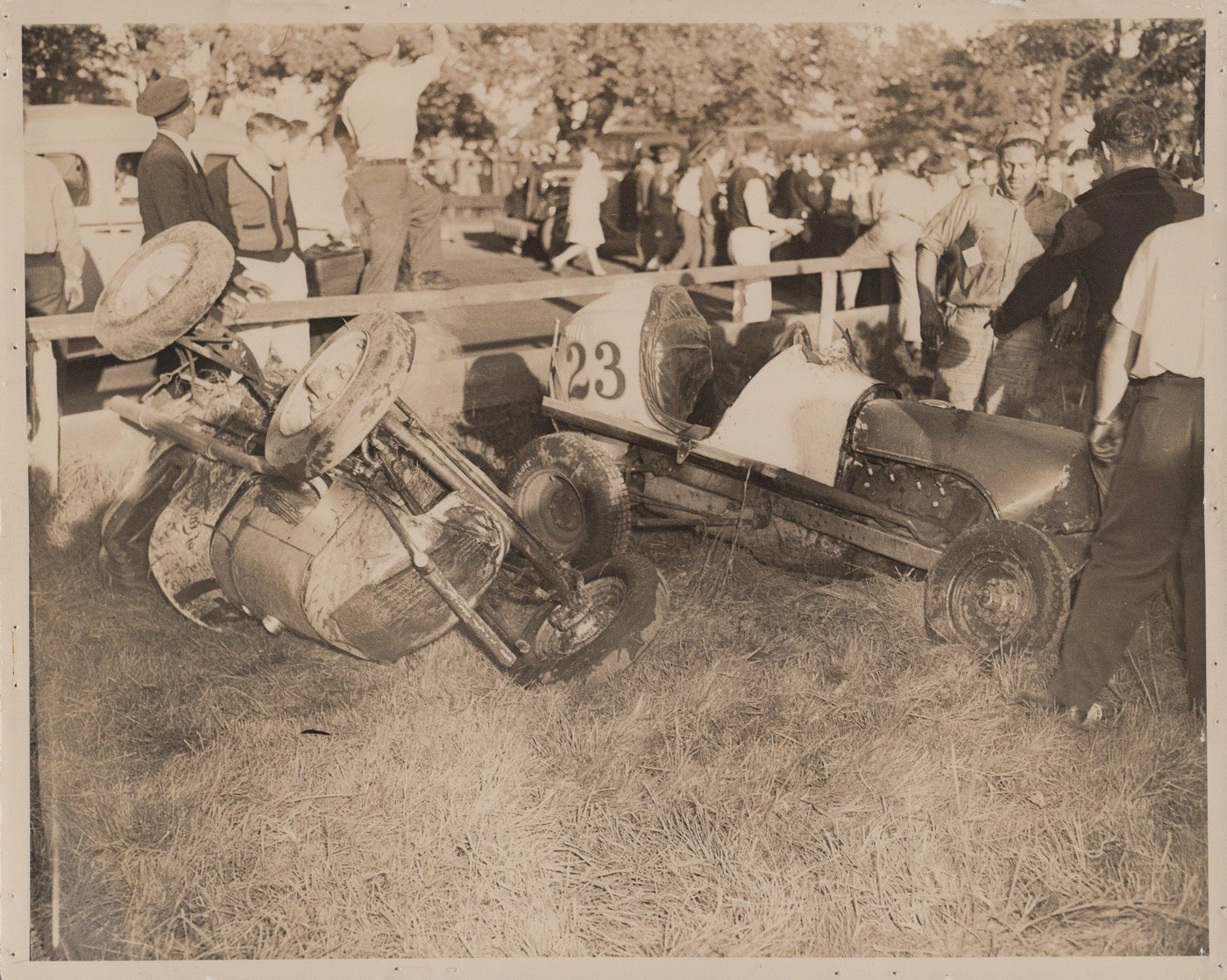
An original 8x10" vintage photo (NOT a modern reprint) from the Marty Himes estate.
This specific photo is from a set that was labelled "Riverhead, Freeport, and Islip".
Provenance: This photograph comes directly from the Marty Himes Racing Museum Collection, assembled over decades by Marty Himes - racer, restorer, and lifelong archivist of American racing. Every piece he preserved tells part of the story of motorsport’s rise from dirt tracks to the spectacle of the Indy 500. We acquired the majority of his photo collection after his passing. Many of his photos are extremely rare or even one of a kind.
Photo Overview
A dramatic midget auto racing crash photograph showing two wrecked midget race cars - including car #23 - that have come to rest against a wooden guardrail on a grassy infield area. One car is flipped nearly upside down while the other sits heavily damaged beside it. Spectators and crew members crowd around the wreckage, examining the aftermath. The scene is from a Long Island, New York area speedway, likely Freeport or Islip Speedway, during the late 1930s or early 1940s. The clothing of the spectators - suits, fedoras, and casual summer attire - places this firmly in the pre-war era of American midget racing.
This 8x10 photograph was taken by R. McDowell, a portrait and commercial photographer based in Oceanside, New York, and comes directly from the Marty Himes Racing Museum Collection. Himes was a racer, restorer, and lifelong archivist of American motorsport who assembled one of the most comprehensive private collections of racing photography in the country. This photo was part of a set specifically labeled "Riverhead, Freeport, and Islip," all tracks on Long Island that were hotbeds of midget racing activity during this golden era.
Historical Notes
Midget auto racing exploded in popularity across the northeastern United States during the late 1930s, with Long Island becoming one of its epicenters. Tracks at Freeport, Islip, and Riverhead drew huge crowds to watch these small but powerful open-wheel cars battle on tight oval courses. The Freeport Speedway and Islip Speedway were among the most popular venues on the circuit, attracting top regional drivers who competed under the sanction of organizations like the American Racing Drivers Club (ARDC). Crashes like the one depicted here were common due to the close-quarters racing and rudimentary safety equipment of the era - wooden guardrails and no roll cages meant that wrecks could be extremely dangerous. Despite the risks, midget racing continued to thrive on Long Island through the 1940s and into the 1950s before suburban development gradually consumed many of these storied tracks. The Freeport track closed in the early 1950s, while Islip Speedway survived longer, eventually transitioning to stock car racing before closing for good in 1984.
Browse our complete Marty Himes Racing Museum photograph collection.
Text Present
On the front of the photo:
Number "23" visible on one of the midget race cars.
On the back of the photo:
PHOTO BY
R. McDOWELL
PORTRAIT & COMMERCIAL
16 THIRD ST. OCEANSIDE, N.Y.
Rockville Centre 3571-M
Print analysis
This is a Type 1 original photograph, printed contemporaneously with when the image was taken in the late 1930s to early 1940s. The photo bears the studio stamp of R. McDowell of Oceanside, New York on the back, indicating it was printed by the photographer himself. The paper stock, tonal quality, and overall aging characteristics - including light foxing on the back and slight yellowing - are consistent with a silver gelatin print from this era. The sepia-warm tone is typical of photographic papers used in the late 1930s. There are no indicators of later reproduction.
Condition
Please see scans of the image we have provided for the most accurate and complete state of the photo. Many of the photos in this collection are very old and have age related wear, chips, creases, curling, etc. Others are remarkably well maintained.