When you click on links to various merchants on this site and make a purchase, this can result in this site earning a commission. Affiliate programs and affiliations include, but are not limited to, the eBay Partner Network.
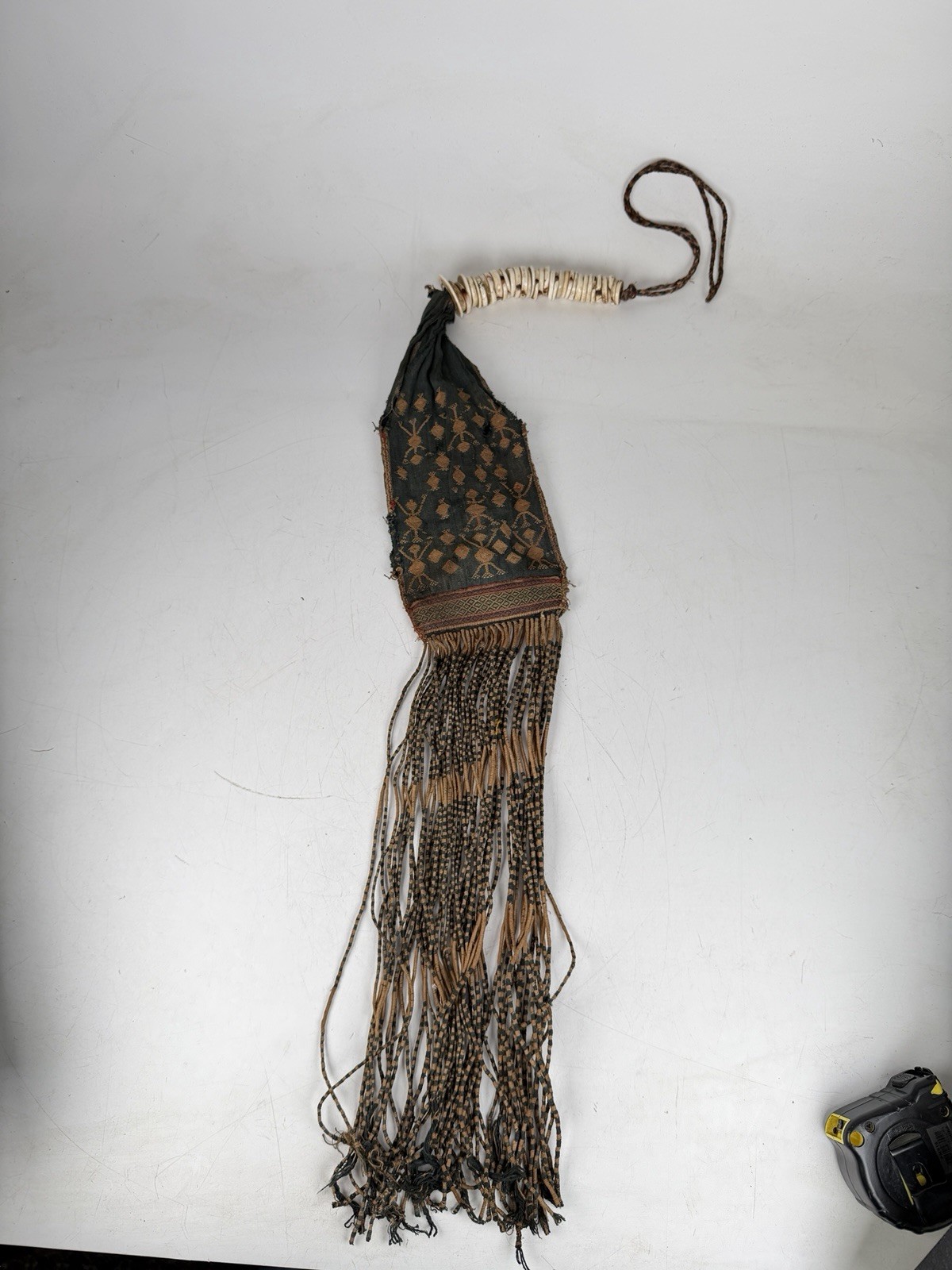
This is a rare, museum-quality 19th-century Ceremonial Betel Nut Bag from the Atoni people of West Timor. This piece is a significant ethnographic artifact, combining intricate textile artistry with a "money strap" featuring traditional Conus shell currency.
Textile & Iconography:
The bag body is masterfully hand-woven using hand-spun cotton and colored with all-natural botanical dyes, including deep organic Indigo (blue-black) and Morinda root (rusty red). The central panel features highly stylized "Tuaf" human figures—traditional ancestor motifs intended to provide protection to the wearer. These are surrounded by complex geometric ikat diamond patterns, a hallmark of 19th-century Timorese weaving.
Conus Shell Currency:
The strap is adorned with a substantial sequence of hand-carved Conus shell discs. In the late 1800s, these discs served as a primary form of tribal wealth and "bride price" currency. The shells on this piece show a beautiful, softened organic patina and varied thickness consistent with manual 19th-century production, rather than modern uniform reproductions.
Construction Details:
• Fringe: Features a long, hand-twisted "money fringe" at the base, characteristic of high-status ceremonial bags.
• The Weave: The reverse and strap show the raw, textured quality of 19th-century hand-loomed textiles.
• Dimensions: The total length is roughly 48", with the main bag body measuring approximately 4" in width.
Condition Report:
For a textile of this age, it is in remarkable condition. There is expected "honest" age-related wear to the cotton fibers and a natural mellowing of the dyes. The shell discs are securely attached. No major modern repairs or synthetic alterations.
Provenance & Collectibility:
Late 19th-century Timorese bags with intact shell money are increasingly difficult to find outside of private museum collections. This is an essential piece for collectors of Indonesian textiles, Southeast Asian tribal art, or primitive currency.