When you click on links to various merchants on this site and make a purchase, this can result in this site earning a commission. Affiliate programs and affiliations include, but are not limited to, the eBay Partner Network.
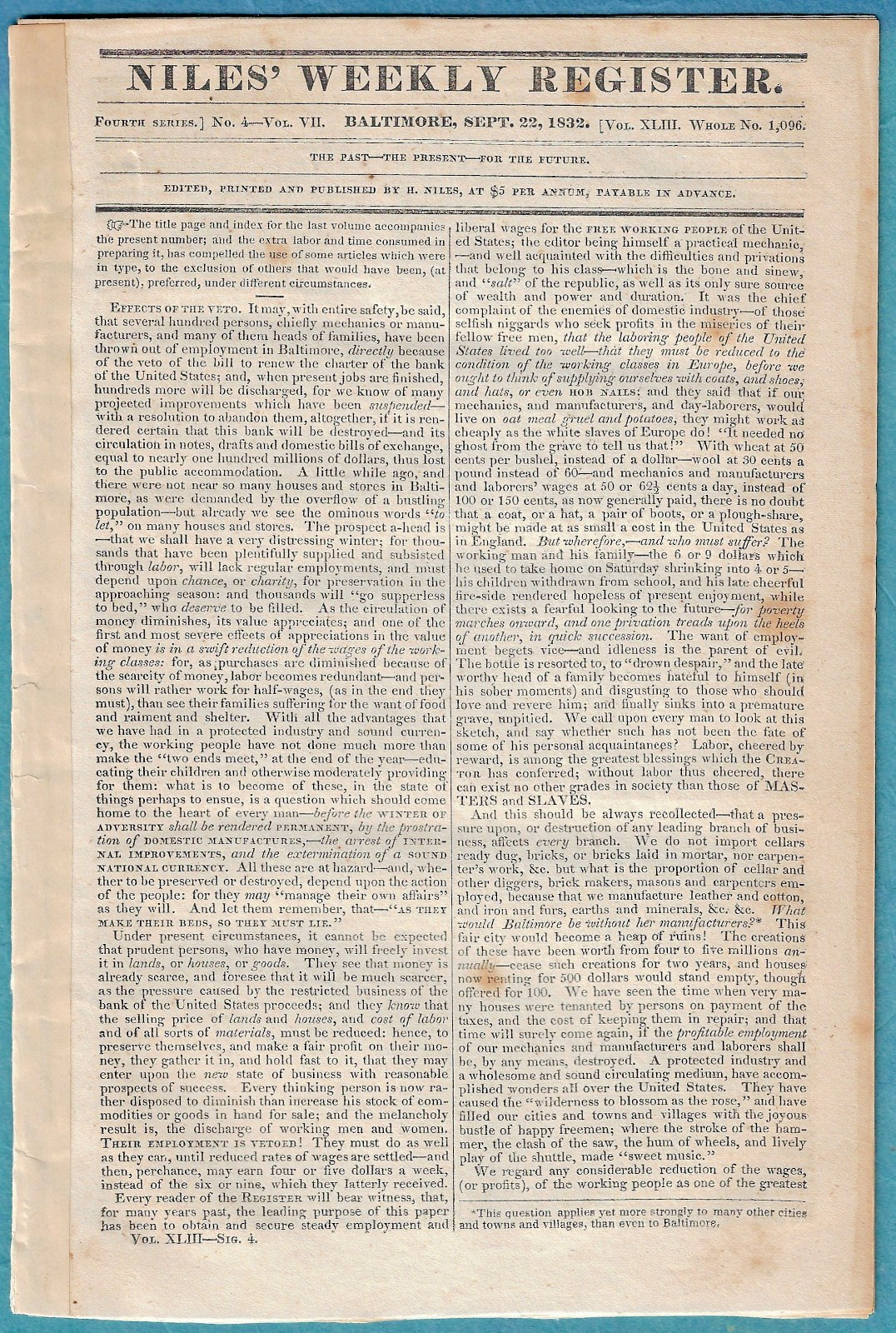
The September 22, 1832 issue of Niles\' Weekly Register focuses on the immediate aftermath of the Black Hawk War, detailing the capture of Black Hawk, the cholera epidemic among U.S. troops, and General Winfield Scott’s reports. The publication also tracks the subsequent treaty negotiations that forced the Sauk and Fox nations to cede land in the Black Hawk Purchase while supporting broader federal Indian removal policies.
Also highlights the peak of the Nullification Crisis, featuring a \"Revolution in South Carolina\" (a planned, armed rebellion by South Carolinians against federal tariffs). Henry Clay is mentioned as the architect of the disputed tariff policy and a key political rival in the upcoming 1832 election, whose compromise attempts were failing to stop the state’s radical turn.
The references to \"Masters and Slaves\" in this provide a stark, real-time snapshot of a country deeply terrified of slave rebellions and aggressively tightening legal control over Black Americans. This issue came out just one year after Nat Turner’s violent slave rebellion in Virginia (August 1831), a watershed event that triggered massive paranoia across the American South. The articles and local updates in this issue use the framing of \"masters and slaves\" to discuss the enforcement of oppressive new laws, often called Black Codes. Following Nat Turner\'s revolt, Southern state legislatures passed a wave of emergency legislation. In the Register, this vocabulary appears when documenting new restrictions banning enslaved people from learning to read or write. Laws prohibiting enslaved people from gathering in public without a white supervisor. The mobilization of local white militias and night patrols to monitor plantations and their owners.
791 Our 27th year on