When you click on links to various merchants on this site and make a purchase, this can result in this site earning a commission. Affiliate programs and affiliations include, but are not limited to, the eBay Partner Network.
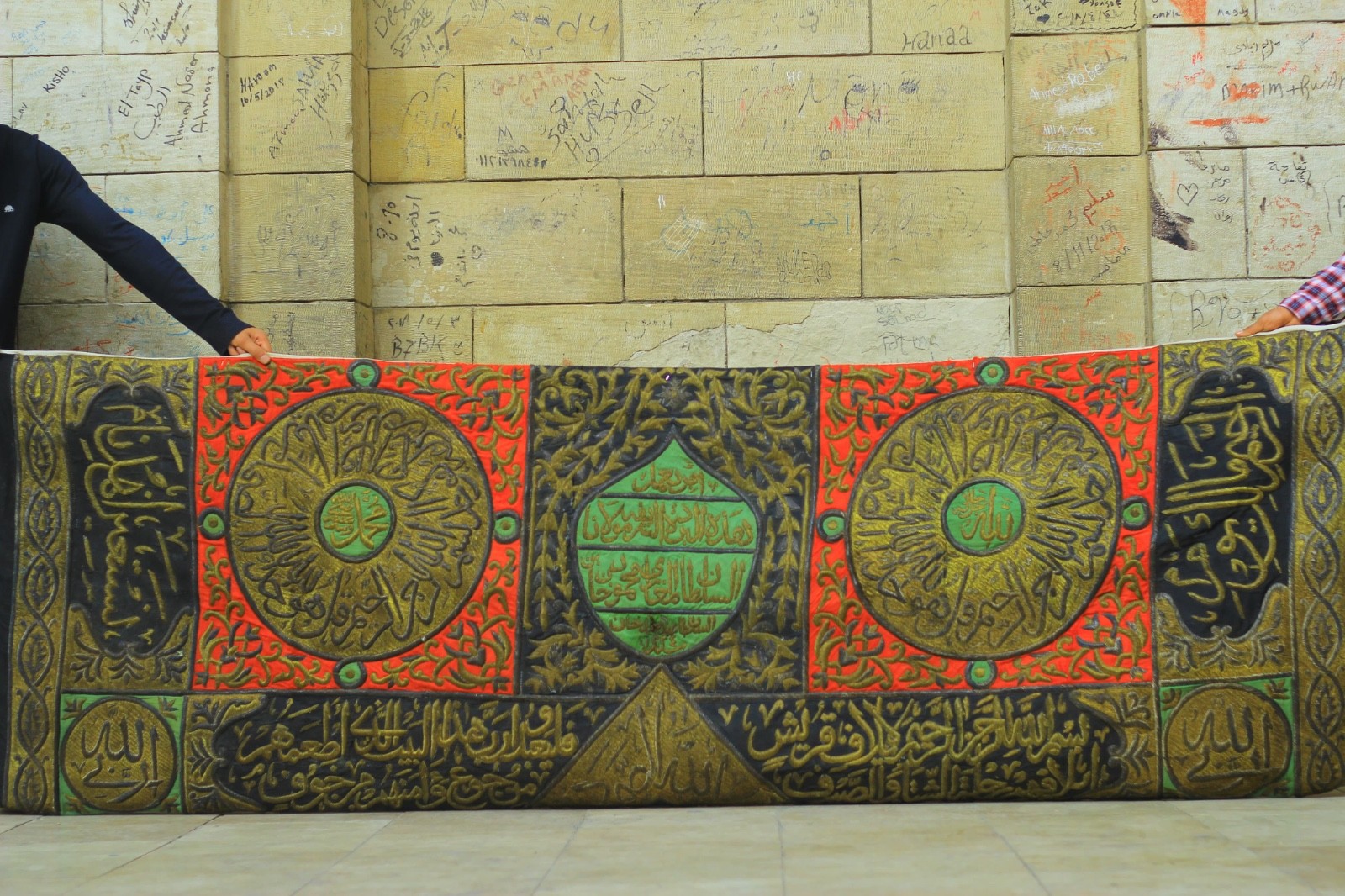
Sitarah for the Door of the Ka‘bah
Date: 1236 AH (1820–21 AD)
Material: Black silk with red and olive-green silk appliqués, relief-embroidered in silver-gilt wire, with a hand-crafted copper background made using the traditional mat-weave technique.
Dimensions: 290 × 98 cm
The sitarah, or curtain of the door of the Ka‘bah—also known as the burdah or burqu‘—was by far the most elaborate part of the kiswah and was traditionally replaced every year.
Since Mamluk times and until the mid-20th century, sitarahs were made in Egypt and transported from Cairo to Makkah with the annual kiswah, accompanied by the caravan of pilgrims amid great pomp and ceremony.
The sitarah formed an important part of the decoration of the Ka‘bah’s door. Historically, when the old coverings or textiles were replaced, portions of them could be cut into smaller pieces and distributed to prominent families, dignitaries, and other distinguished recipients.
Although the basic design of the sitarah evolved over the centuries, Qur’anic verses and Islamic inscriptions always played a central role in its decoration. These inscriptions were arranged in panels, friezes, and cartouches, predominantly executed in Thuluth script.
At the centre of this sitarah is a prominent cartouche bearing the name and titles of the Ottoman Sultan Mahmud II, who commissioned the sitarah, together with the date 1236 AH (1820–21 AD).
Decorative and Inscriptional Program
The sitarah features an extensive program of Qur’anic verses, devotional inscriptions, and ornamental elements, including:
- Two roundels containing Surat al-Ikhlas, written in radiating script around the names of Allah and Muhammad, flanking the central dedication panel.
- Surat Quraysh and Surat al-Ikhlas arranged around the upper portion of the door opening.
- The Shahadah—“There is no god but God, Muhammad is the Prophet of God”—placed on either side of the door opening.
- The inscriptions “There is no god but God, the King, the Truth, who makes all things manifest” and “Muhammad is the Prophet of God, true to what he promised, worthy of all trust.”
- Verses from Surat al-Fatihah arranged within the side borders.
- Small roundels bearing the devotional phrases “God is my Lord” and “God suffices me.”
- The lower border is decorated with stylised palm trees and vases, a characteristic ornamental feature of sitarahs from this period.
Hand-Crafted Copper Background
One of the most distinctive features of this work is the copper background beneath the inscriptions. The copper was meticulously handcrafted using a traditional mat-weave technique, a demanding and labor-intensive process requiring considerable skill, patience, and precision.
The background was deliberately designed in copper to create a striking contrast between the metal surface, the dark silk, and the embroidered inscriptions, enhancing the visual depth and richness of the composition. The interplay of the different materials and colors gives the piece a remarkable decorative effect while highlighting the intricate calligraphy.
This sitarah is therefore not only a richly decorated textile but also an exceptional example of 19th-century Ottoman religious art, combining silk, silver-gilt embroidery, handcrafted copperwork, Qur’anic calligraphy, and elaborate ornamental design associated with the sacred door of the Ka‘bah.