When you click on links to various merchants on this site and make a purchase, this can result in this site earning a commission. Affiliate programs and affiliations include, but are not limited to, the eBay Partner Network.
AN EXTRAORDINARILY EARLY “PYNCHON / BOSTON” OPEN-PONTIL BOTTLE
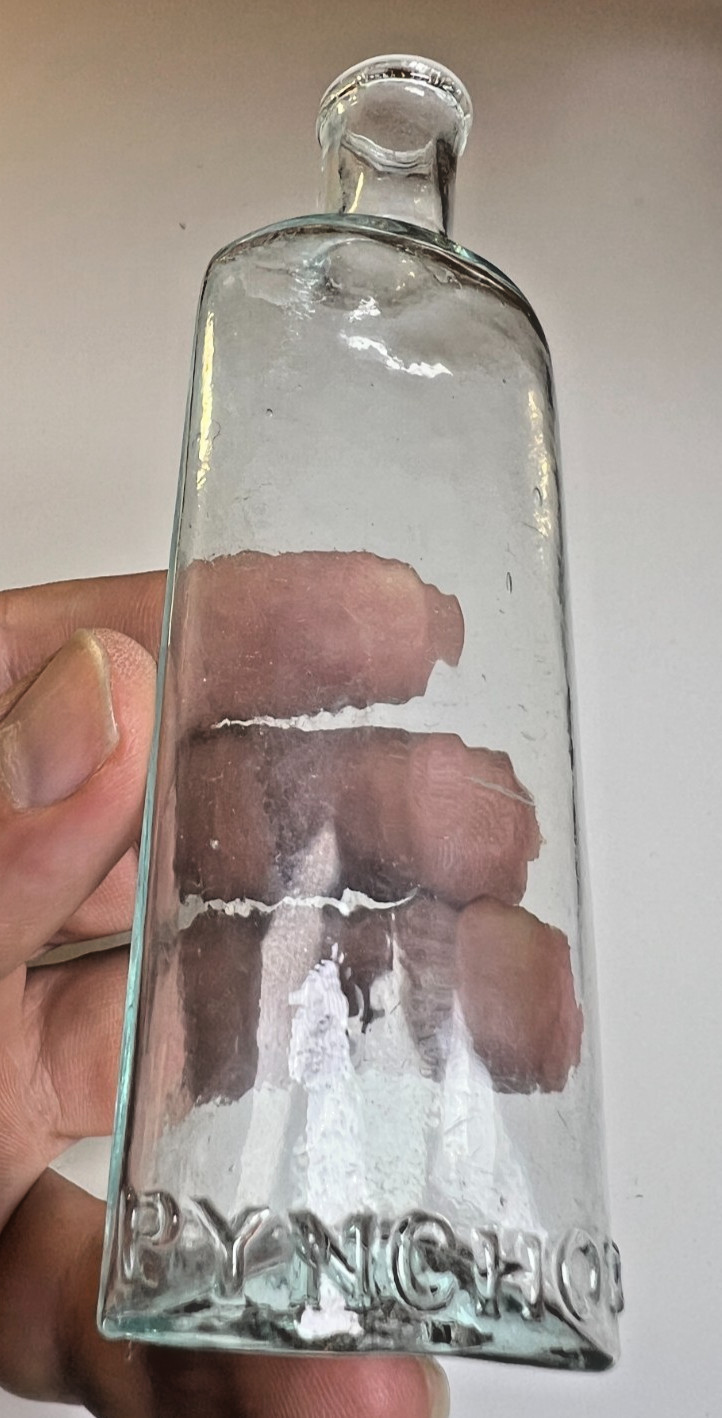
Offered here is a remarkable little piece of early Boston commercial history: an exceptionally crude, paper-thin aqua bottle boldly embossed on its base:
PYNCHONBOSTON
Standing only 4¾ inches tall, this diminutive bottle possesses nearly every characteristic collectors hope to find in genuinely early American glass: a large open pontil-rod impression, hand-rolled lip, extraordinarily thin glass, irregular hand construction, a slightly bowed body, crooked neck, flowing annealing lines and wonderfully primitive embossing.
Extensive research identifies the name with James Lawrence Trask Pynchon (1809–1878), an early Boston merchant who was already described as being “of Boston” when he married there in approximately 1836.
Even more importantly, James was a documented descendant of William Pynchon, the prominent colonial merchant who arrived with the Massachusetts Bay migration of 1630 and founded Springfield, Massachusetts, in 1636.
This is not merely a bottle bearing a coincidentally familiar surname. The documented Boston merchant belonged to the historic Massachusetts Pynchon family—one of New England’s oldest and most consequential mercantile families.
CONDITION
The bottle is in excellent condition for an exceptionally thin, approximately 185-year-old piece of hand-blown glass.
- No chips
- No cracks
- No repairs
- Faint, generally uniform interior haze
- Paper-thin early glass
- Large open pontil-rod depression on the base
- Hand-rolled or folded lip
- Strongly irregular and crude construction
- Slightly bowed body
- Noticeably crooked neck
- Beautiful wavy annealing lines
- Primitive early base embossing
- Stands independently
- Slight wobble caused by the crude pontiled base
- Approximately 4¾ inches tall
The lean, bend and unevenness are original manufacturing characteristics—not damage. This bottle was never intended to possess the machine-made symmetry of later glass. Its irregularities are precisely what make it so visually compelling.
ESTIMATED DATE: CIRCA 1838–1840
The strongest working date for this bottle is:
Circa 1838–1840Most likely approximately 1839
An exact production year cannot be established from a dated label or surviving invoice. Nevertheless, several independent lines of evidence converge tightly around the closing years of the 1830s.
HOW THE DATE WAS DETERMINED1. The open pontil-rod impression
The base retains a conspicuous open depression where a pontil rod was attached while the lip was completed.
Pontils continued to be used into the 1850s, so the pontil alone cannot prove an 1830s date. However, this bottle does not merely have a pontil scar. It combines that feature with extraordinarily thin glass, extreme asymmetry, a primitive lip and very early-style embossing.
The complete manufacturing package is substantially earlier than the average pontiled medicine bottle encountered from the 1850s.
2. The hand-rolled lip
The mouth was not formed by an automatic machine or later standardized finishing tool. It was individually worked while the glass remained hot.
Its irregular folded or rolled appearance is consistent with early hand finishing and predates the increasingly standardized applied and tooled finishes of the middle and later nineteenth century.
3. The remarkably thin glass
The body is almost paper-thin in places. This was a delicate, hand-produced commercial container—not a heavy later utility bottle.
Such thinness helps explain the bottle’s wonderfully irregular profile and makes its survival without a chip or crack particularly noteworthy.
4. The crooked neck and bowed body
The bottle has a slight bend, particularly noticeable through the neck and shoulder. It appears to have relaxed or shifted while still hot, before the glass had completely set.
This kind of asymmetry is a genuine manufacturing characteristic. It would have been unacceptable in later mechanized production, but it is part of the unmistakable personality of very early American glass.
5. Wavy annealing lines and surface character
The body displays beautiful flowing lines created as the gather of molten glass was expanded and manipulated. These are sometimes described by collectors as annealing lines, flow lines, whittle or glass character.
They record the movement of the glass during manufacture. Under changing light, the bottle’s surface seems almost to move—one of the great visual pleasures of early hand-blown glass.
6. Primitive embossing
The compact PYNCHON / BOSTON marking is simple, direct and early in character. It identifies the merchant and city without a lengthy product name or elaborate promotional claim.
This resembles the earliest stage of embossed commercial branding, when the container itself was beginning to serve as a permanent advertisement.
7. James Pynchon’s documented Boston presence
A nineteenth-century marriage notice records:
“In Dorchester, Mr. James L. Pynchon, of Boston, to Miss Margaret Lodge.”
Genealogical indexing places that marriage at approximately 1836. The wording “of Boston” is extremely important: it establishes James in Boston during the decade indicated independently by the glass.
The marriage record therefore prevents the 1845 Boston directory from being misinterpreted as the beginning of his Boston career. He was associated with Boston several years earlier.
WHO WAS JAMES L. PYNCHON?
The man behind the embossing can now be identified as:
James Lawrence Trask PynchonAugust 2, 1809–December 2, 1878
James was born in Brimfield, Massachusetts, the son of Stephen Pynchon and Sarah Trask.
His complete name is recorded in the municipal inventory for Brimfield Cemetery as James Lawrence Trask Pynchon. This establishes that the “L.” used throughout the Boston records stood for Lawrence.
A published genealogy of the family specifically describes him as:
“James L., merchant in Boston, born and died in Brimfield, Mass.”
That concise entry ties together the unusual embossed surname, the city on the bottle and the occupation expected of someone ordering privately marked commercial containers.
James did not manufacture the bottle personally and should not be described as its glassblower. He was the probable merchant, proprietor or brand owner whose name appeared on it. The actual glasshouse and individual blower have not been documented.
HIS MARRIAGES AND FAMILY
James married twice.
His first wife was:
Margaret Lodge of Boston
Their marriage occurred at approximately 1836, with the contemporary notice identifying James as being “of Boston.”
His second wife was:
Charlotte Elizabeth Warren
She was the daughter of George Warren of Framingham, Massachusetts.
The published family genealogy does not list children under James, although it carefully lists children for several neighboring family members. This may mean that James left no surviving children, but it should not yet be treated as definitive proof that both marriages were childless.
James eventually returned to Brimfield and died there on December 2, 1878.
HIS DOCUMENTED BOSTON CAREER
The available records reveal a long commercial career.
Approximately 1836
James was already identified as “of Boston” when he married Margaret Lodge.
Late 1830s
This is the period in which the bottle was probably ordered and blown. The bottle’s physical characteristics point to approximately 1838–1840, with circa 1839 the strongest working date.
1845
A Boston directory lists James L. Pynchon in the dry-goods trade at 353 Washington Street, with a residence at 40 Essex Street.
1855
He appears in the perfumery trade at 25 Eliot Street.
1865
He remains in perfumery at 37 Eliot Street.
1870
He is again recorded as a perfumer at 37 Eliot Street, residing at 1 Barre Place.
This progression is important. It demonstrates that James was not a fleeting or imaginary proprietor reconstructed solely from the bottle. He was a real Boston merchant with a commercial career extending over decades.
WHAT DID THE BOTTLE CONTAIN?
No original label survives, and the base does not state a product. Therefore, the exact contents cannot responsibly be claimed as certain.
Its exceptionally small size and narrow mouth suggest a concentrated or relatively valuable liquid, possibly:
- Perfume or cologne
- Fragrant essence
- Hair oil or toilet preparation
- Medicinal essence or tincture
- Flavoring extract
- Proprietary household preparation
- Another concentrated apothecary or personal-care product
Pynchon’s later documented career in perfumery makes a fragrance, essence, hair preparation or toilet article especially plausible. Nevertheless, his earlier dry-goods associations leave open the possibility that he sold a wider assortment of bottled preparations.
In the 1830s, “dry goods” establishments could offer a surprisingly broad inventory. Retail categories were less rigid than they are today, and merchants frequently dealt in imported luxuries, toiletries, patent preparations, extracts and small specialty goods alongside textiles and ordinary merchandise.
The most accurate description is consequently an early proprietary commercial, perfumery, essence or medicine-type bottle, with its precise original contents unknown.
A GENUINE MEMBER OF THE HISTORIC PYNCHON FAMILY
The surname is not a speculative connection. The published Record of the Pynchon Family places James in the eighth generation of the Massachusetts family descended from:
William Pynchon1590–1662
James’s recorded line runs through the old Springfield branch:
GenerationPynchon Family MemberFirstWilliam Pynchon, colonial merchant and founder of SpringfieldSecondJohn PynchonThirdCol. John PynchonFourthCol. John PynchonFifthWilliam PynchonSixthMajor William PynchonSeventhStephen PynchonEighthJames Lawrence Trask Pynchon
This makes James a direct descendant of the celebrated colonial founder—not simply a person sharing the spelling.
The modern novelist Thomas Ruggles Pynchon Jr., author of V., The Crying of Lot 49 and Gravity’s Rainbow, also descends from the historic William Pynchon family. James and Thomas therefore belong to the same extended New England family and are distant cousins.
WILLIAM PYNCHON: MERCHANT, FOUNDER AND RELIGIOUS CONTROVERSIALIST
William Pynchon came to Massachusetts with the Winthrop Fleet in 1630. He was already an experienced English landowner and merchant and became one of the original patentees and leading figures of the Massachusetts Bay Colony.
After initially settling at Roxbury, he looked westward toward the Connecticut River Valley, where trade routes and fertile lands offered extraordinary commercial possibilities.
In 1636, he led the establishment of the settlement that became Springfield, Massachusetts. The community began partly as a commercial venture positioned to participate in the Connecticut River trade.
William dealt extensively in furs and provisions and became one of the most important merchants in early western New England. This mercantile tradition continued through succeeding generations of the family.
His life also produced one of the most remarkable episodes in early American publishing. William wrote a theological work titled The Meritorious Price of Our Redemption. Massachusetts authorities considered its arguments heretical. Copies were publicly condemned and burned in Boston in 1650—making it the first book known to have been formally banned and burned in English North America.
Thus, nearly two centuries before James placed the Pynchon name on a small Boston bottle, his ancestor’s name had already become intertwined with New England commerce, religion, controversy and the printed word.
A FAMILY NAME ASSOCIATED WITH COMMERCE
The connection is particularly appropriate because both William and James participated in the world of commerce.
William Pynchon’s Springfield settlement stood at the intersection of trade, geography and colonial expansion. James entered the rapidly modernizing commercial world of nineteenth-century Boston.
The bottle becomes a fascinating physical bridge between those eras:
- William’s seventeenth-century world of colonial trading networks
- James’s nineteenth-century world of urban retailing and branded merchandise
- The later cultural prominence of the Pynchon name
Few early commercial bottles permit such a specific connection between an embossed merchant, a documented Boston career and one of Massachusetts’s foundational families.
BOSTON AROUND 1839
When this bottle was probably made, Boston was moving rapidly from an eighteenth-century seaport into a modern industrial and commercial city.
Its population was approaching 100,000. Washington Street was one of the city’s principal retail arteries, crowded with shops, hotels, stage traffic, pedestrians and horse-drawn vehicles.
Boston Harbor connected local merchants with Europe, the Caribbean and ports throughout the United States. Imported oils, spices, botanical ingredients, glassware, textiles and luxury goods passed through the city’s warehouses.
The city still retained an intimate physical scale. Much of modern Boston’s Back Bay remained tidal marsh. Streets were lit principally by oil and the developing gas-light system. Water generally came from wells, pumps and cisterns; Boston’s major Cochituate municipal water system would not be completed until 1848.
Railroads were transforming travel. Lines connecting Boston with surrounding towns began appearing during the 1830s, allowing merchandise, correspondence and customers to move with unprecedented speed.
A small bottle bearing a merchant’s name was part of this changing commercial landscape. Its embossing was permanent advertising—an early glass equivalent of a business card, shop sign and trademark combined.
MEDICINE AND PERSONAL CARE IN THE 1830s
American medicine in the late 1830s existed before germ theory, antibiotics, modern anesthesia or federal regulation of medicines.
Physicians and ordinary households relied upon botanical tinctures, alcohol-based preparations, aromatic waters, oils, purgatives and compounded remedies. Pharmacists and merchants often mixed or packaged products locally.
Fragrances and toilet preparations occupied an overlapping world. Cologne, lavender water, hair oils, shaving preparations and aromatic essences could be sold by apothecaries, perfumers, dry-goods dealers and specialty merchants.
A bottle of this size would have been suitable for a preparation dispensed sparingly. Its contents may have been poured a few drops at a time, making the small container economically sensible.
Whatever it held, it predates the rigid separation of medicine, cosmetics, toiletries and household preparations that developed later in the nineteenth and twentieth centuries.
TECHNOLOGY AT THE TIME
This bottle was made during an extraordinary transitional period.
Samuel Morse was developing the practical electromagnetic telegraph, publicly demonstrated in the late 1830s. Commercial photography was only beginning to emerge following the announcement of the daguerreotype in 1839. Railroads were expanding, but horses, sailing vessels and human labor still powered most daily transportation and trade.
Glassmaking remained intensely physical. A gather of molten glass was taken on a blowpipe, expanded, placed in a mold and manipulated by hand. A second worker attached a pontil rod to the base so the blower could finish the mouth.
The scar on this bottle’s bottom is therefore more than a diagnostic feature. It is the surviving footprint of the workman who held the hot vessel nearly two centuries ago.
Its crooked neck, thin walls and flowing surface are not defects to be apologized for. They are the frozen evidence of its manufacture.
POLITICS AND REFORM
Martin Van Buren occupied the presidency during most of the bottle’s likely production period. The country was struggling through the aftermath of the Panic of 1837, one of the young nation’s most serious financial crises.
Boston was also a center of reform activity. Abolitionism was becoming increasingly visible and contentious. William Lloyd Garrison published The Liberator in the city, while antislavery meetings provoked passionate support and violent opposition.
Public debate included slavery, temperance, women’s education, imprisonment, poverty, immigration and the proper role of government in economic life.
This was the Boston in which James Pynchon built his mercantile career: ambitious, intellectually energetic, morally divided and rapidly changing.
COMPARISON WITH OTHER EARLY BOSTON BOTTLES
The bottle belongs to an exceptionally early stage of Boston’s embossed-container history.
Its construction bears a close visual relationship to other small Boston bottles having rolled or flared lips, deep open pontils, very thin glass and markedly irregular bodies—including the early J. P. Preston / Boston type.
No claim is made that the two bottles were produced by a provably identified individual glassblower. Without molds, glasshouse records or contemporary invoices, that would go beyond the evidence.
However, their shared construction suggests the same early Boston-area glassmaking and moldmaking tradition—and possibly a closely related manufacturing circle.
Both appear to come from a period before commercial bottles became heavier, straighter and more standardized.
WHY THIS BOTTLE IS IMPORTANT
This bottle combines several forms of collector interest that rarely converge in one object:
- Exceptionally early Boston embossing
- Strong late-1830s manufacturing characteristics
- Large open pontil-rod impression
- Hand-rolled or folded lip
- Extremely thin aqua glass
- Dramatically crude construction
- Documented Boston merchant attribution
- Mid-1830s Boston marriage evidence
- Long subsequent career in dry goods and perfumery
- Direct descent from William Pynchon
- Association with one of Massachusetts’s foundational families
- Distant family relationship to novelist Thomas Pynchon
- Excellent structural condition
- Compact and highly displayable size
Most importantly, it is an object through which a specific person can be recovered.
James Lawrence Trask Pynchon was only a name impressed into molten glass when the research began. He can now be placed within a family, a marriage, a city, a profession and nearly three centuries of Massachusetts history.
AN EARLY SURVIVOR
At approximately 4¾ inches tall, the bottle would have been easily discarded, broken or lost. Its paper-thin walls made it especially vulnerable.
Instead, it has survived nearly two centuries without a chip or crack, still carrying the name of its merchant and city.
The slight lean, wavy surface, rolled mouth and crude pontil preserve the gestures of its makers. The base embossing preserves the identity of its proprietor. The documentary record supplies the rest of the story.
This is more than an attractive pontiled bottle. It is an exceptionally early piece of embossed Boston commerce connected directly to one of the most historically significant families in Massachusetts.
RESEARCH QUALIFICATIONS
The attribution to James Lawrence Trask Pynchon is supported by the unusual surname, Boston embossing, approximately 1836 marriage notice identifying James as “of Boston,” the family genealogy calling him a Boston merchant and subsequent Boston directories documenting his commercial career.
The proposed circa 1838–1840 date is based upon the combined documentary chronology and physical manufacturing evidence. Circa 1839 is the strongest working date, but no surviving label, invoice or mold record establishes one exact year.
The precise contents and glasshouse remain unknown. Possible perfume, essence, toilet or medicinal uses are informed interpretations and are presented as such.
That distinction strengthens the attribution: the documented facts are allowed to stand on their own, while the remaining possibilities are clearly identified as possibilities.
SHIPPING
The bottle will be packed with exceptional care, with its delicate lip and thin body fully protected. It will be securely boxed and shipped insured.
A rare opportunity to acquire an exceptionally early, historically attributable and wonderfully crude Boston bottle dating from approximately 1838–1840—with a direct connection to the celebrated Pynchon family of Massachusetts