When you click on links to various merchants on this site and make a purchase, this can result in this site earning a commission. Affiliate programs and affiliations include, but are not limited to, the eBay Partner Network.
Precise Date
Circa 1858–1862, most likely about 1860.
That narrow date is supported by:
- Documented advertising for Mowe & Son in Lowell’s 1858 directory
- Dr. Daniel Mowe’s death on November 3, 1860
- The bottle’s transitional construction: crude mold-blown glass, hand-applied double-collar top and smooth hinge-mold base without a pontil scar
- A recognized bottle reference documents an otherwise similar 4¼-inch open-pontil example, suggesting that your smooth-base bottle represents a slightly later, transitional production variant.
A SCARCE LOWELL PATENT MEDICINE FROM THE DAWN OF THE CIVIL WAR
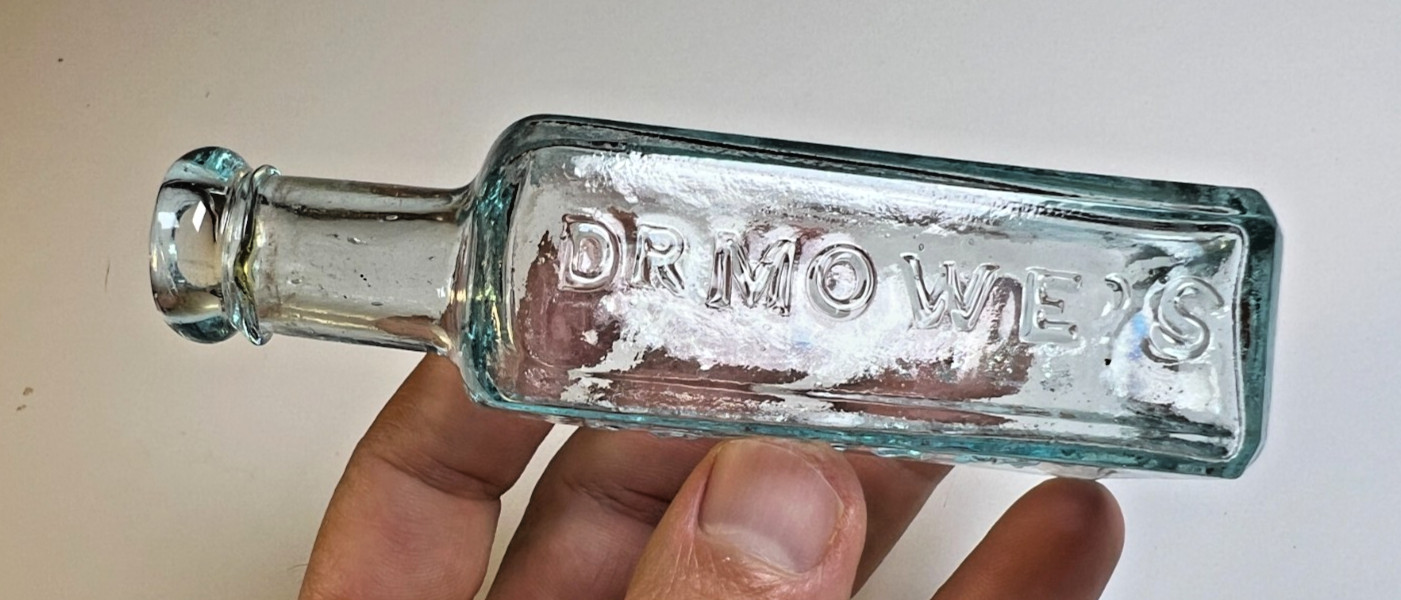
Offered here is a remarkably crude and beautifully colored Dr. Mowe’s Cough Balsam bottle from Lowell, Massachusetts.
Standing approximately 4 inches tall, this little bottle has all the character collectors seek in early American glass: rich medium sky-blue aqua color, crooked and unevenly expanded sides, varying glass thickness, wavy or whittled surfaces, scattered suspended bubbles and wonderfully irregular embossed lettering.
Although small enough to sit in the palm of your hand, its tall rectangular shape gives it the appearance of a miniature bitters bottle. The bottle is embossed on three panels:
DR. MOWE’S
COUGH BALSAM
LOWELL, MASS.
The product was correctly called Cough Balsam, not cough syrup. “Balsam” was a familiar 19th-century marketing term for soothing proprietary preparations sold for respiratory and other complaints.
EARLY GLASS CONSTRUCTION
The bottle was mold-blown in an early hinge mold and completed with a crude hand-applied double-collar top. The applied finish retains a small amount of drippy excess glass beneath the lower collar—an appealing indication of the glassworker’s hand.
The underside has an extremely crude smooth base with visible hinge-mold seam lines. It does not have a pontil scar. That distinction is important: it should be described as a scarce smooth-base variant from the transitional period when American bottle production was moving away from routine pontil use.
The wavy panels, crooked alignment, uneven thickness, bubbles and irregular lettering are all original manufacturing characteristics—not later damage.
A reference devoted to early American medicine bottles records the standard Dr. Mowe’s example as approximately 4¼ inches tall, rectangular, aqua, double-collared and open-pontiled, assigning it a three-star scarcity rating. Your smooth hinge-base example appears to be a later or transitional variant of the same medicine bottle.
WHO WAS DR. DANIEL MOWE?
Dr. Daniel Mowe was born in Pembroke, New Hampshire, on February 3, 1790. He studied medicine under Dr. Joseph Wilson of Salisbury and continued his medical education at Dartmouth College, receiving his medical degree in 1819.
In 1831 he moved to the rapidly growing industrial city of Lowell, Massachusetts, where he opened a medical practice. Contemporary historical accounts describe him as a successful and respected physician who developed a particularly strong following among Lowell’s Methodist community.
Dr. Mowe was deeply interested in materia medica—the study and preparation of substances used medicinally. From that interest came his best-known proprietary remedy, Mowe’s Cough Balsam. Unlike many anonymously branded patent medicines, this preparation was closely associated with an actual practicing physician. Dr. Mowe continued practicing in Lowell until his death from pneumonia on November 3, 1860.
The irony is poignant: the doctor who became known for a medicine advertised for serious respiratory complaints ultimately died from pneumonia.
WHAT DID THE BOTTLE CONTAIN?
The bottle originally held a liquid proprietary medicine called Dr. Mowe’s Cough Balsam. A surviving circa-1850 instruction sheet is known, demonstrating that the preparation was actively marketed by the middle of the century.
The complete formula has not been reliably established, so this listing does not speculate about particular ingredients. Mid-19th-century balsams commonly relied on sweetened herbal extracts and sometimes alcohol or other medicinal compounds, but without an original label or formula it would be improper to assign those ingredients specifically to Mowe’s preparation.
What is documented is its astonishingly broad marketing. An 1858 Lowell directory promoted Mowe’s Cough Balsam for:
- Consumption
- Coughs and colds
- Influenza
- Bronchitis
- Whooping cough
- Summer complaints of children
- Diarrhea and dysentery
- General nervous uneasiness preventing sleep
The advertisement warned customers that no bottle was genuine unless prepared by the doctor himself at his residence on Middle Street in Lowell. It was offered wholesale and retail through Mowe & Son.
That sweeping list of claimed uses was typical of the patent-medicine era, when advertising promises greatly exceeded what manufacturers would legally be permitted to claim today. These bottles were sold before federal laws required standardized ingredient disclosure or proof that a medicine actually performed as advertised.
MOWE & SON AND THE PRODUCT’S MARKETING
By 1858 the business was being advertised as Mowe & Son, suggesting that the doctor’s family helped manufacture, distribute or sell the remedy. Marketing emphasized personal authenticity: purchasers were told that genuine medicine came directly from Dr. Mowe’s Middle Street residence.
That was an effective sales strategy. In a market crowded with imitations and traveling nostrum vendors, presenting the balsam as the personal personal preparation of an established local physician gave buyers a feeling of confidence and accountability.
Mowe’s remedy already had enough recognition to be mentioned in the Boston Medical and Surgical Journal—the predecessor of today’s New England Journal of Medicine—in Jurch21"}}
The family also marketed Dr. Mowe’s Vegetable Bitters in a considerably larger bottle measuring more than 10 inches tall. The small Cough Balsam bottle resembles a miniature companion to that imposing bitters container, linking the two remedies visually as products from the same Lowell medicine business.
LIFE IN LOWELL WHEN THIS BOTTLE WAS MADE
Around 1860, Lowell was one of America’s most important industrial cities. Long brick textile mills crowded the banks of the Merrimack River and an elaborate system of canals carried water to enormous turbines and machinery.
By 1850, Lowell’s textile companies were producing approximately 115 million yards of cotton and wool cloth annually. Thousands of looms ran inside multi-story mills, producing constant noise, airborne lint and long, physically exhausting wrch13"}}
Earlier generations of workers had included the famous young Yankee “mill girls,” many between 15 and 30 years old. By the 1840s and 1850s, growing numbers of Irish immigrants fleeing famine and poverty were taking jobs in Lowell’s mills and settling in neighborhoods such as trch1"]}}
Respiratory complaints would have been painfully familiar in such a city. Workers spent long days among textile fibers, dust, machinery oil, coal smoke, damp canals and crowded boardinghouses. Tuberculosis—then usually called consumption—was feared and poorly understood. A medicine advertised for consumption, bronchitis, influenza and persistent coughing would have found a ready market among Lowell’s working families.
This little bottle therefore belongs directly to the world in which it was sold: a booming industrial city filled with mill whistles, water-powered machinery, crowded tenements, physicians making house calls and proprietary medicines promising relief from illnesses that conventional medicine could not yet reliably cure.
LOWELL AT THE BEGINNING OF THE CIVIL WAR
The years surrounding 1860 brought enormous upheaval.
Lowell’s prosperity depended heavily upon cotton cultivated by enslaved labor in the American South. That economic dependence existed alongside a strong local antislavery movement, creating a deep contradiction within trch8"]}}
When the Civil War began in 1861, Lowell men Luther Ladd and Addison Whitney were killed during the Baltimore riot while traveling with the Sixth Massachusetts Regiment. They became widely recognized among the first Union soldiers killed in hostile action during the war.
The conflict also severed Lowell’s supply of Southern cotton. Mill owners initially sold their stored raw cotton at substantial profits, but warehouses eventually emptied and mills closed or sharply reduced production. Many workers—particularly residents of Lowell’s Irish Acre—lost their jobs and fell into rch1"]}}
After the war, production resumed and French Canadian immigration increased dramatically. Lowell entered a new period of industrial and demographic growth, but the prewar city of Dr. Mowe and the early Yankee mill system had already begun to disappear.
This bottle survives from precisely that turning point.
CONDITION
Attic-mint condition—bright, clean and shiny. No chips, no cracks, no scratches and no haze.
There is a small white non-radiating potstone within the glass. It is a stable, original manufacturing inclusion and shows no surrounding stress lines or radiations. It is not a chip or subsequent form of damage.
The bottle also displays expected early glassmaking characteristics including waviness, uneven thickness, crooked panels, scattered bubbles, crude embossing and excess glass around the applied top. These irregularities are original to manufacture and are a major part of the bottle’s appeal.
DETAILS
- Maker and proprietor: Dr. Daniel Mowe / Mowe & Son
- Product: Dr. Mowe’s Cough Balsam
- Location: Lowell, Middlesex County, Massachusetts
- Date: Circa 1858–1862; most likely about 1860
- Color: Medium sky-blue aqua
- Form: Small rectangular proprietary-medicine bottle
- Manufacture: Mold-blown in a hinge mold
- Finish: Crude hand-applied double-collar top
- Base: Early smooth hinge-mold base; no pontil scar
- Height: Approximately 4 inches
- Contents: Empty; sold solely as an antique collectible
- Condition: Attic mint, with one stable non-radiating white potstone