When you click on links to various merchants on this site and make a purchase, this can result in this site earning a commission. Affiliate programs and affiliations include, but are not limited to, the eBay Partner Network.
Rarely Encountered Hand-Carved African Female Basket Carrier Figure – Research-Based Punu/Lumbo Attribution, Gabon
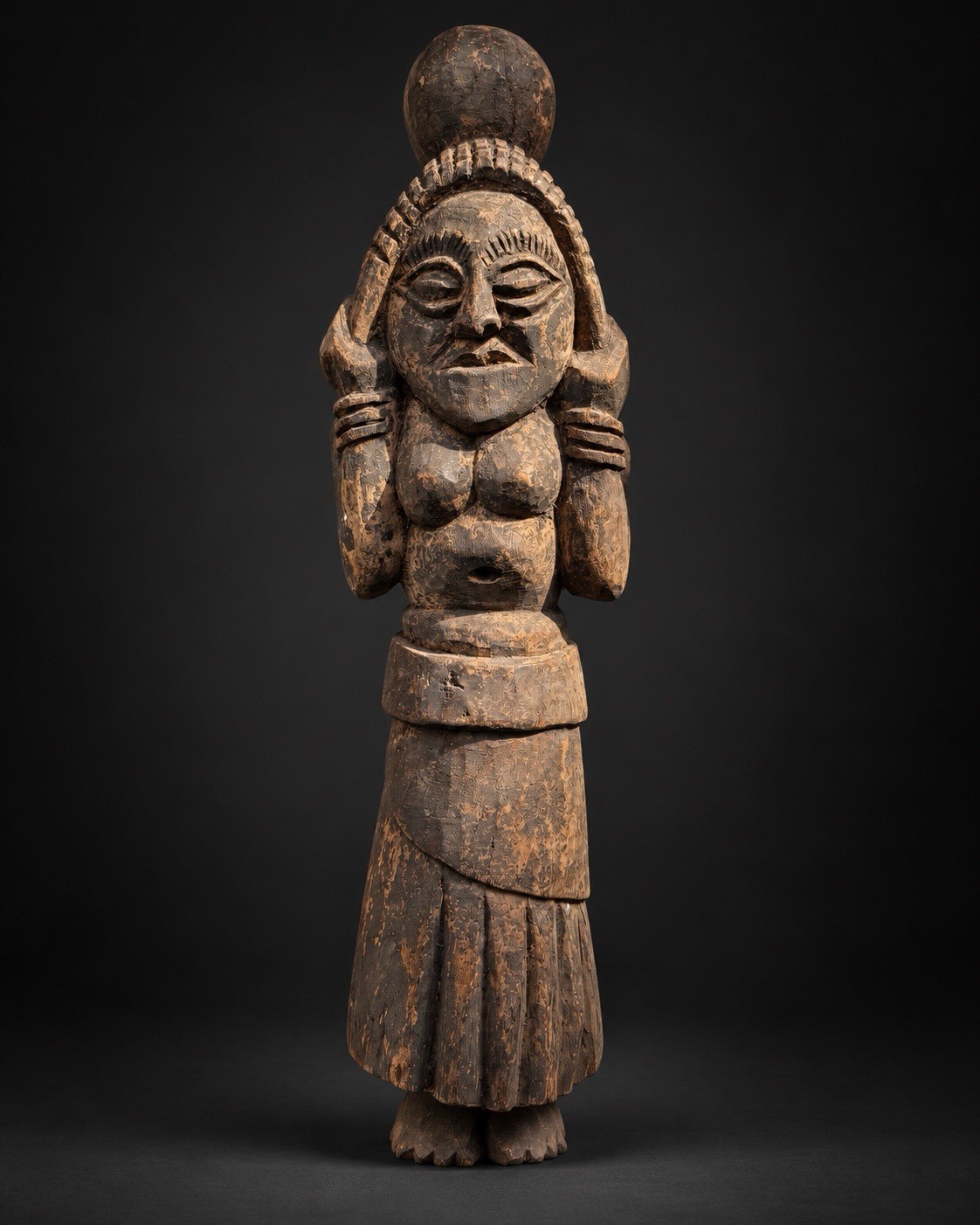
This is a striking and unusually detailed hand-carved wooden female figure depicting a woman carrying a large woven-style basket on her back. The basket is supported by a carved carrying band that passes over the top/front of the head, while both hands are raised beside the head in connection with the carrying system.
This particular combination of female figure, back basket, forehead/head-supported carrying strap, raised hands, bracelets, and a side-mounted bladed implement is an uncommon and highly distinctive figural type. During comparative research, only a limited number of documented African sculptural examples using this specific basket-carrying arrangement were located.
The figure has a powerful, intentionally non-naturalistic appearance, with deeply carved almond-shaped eyes and brows, prominent nose and mouth, a large rounded coiffure/bun, exposed breasts and abdomen, carved navel, multiple wrist bracelets, a simplified lower garment, and minimally separated feet. The surface retains extensive visible hand-tool marks and a strongly rustic, sculptural character.
The large basket on the back is particularly noteworthy. It is deeply carved with geometric chevron and woven-pattern decoration and is represented as being supported by a broad strap passing over the head/forehead.
A carved bladed implement is also visible at the side of the figure. Its form and placement suggest a knife, machete, or agricultural cutting tool, although its exact traditional function cannot be confirmed.
Research-Based Cultural Attribution
Based on extensive comparative research, this figure appears most consistent with the Punu/Lumbo (Bapunu/Balumbo) cultural sphere of southern or southwestern Gabon, or with a closely related carving tradition from the surrounding Central African forest region.
This attribution is based on documented iconography, traditional carrying practices, and comparison with published sculpture. It is not based on a maker’s signature, original collection label, scientific testing, or documented provenance.
One particularly important comparison appears in Louis Perrois’ reference work “Ancestral Art of Gabon,” associated with the Barbier-Mueller Museum. Object No. 25 in that publication is identified as a Bapunu/Balumbo wooden female pendant from the Josef Mueller Collection, acquired before 1939.
That documented sculpture depicts a woman carrying a wicker basket on her back using a head-supported band. The published description specifically notes that the carrying band passes across the top of the head and is visually incorporated into the woman’s coiffure.
Although that museum-published example is much smaller and more finely finished than the present sculpture, the highly unusual combination of a female figure, woven basket on the back, head-supported carrying band, and raised arms provides a significant iconographic comparison.
Additional published Punu/Lumbo female sculptures also demonstrate considerable variation in size, naturalism, carving refinement, and surface finish. Documented examples exist in approximately the same general 40 cm scale as the present figure, showing that larger independent female sculptures were also produced within this broader artistic tradition.
Published ethnographic research on Punu culture further documents women carrying woven baskets on their backs with straps supported by the head or forehead during agricultural and gathering activities. Cutting implements such as machetes were also associated with this work, making the carved bladed object represented on the side of this figure particularly interesting.
Taken together, the basket-carrying system, coiffure, female form, bracelets, carved basket pattern, and bladed implement provide meaningful evidence for a possible connection to the Punu/Lumbo cultural sphere and the forest regions of southern Gabon.
Age / Dating
The sculpture is being offered conservatively as Vintage / 20th Century.
Its exact age is unknown and has not been scientifically tested. The dark, dry surface, extensive wear, abrasions, visible hand-tool marks, natural wood cracking, areas of lighter exposed wood, and accumulated surface character are consistent with an older hand-carved object.
The piece may possibly date to the early-to-mid 20th century, but this is an estimate based on appearance and comparative research only.
This listing does not claim that the sculpture is a confirmed antique or that it predates 1926.
Important Attribution Note
Gabon / Punu-Lumbo is a research-based attribution and is not presented as a definitive identification.
The exact country of manufacture, ethnic subgroup, individual carver, workshop, original date, and original ceremonial or utilitarian context remain unconfirmed.
The attribution is based on comparison with published museum and scholarly material concerning Punu/Lumbo sculpture and documented basket-carrying traditions from Gabon and the surrounding Central African region.
Condition
Vintage condition with substantial age-related surface wear and patination.
The sculpture shows scratches, abrasions, areas of lighter exposed wood, old drying/shrinkage cracks, small losses and irregularities, darkened patina, and visible hand-carving/tool marks throughout. These characteristics contribute strongly to the aged, handmade character of the piece.
The carving of the basket, carrying strap, bracelets, facial features, coiffure, and side-mounted implement remains clearly visible.
Please examine all photographs carefully, as the photographs are an important part of the condition description.
Measurements
Height: approximately 14.5–15 in (about 37–38 cm)
Maximum width/projection: approximately 4.5 in (about 11.5 cm)
Weight: approximately 2 lb 0.1 oz (about 910 g)
This is a rarely encountered and visually compelling African figural form, distinguished by its head-supported back basket, elaborate carved basket pattern, raised hands, female imagery, and side-mounted bladed implement. Its documented parallels in Punu/Lumbo imagery and Central African ethnographic material make it an especially interesting piece for collectors of African art, ethnographic sculpture, traditional wood carving, and Central African cultural objects.