When you click on links to various merchants on this site and make a purchase, this can result in this site earning a commission. Affiliate programs and affiliations include, but are not limited to, the eBay Partner Network.
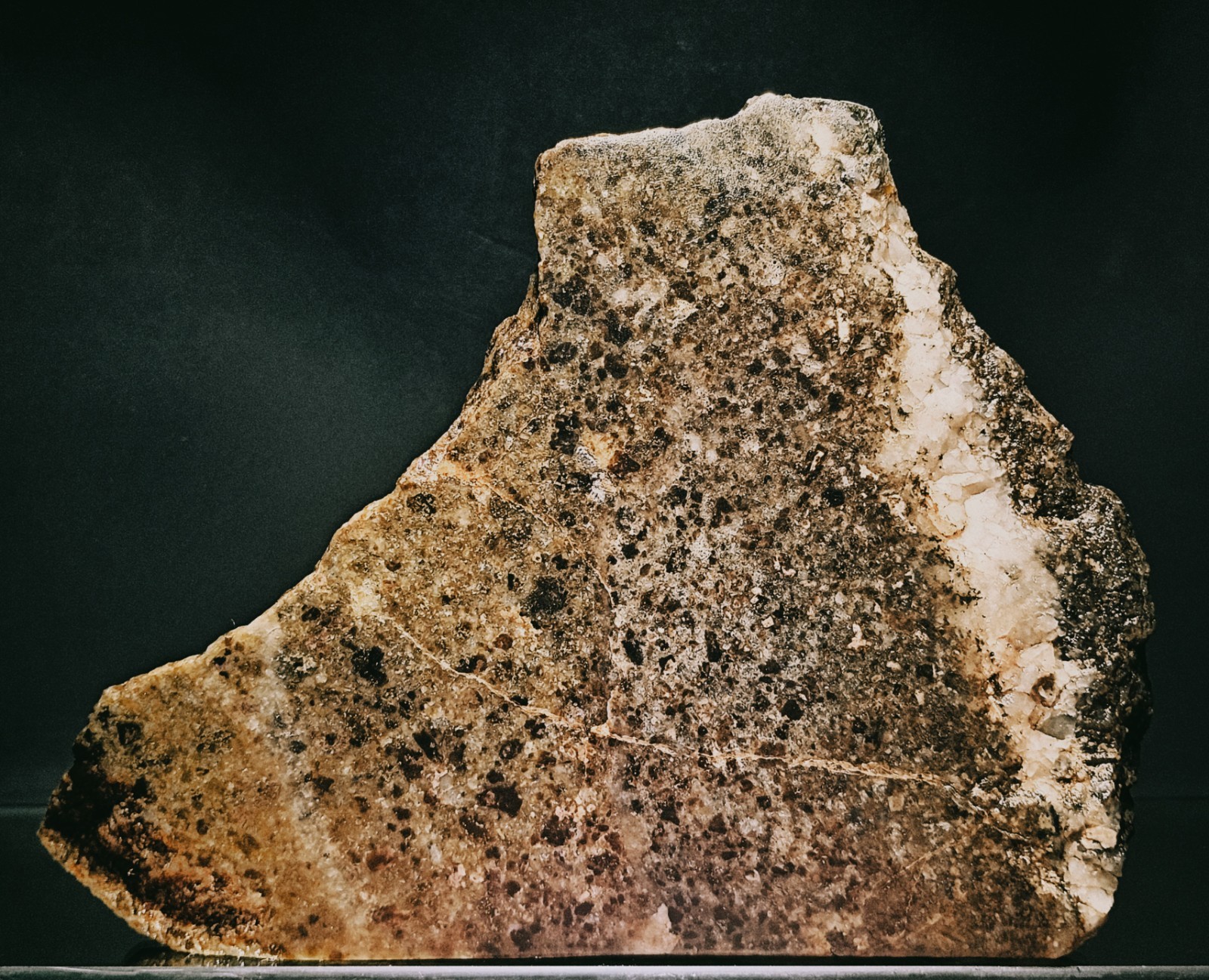
Koch Shaft — Silver Mine District, Madison County, Missouri
Ex-Charley Cox Collection
Dimensions: 8.75" x 6.25" x 2.185" (222 x 159 x 55 mm)
Weight: 3 lbs 14.7 oz (1777 g)
Large Cabinet / Display Piece
Some 1.47 billion years ago, the granites of what would become the St. Francois Mountains were still cooling. As the last of that magma froze, the leftover fluids — hot, acidic, loaded with fluorine and tungsten and rare metals that wouldn't fit into ordinary crystal structures — were squeezed upward into fractures in the roof rock. Where those fluids hit granite, they attacked it. Feldspar dissolved. Quartz and mica grew in its place. What was left is greisen: granite unmade and remade by its own chemistry.
This slab is a piece of that reaction front. The olive-brown sheen across the face is mica — the lithium-bearing zinnwaldite that gives Silvermine greisen its character. Cutting through it is a white quartz vein, and along the lower edge, fluorite in soft pinks and lavenders. Small druzy pockets are scattered through the matrix where the fluid had room to grow crystals freely.
Then turn out the lights.
Under 365 nm longwave UV, the face transforms. Blue-white seams of scheelite — calcium tungstate, the reason men sank shafts into this hillside — thread through the rock in bright ribbons. The fluorite answers in violet and deep blue. Orange masses glow where phosphate-bearing pockets sit in the matrix, and a scatter of fine green pinpoints lights up across the entire cut surface. It is one rock in daylight and a completely different one in the dark.
The mine: The Silver Mine district on the St. Francis River is unique in Missouri — argentiferous galena and tungsten mineralization hosted in Precambrian granite, unlike anything in the Mississippi Valley lead belts. Workings date to the 1870s under Knox and Einstein, expanded in 1879 with a stock company, a river dam for water power, a furnace, dressing works, and 200–300 men employed. The Koch Shaft is one of the district's smaller and less-collected workings, and specimens carrying its label are considerably scarcer than Einstein or Apex material.
Provenance: Ex-Charley Cox Collection. Old-time Missouri material, collected when these workings were still accessible.
Dimensions: [PENDING]
Weight: [PENDING]
Cut and polished face with natural back. Ships free, carefully dir="ltr" style="margin-top:0; margin-bottom:0;">KEYWORDS
Koch Shaft, Silver Mine, Silvermine Missouri, Fredericktown Mining District, Madison County Missouri, Missouri minerals, St. Francois Mountains, St. Francis River, Mark Twain National Forest, Charley Cox Collection, ex-Cox Collection, old collection specimen, scheelite, calcium tungstate, tungsten ore, fluorite, purple fluorite, pink fluorite, quartz, druzy quartz, zinnwaldite, lithium mica, greisen, topaz greisen, granite greisen, Precambrian, 1.47 billion years, Mesoproterozoic, rhyolite, hydrothermal, vein mineralization, fluorescent mineral, fluorescent specimen, UV mineral, 365nm longwave, shortwave fluorescent, blue white fluorescence, orange fluorescence, green fluorescence, phosphorescence, glow rock, blacklight mineral, display specimen, cabinet specimen, cut and polished, polished slab, lapidary slab, mineral specimen, rockhound, mineral collection, rare locality, historic mine, silver mine, argentiferous galena, Ozarks geology, Midwest minerals, US minerals, collector grade