

|
Site Categories |
|
Featured Items |

Poodle, Spaghetti Trim, Ucagco


|
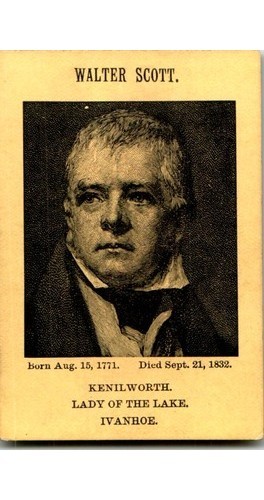
Sir Walter Scott Playing Card Kenilworth Ivanhoe 1800s For Sale

When you click on links to various merchants on this site and make a purchase, this can result in this site earning a commission. Affiliate programs and affiliations include, but are not limited to, the eBay Partner Network.

Sir Walter Scott Playing Card Kenilworth Ivanhoe 1800s:
$8.39
This playing card presents a portrait of Sir Walter Scott, the celebrated Scottish historical novelist, poet, and playwright. The sepia-toned image, likely inspired by 19th-century engraving techniques, stands out against a darkened background on the card's obverse. Beneath the portrait, printed text identifies Scott alongside his birth date (August 15, 1771) and death date (September 21, 1832). The inclusion of three prominent titles from his extensive oeuvre – "Kenilworth," "Lady of the Lake," and "Ivanhoe" – further underscores his literary significance. The card stock exhibits a yellowish tint, a common indicator of age in paper artifacts, suggesting its production within the timeframe proposed (circa 1800s). Further research into contemporary printing techniques and paper production of that era could refine this dating.The reverse side of the playing card displays a repeating pattern of stylized green foliage and floral elements against a yellowish-tan background. This design, characteristic of vintage playing cards, offers potential clues for more precise dating. Analysis of the ink composition, printing method (likely lithography), and the specific design motifs compared against established chronological trends in playing card decoration could yield a more accurate production timeframe. The color palette – the contrast of green ink on a yellowish-tan ground – also merits further investigation within the context of 19th-century printing practices.The overall condition of the card, as indicated by the analysis, reflects age-related wear and discoloration. To fully assess the card's condition within a scholarly context, a precise description of the type and extent of wear is required. This would include noting any creases, tears, stains, foxing (age spots), edge wear, or other signs of handling and deterioration. Accurate measurement of the card's dimensions is also essential for proper documentation. Determining the card's relationship to a full deck – whether it is a surviving single or part of a fragmented set – is another crucial point for future research. The presence or absence of corner indices or suit markings, often found on traditional playing cards, should be documented. The card's unknown country of manufacture presents an opportunity for further research. Stylistic comparisons with other playing cards of the period, as well as examination of the paper type and printing methods, might provide clues to its origin. If any evidence of a manufacturer's mark or other identifying features exists, even partially obscured, it should be documented as it could be critical in pinpointing the card's provenance. Contextualizing this artifact within the wider popularity of Sir Walter Scott's works in the 19th century, including the adaptation of his novels into theatrical productions and other forms of popular entertainment, adds another layer to its cultural significance. Such playing cards potentially served as both a recreational pastime and a vehicle for disseminating the image and renown of prominent literary figures like Scott.
|
|
Related Items:Too many requests. | |
