When you click on links to various merchants on this site and make a purchase, this can result in this site earning a commission. Affiliate programs and affiliations include, but are not limited to, the eBay Partner Network.
VERY RARE MAKERS MARK!
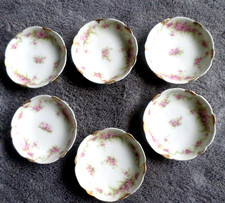
4 INDIVIDUAL PATS FOR $25 EACH. IF YOU BUY MORE THAN 1 YOU RECEIVE A DISCOUNTED PRICE.
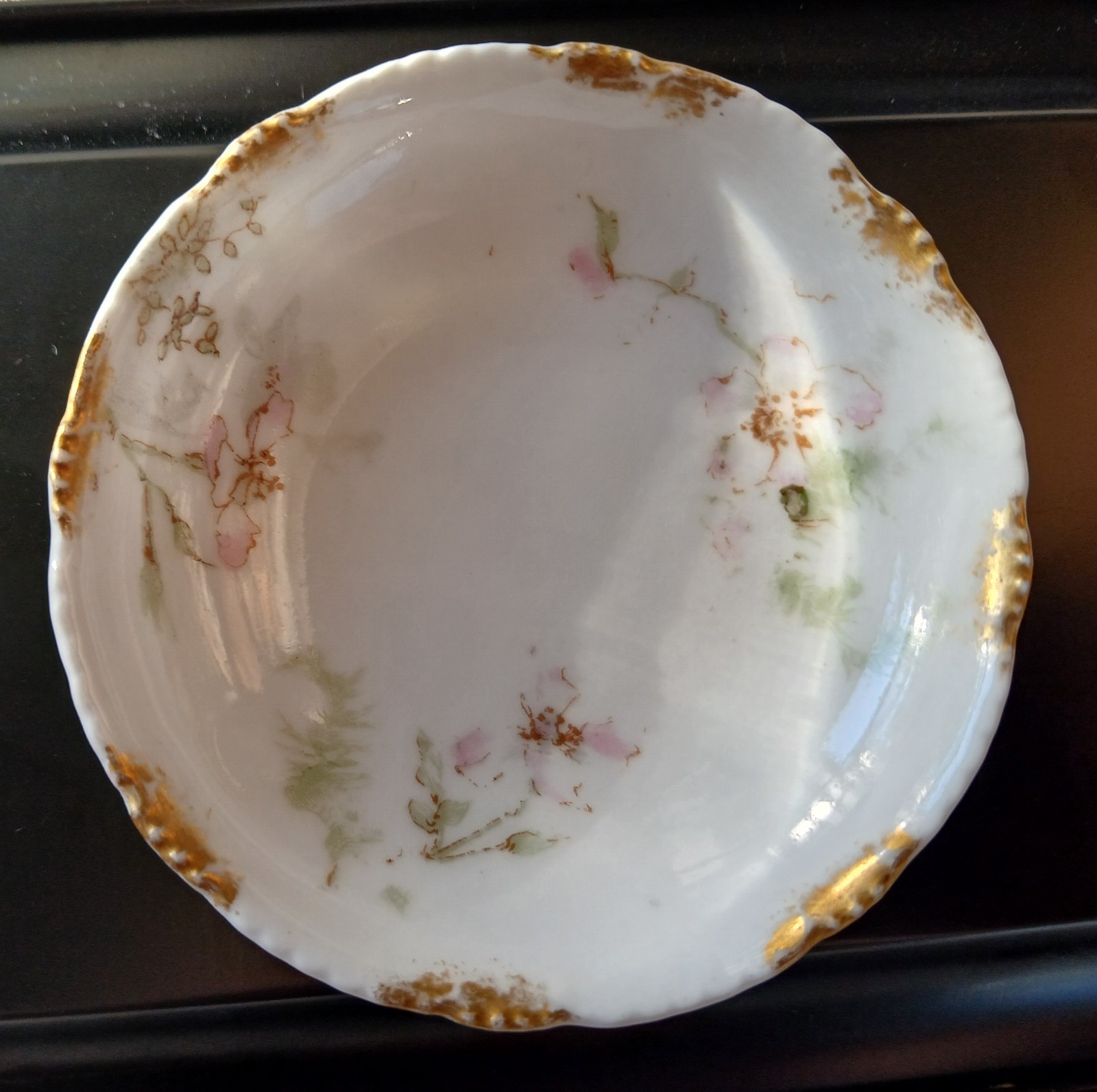
Antique Theodore Haviland Limoges 3\" Butter Pats made in Limoges, France, around 1903.
PLEASE LOOK AT MY PHOTOS CLOSELY. THESE ARE IN BEAUTIFUL ANTIQUE CONDITION WITH EXPECTED WEAR FROM USE AND AGE. NO VISIBLE CRACKS OR CHIPS.
**Some areas along the edges may show thinner, more faded gold gilding that may suggest actual wear from handling over time.**
**The pink floral designs may show slight fading or loss of detail compared to when they were newly manufactured.**
**Minor light scratches or \"utensil marks\" are sometimes present on the white porcelain surface of pieces from this era, indicating historical use.**
**The yellowish/brownish staining around the bottom base rim is common for porcelain of this age. It typically results from mineral deposits from water or the natural aging of the unglazed \"foot\" of the dish where it rested on surfaces.**
These are part of the \"Schleiger\" designs. The butter pats have delicate pink blossoms with soft green foliage on a white fine porcelain base. They feature a distinctive scalloped edge with gold daubs, which are hand applied gold accents.
This back stamp is special because it is a decorator mark that tells a specific story about the piece\'s production, retail history, and age.
\"Patent Applied For\" was a specific phrase was used by Theodore Haviland for a limited time, starting around 1903. It typically indicates a piece that was both manufactured and decorated within the Haviland factory in Limoges, France, rather than being sold as a \"blank\" to be painted elsewhere.
The inclusion of \"John W. O\'Neill Co. Birmingham Ala\" makes this a \"store mark.\" Theodore Haviland was a pioneer in marketing who collaborated with major department stores, imprinting their names on the back to make the china feel exclusive to that retailer. Because it identifies a specific historical retailer (John W. O\'Neill Co. in Alabama), it holds extra interest for regional collectors or those specializing in \"business-related\" porcelain history.
In Haviland porcelain, the color of the stamp is significant. While green marks were often \"whiteware\" (undecorated) factory marks under the glaze, red marks like this one were applied over the glaze to signify that the piece was finished by Haviland’s own factory artists.