

|
Site Categories |
|
Featured Items |

Poodle, Spaghetti Trim, Ucagco


|
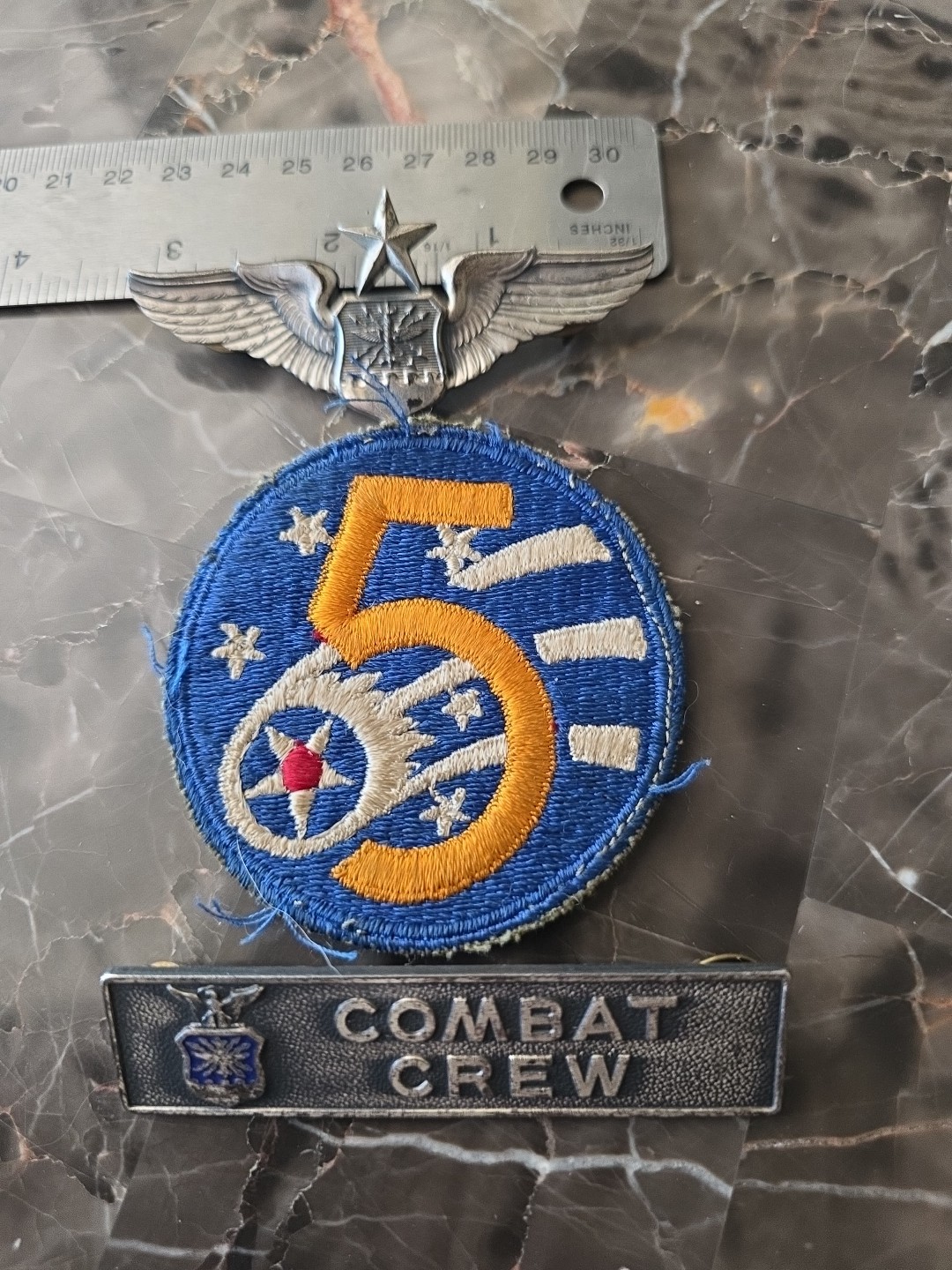
VIET NAM ERA STERLING 3" NAVIGATOR WIN+COMBAT CREW BADGEBY-MYERS +PATCH-WW2 For Sale

When you click on links to various merchants on this site and make a purchase, this can result in this site earning a commission. Affiliate programs and affiliations include, but are not limited to, the eBay Partner Network.

VIET NAM ERA STERLING 3" NAVIGATOR WIN+COMBAT CREW BADGEBY-MYERS +PATCH-WW2:
$49.99
PLEASE FOLLOW OUR E BAY STORESEE ALL PICSPLEASE READ WHOLE ADD PLEASE SEE STORELOT MORE --COMBINE SHIPPINGSAVE $$$$$$$$$$$$$$$Our Motto ,We want your repeat business ,We get by having best prices on the netWe try all ways to include a bit of history of the item you are buying .NICE SET OF SENIOR NAVIGATOR WINGS,HALLMARKED N.S.MEYER INC. NEW YORK.MEYER SHIELD AND 22/M IN SHIELD.HALLMARKS ARE RAISED.HALLMARK USED BY MEYER FROM 1965 TO MID 1970.S.ORGINAL PATINA TARNISH ON REVERSE.SEE PHOTOS,NICE VIETNAM ERA NAVIGATOR WING.FLAT BACK AND HEAVY .8 OZ.8 OUNCE STERLING WITHOUT CLUTCHES.SILVER IS OVER $38.00 OZ.SEE PHOTO'S Combat Crew BadgeTypeBadgeAwarded forActive services on a USAF combat crewPresented byUnited States Air ForceEligibilityServing with a U.S. Air Force combat crewStatusNo longer awardedEstablishedSeptember 1, 1964Final awardAugust Combat Readiness Medal TheCombat Crew Badgewas established by theUnited States Air Forceon September 1, 1964. It was worn by those USAF personnel serving in positions where they were accruing creditable service towards theCombat Readiness Medalas outlined in U.S. Air Force regulation 900-48. It was a qualification badge and not a medal; it was therefore not a permanent award. The Air Force eliminated the Combat Crew Badge from wear in August 1993. This was done under the auspices of addressing uniform accoutrements to eliminate duplication, achieve standardization, and promote an uncluttered appearance.[1]The badge was worn on the wearer's right side above the name tag.[2] Fifth Air Force Fifth Air ForceShield of the Fifth Air ForceActive5 February 1942 – present (as Fifth Air Force) 5 February 1942 – 18 September 1942 (as 5 Air Force) 28 October 1941 – 5 February 1942 (Far Eastern Air Force) 16 August 1941 – 28 October 1941 (as Philippine Department Air Force) (84years, 2months)[1]CountryUnited StatesBranchUnited States Air Force(18 September 1947 – present) United States Army(Army Air Forces, 16 August 1941 – 18 September 1947)TypeNumbered Air ForceRoleProvide combat-ready air forces forU.S. Indo-Pacific CommandandU.S. Forces Japan, along with serving as theair componentforU.S. Forces Japan[2]PartofPacific Air Forces U.S. Indo-Pacific Command U.S. Forces JapanHeadquartersYokota Air Base, Tokyo Metropolis, JapanEngagementsSee list
- TheFifth Air Force(5 AF) is aNumbered Air Forceof theUnited States Air ForcePacific Air Forces(PACAF). It is headquartered atYokota Air Base, Japan. It is the U.S. Air Force's oldest continuously serving Numbered Air Force. The organization has provided 80 years of continuous air power to the Pacific since its establishment in September 1941.[3]
Fifth Air Force is the Headquarters Pacific Air Forces forward element in Japan, and maximizes partnership capabilities and promotes bilateral defense cooperation. In addition, 5 AF is the air component toUnited States Forces Japan.[3] Its mission is three-fold. First, it plans, conducts, controls, and coordinates air operations assigned by the PACAF Commander. Fifth Air Force maintains a level of readiness necessary for successful completion of directed military operations. And last, but certainly not least, Fifth Air Force assists in the mutual defense of Japan and enhances regional stability by planning, exercising, and executing joint air operations in partnership with Japan. To achieve this mission, Fifth Air Force maintains its deterrent force posture to protect both U.S. and Japanese interests, and conducts appropriate air operations should deterrence fail.[3] Fifth Air Force is commanded by Lieutenant GeneralStephen Jost.[4] HistorySee also:United States Army Air Forces in AustraliaFourteenBoeing B-17 Flying Fortressesthat survived theBattle of the Philippinesleft Mindanao forDarwin, Australia, between 17 and 20 December 1941, the only aircraft of theFar East Air Forceto escape. After its evacuation from the Philippines on 24 December 1941, FEAF headquarters moved to Australia and was reorganized and redesignated5 Air Forceon 5 February 1942, with most of its combat aircraft based on fields on Java. It seemed at the time that the Japanese were advancing just about everywhere. The remaining heavy bombers of the 19th Bombardment Group, based atMalangon Java, flew missions against the Japanese in an attempt to stop their advance. They were joined in January and February, two or three at a time, by 37 B-17Es and 12LB-30sof the7th Bombardment Group. The small force of bombers, never numbering more than 20 operational at any time, could do little to prevent the invasion of the Netherlands East Indies, launching valiant but futile attacks against the masses of Japanese shipping, with six lost in combat, six in accidents, and 26 destroyed on the ground. The 7th Bombardment Group was withdrawn to India in March 1942, leaving the 19th to carry on as the only B-17 Fortress-equipped group in the South Pacific. About this time it was decided that replacement B-17s would not be sent to the southwest Pacific, but be sent exclusively to theEighth Air Forcewhich was building up in England. By May, Fifth Air Force's surviving personnel and aircraft were detached to other commands and the headquarters remained unmanned for several months, but elements played a small part in theBattle of the Coral Sea(7–8 May 1942) when the 435th Bomb Squadron of the 19th Bomb Group saw the Japanese fleet gathering inRabaularea nearly two weeks before the battle actually took place. Because of the reconnaissance activity of the 435th Bomb Squadron, the US Navy was prepared to cope adequately with the situation. The squadron was commended by the US Navy for its valuable assistance not only for its excellent reconnaissance work but for the part played in the battle. 39th Fighter Squadron, 35th Fighter GroupThe situation in New Guinea during June of 1942, was critical. Port Moresby was the last remaining Allied foothold on the island and the Japanese seemed determined to take it at all costs. After their victory in the Java Sea Battle, in March of 1942, the enemy swarmed down through New Guinea’s northern coast like locusts—taking Wewak, Rabaul, Madang and Lae in quick succession. Following the capture of Lae the Japanese staged, by June, two determined attempts to take Port Moresby. In their first attempt they tried to move overland from Salamaua and Lae through the Owen and Stanley Range, but their forces bogged down in the heavy rains of the Markham Valley. The second attempt was a naval attack to cut Moresby off from Australia and land sea-borne troops on the southern coasts of the island.[5] HeadquartersFifth Air Forcewas re-staffed atBrisbane, Australia on 18 September 1942 and placed under the command of Major GeneralGeorge Kenney.United States Army Air Forcesunits in Australia, including Fifth Air Force, were eventually reinforced and re-organised following their initial defeats in the Philippines and the East Indies. At the time that Kenney had arrived, Fifth Air Force was equipped with three fighter groups and five bombardment groups. Fighter Groups: - 8th FG(P-39) Townsville, Australia
- 35th FG(P-40) Port Moresby, New Guinea
- 49th FG(P-40) Darwin, Australia
Bomber Groups: - 3rd BG(B-25, A-20, & A-24) Charters Towers, Australia
- 19th BG(Non-Operational. Battle scarred from Philippines & Java) Mareeba, Australia
- 22nd BG(B-26) Woodstock, Australia
- 38th BG(B-25) Charters Towers, Australia
- 43rd BG (B-17 until 1943; B-24 1943–1945) Port Moresby, New Guinea
In addition, Fifth Air Force controlled two transport squadrons and one photographic squadron comprising 1,602 officers and 18,116 men. Kenney was later appointed commander of Allied air forces in theSouth West Pacific Area, reporting directly toGeneral Douglas MacArthur. Under Kenney's leadership, the Fifth Air Force andRoyal Australian Air Forceprovided the aerial spearhead for MacArthur's island hopping campaign.
PLEASE SEE STORE WW1- WW2 MEDALS -STERLING SILVER BADGES - RARE COINS PCGS GRADED /RARE GRADED CURRENCY
|
|
Related Items: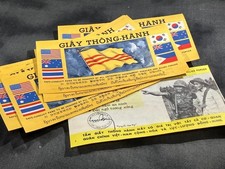
1 each, Original Viet Nam war Chiêu Hồi SAFE CONDUCT PASS vietnam leaflet $6.50
Vietnam 1969 Gray on Black 3.5 inch Patch IV2420 F4D19W $2.97
6232 i - MAP - Choam Kravien - 1968 - Loc Ninh - Cambodia Border - Vietnam War $185.00
|
|
|
Shopping Cart  |

|
Recently Viewed |
|
Latest Items |
|
Facebook |
Secure Websites

|
