When you click on links to various merchants on this site and make a purchase, this can result in this site earning a commission. Affiliate programs and affiliations include, but are not limited to, the eBay Partner Network.
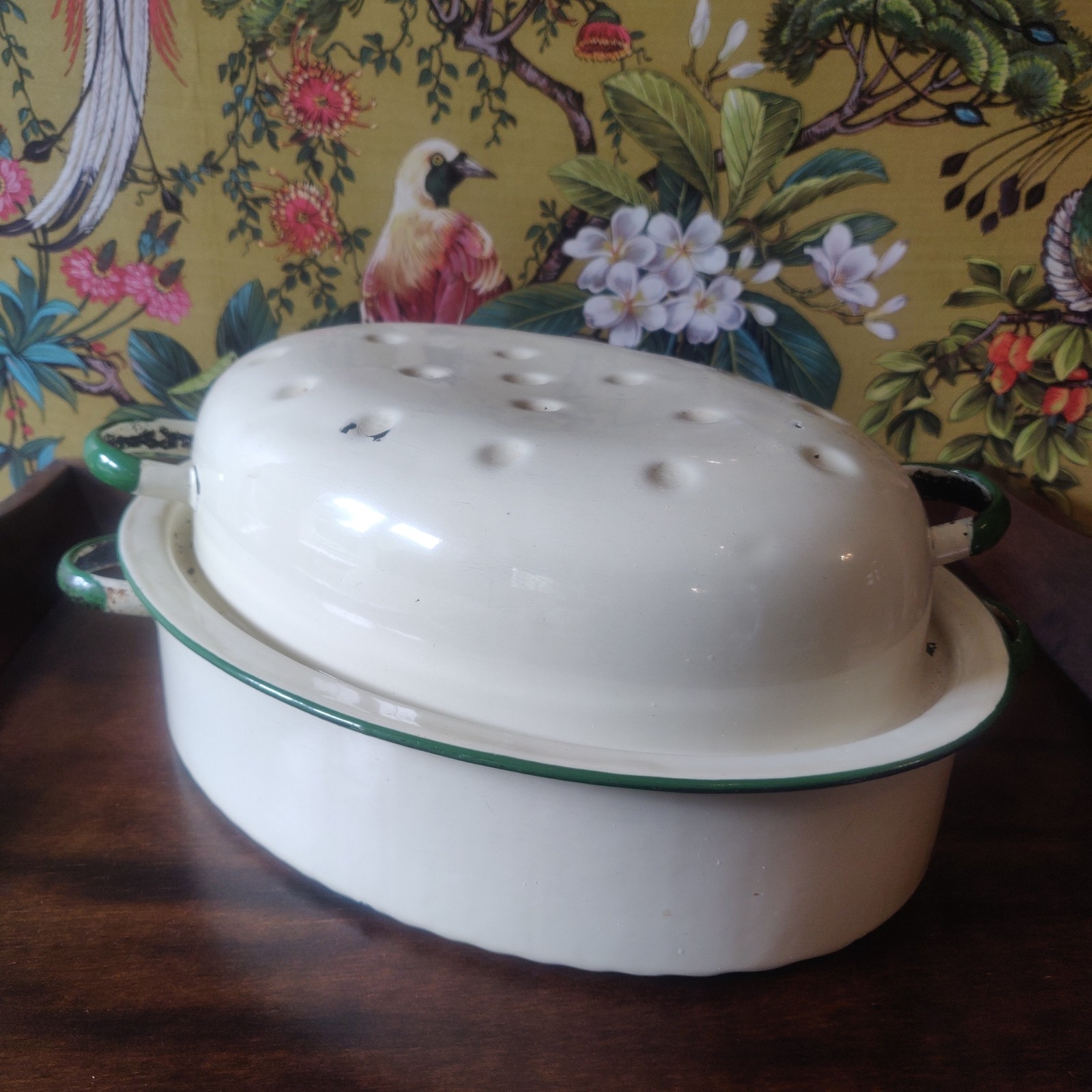
Vintage 1940s/50s enamel oval roasting tin with lovely green handles.
-
This lovely tin is a great piece of kitchenalia which could still be used. See pictures for illustration only!
-
Size: 33 cm wide 24 cm depth 15 cm tall.
-
Some age related wear.
-
Enameling, the process of fusing coloured glass to a metal base, has a long history, with origins in ancient civilizations like those in Mesopotamia and Egypt. The earliest known enamelled objects date back to the 13th century BC, with evidence found in Cyprus during the Mycenæan period. The technique spread to other regions, including Ancient Greece, the Roman Empire, and China.
-
Early Developments and Techniques:
Cloisonné:
The earliest enamelling techniques involved using a cloisonné method, where thin metal wires created cells that were filled with colored enamel. This technique was used to create intricate designs on jewelry and decorative items.
Ancient Civilizations:
Enameling was used in various cultures, including Ancient Egypt, where it was used to decorate ceremonial objects and jewelry. The Egyptians developed techniques for fusing powdered glass onto metal surfaces, creating vibrant colors.
Mycenaean and Minoan Civilizations:
By the 12th century BC, enameling had spread to the Mediterranean region, with Mycenaean and Minoan civilizations creating intricate enamel pieces, including jewelry.
Middle Ages and Beyond:
Byzantine Empire:
The Byzantine Empire saw a flourishing of enamelling during the 6th to 12th centuries, with the cloisonné technique being widely used, often on gold objects.
Basse-taille:
Later, a new technique called basse-taille developed, allowing for the use of translucent enamels to create visual depth.
Western Europe:
Western Europe also saw the development of enameling, with various techniques like champlevé and plique-à-jour emerging.
Modern Era:
Revival in the 19th Century:
The 19th century saw a renewed interest in enamelling, with artists and craftspeople experimenting with new techniques and designs.
Art Nouveau and Beyond:
Enameling continued to be used in various art movements, including Art Nouveau, where it was used to create intricate and colorful designs.
Modern Applications:
Enamelling is still used today in jewelry, decorative arts, and other applications, with artists and artisans continuing to innovate and push the boundaries of the technique.
-
Kitchenalia\" refers to items traditionally used in a kitchen, encompassing utensils, cookware, appliances, and tableware. The term itself has a relatively recent origin, with the earliest known use dating back to the 1920s. Kitchenalia items have evolved significantly throughout history, reflecting changes in technology, materials, and culinary practices.
Evolution of Kitchenalia:
Early Times:
Early kitchen tools were often made from natural materials like wood, clay, and stone. Examples include mortaria (for grinding), testum (for baking), and glirarium (for raising edible dormice).
Medieval Period:
The introduction of metalworking led to the creation of more durable and functional tools, including pots, pans, and cutlery.
Renaissance and Beyond:
The development of glassblowing and porcelain brought new tableware and decorative items into kitchens.
Industrial Revolution:
Technological advancements led to the creation of appliances like the electric kettle and the food processor.
Post-War Era:
Fitted kitchens and affordable materials like Formica and laminate became popular.
Key Periods and Trends:
Victorian Era: Characterized by elaborate decorations and ornate items.
Art Deco: Geometric designs and streamlined aesthetics influenced kitchenware.
1950s: The rise of the \"kitchen queen\" and focus on convenience and efficiency.
Modern Era: Kitchens have become increasingly technologically advanced and space-efficient.
Examples of Kitchenalia:
Mortaria: A stone container used for grinding grains or other ingredients.
Larding Pins: Large skewers for inserting fat into meat.
Fish Eaters: Distinctive knives and forks used for eating fish in the 1880s.
Hostess Trolley: A rolling cart designed to make serving dinner parties easier.
Electric Kettle: A uniquely British invention that revolutionized tea-drinking.