When you click on links to various merchants on this site and make a purchase, this can result in this site earning a commission. Affiliate programs and affiliations include, but are not limited to, the eBay Partner Network.
🌍 What Does a Flag With No Words Still Manage to Say?
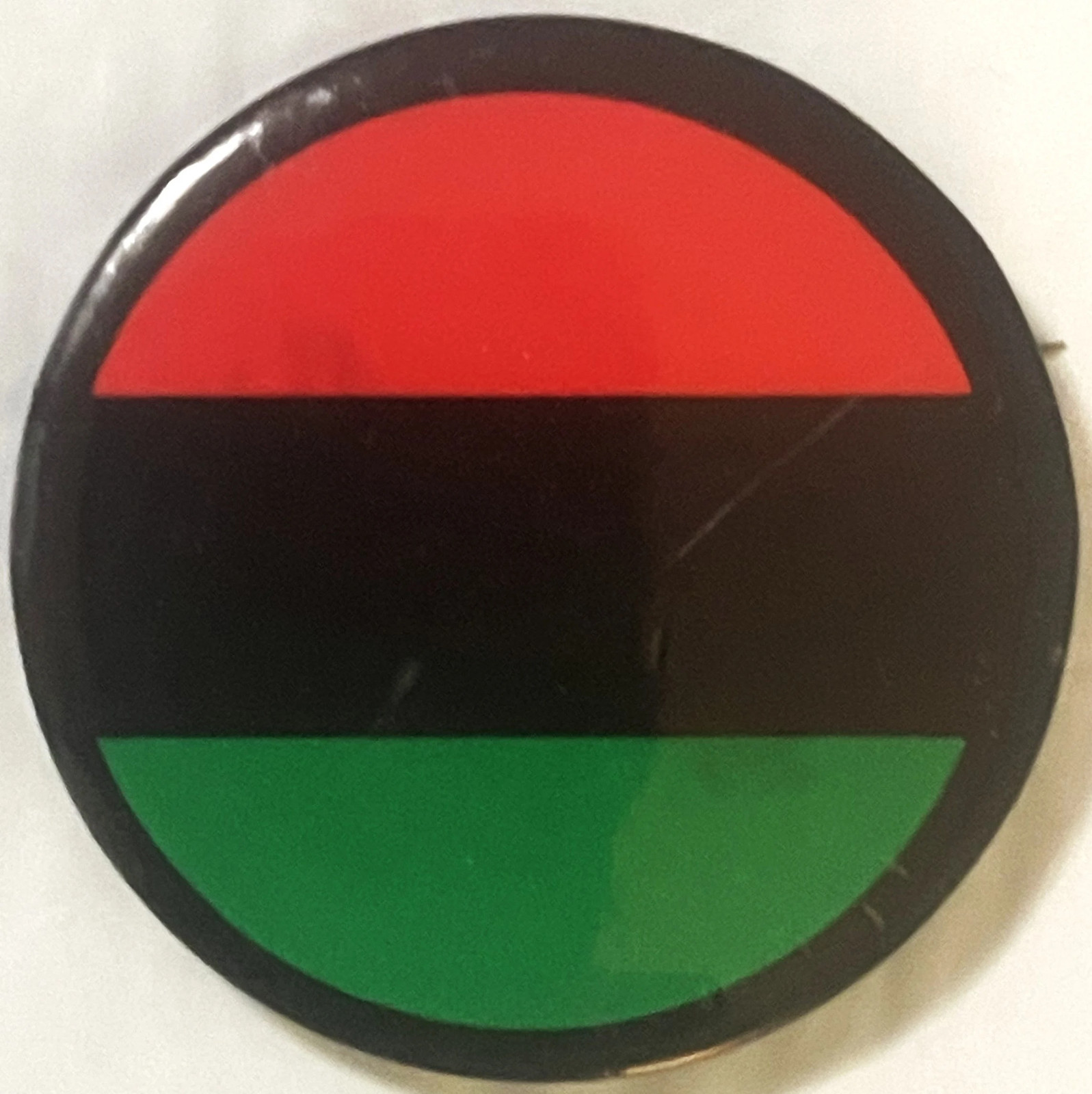
I've handled a lot of pinback buttons over the years — political candidates, soda pop advertising, union lapel pins, novelty giveaways — and most of them lean on a slogan or a face to do the talking.This one doesn't say a single word. It doesn't need to. Three bold horizontal bands of red, black, and green have carried more meaning across more decades and more continents than almost any other design in American political memorabilia, and the moment you see it, you know exactly what it's telling you. That's the kind of graphic power that keeps a design like this in demand generation after generation.
This is a vintage Pan-African flag pinback button, lithographed in three clean horizontal stripes of red, black, and green — no lettering, no maker's imprint, no printed date anywhere on the face.It measures a true 1.75 inches (about 4.4 cm) across, finished with the classic metal-shell pin back common to this style of button, and this example comes to you as New Old Stock — unused since it left original production. Because there's no legible manufacturer's stamp anywhere on the piece, I can't hang an exact printer or a precise decade on it, and I won't pretend otherwise — but that doesn't mean the story runs dry.Quite the opposite.
🚩 The Day a Flag Was Born
This color combination isn't folk art or a happy accident — it has a documented birthday. On August 13, 1920, delegates to the Universal Negro Improvement Association and African Communities League (UNIA-ACL) formally adopted red, black, and green as the official colors of Black nationhood in Article 39 of their Declaration of the Rights of the Negro Peoples of the World, signed during a month-long convention that filled Madison Square Garden in New York City.The man behind it was Marcus Mosiah Garvey, the Jamaican-born organizer who served as the UNIA's first President-General and who had been agitating for years about the need for a flag — because a flag, he argued, was a mark of political maturity, proof that a people had arrived. Garvey didn't invent the idea from nothing; he built on the 1917 tricolor of the Liberty League of Negro-Americans (black, brown, and yellow), passed through a short-lived black-red-gold "Black Liberation Flag," before landing on the red-black-green we know today.
Every stripe carries a meaning that UNIA doctrine spelled out plainly: red for the blood shed in the fight for liberation, black for the people themselves, and green for the growth and fertility of the African homeland.Historians researching Garvey's papers have also pointed to a cultural irritant behind the timing — a popular, ugly 1900 piece of sheet music called "Every Race Has a Flag But the Coon" — which Garvey and his circle are said to have wanted answered, once and for all, with a flag of their own.
🌍 From Harlem to a Continent
What started at a convention in Manhattan didn't stay there.Kenya's national flag, officially adopted December 12, 1963, drew its black-red-green tricolor directly from the Pan-African design, adding its Maasai shield. The short-lived nation of Biafra raised its own variant on the same palette when it declared independence in 1967. Malawi's 1964 flag carries the same three colors as well, even if historians trace it to a separate design lineage.One nugget worth keeping straight for collectors: these colors are frequently confused with the Rastafari palette, but that's actually a different tricolor entirely — green, gold, and red, borrowed from the flag of Ethiopia. The UNIA's own historical record is firm on this point: there was no red-black-green flag before Garvey, and the two traditions, though visually close, come from separate roots.
✊🏾 A Second Life in the Streets
The flag's biggest moment as a piece of everyday material culture came decades after that 1920 convention.Through the 1960s and 1970s Black Liberation and Black Power era, the red-black-green tricolor became a widely worn badge of pride and identity — right alongside the golden age of the pinback button itself, when campaign and protest buttons of every kind became a fixture of American street-level politics. Lore passed down among collectors of civil rights ephemera has long tied buttons in these colors to the broader Pan-African organizing of that decade, including groups like Malcolm X's Organization of Afro-American Unity, founded in 1964 to link Black Americans to a global human-rights and Pan-African movement — a natural home for a flag built on exactly those ideals, even where a single unmarked pin can't be traced to one organization's order desk.What is well documented is that the symbol never faded into a museum piece. In 2014, protesters carried the Pan-African flag through the streets of Ferguson, Missouri, following the killing of Michael Brown, and today it still flies over Black-owned storefronts and neighborhoods in cities like Philadelphia, where Garvey's UNIA once had deep roots.
🏭 The Button Trade Behind the Pin
The lithographed pinback itself, as a format, has its own century-plus pedigree.The Whitehead & Hoag Company, founded in 1892 in Newark, New Jersey, patented the modern pin-back button design in 1896 — a lithographed paper disk sealed under a metal shell around a working pin — and that basic construction is still what you're holding in a button like this one. Their chief rival, Bastian Brothers of Rochester, New York, eventually bought out Whitehead & Hoag in 1959.Political and protest buttons boomed from the 1896 McKinley campaign clear through the civil rights and anti-war buttons of the 1960s-70s, which is exactly the era this style of Pan-African pin is most associated with in the collecting world. The Smithsonian's National Museum of African American History and Culture holds a directly comparable red-black-green pinback in its own collection, with a union-shop stamp on the reverse — confirming these were genuinely produced through the organized button trade of the day.This particular example carries no legible manufacturer's mark of its own, so I can't assign it to one printer or one precise decade with certainty; what I can tell you is that its style sits squarely within the long run of Pan-African flag buttons produced from the Black Pride era onward, a design still made and cherished today.
🖼️ Display Ideas
- 🖼️ Framed solo in a small shadow box alongside a printed line from the 1920 UNIA Declaration
- 📚 Pinned to a Black history or civil rights memorabilia board for classroom or library display
- 🕯️ Set out as part of a Kwanzaa table display, where the same red, black, and green carry their own celebrated meaning
- 🧥 Worn on a lapel or bag for Black History Month, Juneteenth, or Pan-African heritage events
- 🗂️ Added to a themed collection of vintage protest and civil rights-era pinback buttons
- 🏺 Displayed on a stand alongside other UNIA, Garvey, or Pan-African print ephemera
🎁 Who Collects These
This piece draws in a wide range of collectors: civil rights and Black history memorabilia collectors building out a themed archive, Pan-Africanism and Garveyism scholars and enthusiasts, pinback button collectors chasing the great eras of American button-making, and anyone assembling a Black History Month, Juneteenth, or Kwanzaa display who wants a genuinely vintage piece rather than a modern reprint.It's also a favorite with teachers and museum-adjacent collectors looking for a compact, honest artifact to anchor a lesson on the UNIA, Marcus Garvey, or the visual language of Black liberation movements.
❓ FAQ
- What do the colors on this flag mean? Under UNIA doctrine, red stands for the blood shed in the struggle for liberation, black for the people themselves, and green for the growth and fertility of the African homeland.
- Who created the Pan-African flag? It was formally adopted August 13, 1920 by the Universal Negro Improvement Association and African Communities League, driven by Marcus Garvey, its first President-General.
- Exactly how old is this button? There's no legible maker's mark or date on the piece, so I can't assign it a precise year or decade — its style is consistent with the long production run of Pan-African flag pinbacks from the mid-20th-century Black Pride era onward.
- Is this the same as the Rasta flag? No — Rasta colors are green, gold, and red drawn from the Ethiopian flag, a separate tradition from this red-black-green Pan-African design.
- Is there a manufacturer's mark on it? No maker's imprint is legible on this piece, which is common for buttons of this kind and doesn't change the design's history or significance.
- What does NOS mean? New Old Stock — this button has never been used or worn since it originally left production.
- What size is the button? A true 1.75 inches (about 4.4 cm) in diameter, the classic size for this style of lithographed pinback.