When you click on links to various merchants on this site and make a purchase, this can result in this site earning a commission. Affiliate programs and affiliations include, but are not limited to, the eBay Partner Network.
🧊 Remember When "Cool Down Quick!" Was the Only Advice You Needed All Summer?
Long before frozen coffee turned into a billion-dollar category with three competitors on every single corner, there was the Coolatta — and there was this little keychain, tagging along on somebody's keyring, quietly doing its job as a tiny traveling piece of Dunkin' Donuts advertising.If you grew up anywhere near a Dunkin' counter, that grinning cartoon fellow sprawled out on a giant striped Dunkin' cup float, iced drink in hand, is instantly, warmly recognizable. This is a small, sturdy slice of American fast-food advertising history — the kind of everyday promotional ephemera that companies handed out by the thousands and that almost nobody thought to save, which is exactly why an unused example like this one is worth pausing over.
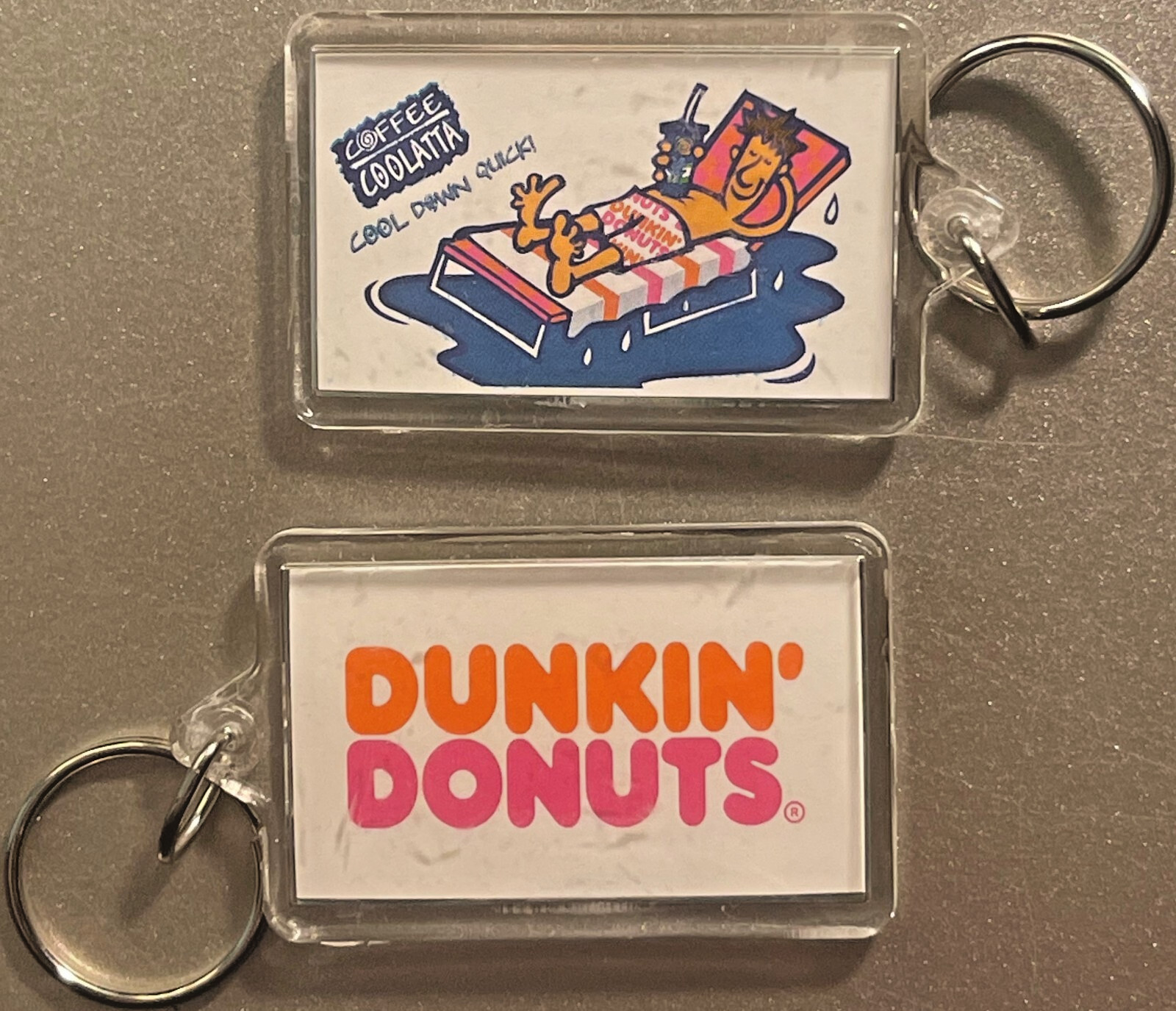
This is a genuine Dunkin' Donuts promotional keychain fob, produced to advertise the chain's Coffee Coolatta frozen coffee beverage under the tagline "COOL DOWN QUICK!" — the brand born in Quincy, Massachusetts.The front carries a full-color, offset-lithographed paper insert sealed under clear acrylic: a hand-drawn cartoon man reclining on a lounge chair patterned exactly like a Dunkin' Donuts cup — its familiar orange-and-pink stripes doing double duty as beach-chair upholstery — sunglasses-cool, one hand dangling and the other gripping a tall, sweating Coolatta cup with a straw, a puddle of melted ice spreading beneath him like he's dripped his way clean off the chair.The "COFFEE COOLATTA" lettering sits in a scrawled, hand-lettered style up top, "COOL DOWN QUICK!" scripted just below it, all rendered in the brand's orange, pink, and blue against white, with the figure inked in a warm tan/skin tone. It's a double-sided fob, finished with a silver split keyring, and this example is New Old Stock — unused promotional inventory that was set aside and preserved rather than ever carried day to day.The acrylic itself runs a slim 0.25 inches (about 0.6cm) thick, sized exactly the way these countertop fobs were meant to be: light enough to disappear into a pocket, sturdy enough to survive decades in a drawer. Dealers and collectors who handle this particular style commonly place it in the 1990s, tied to the drink's original run — though with no manufacturer's mark surviving on this piece to pin down an exact production year, the honest range I can stand behind is the 1990s through the early 2000s, the working lifetime of the Coffee Coolatta line itself.
☕ From a Quincy Coffee Stand to a National Institution
The company behind this little fob has one of the great only-in-America origin stories, and it starts small.Bill Rosenberg opened a shop called the Open Kettle in Quincy, Massachusetts, on Memorial Day weekend in 1948, selling doughnuts and coffee — the two things he'd already learned, from years running a food-delivery business to factory workers, that people wanted more than anything else on a work break. By 1950 he'd renamed the shop Dunkin' Donuts, and where a typical doughnut counter of the era sold maybe four varieties, Rosenberg — taking a cue from Howard Johnson's twenty-eight ice cream flavors — decided to offer fifty-two kinds of doughnuts, one for every week of the year, plus seating and real coffee service, not just a to-go counter.
Rosenberg's bigger insight was that the fastest way to grow wasn't to build every store himself — it was franchising, and Dunkin' became one of the pioneering name-brand franchise operations in the country.The chain grew from that single Quincy storefront into a national fixture, was folded into Baskin-Robbins' parent company Allied Lyons in 1990 (the same year Dunkin' absorbed the Mister Donut chain and converted its stores over), and eventually became part of Dunkin' Brands, headquartered in Canton, Massachusetts, in 2004 — meaning the corporate home never wandered far from the town where it all began.
🏙️ Quincy, Massachusetts: The Town That Started It All
Quincy is a Boston suburb with its own deep civic pride long before Dunkin' ever set up shop there — it's the birthplace of two U.S. presidents, John Adams and John Quincy Adams, and locals have never let anyone forget it.Into that history came a modest doughnut-and-coffee counter that would eventually put the town's name on menus and keyrings worldwide. Local legend holds that a remodeled version of Rosenberg's very first shop still stands in Quincy today, kept going as a living piece of hometown history rather than torn down and forgotten — the kind of detail passed down among collectors and old-timers that keeps a company's origin story tethered to an actual street corner instead of drifting into corporate legend.
🧑💼 The Man Behind the Counter
Bill Rosenberg was born in 1916 and, like a lot of men of his generation, went to work young — he entered the workforce at fourteen during the Great Depression to help support his family.He built a career in food service and delivery before opening that first Quincy shop in 1948 with his brother-in-law, Harry Winokur, as his partner. Rosenberg stayed close to the business for the rest of his life; his son Bob Rosenberg became CEO of Dunkin' Donuts at just twenty-five years old, the same year the chain opened its hundredth store, carrying the family imprint into Dunkin's national expansion.Bill Rosenberg died in September 2002 at eighty-six, at his home in Mashpee, Massachusetts — but the company he built from a single counter in Quincy had, by then, already become a genuine American institution.
🥤 The Coffee Coolatta: Cooling Down a Generation
The drink this keychain promotes has its own tangled but well-loved history.Most news coverage of the Coffee Coolatta's eventual discontinuation traces it back to 1994, describing it as a menu fixture from that year forward; other sourcing ties the broader multi-flavor "Coolatta" branding to 1997, framed at the time as Dunkin's answer to Starbucks' Frappuccino. It's entirely possible the coffee version launched first and the wider Coolatta lineup — fruit flavors and all — rolled out a few years later under one unified name; either way, by the mid-to-late '90s, "Coolatta" was shorthand at the counter for a frozen coffee big enough to survive a New England summer.Dunkin's own telling of the drink's purpose is refreshingly simple: it was built to keep customers cool at the beach, at a backyard barbecue, or stuck behind a desk — a blended, icy answer to hot coffee on the one day a year nobody wanted hot coffee. The Coffee Coolatta eventually left Dunkin' menus nationally in 2017, closing out a run of more than two decades as one of the chain's signature warm-weather drinks.
📈 What It Left Behind
Collectors and longtime regulars still bring the Coolatta up by name years after it left the menu — it's the kind of discontinued item that develops its own quiet cult following, the drink people describe to newer employees who've never heard of it.Its legacy is bigger than nostalgia, too: Dunkin's whole identity shifted around drinks like this one, and in 2019 the company officially trimmed its name from "Dunkin' Donuts" down to simply "Dunkin'," a nod to just how far the brand had grown beyond doughnuts and into the frozen-and-iced coffee business the Coolatta helped pioneer.A little countertop keychain advertising "Cool Down Quick!" turns out to be a pretty accurate snapshot of exactly the moment Dunkin' started becoming a coffee company first.
🖼️ Display Ideas
- 🔑 Clipped onto a keyring for everyday carry, the way it was originally meant to travel
- 🎁 Wrapped up as a fun, offbeat gift for the coffee obsessive or Dunkin' loyalist in your life
- 🧊 Grouped with other frozen-drink or fast-food advertising ephemera in a shadow box
- 📌 Pinned to a corkboard in a kitchen or home office as a pop of retro color
- 🚗 Hung from a rearview mirror or car keys for a little dashboard nostalgia
- ☕ Displayed near a coffee bar or breakfast nook alongside other Dunkin' collectibles
🎁 Who Collects These
This one draws in fast-food and restaurant advertising collectors first — the folks who chase down countertop giveaways, tray liners, and promotional fobs from chains before they get streamlined or redesigned into oblivion.Dunkin' brand loyalists and superfans want it because it captures a specific, beloved menu item that's gone now. Coffee culture collectors like it for the same reason vintage soda and diner ephemera holds appeal — it's a snapshot of how a company sold a drink before frozen coffee was everywhere. And plenty of buyers simply want a small, cheerful, nostalgic gift for somebody who remembers standing at a Dunkin' counter asking for a Coolatta on the first truly hot day of the year.
❓ FAQ
Is this an original vintage keychain or a modern reproduction?
It's an original Dunkin' Donuts promotional piece from the Coffee Coolatta era — an offset-printed paper insert under clear acrylic, not a modern reprint.
What does "NOS" mean here?
New Old Stock — unused promotional inventory from the original run that was set aside rather than ever carried or handed out.
What era does this date to?
There's no manufacturer's mark to pin an exact year, so the honest range is the 1990s through the early 2000s, matching the Coffee Coolatta's original run on Dunkin' menus.
Is the Coffee Coolatta still sold at Dunkin'?
No — it was discontinued nationally in 2017 after more than two decades on the menu, which is part of why pieces like this hold appeal now.
How big is the keychain?
The acrylic body runs a slim 0.25 inches (about 0.6cm) thick, sized to sit easily on a keyring or tucked into a small display.
Is it meant to actually be used as a keychain, or just displayed?
Both — it was built as a working keyring fob, and it holds up just as well simply displayed or gifted as a nostalgic piece.