When you click on links to various merchants on this site and make a purchase, this can result in this site earning a commission. Affiliate programs and affiliations include, but are not limited to, the eBay Partner Network.
🪶 VINTAGE ART LEWIS “NEETA-LOOSA” TOMAHAWK PENDANT 🪶
Choctaw • Coin Silver • Turquoise • Documented Hallmark • Exceptional Hand-Wrought Construction
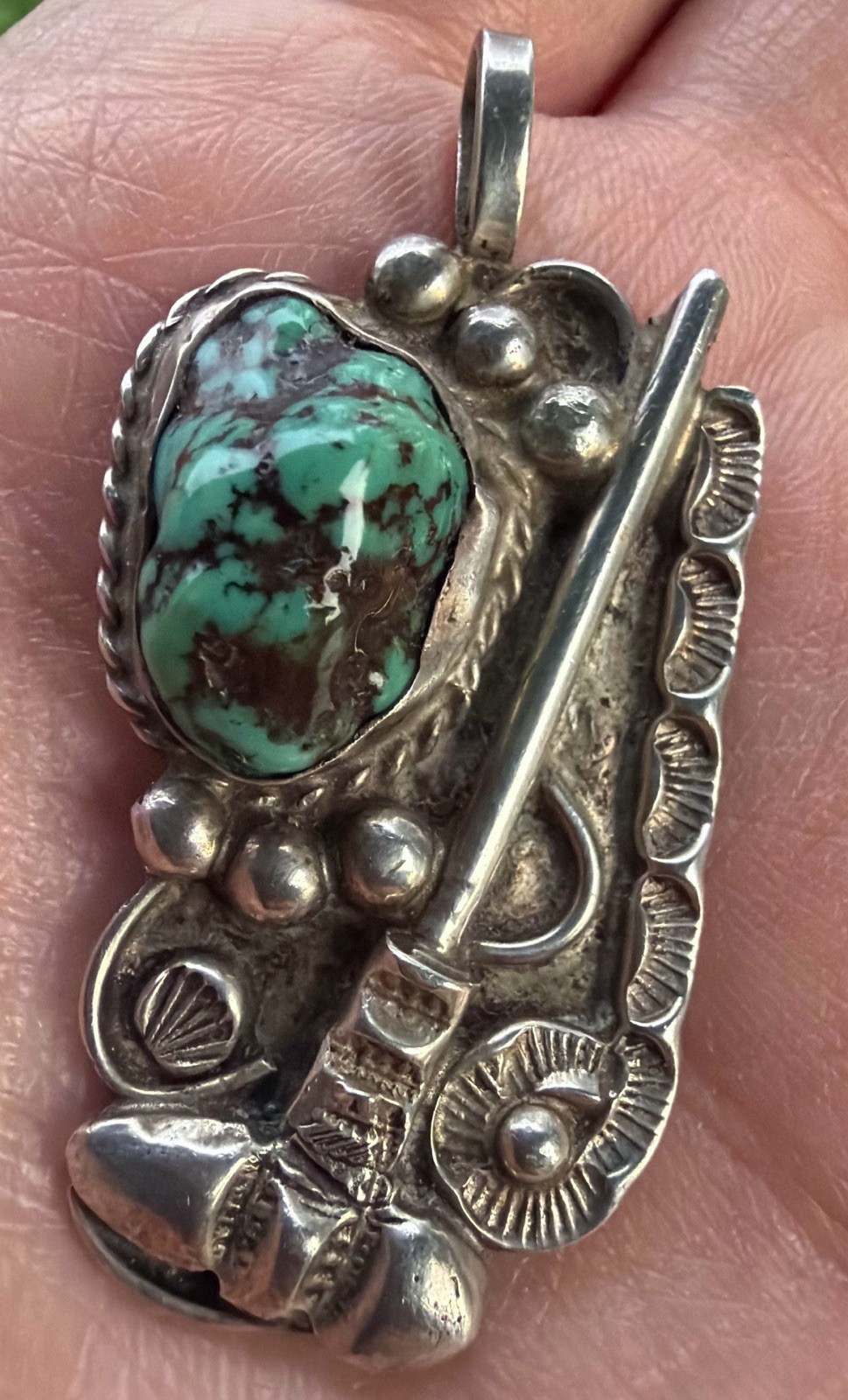
An extraordinary vintage Native American pendant by Choctaw silversmith Art Lewis, whose Choctaw name was Neeta-Loosa (“Black Bear”), featuring a wonderfully expressive hand-wrought tomahawk motif and a substantial natural-form turquoise nugget set into an individually formed silver bezel.
Lewis reportedly began making jewelry in 1929 and continued until retiring sometime during the 1970s. His work is immediately compelling for its extraordinarily handmade character. Rather than striving for machine-like uniformity, the pendant preserves the evidence of its creation everywhere: individually struck stamps, irregularly formed silver elements, hand-worked surfaces, solder work, tool marks, pits, asymmetry and subtle variations from one decorative element to the next.
The reverse bears Lewis’s distinctive arrow beneath a small tepee hallmark, documented on page 185 of Bille Hougart’s Native American and Southwestern Silver Hallmarks, 5th Edition.
At only approximately 1.976 inches long including its bail, this is a remarkably detailed little work of wearable sculpture—one that becomes increasingly fascinating the closer it is examined. THE TOMAHAWK MOTIF
The face is dominated by an intriguing dimensional tomahawk rendered in silver.
Rather than simply stamping the image into a flat surface, Lewis constructed the motif with considerable dimension. A long raised handle extends through the composition to a substantial tomahawk head decorated with individually struck impressions and surrounded by additional hand-formed ornament.
The surrounding composition incorporates numerous individually fabricated and applied elements, including silver drops, wirework, scroll-like forms, twisted-wire detailing and repeated radiating/fan-like stamped decorations.
No two impressions or components are perfectly identical. Differences in depth, alignment, shape and surface are readily visible under magnification and beautifully demonstrate the intensely handmade nature of the piece.
IMPORTANT: A visible line/seam appears immediately beneath the tomahawk head. Based upon its placement and the construction of the piece, this appears inherent to the original handmade fabrication rather than subsequent damage. It has been photographed closely and is specifically disclosed so buyers can examine it for THE TURQUOISE
The pendant features a substantial hand-cut natural-form turquoise nugget displaying beautiful bluish-green coloration with prominent chocolate-brown matrix.
Rather than being shaped into a conventional calibrated cabochon, the stone retains a wonderfully irregular, highly dimensional form and rises approximately 8.10mm / 0.319 inch at its measured thickness.
The turquoise measures approximately:
17.45 × 11.35 × 8.10mm
0.687 × 0.447 × 0.319 inch
Its irregular contours, richly contrasting matrix and substantial dome give the stone tremendous visual depth despite the pendant’s relatively compact dimensions.
Small areas of clear material are visible on portions of the turquoise surface and are documented closely in the photographs.
I have observed similar clear material on other pieces by Art Lewis. Among collectors familiar with his work, one possibility discussed is that Lewis may occasionally have used some form of clear sealer or protective material on stones. However, this is only a working theory. The composition, date and purpose of the clear material on this stone have not been scientifically determined, and I make no definitive representation regarding its origin or whether the turquoise would meet any modern gemological definition of “treated” or “stabilized.”
Importantly, the turquoise is tight and securely seated in its hand-formed bezel, with absolutely no detectable rattle, looseness or movement whatsoever when gently EXTRAORDINARY HAND-WROUGHT SILVERWORK
One of the most fascinating aspects of this pendant is the evidence of Art Lewis’s working process preserved throughout the silver.
According to an individual personally acquainted with Lewis who assisted with delivering jewelry Lewis made, Lewis worked in an exceptionally hands-on manner—melting silver himself using an old-fashioned blowtorch and forming his jewelry by hand rather than beginning with commercially prepared sheet silver.
That information provides remarkable context for what can still be seen throughout this pendant.
The silver retains:
• Individually formed dimensional components
• Hand-struck decorative impressions
• Applied silver drops
• Hand-formed wire and scroll elements
• Twisted-wire detailing surrounding the turquoise
• Individually formed turquoise bezel
• Dimensional tomahawk construction
• Hand-formed bail
• Visible solder/fabrication evidence
• Irregular contours and subtle asymmetry
• Tool and working marks
• Small pits and surface irregularities
• Beautifully preserved oxidation and patina within recessed areas
Even under extreme magnification, the pendant never becomes mechanically perfect—and that is precisely part of its character.
The reverse is particularly fascinating because it retains abundant scratches, tool marks, pits, depressions, surface variation and other evidence associated with its handmade fabrication and subsequent history.
Nothing about this piece should be evaluated against the uniformity of modern factory-produced DOCUMENTED ART LEWIS HALLMARK
The reverse is fully hallmarked with Art Lewis’s distinctive arrow beneath a small tepee maker’s mark.
This hallmark is documented for Lewis on:
Bille Hougart
Native American and Southwestern Silver Hallmarks
5th Edition — Page 185
Both elements of the hallmark remain readily identifiable, and detailed macro photographs have been included so buyers can examine the marks closely.
Art Lewis was a Choctaw silversmith whose Choctaw name was Neeta-Loosa (“Black Bear”). He reportedly began making jewelry in 1929 and, according to information provided by an individual personally acquainted with him, retired sometime during the 1970s.
The hallmark provides the central documented basis for the attribution of this pendant to SILVER TESTING
The pendant was tested by the seller using a JSP silver acid test performed on a separate scratch stone.
No testing acid was applied directly to the pendant.
The reaction was consistent with high-grade silver of approximately .900 coin-silver fineness or greater based upon the seller’s interpretation of the JSP test.
Because this was a scratch-stone acid test rather than laboratory assay or XRF analysis, the precise elemental composition and exact silver fineness have not been independently laboratory verified.
Accordingly, the pendant is described as coin silver / high-grade silver consistent with at least approximately .900 fineness based upon the test performed, rather than representing an exact laboratory-certified ART LEWIS / NEETA-LOOSA & APPROXIMATE PERIOD
Art Lewis, whose Choctaw name was Neeta-Loosa (“Black Bear”), reportedly began making jewelry in 1929 and continued his craft for decades before retiring sometime during the 1970s.
This pendant is believed to date to approximately the 1960s.
Its attribution to Lewis is supported by the distinctive arrow-beneath-small-tepee hallmark documented in Bille Hougart’s Native American and Southwestern Silver Hallmarks, 5th Edition, p. 185.
Additional information regarding Lewis’s working methods and retirement period comes from an individual personally acquainted with Lewis who assisted with delivering jewelry he made. This information is valuable oral history but is identified as such rather than represented as information documented by Hougart.
The pendant’s intensely handmade construction, preserved fabrication evidence and distinctive design provide a remarkable physical record of Lewis’s individual approach to APPROXIMATE MEASUREMENTS
• Total weight: 14.76 grams / 0.521 ounces
• Pendant including bail: approximately 50.20 × 25.10mm / 1.976 × 0.988 inches at widest point
• Turquoise: approximately 17.45 × 11.35 × 8.10mm / 0.687 × 0.447 × 0.319 inch thick
• Bail inner opening: approximately 7.3 × 4.1mm / 0.287 × 0.161 inch
A U.S. Mercury dime is shown in photographs solely for visual scale and is not included with the pendant.
No chain or necklace is included unless specifically stated otherwise.
All measurements were taken by hand and should be considered CONDITION
This remarkable vintage pendant has been lovingly preserved and retains extensive surface character associated with its age, previous use and intensely handmade construction.
The silver displays scratches, scuffs, small marks, pits, surface irregularities, oxidation/patina, solder/fabrication evidence, tool marks and variations in finish throughout. Many of these characteristics are particularly visible under the extreme magnification used in the listing photographs.
I have not cleaned, polished or otherwise altered this pendant in any way. I do not clean or polish vintage Native American jewelry. Its existing patina, oxidation and surface character have intentionally been left undisturbed.
The turquoise remains beautifully glossy and displays natural-looking matrix, inclusions, irregularities and surface character. Small areas of unidentified clear material are present on portions of the stone and are clearly shown in the macro photographs. As discussed above, their precise composition, age and purpose are unknown.
The stone remains tight and securely seated in its bezel with absolutely no detectable rattle, looseness or movement when gently checked.
A visible line/seam is present immediately beneath the tomahawk head. Based upon its placement and the construction of the pendant, this appears inherent to the original handmade fabrication and is not believed to represent subsequent damage. It has intentionally been photographed closely for buyer examination.
The handmade bail remains attached and functional.
No restoration or repair is known to me.
The front, reverse, turquoise, bezel, bail, hallmark, tomahawk and individual silver components have intentionally been photographed extremely closely from numerous angles so buyers can evaluate their condition and construction.
Please examine all photographs carefully at full resolution, as they form an important part of the condition PHOTOGRAPHY & COLOR
This pendant was intentionally photographed outdoors in natural daylight while resting in the palm of my hand.
The hand provides an immediate visual reference for scale while also, quite appropriately, reflecting the profoundly handmade character of Art Lewis’s work.
The photographs are intended to document not merely the overall appearance of the pendant but also its turquoise, chocolate-brown matrix, surface character, hallmark, patina, hand-working marks, solder/fabrication evidence and the minute irregularities inherent to its construction.
The turquoise displays a beautiful bluish-green coloration with chocolate-brown matrix. Its apparent color, depth, saturation, contrast and surface reflections may vary depending upon natural or artificial lighting, viewing angle and surrounding environment.
Colors may also display differently depending upon individual screen and device settings.
Macro photographs greatly enlarge small details that may be substantially less apparent to the unaided eye.
Please review the entire photograph set when evaluating the turquoise, silverwork, construction, surface characteristics and overall PLEASE NOTE
This is a vintage, individually handmade Native American object rather than modern factory-produced jewelry.
Natural asymmetry, irregular contours, varying stamp impressions, pits, tool marks, solder/fabrication evidence, surface wear, scratches, oxidation, patina and other variations are part of the physical character and history of the piece.
The attribution to Art Lewis is supported by his documented maker’s hallmark as referenced above. The approximately 1960s date and additional biographical/workshop information reflect available information and oral history but should not be interpreted as an independently documented exact production date for this particular pendant.
The clear material visible on portions of the turquoise has not been scientifically analyzed. Its composition, age and purpose therefore remain unknown.
The silver test was performed by the seller using a separate scratch stone and JSP testing solution; no acid was applied directly to the pendant. The exact silver fineness has not been established by laboratory assay.
All measurements were taken by hand and should be considered approximate.
Please review the complete description, measurements and all photographs carefully before purchasing. I am happy to answer reasonable questions or provide additional photographs prior to purchase. SHIPPING
• Ships same or next business day 🩵🩵🩵
• FREE USPS Ground Advantage within the United States
• Fully insured with tracking
• Carefully and securely packaged
• Ships in a sturdy cardboard box—never a bubble INTERNATIONAL SHIPPING
• FREE through International Shipping
OR
• USPS Priority Mail International
• Flat rate: $48.95
• Insurance and tracking included
Buyer is responsible for any customs duties, VAT, brokerage fees, tariffs, taxes or other import charges imposed by their OFFERS & RETURNS
All serious offers considered.
All sales are final unless the item has been grossly misrepresented.
Please review the complete description, measurements and photographs carefully before purchasing. Questions are always welcome prior to A REMARKABLE SURVIVING EXAMPLE OF ART LEWIS’S WORK 🩵🪶
A rare opportunity to acquire a wonderfully preserved vintage Choctaw Art Lewis / Neeta-Loosa (“Black Bear”) tomahawk pendant, combining a documented maker’s hallmark, intensely hand-wrought silver construction and a beautiful dimensional bluish-green turquoise nugget with rich chocolate-brown matrix.
From the irregular hand-struck decoration and individually formed silver elements to the tool marks, patina and fabrication evidence still preserved across its surfaces, this is a piece whose character becomes more compelling under magnification rather than less.
It is not simply a vintage turquoise pendant—it is a remarkably tactile surviving example of the hand, tools and working methods of an identifiable Native American silversmith whose jewelry-making career reportedly began nearly a century ago. 🪶🩵