When you click on links to various merchants on this site and make a purchase, this can result in this site earning a commission. Affiliate programs and affiliations include, but are not limited to, the eBay Partner Network.
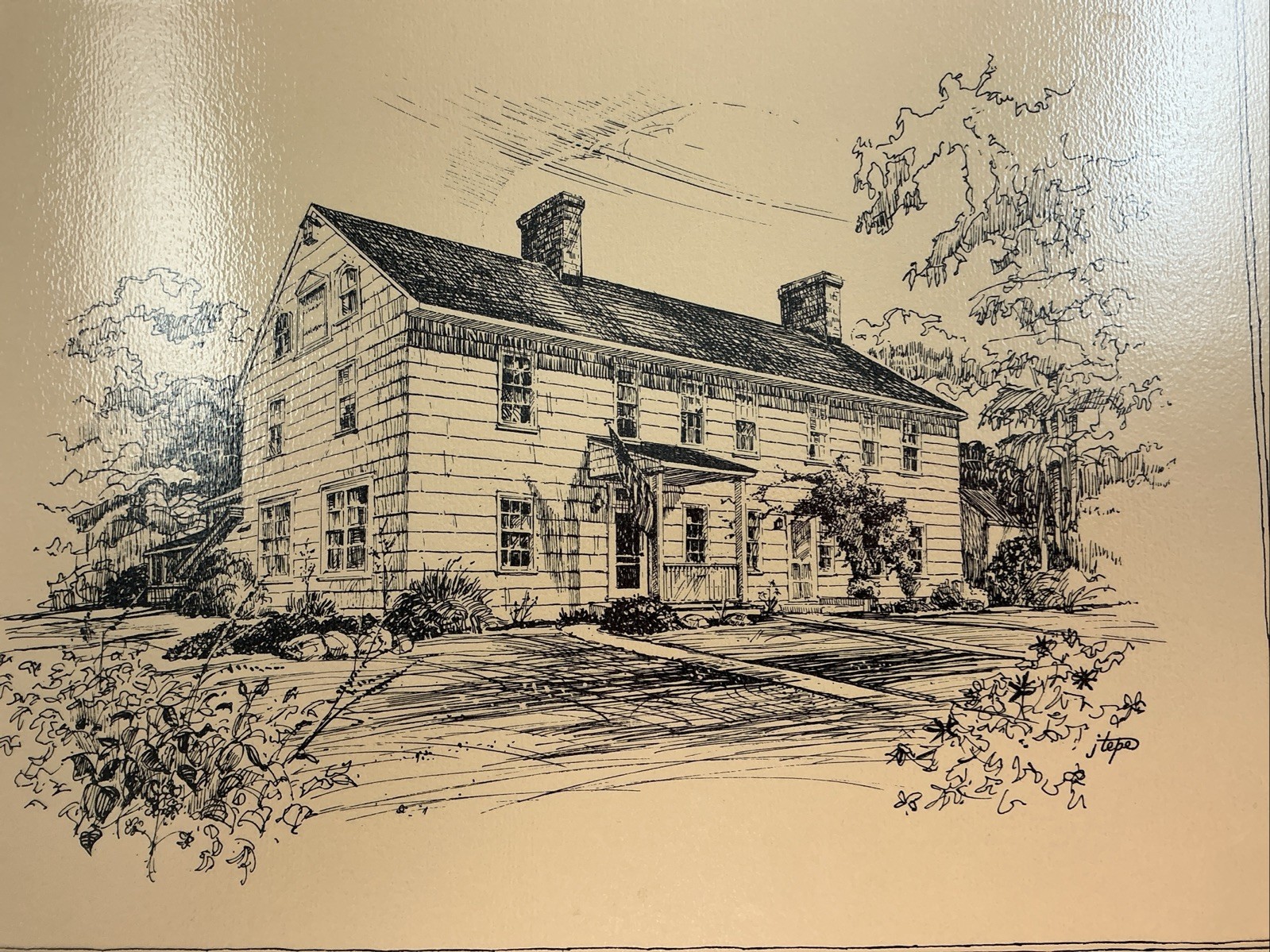
You are looking at a vintage etching print from the 1950’s depicting Mount house in Stony Brook, Long Island, New York.
Signed by J. Tepe, is attributed as “courtesy of the Roslyn Savings Bank" because the artist, Jerome Tepe, created art renditions of Long Island landmarks specifically for the bank. This suggests a commissioned series or a partnership where the bank distributed or utilized Tepe's artwork featuring local Long Island historical sites.
The William Sidney Mount House (also known as the Hawkins-Mount House) is a profoundly significant cultural landmark located at the corner of Route 25A and Stony Brook Road in Stony Brook, New York.
1725 Origins: The oldest section (the west side and rear wing) was built by Eleazer Hawkins, the artist's maternal grandfather. It was originally operated as an "ordinary" (a colonial tavern and inn) for travelers moving across Long Island's North Country Road.
1810 Expansion: The home was substantially enlarged to its current 2.5-story, 20-plus-room footprint. This expansion added the grander, shingled, seven-bay-wide front facade and additional brick chimneys.
The Mount Family Move: William Sidney Mount, along with his mother and four siblings, moved into the ancestral homestead in 1814. The property quickly became a hotbed of American artistic talent; his brother Shepard was an accomplished portraitist, and his brother Henry painted signs and ornaments.The Attic Studio: In 1847, William Sidney Mount permanently moved back into the home and converted the attic into a customized studio space complete with a skylight. He painted many of his nationally revered masterpieces from this exact window, utilizing the local barn, outbuildings, and neighbors as inspiration for his famous American genre scenes.
Preservation: The Mount family retained ownership of the homestead until 1918. Because of its immense role in anchoring 19th-century American art, the house was declared a National Historic Landmark in 1965.
The Promotional Print: The drawing was part of a vintage community history preservation series commissioned courtesy of The Roslyn Savings Bank. During the mid-to-late 20th century, local banks on Long Island frequently distributed these high-quality, pen-and-ink lithograph prints to customers to celebrate and document prominent architectural landmarks in the area.
The print is 13” x 9.5” on a paper measuring 13.75” x 17” sealed in plastic.
It is a very nice print and would make a nice wall hanging.
Please see all photos for complete details. Thank you.