When you click on links to various merchants on this site and make a purchase, this can result in this site earning a commission. Affiliate programs and affiliations include, but are not limited to, the eBay Partner Network.
🎨 Remember When a Painted Woman Could Stop Traffic Before Photography Ever Learned How?
There was a stretch of American print — long before "photo spread" meant anything and long before anyone needed the word "influencer" — when a single painted figure on a magazine page could sell swimsuits, cigarettes, wristwatches, and the magazine itself, all at the same time. Collectors still say her name with a little reverence: the Petty Girl. I've handled a fair amount of vintage paper ephemera over the years, and a factory-sealed box of trading cards built entirely around George Petty's original pin-up art doesn't cross my table often — and finding one still wrapped and never opened is the kind of thing that makes an afternoon.
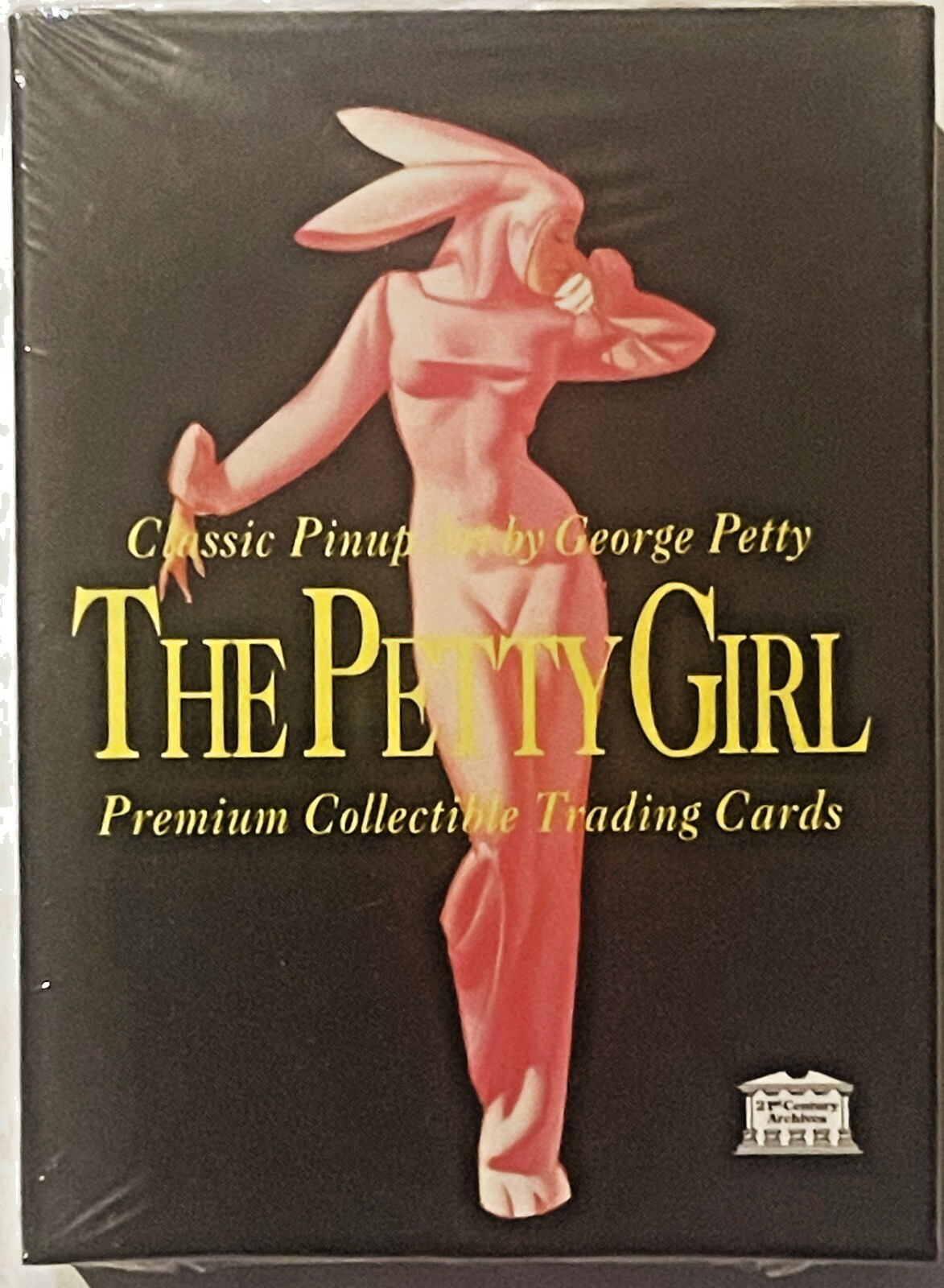
This is The Petty Girl — Classic Pinup Art by George Petty, a 50-card Premium Collectible Trading Card boxed set produced by 21st Century Archives, styled and printed in a manner consistent with the 1990s wave of nostalgia-driven trading card sets built around vintage American illustration. The box itself is a small piece of graphic design in its own right — full color offset lithography in black, pink, yellow, cream, and white, with the brand name and title rendered in a warm metallic gold-toned script and serif lettering that plays off the glamour of the era it's celebrating. The front panel carries a reproduction of one of Petty's signature images: a long-limbed figure caught mid-turn in a pink rabbit-eared showgirl costume, one gloved hand raised, set against a deep black field that makes the pink practically glow. This box comes to you as New Old Stock — sealed at the factory and never opened.
🖌️ The Man Who Put a Woman Inside the Magazine, Not Just on the Cover
The story collectors have long passed down about George Brown Petty IV begins in the deep south — Abbeville, seat of Vermilion Parish, Louisiana — before his family relocated north to Chicago while he was still young, his father working there as a photographer. Petty trained formally at the School of the Art Institute of Chicago under Ruth Van Sickle Ford and spent a stretch studying at the Académie Julian in Paris — the kind of academic grounding that shows up in the confidence of his linework decades later. Back in Chicago by the late 1920s, he opened his own studio and built a solid, workmanlike reputation doing commercial advertising illustration for accounts like Marshall Field's and Atlas Beer — respectable work, but nothing that hinted at what came next.
What came next was October 1933, and the debut issue of a brand-new magazine called Esquire. Almost overnight, a competent regional commercial artist became the man setting the visual standard for American feminine beauty in print. The Petty Girl ran in Esquire from that very first issue clear through 1956, and it was Petty who is credited, in the lore that surrounds him, with essentially inventing the magazine gatefold — the fold-out page that later publications would build entire empires on. Before Petty, a magazine put a pretty woman on the cover to sell the issue. Petty put her inside, living in the pages themselves, and that shift — from cover girl to pin-up — is the one this whole card set is quietly commemorating.
His reach ran well past the printed page. The card box itself compares the Petty Girl's cultural footprint to Harlow and Grable's on the silver screen, and calls George Petty "to the American woman what Norman Rockwell was to the family" — a fair measure of how thoroughly his figure worked its way into the national imagination. Collectors who've traced his advertising work point to a Jantzen swimsuit line marketed under the "Petty Girl" name and tie-ins with Old Gold cigarettes, among other period accounts — the kind of licensing crossover that only happens when an illustrator's figure has become bigger than the magazine that made her famous.
📖 "There Would Have Been No Varga Girl" — The Box Makes Its Own Case
The set doesn't ask you to take its subject's importance on faith — it prints the argument right on the box: "Without George Petty's Petty Girl, there would have been no Varga Girl or Playboy Playmate, for the entire concept of a pinup in a magazine was his. Prior to the Petty Girl, there had been the girl on the magazine cover, but never the girl in the magazine." It's a bold lineage to claim — Petty's gatefold girl leading in a straight line to Alberto Vargas's Varga Girl and, eventually, to the Playboy Playmate — and it's the exact argument that gives this set its reason for existing. Whether you come to this box as a pin-up completist or as someone who collects the broader story of American commercial illustration, that printed claim is the thesis the whole 50-card run is built to support.
Each card in the set carries a back written by Reid Stewart Austin, credited on the box as a "world-renowned authority" on Petty's work — the kind of card-back scholarship that turns a stack of pin-up reproductions into something closer to a small illustrated reference work, with each image tied back to the publication and period it first appeared in across the 1930s, '40s, and '50s.
🃏 The Ridgid Tool Mystery Card
Tucked into the set's marketing is a detail that will make any old-school card collector's ears perk up: one-of-five Ridgid Tool special insert cards, randomly seeded through the boxes. Old-timers who spent time around garages, plumbing shops, and hardware counters will recognize that name on sight — for generations, tool companies were famous for handing out pin-up calendars to mechanics and shop owners as a seasonal thank-you, and the pairing of a tool-company insert with a Petty Girl card taps directly into that beloved shop-wall tradition. It's the kind of insert-card chase mechanic that trading card companies leaned on heavily through the 1990s, and it turns this from a straightforward reprint set into something with an actual hunt built in.
🏛️ 21st Century Archives and the 1990s Nostalgia Card Boom
This set arrives out of a very particular moment in American collecting: the 1990s trading card boom, when card companies discovered that the same collector instinct driving the sports card market could be pointed at almost anything with a nostalgic pull — pin-up art, movie posters, advertising icons, even tool-company calendar girls. 21st Century Archives built this set around that appetite, packaging Petty's decades-old magazine and advertising work into a modern collectible format, complete with scholarly card backs and a chase-card gimmick, aimed squarely at buyers who remembered — or wished they remembered — the golden age of the American pin-up.
💫 Why the Petty Girl Still Turns Heads
Pin-up art occupies a strange and wonderful corner of the collecting world today — equally at home in a mid-century Americana display, a barbershop wall, a garage, or a serious illustration-art collection. George Petty's figures, with their impossibly long lines and confident Art Deco polish, sit at the origin point of an entire genre that runs from Vargas through Playboy and into the pin-up revival culture that's never really gone away. A sealed box like this one preserves that lineage in a format that itself has become collectible in its own right — a 1990s tribute to a 1930s–50s original, still wrapped exactly as it left the factory.
🖼️ Display Ideas
- 🎬 Prop the sealed box upright on a shelf next to other mid-century Americana or advertising art for an instant conversation piece
- 🧰 Pair it with vintage tool-company or garage advertising for a nod to the classic shop-calendar tradition it references
- 🍸 Set it out on a home bar cart or den shelf alongside other Esquire-era ephemera and barware
- 🖋️ Keep it sealed as an investment-grade collectible and store it flat in a display case with other unopened trading card boxes
- 🎁 Give it as a gift to a collector who already has the vintage Esquire originals but is missing this modern tribute set
- 💡 Frame the box art itself (unopened) as a stand-alone piece of pin-up graphic design in a den or studio
🎁 Who Collects These
This set draws in a specific crossover crowd: pin-up and Americana collectors chasing the full Petty/Vargas/Playboy lineage; trading card collectors who specialize in 1990s licensed-art and nostalgia sets rather than sports; vintage advertising and magazine-illustration enthusiasts building out an Esquire-adjacent shelf; garage and man-cave decorators drawn to the Ridgid Tool insert-card angle; and anyone shopping for a genuinely different gift for a collector who thought they already owned everything Petty-related.
❓ FAQ
Is this box actually sealed and unopened?
Yes — this is New Old Stock, still in its factory shrink wrap, never opened or handled.
What era is this set from?
The set's branding, the "21st Century Archives" maker name, and its glossy card-stock trading card format are consistent with the 1990s nostalgia trading card era, produced as a licensed tribute to George Petty's earlier magazine and advertising illustration.
Are the images original 1930s–50s Petty artwork, or new art?
The card box states the 50-card set contains rare images drawn from Petty's original work across the 1930s, '40s, and '50s, reproduced here as a 1990s trading card set rather than new artwork.
What is the Ridgid Tool insert card?
The box advertises a randomly inserted one-of-five Ridgid Tool special card seeded through the sets — a bonus chase card on top of the standard 50.
Who wrote the information on the card backs?
The card backs were written by Reid Stewart Austin, credited on the box as an authority on Petty's work.
Was George Petty connected to Esquire magazine?
Collector history holds that Petty's pin-up work ran in Esquire starting with its debut issue and continued for over two decades, and that his gatefold format helped establish the magazine pin-up as an American institution.
Since it's sealed, will I know exactly which 50 images are inside?
The box itself doesn't checklist the individual cards, so the specific images are part of the surprise of opening a sealed set — consistent with how trading card boxes from this era were sold.