When you click on links to various merchants on this site and make a purchase, this can result in this site earning a commission. Affiliate programs and affiliations include, but are not limited to, the eBay Partner Network.
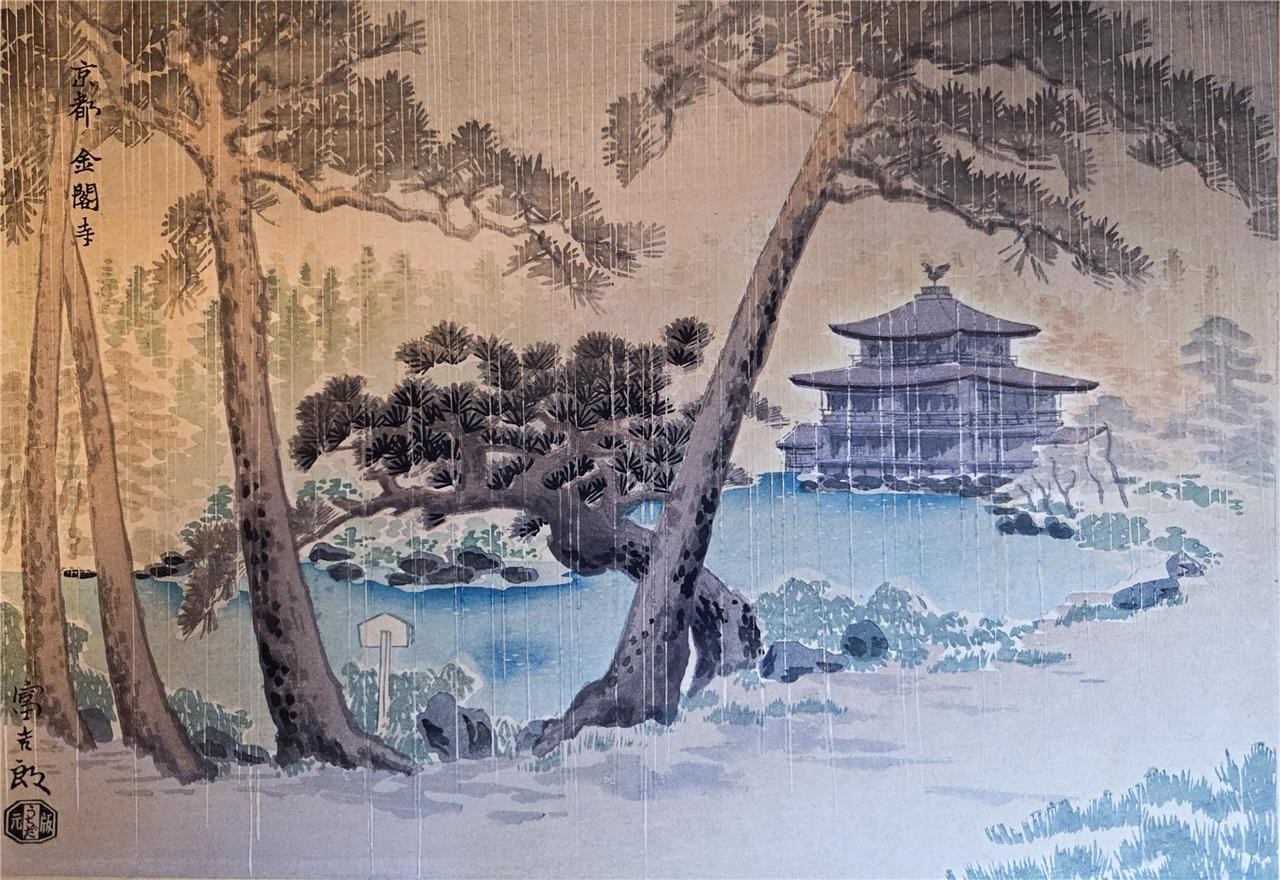
a.imagelink {color:#0000FF;} a:hover.imagelink {color:#0000FF;} a:visited.imagelink {color:#800080;} a.imagelink img.saleimage { border: 2px solid #0000FF; } a:visited.imagelink img.saleimage { border: 2px solid #800080; } Vintage Japanese Woodblock Print Golden Pavilion - Kyoto Kinkaku-ji in Autumn Rain by Tomikichiro Tokuriki c.1941
Presented is a beautiful Japanese oban-size woodblock print created in the 1930s by the renowned artist Tokuriki Tomikichiro.
Tomikichiro Tokuriki (1902–1999) was one of the most versatile Japanese printmakers of the 20th century. He came from a long line of Kyoto-based artists, a family heritage dating back to the Keicho era (1596–1615). Collectors often recognize him for his refined pastel-colored landscape prints, but his lifelong commitment to sosaku hanga (creative prints) reveals a much deeper artistic legacy.
Tomikichiro Tokuriki was born on March 22, 1902, in Kyoto, Japan. He first studied art under his grandfather before entering the Kyoto School of Arts and Crafts, where he completed two years of preparatory courses and four years of regular studies. He then attended the Kyoto College of Art for an additional three years, graduating in 1923. He lived and worked in Kyoto until his death in 1999.
During his student years, Tokuriki became deeply interested in the sosaku hanga movement, which emphasized the artist’s direct involvement in designing, carving, and printing. Trained by a professional carver and an ukiyo-e printer, he mastered the entire printmaking process. This personal engagement embodied the core principles of creative printmaking. Tokuriki joined the Hanga Association, collaborating with leading figures such as Unichi Hiratsuka, Masao Maeda, Kihachiro Shimozawa, Hide Kawanishi, and Shiko Munakata. Through this network, he became one of the central Kyoto-based advocates of sosaku hanga.
Kinkaku-ji (金閣寺, Golden Pavilion) is a Zen temple in northern Kyoto whose top two floors are completely covered in gold leaf. Formally known as Rokuon-ji, the temple was the retirement villa of the shogun Ashikaga Yoshimitsu, and according to his will it became a Zen temple of the Rinzai sect after his death in 1408. Kinkaku-ji was the inspiration for the similarly named Ginkaku-ji (Silver Pavilion), built by Yoshimitsu\'s grandson, Ashikaga Yoshimasa, on the other side of the city a few decades later. Kinkaku-ji is an impressive structure built overlooking a large pond, and is the only building left of Yoshimitsu\'s former retirement complex. It has burned down numerous times throughout its history including twice during the Onin War, a civil war that destroyed much of Kyoto; and once again more recently in 1950 when it was set on fire by a fanatic monk. The present structure was rebuilt in 1955. The print created in 1941, show us the temple as it was before the fire of 1950.
AUTHOR: Tomikichiro Tokuriki
TITLE: Golden Pavilion - Kyoto Kinkaku-ji in Autumn Rain
CREATED: c.1941
PAPER: washi paper
METHOD OF PRINTING: Woodblock printing
PRINTED: c.1941
OVERALL SIZE: Horizontal oban 15\" X 10.25\" excluding margins
BACKING: No
The condition is very good. Great detail and colors, some minor age-related darkening.
Pictures sell!
Auctiva offers Free Image Hosting and Editing.
The complete Selling Solution.
Track Page Views With
Auctiva\'s Counter