When you click on links to various merchants on this site and make a purchase, this can result in this site earning a commission. Affiliate programs and affiliations include, but are not limited to, the eBay Partner Network.
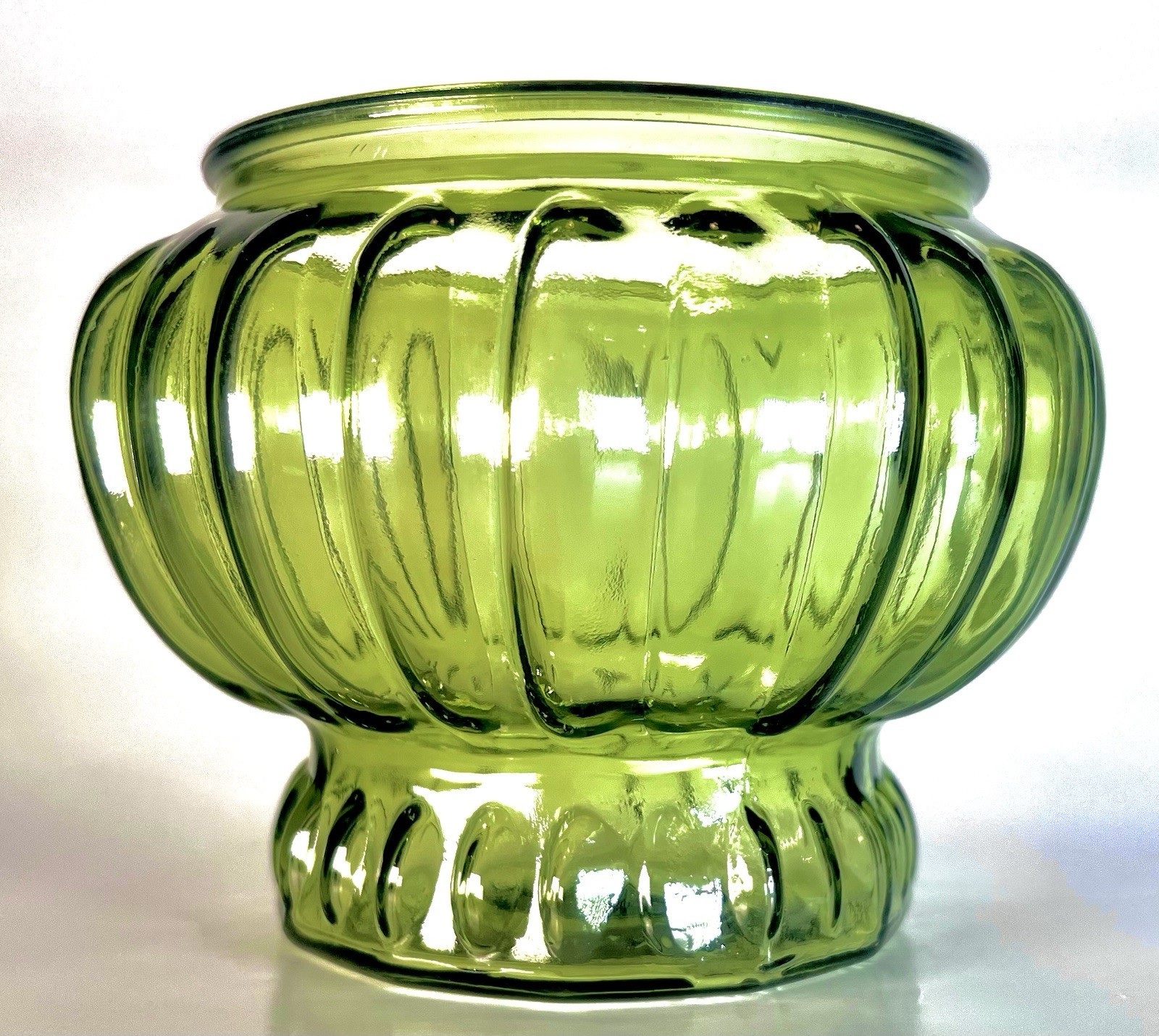
Vintage Olive Green Glass Planter Ribbed Fluted Mid-Century Modern Centerpiece Bowl Inarco #5441 Designer Embossed Stamped
I am selling this super gorgeous and basically flawless and perfect condition, high quality vintage Olive green glass ribbed centerpiece bowl or plantar with a design of fluted bulbous design of vertical pumpkin type rows- all atop of a smaller round cylindrical pediment base.
It was made by a company called Inarco or International Art Ware Corporation. And it is stamped with the maker's mark and model number of #5441.
This brand of mid century modern collectible glasswares are now very highly sought after and are viewed as a total score when lucky enough to locate in your local antique store. Originally based in Cleveland, Ohio, Inarco designed these distinctively ribbed, bulbous glass vessels during the 1960s and 1970s.
This company was known to produce beautifully designed ceramics and glassware that are now very treasured collector finds.
They are widely cherished and highly valued today as classic retro home designed decor and cottagecore accent pieces.
I got this at an estate sale, and as such, you rarely know the source of the item that you purchased there, as a result, you often have to do some guessing as to the age, as well as value of your finds. So I am not totally sure how old this is or what exactly it is worth but from my research, it's likely worth around $100 which I found another just like it for that price, and it's most likely from the 1960's.
From my best research I found the following info:
Key Details
* Type: Vintage olive green glass planter, urn, or centerpiece pumpkin ribbed fluted bowl.
* Color: Green (shades can include emerald or olive/avocado/Melon green shades (this sometimes just depends on lighting).
* Design: Vertical fluted or ribbed panels with a bulbous pumpkin bowl shape on top of a smaller round cylindrical raised footed base.
* Maker: made by mid-century modern glassware producer Inarco (International Art Ware Corporation, Cleveland, Ohio) model #5441 with visually similar contemporaries like E.O. Brody Co.
This comes from a smoke-free and perfume-free home.
SHIPPING:
We ship within 24 hours of receiving payment. We can combine shipping to give cheaper shipping cost when purchasing multiple items.
RETURNS:
If you aren't happy for ANY reason, we will ALWAYS offer a FULL refund, for any reason whatsoever - no questions asked. So, please know that you can buy from us with complete confidence!
It is our highest priority and most important ambition to guarantee you have an enjoyable, fulfilling and trustworthy buying experience with us.
If you have any questions, do not hesitate to ask.
Thank you for looking at my listing.
The following info is from Wikipedia about this item:
A vase (/veɪs/, /veɪz/, or /vɑːz/) is an open container. It can be made from a number of materials, such as ceramics, glass, or non-rusting metals, such as aluminium, brass, bronze, or stainless steel. Even wood has been used to make vases, either by using tree species that naturally resist rot, such as teak, or by applying a protective coating to conventional wood or plastic. Vases are often decorated, and they are often used to hold cut flowers. Vases come in different sizes to support whatever flower is being held or kept in place.
Vases generally share a similar shape. The foot or the base may be bulbous, flat, carinate, or another shape. The body forms the main portion of the piece. Some vases have a shoulder, where the body curves inward, a neck, which gives height, and a lip, where the vase flares back out at the top. Some vases are also given handles.
Various styles and types of vases have been developed around the world in different time periods, such as Chinese ceramics and Native American pottery. In the pottery of ancient Greece "vase-painting" is the traditional term covering the famous fine painted pottery, often with many figures in scenes from Greek mythology. Such pieces may be referred to as vases regardless of their shape; most were in fact used for holding or serving liquids, and many would more naturally be called cups, jugs and so on.
Mid-century modern (MCM) is "a style of design popular in the mid-twentieth century, characterized by clean, simple lines and lack of embellishment."[2] The style was present throughout the world but gained most popularity in North America, Brazil and Europe from roughly 1945 to 1970. MCM style can be seen in interior design, product design, graphic design, architecture and urban development.
MCM-style decor and architecture have seen a major resurgence that began in the late 1990s and continues today.[4]
The term was used as early as the mid-1950s, and was defined as a design movement by Cara Greenberg in her 1984 book Mid-Century Modern: Furniture of the 1950s. It is now recognized by scholars and museums worldwide as a significant design movement.
The MCM design aesthetic is modern in style and construction, aligned with the modernist movement of the period. It is typically characterized by clean, simple lines and honest use of materials, and generally does not include decorative embellishments.
On the exterior, an MCM home is normally very wide, partially brick or glass walls, low footprints with floor to ceiling windows and flat rooflines, while exposed ceilings and beams, open floor plans, ergonomically designed furniture and short staircases connecting rooms throughout the house often define the home's interior.