

|
Site Categories |
|
Featured Items |

Poodle, Spaghetti Trim, Ucagco


|
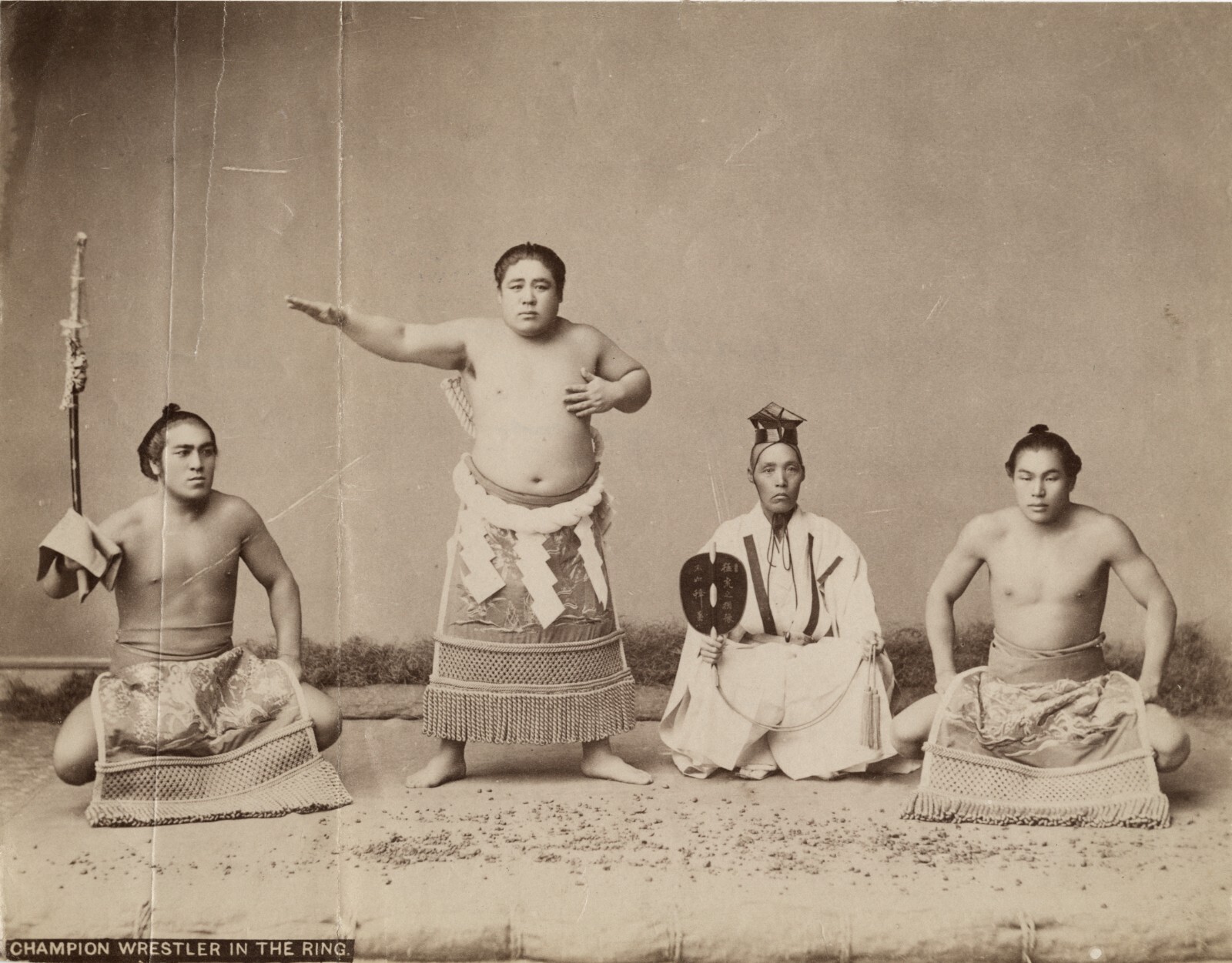
c. 1890's Konishiki Yasokichi I, Sumo 17th Yokozuna Albumen Photo by T. Enami For Sale

When you click on links to various merchants on this site and make a purchase, this can result in this site earning a commission. Affiliate programs and affiliations include, but are not limited to, the eBay Partner Network.

c. 1890's Konishiki Yasokichi I, Sumo 17th Yokozuna Albumen Photo by T. Enami:
$350.00
DATE: c. 1890'sPHOTOGRAPHER:Enami Nobukuni (1859-1929)NOTES: See Subject's and Photographer's bios belowPROCESS: AlbumenSIZE:9.25" x 7.25"CONDITION: Vertical, top-to-bottom, creasing on left side. Scotch tape supporting creasing on back. Slight tears at creasing and on middle-top edge. See photosSHIPPING: Shipping cost is non-negotiable, please consider it when offerding/buying.COMBINED SHIPPING: Yes, I do combine shipping. Additional shipping per item is 20% of the lower shipping cost [For example, if 2 items are purchased that have a $30 and $10 shipping cost each, the combined shipping cost becomes $32 for the 2 items]. If offerding/buying more than 1 item, please wait for an invoice with combined shipping before Yasokichi I (小錦 八十吉, November 21, 1866 – October 22, 1914) was a Japanese professional sumo wrestler from Musha District, Kazusa Province. He was the sport's 17th yokozuna.Early life and career:His real name was Iwai Yasokichi (岩井 八十吉). He was the son of a former ōzeki named Iwajikawa (岩城川) who wanted his son to become a rikishi. His father asked professional wrestler Takamiyama Sogoro (高見山宗五郎), who had come to Sakura on a tour in 1881, to initiate his son into the sport in Takasago stable. At first, Iwai was unable to endure the rigorous training and ran away to his parents' house a couple of times, but with his father's encouragement, he decided to rejoin in 1883 and took up the name Konishiki (小錦). Konishiki earned the nickname of "Kurueru shirozō" (狂える白象, 'raging white elephant') because of his soft, fair-skinned body and ability to get off his feet. He was very popular for his white body, gentle and pretty appearance, and warmth and innocence. He was also a popular figure in the sumo world because of his low profile, honesty, earnestness and his work ethic.Yokozuna:When he received his yokozuna license from the Yoshida family after the May 1896 tournament, he was the first yokozuna in history to receive the license while in his 20s. However, he was already past his prime and did not win a single championship when competing at this rank. It is said that his results were so weak because, around the time of his promotion to yokozuna, his stablemaster (former sekiwake Takamiyama Sōgorō [ja]) suffered an illness, and so Konishiki took care of him. In spite of his amazing debut, he did not have the best record in any tournaments as yokozuna. On April 8, 1900, his stablemaster died. Konishiki was absent from the next tournament and retired in January 1901. In the top makuuchi division, he won 119 bouts and lost 24 bouts, recording a winning percentage of 83.2.Retirement from sumo and death:Konishiki stayed in the Tokyo Sumo Association as an elder under the name of Hatachiyama (二十山). He founded the eponymous stable [ja] and raised komusubi Konishiki Yasokichi II [ja]. Konishiki's great hobby was reading novels and he continued to have a good relationship with the younger wrestlers who replaced him at the top of sumo. Among others, yokozuna Umegatani Tōtarō I and ōzeki Araiwa Kamenosuke would come to listen to him read.Konishiki died on October 22, 1914, at 47. He died just before being officially granted the name "Takasago". As the title was posthumously awarded, he is not counted in the list of Takasago elders. After his death, the Takasago name was succeeded by Asashio Tarō II, who became the stable head coach.Homage:The Konishiki shikona is considered a prestigious legacy in Takasago stable. The name is traditionally bestowed to promising wrestlers. Hawaiian-born ōzeki Konishiki Yasokichi was named after him but is actually the 6th generation Konishiki. In total, three wrestlers named Konishiki have been promoted to the top makuuchi division.Fighting style:Konishiki made up for his lack of physical strength with intense training. He was famous for his tachi-ai, attacking so quickly he had already started the match before the gyōji had the time to finish saying "hakkeyoi". He was good at pushing through and was known as a versatile fighter who could strike, hang, throw, and twist. In addition his style was a combination of fierce and agile Enami (江南 信國, Enami Nobukuni, 1859 – 1929) was the trade name of a Meiji period Japanese photographer. The T. of his trade name is thought to have stood for Toshi, though he never spelled it out on any personal or business document.Biography:Born in Edo (now Tokyo) during the Bakumatsu era, Enami was first a student of, and then an assistant to the well known photographer and collotypist, Ogawa Kazumasa. Enami relocated to Yokohama, and opened a studio on Benten-dōri (Benten Street) in 1892. Just a few doors away from him was the studio of the already well known Tamamura Kōzaburō. He and Enami would work together on at least three related projects over the years.Enami became quietly unique as the only photographer of that period known to work in all popular formats, including the production of large-format photographs compiled into what are commonly called "Yokohama Albums". Enami went on to become Japan's most prolific photographer of small-format images such as the stereoview and glass lantern-slides. The best of these were delicately hand-tinted. His images in all formats eventually appeared in books and periodicals having press-runs in the millions. The Japanese stereoview lines of at least three major American publishers were made up entirely of T. Enami images.Enami survived the 1923 Great Kantō earthquake, and rebuilt his studio which had been destroyed by the quake and subsequent fire. After his death at age 70 in 1929, his first son Tamotsu took over the studio until it was once again demolished in 1945 by the Allied bombing of Yokohama during World War II.Legacy:Because Tamotsu shared the initial "T" with his father, photo-historians later confused attribution of the father's photographs with those produced by his son. Terry Bennett, in his book Photography in Japan 1853–1912 offered interesting commentary concerning the "father or son" attribution problem. The Enami family in Yokohama later resolved the mystery: Tamotsu was not a photographer, and T. Enami never stood for Tamotsu Enami. Rather, the son maintained the studio, and continued the production and sale of his father's old photographs. Fortunately, due to sharing the same first-name initial with his father, he didn't have to change the letterheads or labels of the company ephemera. These revelations, and other biographical data appeared in an essay and stereoview index entry written by Okinawa-based photo researcher Rob Oechsle, and published in Bennett's follow-up volume, Old Japanese Photographs – Collectors' Data Guide.Philbert Ono of PhotoGuide Japan has also speculated on the possibility that T. Enami intentionally named his son with a leading T in the hope that he would someday take over the studio.Perhaps the greatest posthumous honor conferred on Enami was the selection of one of his images to be the sole inset-photograph appearing on the first-edition cover of the monumental Odyssey, The Art of Photography at National Geographic. Early in their history, Enami had been a contributing photographer to the magazine.
|
|
Related Items:Too many requests. | |
