When you click on links to various merchants on this site and make a purchase, this can result in this site earning a commission. Affiliate programs and affiliations include, but are not limited to, the eBay Partner Network.
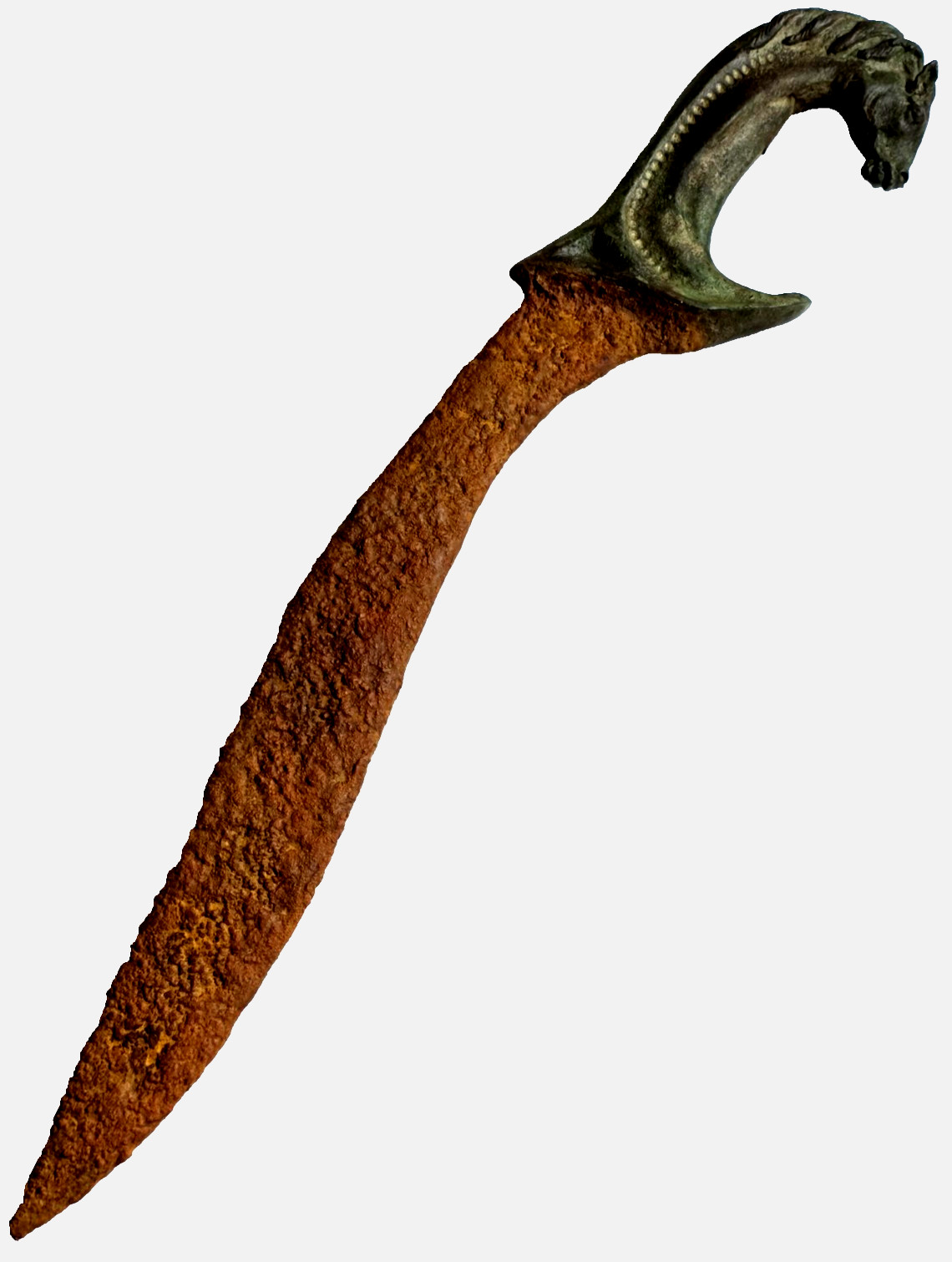
This authentic ancient Roman gladiator battle combat sword is a rare and exquisite artifact crafted with wrought iron and bronze materials. It features a multi-color design and comes with a certificate of authenticity. Expert evaluations have been conducted on the composition of the metals, ensuring its authenticity and origin from Europe, specifically Italy. This original Roman sword, dating back to the ancient Roman era, showcases intricate details and is a valuable decorative collectible for any history enthusiast or collector.
Gladiator : A gladiator (Latin: gladiator \'swordsman\', from Latin gladius \'sword\') was an armed combatant who entertained audiences in the Roman Republic and Roman Empire in violent confrontations with other gladiators, wild animals, and condemned criminals. Some gladiators were volunteers who risked their lives and their legal and social standing by appearing in the arena. Most were despised as slaves, schooled under harsh conditions, socially marginalized, and segregated even in death. Irrespective of their origin, gladiators offered spectators an example of Rome\'s martial ethics and, in fighting or dying well, they could inspire admiration and popular acclaim. They were celebrated in high and low art, and their value as entertainers was commemorated in precious and commonplace objects throughout the Roman world. The origin of gladiatorial combat is open to debate. There is evidence of it in funeral rites during the Punic Wars of the 3rd century BC, and thereafter it rapidly became an essential feature of politics and social life in the Roman world. Its popularity led to its use in ever more lavish and costly games.The gladiator games lasted for nearly a thousand years, reaching their peak between the 1st century BC and the 2nd century AD.Lightly armed and armoured fighters, such as the retiarius, would tire less rapidly than their heavily armed opponents; most bouts would have lasted 10 to 15 minutes, or 20 minutes at most. In late Republican munera, between 10 and 13 matches could have been fought on one day; this assumes one match at a time in the course of an afternoon. Spectators preferred to watch highly skilled, well matched ordinarii with complementary fighting styles; these were the most costly to train and to hire. A general melee of several, lower-skilled gladiators was far less costly, but also less popular. Even among the ordinarii, match winners might have to fight a new, well-rested opponent, either a tertiarius (\"third choice gladiator\") by prearrangement; or a \"substitute\" gladiator (suppositicius) who fought at the whim of the editor as an unadvertised, unexpected \"extra\". This yielded two combats for the cost of three gladiators, rather than four; such contests were prolonged, and in some cases, more bloody. Most were probably of poor quality, but the emperor Caracalla chose to test a notably skilled and successful fighter named Bato against first one supposicitius, whom he beat, and then another, who killed him. At the opposite level of the profession, a gladiator reluctant to confront his opponent might be whipped, or goaded with hot irons, until he engaged through sheer desperation.
Combats between experienced, well trained gladiators demonstrated a considerable degree of stagecraft. Among the cognoscenti, bravado and skill in combat were esteemed over mere hacking and bloodshed; some gladiators made their careers and reputation from bloodless victories. Suetonius describes an exceptional munus by Nero, in which no-one was killed, \"not even noxii (enemies of the state).\" Trained gladiators were expected to observe professional rules of combat. Most matches employed a senior referee (summa rudis) and an assistant, shown in mosaics with long staffs (rudes) to caution or separate opponents at some crucial point in the match. Referees were usually retired gladiators whose decisions, judgement and discretion were, for the most part, respected; they could stop bouts entirely, or pause them to allow the combatants rest, refreshment and a rub-down. Ludi and munera were accompanied by music, played as interludes, or building to a \"frenzied crescendo\" during combats, perhaps to heighten the suspense during a gladiator\'s appeal; blows may have been accompanied by trumpet-blasts. The Zliten mosaic in Libya (circa 80–100 AD) shows musicians playing an accompaniment to provincial games (with gladiators, bestiarii, or venatores and prisoners attacked by beasts). Their instruments are a long straight trumpet (tubicen), a large curved horn (Cornu) and a water organ (hydraulis). Similar representations (musicians, gladiators and bestiari) are found on a tomb relief in Pompeii.
Victory and defeatA match was won by the gladiator who overcame his opponent, or killed him outright. Victors received the palm branch and an award from the editor. An outstanding fighter might receive a laurel crown and money from an appreciative crowd but for anyone originally condemned ad ludum the greatest reward was manumission (emancipation), symbolised by the gift of a wooden training sword or staff (rudis) from the editor. Martial describes a match between Priscus and Verus, who fought so evenly and bravely for so long that when both acknowledged defeat at the same instant, Titus awarded victory and a rudis to each. Flamma was awarded the rudis four times, but chose to remain a gladiator. His gravestone in Sicily includes his record: \"Flamma, secutor, lived 30 years, fought 34 times, won 21 times, fought to a draw 9 times, defeated 4 times, a Syrian by nationality. Delicatus made this for his deserving comrade-in-arms.\"A gladiator could acknowledge defeat by raising a finger (ad digitum), in appeal to the referee to stop the combat and refer to the editor, whose decision would usually rest on the crowd\'s response. In the earliest munera, death was considered a righteous penalty for defeat; later, those who fought well might be granted remission at the whim of the crowd or the editor. During the Imperial era, matches advertised as sine missione (usually understood to mean \"without reprieve\" for the defeated) suggest that missio (the sparing of a defeated gladiator\'s life) had become common practice. The contract between editor and his lanista could include compensation for unexpected deaths; this could be \"some fifty times higher than the lease price\" of the gladiator.
Under Augustus\' rule, the demand for gladiators began to exceed supply, and matches sine missione were officially banned; an economical, pragmatic development that happened to match popular notions of \"natural justice\". When Caligula and Claudius refused to spare defeated but popular fighters, their own popularity suffered. In general, gladiators who fought well were likely to survive. At a Pompeian match between chariot-fighters, Publius Ostorius, with previous 51 wins to his credit, was granted missio after losing to Scylax, with 26 victories. By common custom, the spectators decided whether or not a losing gladiator should be spared, and chose the winner in the rare event of a standing tie. Even more rarely, perhaps uniquely, one stalemate ended in the killing of one gladiator by the editor himself. In any event, the final decision of death or life belonged to the editor, who signalled his choice with a gesture described by Roman sources as pollice verso meaning \"with a turned thumb\"; a description too imprecise for reconstruction of the gesture or its symbolism. Whether victorious or defeated, a gladiator was bound by oath to accept or implement his editor\'s decision, \"the victor being nothing but the instrument of his [editor\'s] will.\" Not all editors chose to go with the crowd, and not all those condemned to death for putting on a poor show chose to submit: Once a band of five retiarii in tunics, matched against the same number of secutores, yielded without a struggle; but when their death was ordered, one of them caught up his trident and slew all the victors. Caligula bewailed this in a public proclamation as a most cruel murder.
STORAGE METHOD : Please do not clean under any circumstances with water or a damp cloth( there is a risk of damaging the patina ). Store in a dry place and in a roomfree from moisture. Protect from impacts with hard objects to avoid damagingthe surfaces and patina. Clean and polish with a soft DRY cotton cloth.
Expertise of the materials ( EXPERT EVALUATION CONTROL NUMBER : 3785197): BLADE WROUGHTIRON. HANDLE BRONZE with authentic GENUINE OLD PATINA.
MUSEUM GRADE RESTORED
GUARANTEES: We give for buyer a 100%lifetime warrantyfor theuniquenessof this artifactONE OF A KINDEXTREMELYUNIQUE.
Odds are you\'llnever see another come up for sale !!!
CERTIFICATEOF AUTHENTICITY (COA) :Below in the listing description, for your convenience and security, is a CERTIFICATE OF AUTHENTICITY(COA) AVAILABLE.
How to obtaina COA - Please print the description and photos( Photos of your choice ), from the listing if desired (laminate) and apply theprinted documents and Photos to the item.
TheAuthenticity of our items is guaranteed and protectedby our 100% buyer satisfaction guarantee as well as a guaranteed one hundredpercent opportunity to return the item and receive a full refund of the amountyou purchased it for, according to policies.
CERTIFICATE OF AUTHENTICITY (COA)NUMBER : 3785197
1. Expertise of thematerials ( EXPERTEVALUATION CONTROLNUMBER : 3785197) : BLADE WROUGHT IRON. HANDLE BRONZE with authentic GENUINE OLD PATINA.
2. MEASUREMENTS & WEIGHT : Weight1981grams : Total length including handle555millimeters : Width blade at widest part50millimeters
3. Condition : Extremely Fine - Museum grade restored
4. GUARANTEES : We give for buyer a 100% lifetime warranty for the uniqueness of this artifact ONE OF A KIND EXTREMELY UNIQUE.
5.Abbreviations, inscriptions, images : At the top of Handle is depicting clear and high detailed head of HORSE.
The UNIQUESWORD is presented in its unaltered condition,with detailing of the features clearly visible, a relatively smooth surface,and a naturally aged patina, deep covered in molted variations of hues andcolours as maintained. If you examine the enlarged photos of this SWORD, you\'ll see that it has been meticulouslycrafted with stunning details. I\'m confident that you\'ll be 100% satisfied withthis sword,which is not only a beautiful work of art but also great antiquities. Thank youfor considering our offerings, and we look forward to serving you !!! At ourshop, we take pride in offering a unique collection of Ancient Artifacts ofdiverse cultures from different eras that are truly one-of-a-kind. Many of these items are quite old andrare, and once they are sold, we may not be able to find another one to replaceit. That\'s why we believe that whoever possesses one of these special swords can be considered to have true pride. Weunderstand that our customers are discerning collectors who appreciate thevalue and significance of these rare artifacts. That\'s why we make every effortto ensure that our collection is authentic and of the highest quality. Webelieve that owning one of these swordsis not just a matter of acquiring abeautiful object, but also of connecting with a rich cultural tradition thatspans centuries. So if you\'re looking for a truly unique sword to add to your collection - you are in theright place ! Our inventory represents time-tested investment quality itemswith everlasting decorative beauty. We look forward to your business andappreciate any reasonable offers. All of our curated items are vetted andguaranteed authentic and as described. We only deals in original antiques andnever reproductions. 100% Customer Satisfaction Guaranteed - We are extremelyconfident that all items presented from our collection are genuine antiques.
Dear buyers, please keep in mind that we are dealing with ancient and antiqueitems. You should not expect ancient and antique items to be as brand new ones.They always have some degree of wearing. Please, take care to examine thephotos and read descriptions. Thank you.
The photos are part of the descriptionin this Listing !!! Dear Customers, you will receiveexactly the same item which you see on the pictures, not similar or other.Please read the description carefully and review the photos. All items, which Isell, are captured with high - photographic equipment and the photos, which Iinsert in my sales, are with high resolution. The photos are absolutelyclear and the potential buyer can truly identify the item, which purchased.Photos are not further processed by specialized software! Upon purchase myitem, you will receive exactly the same item which you saw on the photo !!! Thepictures in listing are CLEAR with opportunities ZOOM for expansion + VIDEO sothat you can perfectly identify all the details of item !
RETURNS : IF YOU HAVE ANY REASON TO DOUBTA ITEM THAT YOU HAVE PURCHASED, YOU MAY RETURN IT WITHIN 14 DAYS !!!
Thank you foryour time, I wish you successful and happy days.