When you click on links to various merchants on this site and make a purchase, this can result in this site earning a commission. Affiliate programs and affiliations include, but are not limited to, the eBay Partner Network.
War of 1812, Napoleonic War.
[140 original daily newspapers, asking $850 the equivalent of just $6.07 per 211-year-old newspaper ]
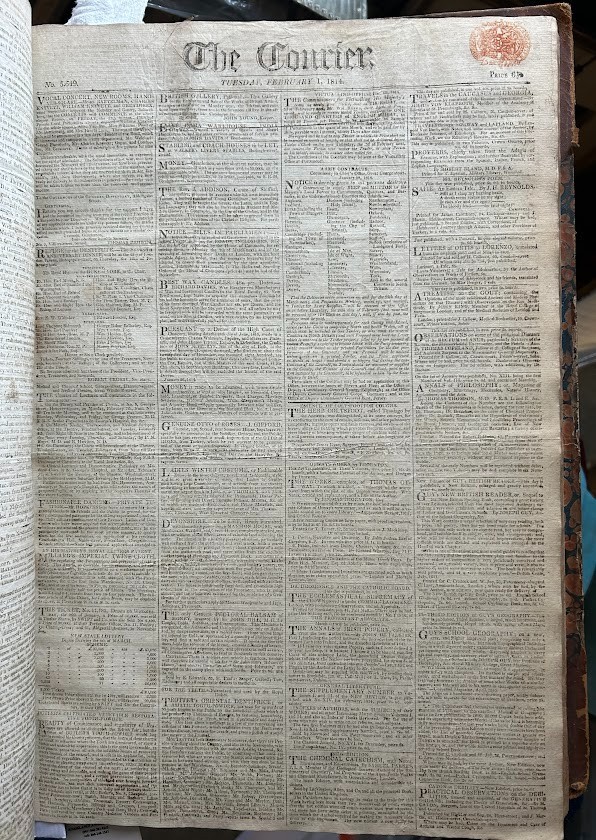
The Courier.
London: printed by B.McSwyny, published by J.W. Haywood, Friday November 19th 1813 –Wednesday June 15th 1814. 1 volume containing a selection of 140issues (not a continuous run, there arenumerous gaps), folio (18 ¾ x 12 ½ inches). (Old folds, occasional issues withsections torn away with loss, about half of the issues with a central hole leadingto some loss, scattered staining, about 20 issues shaved with a little loss).19th-century half leather over marbled paper-covered boards, spine ruledand lettered in gilt (worn, heavily scuffed, lower cover detached, the uppercover almost detached, spine heavily rubbed).
An excellent selection of this ‘daily’ newspaper (it wasactually only published 6 days a week – Sunday was a day of rest). Each issueran to four pages – this usually meant page 1 was advertisements, pages 2 and 3:news, reviews, etc., and page 4 either adverts or a mixture of adverts andnews. Every issue should have had a red duty stamp added to the upper right corner of the first page - some of these are very faint, others were truncated when the volume was bound - see images for some better clearer examples .
·The War of 1812 between the UnitedStates and Great Britain intensified. On 18 December 1813, British and Nativeforces captured Fort Niagara, and over the next weeks, retaliatory raidsdestroyed the American towns of Lewiston and Buffalo as retribution for earlierAmerican attacks in Canada.
·In March 1814, the Battle of HorseshoeBend saw Andrew Jackson lead American forces (with Native allies) to defeat theRed Stick Creek faction in Alabama, ending significant Indian resistance there.
·American and British operationscontinued across the Niagara frontier and in Upper Canada, with both sidesfortifying, raiding, and occasionally capturing each other's positions.
·In spring 1814, with Napoleon’s defeat,the British redeployed experienced veteran troops to North America, setting thestage for the war’s last and most famous battles later in 1814.
·Britain strengthened its effortsagainst Napoleon by supporting the coalition powers in Europe and sendingadditional troops to the Low Countries and Spain, helping to liberate moreterritory from French control.
·British and coalition victories on thecontinent allowed Great Britain to divert more military resources to the war inNorth America, directly impacting the War of 1812.
·The campaign that would culminate inNapoleon’s first abdication was underway. The Allies (Britain, Russia, Prussia,Austria, and Sweden) invaded France after driving French forces out of Germanyduring late 1813.
·On 19–22 December 1813, the Alliesbesieged Breda in the Netherlands; by January, they fought the Battle ofHoogstraten in the Low Countries, with coalition forces slowly overwhelmingremaining French resistance.
·The Siege of Danzig ended in earlyJanuary 1814, removing another French stronghold.
·The French Campaign of early 1814 sawmajor battles as Allied armies closed in on Paris, ultimately forcingNapoleon’s abdication on 6 April 1814 and his exile to Elba.
·In the Iberian Peninsula, British-Alliedadvances drove French forces toward the Pyrenees and back into France, withlocalized fighting continuing during this period, especially in northern andwestern Spain.
·The Treaty of Kiel (January 1814) endedDenmark’s involvement in the war and forced it to cede Norway to Sweden as partof the coalition settlement.
This half-year was pivotal, withNapoleon’s collapse and abdication realigning European affairs, while in theAmericas, the War of 1812 escalated due to new British resources and continuedfrontier clashes with profound consequences for U.S.–British and Native Americanrelations