When you click on links to various merchants on this site and make a purchase, this can result in this site earning a commission. Affiliate programs and affiliations include, but are not limited to, the eBay Partner Network.
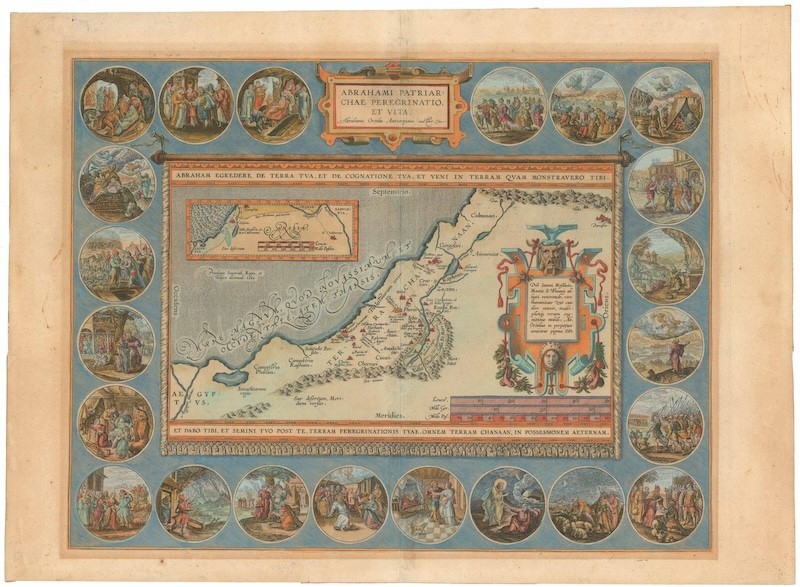
56.5 x 40.5 cm (22.25 x 16 in). Very good with fine contemporary color. Some remnants of hanging tape and mat burn on the verso.Ortelius\' map of the Holy Land, illustrating the life of Abraham, is a finely colored and highly decorative example of his cartographic artistry. Known as \'The Wanderings of Abraham,\' this map is among Ortelius\' most elaborate productions, showcasing his combined talents as a mapmaker, artist, and historian.
The map is a remarkable historical document. It reflects the geographical and cultural understanding of the time and provides a visual narrative of one of the most significant figures in biblical history.Historical and Artistic Significance
Ortelius\' map, first added to the Theatrum Orbis Terrarum in 1590, is based on the geography of the Holy Land during Abraham\'s time. It features 22 medallion vignettes depicting key episodes in Abraham\'s life, making it a geographical document and a visual historical narrative. The map attempts to be geographically faithful to Abraham\'s era, with tribal names and territorial divisions as they were during his lifetime. Cities such as Sodom and Gomorrah are marked.
Kenneth Nebenzahl highlights the map\'s significance, noting it as one of Ortelius\' most elaborate compositions, demonstrating his skills as a cartographer, artist, and historian. The map is drawn in a trompe l\'oeil style, presenting it as a wall map with rollers and nails. Unlike most maps in Ortelius\' atlas, this and other maps depicting classical and ancient geography were composed by Ortelius himself, reflecting his personal interest in these areas.Map Details
The map shows the land of Canaan, with an inset labeled \'Arabia\' detailing the wanderings of Abraham, the first patriarch of Judaism. The primary map depicts territorial divisions described in the Book of Genesis, with ancient tribal names, cities, significant fortifications, and geographical features. The inset traces Abraham\'s journey from Ur of the Chaldees in the lower Euphrates Valley to Shechem, Bethel, Damascus, Egypt, and Hebron.
The decorative outer border contains twenty-two beautiful medallions depicting scenes from Abraham\'s biblical account, such as the sacrifice of Isaac. Two decorative cartouches further embellish the map, enhancing its visual appeal.Latin Inscription
The map includes a Latin text bordering the primary map, which translates to: \'Abraham, go out from your land with your family to a land which I will show you and will give to you and your descendants after you, the land, all the land of Canaan, for an everlasting possession.\'This elaborate map of the Holy Land is based on the biblical command given to Abraham to take his family and journey to a land that would be shown to him and given to his descendants as an everlasting possession.