When you click on links to various merchants on this site and make a purchase, this can result in this site earning a commission. Affiliate programs and affiliations include, but are not limited to, the eBay Partner Network.
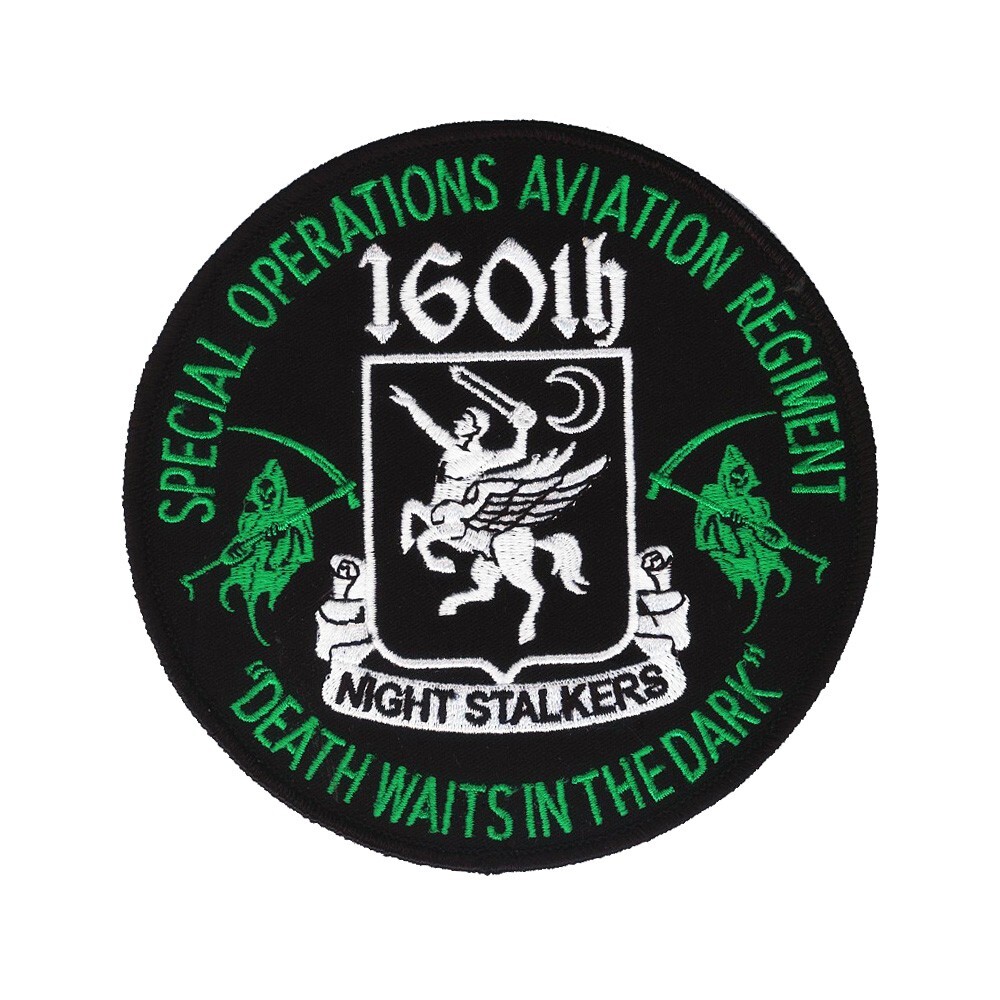
160th SOAR patch - Night Stalkers - Death Waits in the Night - 5" Wax Backed Patch
The United States Army 160th Special Operations Aviation Regiment (Airborne), also known as Night Stalkers, is a special operations force of the United States Army that provides helicopter aviation support for general purpose forces and special operations forces. Its missions have included attack, assault, and reconnaissance, and are usually conducted at night, at high speeds, low altitudes, and on short notice. The 160th SOAR is headquartered at Fort Campbell, Kentucky.
OverviewThe regiment consists of four "operations" battalions: the 1st and 2nd at Fort Campbell, the 3rd at Hunter Army Airfield, Georgia, and the 4th at Joint Base Lewis-McChord, Washington.
The 160th SOAR (A) consists of the Army's best-qualified aviators, Crew Chiefs and support soldiers. Officers volunteer while enlisted soldiers volunteer or are assigned by the U.S. Army Human Resources Command. All soldiers receive intensive training upon joining the 160th and are required to pass the Green Platoon course. The basic Night Stalker course for enlisted soldiers lasts five weeks; the officer course lasts 20 to 28 weeks. A new Night Stalker arrives to his unit Basic Mission Qualified (BMQ), after a series of test qualifications, experience and leadership, the Night Stalker is designated Fully Mission Qualified (FMQ). After three to five years as an FMQ, the Night Stalker will have the chance to assess for flight lead qualification. The 160th previously recruited men only for staff positions, but as of June 2013 has opened combat positions to females as well.
HistoryAfter the 1980 Operation Eagle Claw attempt to rescue American hostages held in Tehran, Iran, failed, President Jimmy Carter ordered former Chief of Naval Operations Adm. James L. Holloway III to figure out how the U.S. military could best mount another attempt. At the time there were no U.S. helicopter units trained in this kind of stealthy, short-notice Special Operations mission.
The Army looked to the 101st Aviation Group, the air arm of the 101st Airborne Division (Air Assault), which had the most diverse operating experience of the service's helicopter units, and selected elements of the 158th Aviation Battalion, 229th Aviation Battalion, and the 159th Aviation Battalion. The chosen pilots immediately entered intensive training in night flying.
This provisional unit was at first dubbed Task Force 158 since the majority of the pilots were Blackhawk aviators detached from the 158th. Their distinctive 101st "Screaming Eagle" patches remained on their uniforms. The Blackhawks and Chinooks continued to operate around Campbell Army Airfield at the north of post, and Saber Army Heliport at the south. The OH-6 Cayuses, an aircraft that vanished from the division's regular inventory after Vietnam, were hidden out by the ammunition holding area at a location still known as the "SHOC Pad", for "Special Helicopter Operations Company".
As the first batch of pilots completed training in the fall of 1980, a second attempt to rescue the hostages was planned for early 1981. Dubbed Operation Honey Badger, it was called off when the hostages were released on the morning of President Ronald Reagan's inauguration.
The capability gained was judged too important to future contingencies to lose. The new unit was quickly recognized as the Army's premier night fighting aviation force, and its only Special Operations Aviation force. The pilots and modified aircraft would not be returned to the 101st. Original members of the Night Stalkers refer to it as "the day the Eagles came off". The 101st's patches came off, the personnel and equipment would be reassigned, and a new tradition was born. The unit was officially established on 16 October 1981, when it was designated as the 160th Aviation Battalion.
The 160th first saw combat during 1983's Operation Urgent Fury, the U.S. invasion of Grenada.
In 1986, it was re-designated as the 160th Aviation Group (Airborne); and in May 1990, the 160th Special Operations Aviation Regiment (Airborne). As demand for highly trained Special Operations Aviation assets bloomed, the regiment activated three battalions, a separate detachment, and incorporated one Army National Guard unit, the 1st Battalion, 245th Aviation (OK ARNG).
In 1987 and 1988, its pilots took part in Operation Earnest Will, the protection of re-flagged Kuwaiti tankers in the Persian Gulf during the Iran–Iraq War. They flew from US Navy warships and leased oil barges in a secret sub-part called Operation Prime Chance, and became the first helicopter pilots to use night vision goggles and forward looking infrared devices in night combat.
In June 1988, the unit executed Operation Mount Hope III. Two MH-47 crews flew 490 miles (790 km) deep into Chad to retrieve a crashed Mi-24 Hind medium-attack helicopter.
The Night Stalkers spearheaded Operation Just Cause, the 1989 invasion of Panama, and they were also used in Operation Desert Storm in 1991.
In October 1993 in Somalia, Night Stalkers became involved in the Battle of Mogadishu, which later became the subject of the book Black Hawk Down, and its film adaptation. Two Night Stalker Black Hawks, Super 6-1 (piloted by Cliff Wolcott), and Super 6-4 (piloted by Mike Durant), were shot down in the battle. Five of the eighteen men killed (not counting a nineteenth post-operation casualty) in the Battle of Mogadishu were members of the SOAR(A) Night Stalkers team, who were lost along with the two Black Hawks.
Afghanistan 2001: On 19 October an MH-47E carrying ODA 595 landed at Dehi. They flew over 150 miles from Karshi-Khanabad (K2) in Uzbekistan. A few weeks later ODA 595 and ODA 555 along with the Northern Alliance retook the city of Mazari Sharif from the Taliban.
In December the same year Night Stalker crews were essential in resupplying over 150 Delta Force, British SBS and CIA SAD operatives during their hunt for Osama bin Laden in the Tora Bora mountain complex.
Philippines, 2002: Chinook helicopter lost-10 killed while supporting the Philippine Army special operations Soldiers trying to rescue American missionary Gracia Burnham, of Wichita, Kansas, held captive approximately two years. Her husband Martin was killed during the subsequent rescue. Later in 2002, TF160th Soldiers supported a Philippine Army ambush at sea killing Abu Sayya, the terrorist organization founder and leader.
Afghanistan, 2005: Eight Night Stalkers were lost along with eight Navy SEALs on a rescue mission for Marcus Luttrell, after their MH-47 Chinook helicopter was hit by an RPG (rocket propelled grenade). They were sent out to look for Luttrell after Operation Red Wings, in which he was involved with three other SEALs, was compromised and Luttrell's teammates killed. The Night Stalkers lost on the search and rescue mission included:
SSG, Shamus O. Goare, 29, of Danville, OhioChief Warrant Officer, Corey J. Goodnature, 35, of Clarks Grove, Minnesota.SGT, Kip A. Jacoby, 21, of Pompano Beach, FloridaSFC, Marcus V. Muralles, 33, of Shelbyville, IndianaMSG, James W. Ponder III, 36, of Franklin, TennesseeMAJ, Stephen C. Reich, 34, of Washington Depot, Connecticut.SFC, Michael L. Russell, 31, of Stafford, VirginiaChief Warrant Officer, Chris J. Scherkenbach, 40, of Jacksonville, FloridaThe 160th provided aviation support during numerous special operations raids during the invasion of Iraq in 2003. One of them was the rescue mission of PFC. Jessica Lynch taken prisoner in 2003, the raid in Al Qadisiyah, as well as the rescue of three Italian contractors and one Polish businessman held for ransom by Iraqi insurgents in 2004.
Night Stalker helicopters were present during the 2008 SOCOM counter-terror exercises in Denver.
On 24 April 2008, Company D, 160th SOAR was inactivated at a ceremony conducted at Hunter Army Airfield, GA, as part of an overall regimental transformation plan.
The 160th SOAR also took part in the 2008 Abu Kamal raid.
On 19 August 2009, four Night Stalkers from D Company, 1st Battalion, 160th SOAR lost their lives in a MH-60 Black Hawk helicopter crash in Leadville, Colorado, during a mountain and environmental training.
On 22 October 2009, a 3rd Battalion helicopter crashed into the USNS Arctic during a joint training exercise involving fast roping about 20 miles off Fort Story, Virginia. The crash killed a soldier, Sergeant First Class James R. Stright, 29, and injured eight others, three seriously.
The Night Stalkers provided insertion and cover for the raid on Osama bin Laden's compound in May 2011.
On 15 January 2014, a MH-60 Black Hawk of the 160th performed a hard landing at Hunter Army Airfield in Georgia. One soldier was killed with another two injured.160th Special Operations Aviation Regiment (Airborne)“Night Stalkers”
The Army owes its modern night fighting aviation capabilities to the 160th Special Operations Aviation Regiment (Airborne) who pioneered night flight techniques, shared in the development of equipment and proved that “Night Stalkers Don’t Quit,” a motto the Regiment lives by. The unit originally formed from attachments of the 101st Airborne Division. It immediately entered into a period of intensive night flying, quickly becoming the Army’s premier night fighting aviation force and the Army’s only Special Operations Aviation force. Task Force 160 was officially recognized as a unit on Oct. 16, 1981, when it was designated the 160th Aviation Battalion. Since that time, the 160th has become known as the “Night Stalkers” because of its capability to strike undetected during the hours of darkness and its impeccable performance around the world.
The 160th received its baptism by fire during Operation Urgent Fury in Grenada in 1983. While conducting an assault on simultaneous targets, the unit suffered its first combat loss. Since that time, the unit has responded to numerous missions at the request of the President of the United States and the Secretary of Defense. On Oct. 16, 1986, the tough Warrior spirit of the Airborne and the tenacious determination of the Night Stalkers were joined as the Task Force further evolved and became an Airborne unit. With re-designation as the 160th Special Operations Aviation Group (Airborne) came the honored and rich tradition of the Airborne Soldier. In September 1987, Night Stalkers participated in Operation Prime Chance, engaging and neutralizing an enemy threat while using aviator night vision goggles and forward-looking infrared devices over water, the first successful night combat engagement under these conditions. The successful Mount Hope III operation in June 1988, performed in the most demanding environmental flight conditions imaginable, clearly demonstrated the ability of man and machine to strike deep, accomplish the mission and return safely.
In December 1989, Night Stalkers were called upon to spearhead Operation Just Cause, the liberation of Panama. Soldiers of the 160th deployed from Fort Campbell during the harshest winter conditions on record into the sweltering heat and darkness of Panama, again simultaneously engaging multiple targets, which resulted in two combat losses and two aircraft destroyed. The organization continued to grow and was officially activated as the 160th Special Operations Aviation Regiment (Airborne) in June 1990. In 1991, the reckless and senseless destruction of Kuwait was met by the swift introduction of Special Operations Aviation into the Southwest Asian theater of operations during Operations Desert Shield and Desert Storm. Both operations proved the 160th’s ability to conduct complicated night missions and sustain combat operations as a unit against a determined enemy.
In October 1993, while supporting the requirements of the President of the United States, Night Stalkers engaged an unconventional, hostile force in Somalia. The Soldiers of the 160th entered into an 18-hour firefight of intensity that had not been encountered since Vietnam. This battle resulted in the loss of five Night Stalkers and eight aircraft damaged or destroyed. The dedicated efforts exhibited by these Soldiers to overcome adversity and rescue fellow comrades once again demonstrated that “Night Stalkers Don’t Quit.” The Regiment supported Operation Uphold Democracy in late 1994, validating the Adaptive Joint Force Package concept, by conducting missions from the aircraft carrier USS America. Since February 2001, the Regiment had been comprised of three assault battalions, 1st and 2nd Bns. at Fort Campbell and 3rd Bn. at Hunter Army Airfield, Ga.; the Headquarters Company at Fort Campbell; the Special Operations Aviation Training Company at Fort Campbell; D Co., 160th, forward deployed in support of U.S. Southern Command; and E Co., 160th, forward deployed in the U.S. Pacific Command area of responsibility.
Since the devastating attack on our nation Sept. 11, 2001, the 160th SOAR(A) has been continuously and actively engaged in combat operations. Night Stalkers first deployed in support of the War on Terror in October 2001, for Operation Enduring Freedom Afghanistan, with a short period supporting OEF-Philippines. In spring 2003, the 160th deployed its first assets supporting Operation Iraqi Freedom. As the organization continued maturing to meet the nation’s special operations aviation requirements, the Regiment stood up a fourth assault battalion, 4th Bn., 160th, at Fort Lewis, Wa., in December 2005. Following the deactivation of E Co., 160th, on July 31, 2007, the USPACOM area of responsibility was handed over to 4th Bn., which was formally activated in December 2007. On April 24, 2008, D Co., 160th, was officially deactivated with 3 Bn. assuming the responsibility of the USSOUTHCOM area of operations. Today, the Regiment maintains a sustained forward presence in both Afghanistan and Iraq, while simultaneously providing increased training support to USPACOM, an in-extremis force for USSOUTHCOM, and maintaining a national mission alert force.
The courageous response of the Army’s only special operations aviation unit has successfully deterred aggressive and provocative threats by those who seek to harm our country, bolstered national morale and prestige, and supported national foreign policy goals. Today, as in the past, the 160th Special Operations Aviation Regiment (Airborne) continues to take the fight to the enemy and is constantly ready for the next mission, anytime, anywhere, and is poised to arrive time on target plus or minus 30 seconds.
Units:Headquarters and Headquarters Company, 160th Special Operations Aviation Regiment (Airborne)1st Battalion, 160th Special Operations Aviation Regiment (Airborne)2nd Battalion, 160th Special Operations Aviation Regiment (Airborne)3rd Battalion, 160th Special Operations Aviation Regiment (Airborne), Hunter Army Airfield, Ga.4th Battalion, 160th Special Operations Aviation Regiment (Airborne), Fort Lewis, Wa.Special Operations Aviation Training Company.