When you click on links to various merchants on this site and make a purchase, this can result in this site earning a commission. Affiliate programs and affiliations include, but are not limited to, the eBay Partner Network.
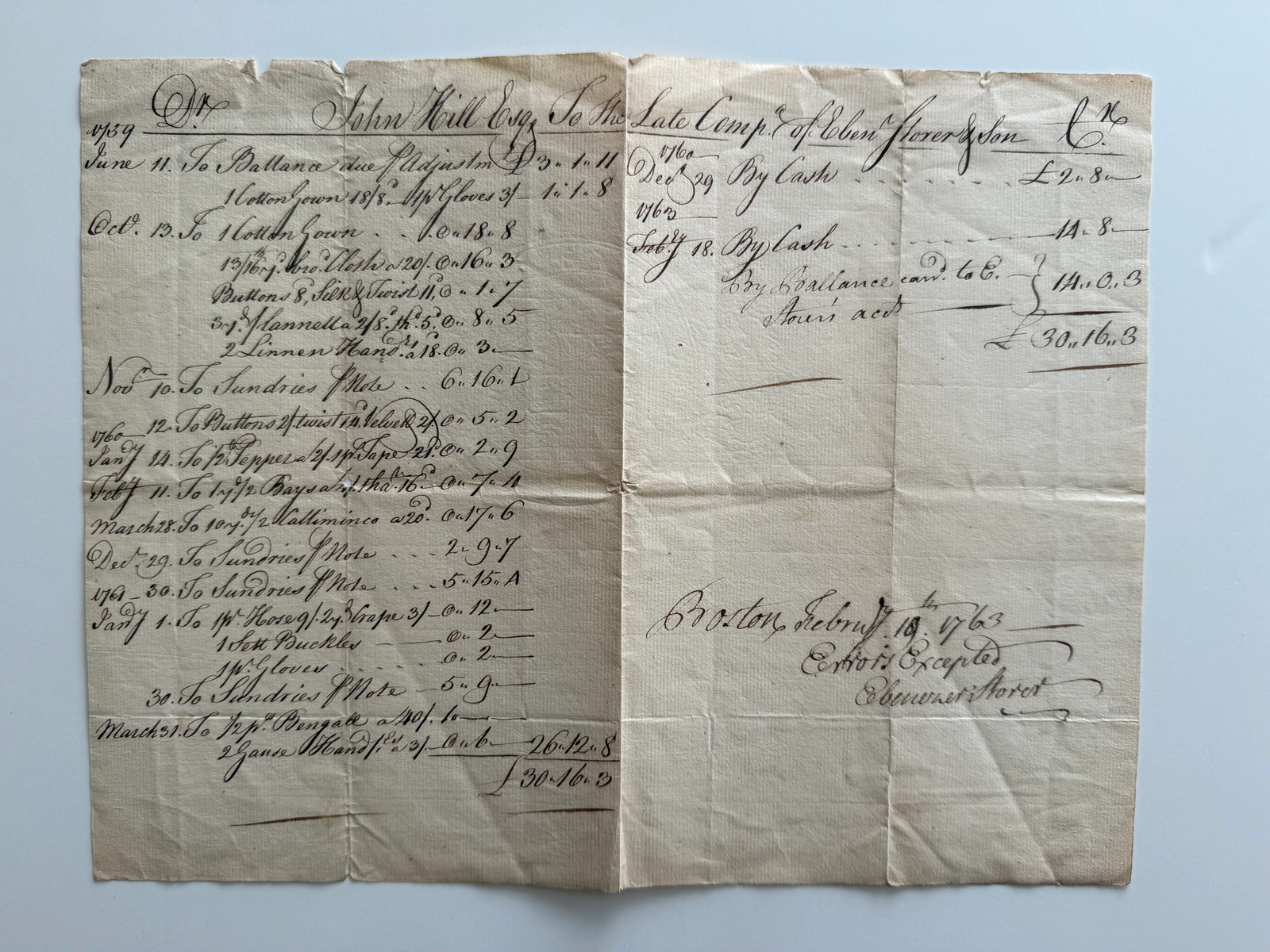
The ledger records purchases of imported English merchandise, including London gloves, cotton goods, flannel, linen handkerchiefs, buttons, pepper, tape, shoe buckles, Bengal cloth, gauze, women\'s gloves, and numerous other dry goods and sundries. Cash payments and credits are carefully entered in period iron-gall ink, reflecting the bookkeeping practices of Boston merchants during the years immediately preceding the American Revolution.
The account concludes with a contemporary acceptance notation dated:
\"Boston, February 18, 1763 – Errors Excepted – Edward Storer.\"
Written on laid paper and preserved in very good condition, this manuscript provides a fascinating glimpse into the commercial life of colonial Massachusetts during the French and Indian War era. Merchant account sheets of this quality are increasingly difficult to obtain, particularly those preserving complete transactional details over multiple years.
An attractive and highly displayable piece of early American economic history, ideal for collectors of colonial manuscripts, Boston history, New England mercantile records, and pre-Revolutionary American documents.
- London gloves
- Cotton goods
- Buttons
- Linen handkerchiefs
- Flannel
- Pepper
- Tape
- Shoe buckles
- Women\'s gloves
- Bengal cloth
- Gauze
- Various sundries
- Cash payments and credits
The reverse bears an acceptance notation:
Boston, February 18, 1763
Errors Excepted
Edward Storer
This indicates the account was reviewed and accepted by Edward Storer, likely acting on behalf of the estate of Ebenezer Storer.
The account is headed:
\"John Hull & Co. To the Late Compy. of Eben Storer\"
The handwriting, accounting format, and imported textile inventory are typical of Boston merchant records immediately before the American Revolution. Such ledgers document the dependence of colonial New England on imported English manufactured goods. Merchant account books of this type are important primary sources for the study of colonial commerce.
Historical Significance
Although this is not the seventeenth-century mintmaster John Hull, it is an excellent surviving Boston merchant account from the French and Indian War era, documenting consumer purchases only a dozen years before the Boston Tea Party.
The variety of imported fabrics and haberdashery items provides an excellent snapshot of everyday commerce among Boston\'s merchant class during the 1760s. Similar merchant accounts were typically discarded after settlement, making surviving examples increasingly scarce.
Condition
- Large laid-paper folio.
- Strong, dark iron-gall ink.
- Complete and highly legible.
- Normal fold wear.
- Minor edge losses at upper margin.
- No significant paper loss affecting text.
- Very good colonial manuscript condition.