When you click on links to various merchants on this site and make a purchase, this can result in this site earning a commission. Affiliate programs and affiliations include, but are not limited to, the eBay Partner Network.
Rare Early U.S. Customs Drawback Document – Port of New York, 1804–1805
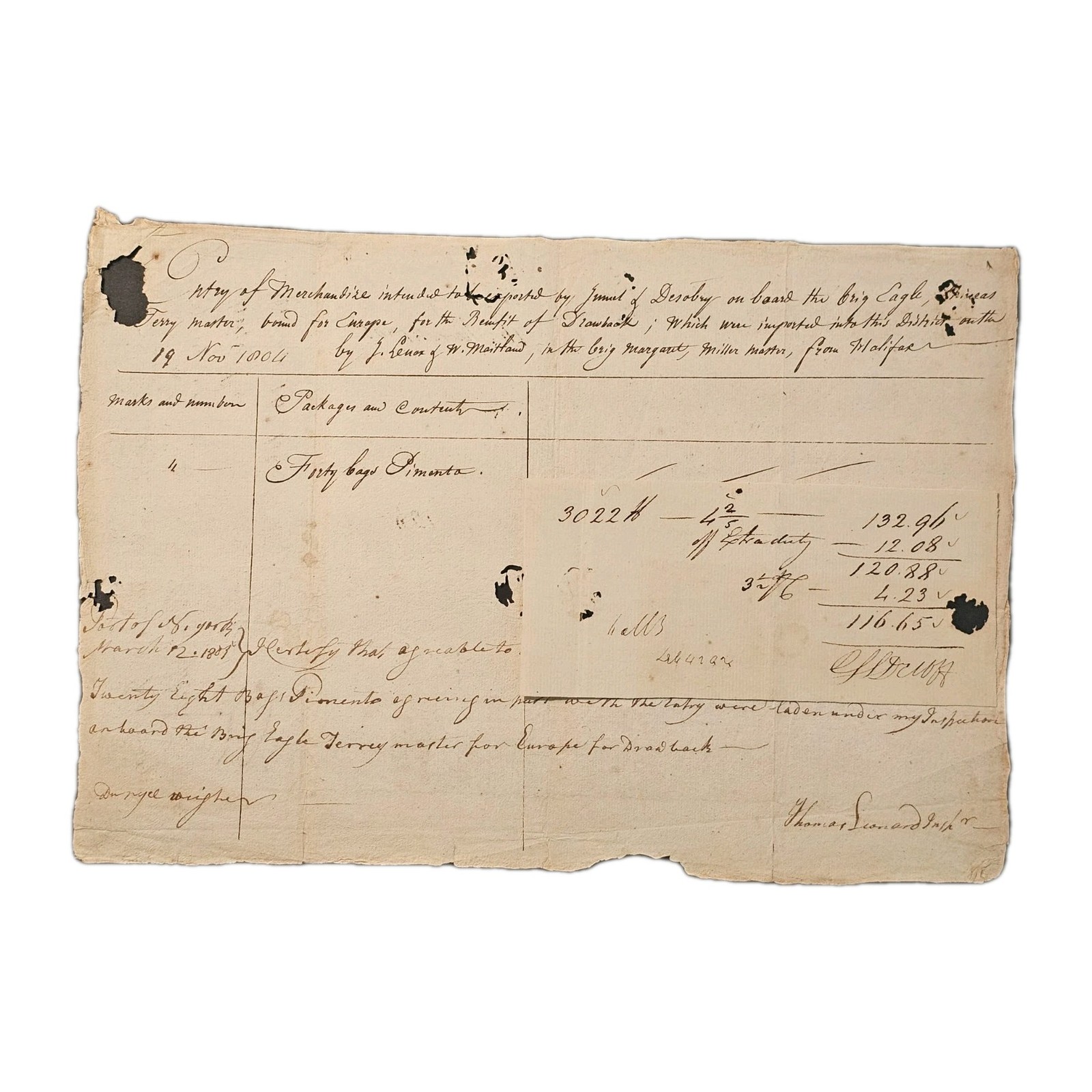
Offered here is an original early 19th-century Port of New York customs drawback entry and debenture request, dated between November 1804 and March 1805. This document records the re-export of fifty bags of pimento (allspice) aboard the brig Eagle, Capt. Terry, master, bound for Europe, originally imported from Halifax on the brig Margaret.
The paper includes detailed customs calculations of duties paid and refunded, reflecting the drawback system, under which merchants could reclaim import duties on goods re-exported from the United States.
---
Key Details
Date: 1804–1805 (entries from Nov. 19, 1804; signed off Mar. 9–16, 1805)
Cargo: 50 bags of pimento (allspice) weighing over 30,000 lbs.
Lenox & Maitland – one of New York’s most important merchant houses.
Stephen Leonard – merchant/agent requesting the debenture.
Ismael & Desobry – New York trading firm.
Customs Inspector: Thomas Leonard, Insp’r, certifying the export.
Signatures present:
Stephen Leonard (merchant agent)
Thomas Leonard (Inspector)
Ismael & Desobry (merchants)
Additional customs officer initials.
---
Historical Significance
This document is notable for its connection to Lenox & Maitland, founded by Robert Lenox (1759–1839) and William Maitland. Lenox rose to become one of the wealthiest men in New York, owning vast tracts of Manhattan (later known as the Lenox Farm). His son, James Lenox, became a famous philanthropist and book collector, establishing the Lenox Library, which ultimately merged into the New York Public Library.
The shipment of pimento (allspice) underscores the importance of the Caribbean spice trade in the early Republic. Pimento was valued in Europe and America for cooking, distilling rum and cordials, medicinal uses, and perfumery. Alongside sugar and rum, it was one of Jamaica’s most profitable exports, making this a vivid example of Atlantic world commerce.
---
Condition
Original laid paper with period ink.
Expected edge wear, small paper loss (not affecting main text), and light toning consistent with age.
Strong legible signatures and handwriting.
---
Collector Interest
Early American customs & trade history
New York mercantile documents
Lenox family / Lenox Library collectors
Maritime & spice trade ephemera