When you click on links to various merchants on this site and make a purchase, this can result in this site earning a commission. Affiliate programs and affiliations include, but are not limited to, the eBay Partner Network.
1837 WESTPORT MASSACHUSETTS FOLDED LETTER TO EAST HADDAM CONNECTICUT – SILK INDUSTRY COLLAPSE COMMENTARY – PROMINENT BROWNELL & GIFFORD MERCHANT FAMILIES – PANIC OF 1837 ERA – ALBANY TRADE & NEW ENGLAND TRAVEL CONTENT
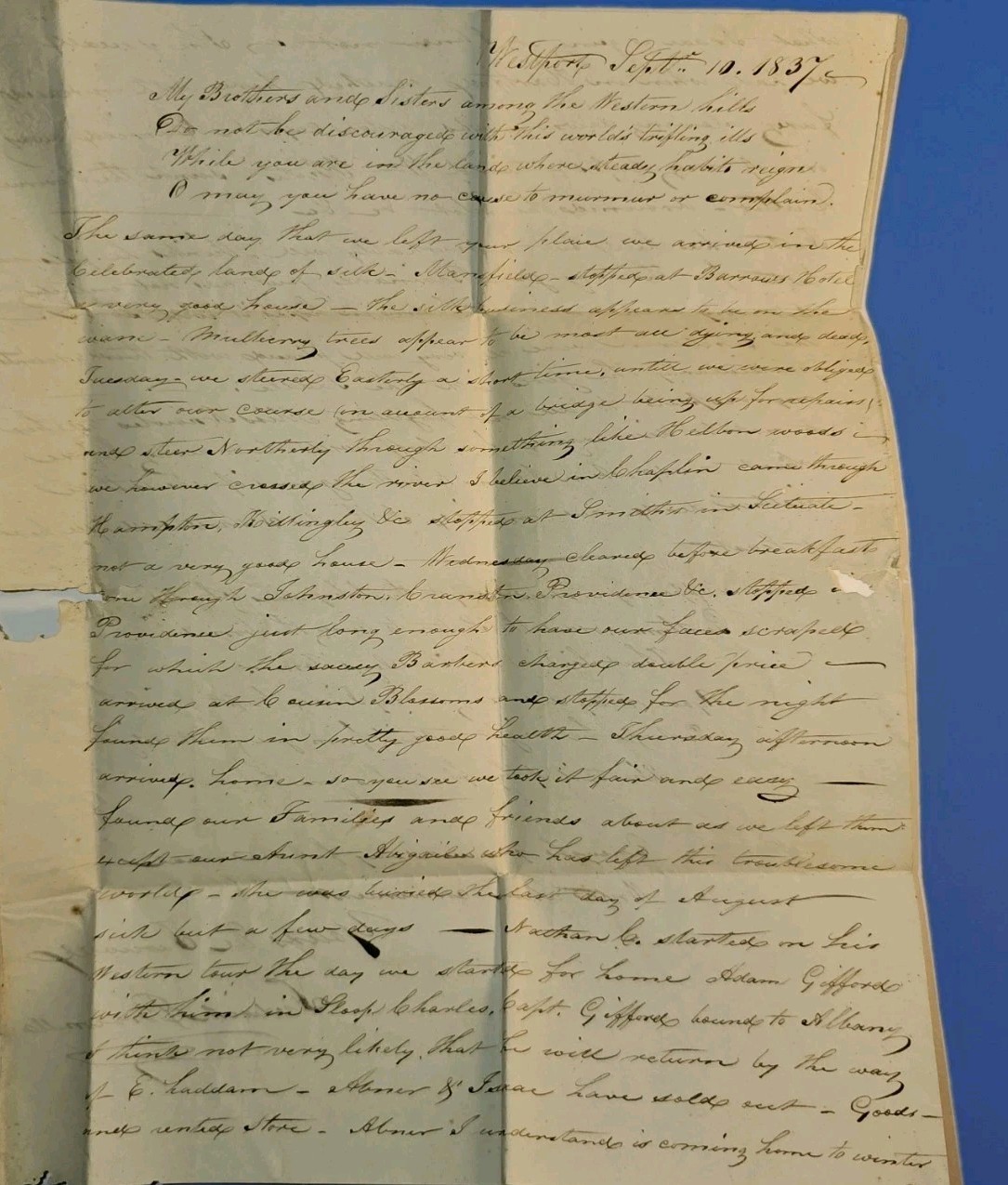
Offered here is a historically important 4-page folded letter written in Westport, Massachusetts on September 10, 1837 and sent to Edward P. Brownell Esq. of Mechanicville, East Haddam, Connecticut. The letter bears a manuscript “12½” postal rate and docketing reading “Westport September 14th 1837.”
This remarkable manuscript documents a network of prominent New England merchant and civic families during the economic turmoil of the Panic of 1837. The letter contains firsthand commentary on the collapse of Connecticut’s silk boom, references to coastal trade and Albany shipping routes, and detailed observations of travel through Connecticut and Rhode Island.
The sender was almost certainly Frederick Wheeler Brownell (1789–1872), a major civic figure in Westport, Massachusetts during the early 19th century. Brownell served repeatedly as Town Clerk, Selectman, Treasurer, and merchant. Town records from the 1830s frequently mention his participation in town governance, elections, and highway administration, and local notices were reportedly posted at “F. Brownell’s store,” illustrating his importance within the community.
The recipient, Edward P. Brownell Esq., was associated with East Haddam, Connecticut and appears in town records shortly afterward as an active civic and administrative figure during the industrial growth period surrounding the Moodus River mills and manufacturing corridor.
One of the most important passages in the letter concerns the collapse of the New England silk industry:
“The silk business appears to be on the wane — Mulberry trees appear to be most all dying and dead.”
This is exceptional firsthand economic commentary regarding the collapse of the mulberry and silk speculation craze that swept Connecticut during the 1830s. Mansfield, Connecticut became one of the centers of American silk production during this period before disease and economic collapse devastated the industry. Contemporary observations of the decline are highly desirable to collectors of American economic and industrial history.
The manuscript also references:
- Mansfield silk production
- Overland travel through Connecticut and Rhode Island
- Providence, Rhode Island
- Albany trade routes
- Coastal shipping
- Merchant travel
- Maritime storms
- The Gifford merchant family of Westport
- Social and family matters among prominent New England families
The letter humorously notes that Providence barbers:
“charged double price”
and includes a charming personal remark regarding “Miss Knowles”:
“if she is then neither dead nor married I think I shall call & see her”
The manuscript further mentions Adam Gifford, likely the well-documented Westport merchant and former selectman Adam Gifford (1782–1864), as well as Nathan Gifford, who had embarked upon a “Western tour,” likely connected to commercial expansion or trade during the canal era.
A fascinating and highly researchable piece of New England mercantile and civic history from the Panic of 1837 period.
BIOGRAPHIESFrederick Wheeler Brownell (1789–1872)
Frederick Wheeler Brownell was a prominent civic official, merchant, and community leader in Westport, Massachusetts during the early and mid-19th century. Historical records from the Westport Historical Society and town proceedings show Brownell serving in multiple important public roles, including Town Clerk, Selectman, Treasurer, and highway administrator during the 1830s and 1840s. Brownell also operated a local store which functioned as both a commercial and civic gathering point within the community. As a coastal Massachusetts merchant during the era of expanding canal trade and maritime commerce, Brownell was closely connected to the economic life of southeastern New England during the years surrounding the Panic of 1837.
Edward P. Brownell Esq.
Edward P. Brownell was a civic and administrative figure associated with Mechanicville in East Haddam, Connecticut during the mid-19th century. Town records place him in positions of local responsibility during the 1840s and 1850s, a period in which East Haddam experienced substantial industrial growth along the Moodus River manufacturing corridor. The use of “Esq.” in the address suggests social prominence and likely involvement in legal, administrative, or municipal affairs.
Adam Gifford (1782–1864)
Adam Gifford was a merchant, saleeer, and public official of Westport, Massachusetts. Born in 1782, he belonged to one of the important maritime and mercantile families of the Old Dartmouth region. Historical records show that Gifford operated a general store, sold goods at sale, and served as a Westport selectman during the early 19th century. His appearance in this letter reflects the interconnected world of coastal trade, shipping, and commerce linking Massachusetts, Rhode Island, Connecticut, and New York during the canal era.
Nathaniel Gifford (1798–1878)
Nathaniel Gifford was a member of the extended Gifford family network active in Westport and Little Compton during the 19th century. Families of this region were heavily involved in maritime trade, shipbuilding, farming, and mercantile activity. The reference in the letter to a “Western tour” likely reflects the broader commercial expansion undertaken by many New England merchants during the Panic of 1837 era as opportunities shifted inland toward New York and the western territories.
FULL TRANSCRIPTIONAddress Panel
Edward P. Brownell Esq.
Mechanicville
East Haddam
Conn.
12½
Westport September 14th 1837
Letter
Westport Sept. 10. 1837
My Brothers and Sisters among the Western hills
Do not be discouraged with this worlds trifling ills
While you are in the land where steady habits reign
O may you have no cause to murmur or complain.
The same day that we left your place we arrived in the
celebrated land of silk — Mansfield — stopped at Barrows Hotel
a very good house — The silk business appears to be on the
wane — Mulberry trees appear to be most all dying and dead.
Tuesday we steered Easterly a short time, until we were obliged
to alter our course (on account of a bridge being up for repairs)
and steer Northerly through something like Hebron woods —
we however crossed the river I believe in Chaplin came through
Hampton, Abingtonly &c stopped at Smiths in Scituate —
not a very good house —
Wednesday cleared before breakfast
drove through Johnston, Cranston, Providence &c. stopped in
Providence just long enough to have our faces scraped
for which the saucy Barbers charged double price —
arrived at Cousin Blossoms and stopped for the night
found them in pretty good health — Thursday afternoon
arrived home, so you see we took it fair and easy —
found our families and friends about as we left them
except our Aunt Abigail who has left this troublesome
world — she was buried the last day of August —
sick but a few days —
Nathan G. started on his
Western tour the day we started for home — Adam Gifford
with him in sloop Charles. Capt. Gifford bound to Albany
I think not very likely that he will return by the way
of E. Haddam —
Abner & Isaac have sold out — Goods
and vintage store — Abner I understand is coming home to winter
[faded section]
what ocean is going at present I
know not — The vessel
which had when in company reached here with some
Jury blowing down — Dutch caps &c carried away
one of my caps — two of Wm White — sunk the Revenue
cutter — drowned the pilot &c &c
Father has held out remarkably well — thinks he
better for the voyage — Brainard’s gout has not entirely
left my back bone but I am in hopes it will soon —
The children were all very well pleased with their presents
particularly the girls with the saddle.
my respects to all not forgetting Miss Knowles
to not be discouraged for chaff will blow away before
wheat and when I come to E.H. again if she is then
neither dead nor married I think I shall call & see her
at least.
I suppose you should say to the Chopmans & Lords
Gentlemen order the Sexton to bury the bones
That lie in the Moselys Tomb.
You may also say to my friend Capt. Wright
Perhaps he might take it from you with delight
The tail of the flock has gone home.
Enough you will say for one mail —
Write when convenient —
Yours & Farewell
Frederick Brownell