When you click on links to various merchants on this site and make a purchase, this can result in this site earning a commission. Affiliate programs and affiliations include, but are not limited to, the eBay Partner Network.
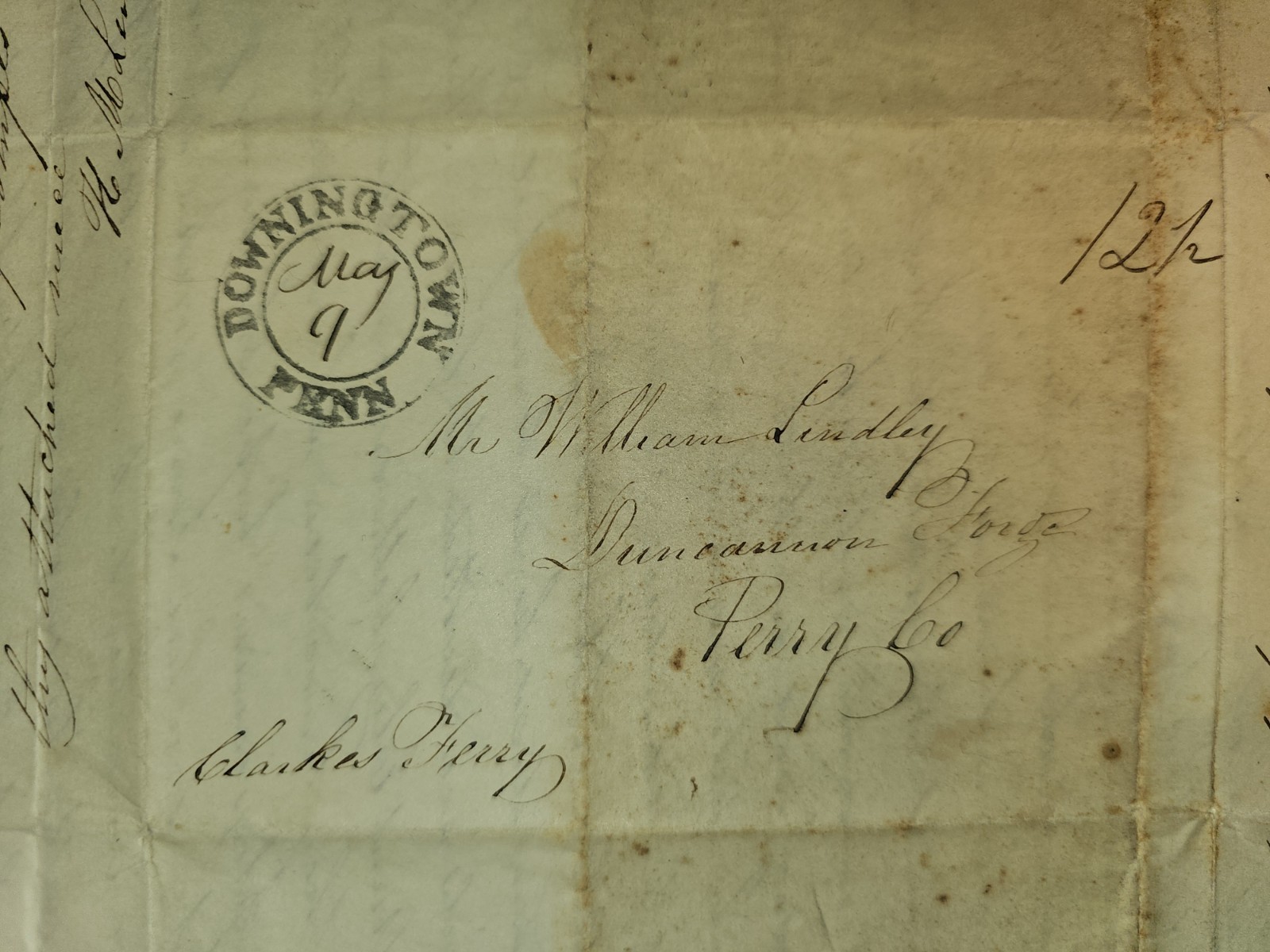
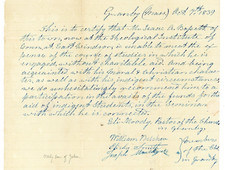
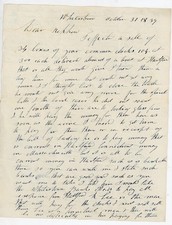
Original 1839 stampless folded letter, postmarked Duncannon, Pennsylvania, addressed to William Lindley at Duncannon Bridge, Perry County. This is a dual-authored family letter, written and mailed at the same time by two members of the same household, sharing a single sheet of paper — a common 19th-century practice.
Authors
Both letters appear on the same sheet and were written contemporaneously, offering two distinct voices within one mailing.
Postal & Physical Details
Stampless letter, carried through the U.S. mails
Circular DUNCANNON, PA postmark dated May 9, 1839
Correct 12½¢ rate marking
Manuscript routing notation “Clarke’s Ferry,” referencing the historic Susquehanna River crossing near Duncannon
Original folds, period ink, legible throughout
Typical edge wear and minor losses consistent with age
Content Highlights (from the letters)
This is a content-rich family correspondence reflecting everyday life in Pennsylvania in the late 1830s. Topics include:
Detailed mention of a social gathering hosted by Hettie Wister, attended by family members
Health and illness, including widespread influenza affecting relatives and neighbors
Household and visiting news, illustrating extended family relationships
Seasonal and agricultural observations, including planting and rural routines
Religious observance, with Sunday noted as a deliberate day for rest and writing
Numerous relatives are named throughout, making this a strong genealogical and social-history document, particularly valuable as a female-authored household letter.
Biography: William Lindley (1805–1881)
William Lindley was born June 3, 1805, in Chester County, Pennsylvania, the son of Jacob Lindley and Ruth Anna (Rutter) Lindley. According to the Potts Memorial, William “was for many years connected with the iron-works at Duncannon, where he still lived unmarried.” By the 1830s, he was residing at Duncannon Bridge, Perry County, Pennsylvania.
William was closely associated with the Duncannon Iron Works, one of the region’s most important early industrial enterprises along the Susquehanna River, tied to canal traffic, ferries, and regional transportation networks. He never married and had no children, and appears to have served as a central figure within the extended Lindley family, regularly receiving correspondence from siblings and nieces.
He died at Duncannon on February 1, 1881, aged 76. His death was noted in multiple Chester County newspapers, and he was interred at New Garden, Chester County, Pennsylvania.
Biography: Thomas Rutter Lindley (1803–1842)
Thomas Rutter Lindley, elder brother of William, was born January 24, 1803, in New Garden, Chester County, Pennsylvania, to Jacob Lindley and Ruth Anna (Rutter) Lindley. He was actively engaged with his brother in operating the Duncannon Iron Works, a major industrial complex located at the junction of the Susquehanna River and Sherman’s Creek.
By the late 1820s and 1830s, the ironworks included a forge, gristmill, sawmill, distillery, rolling mill, and nail factory. In 1839, the Pennsylvania Legislature authorized the construction of a bridge across the Juniata River at Baskins’ Ferry and a railroad from the Pennsylvania Canal at Duncan’s Island to Sherman’s Creek, both intended to support industrial transport. Thomas R. Lindley was appointed as a director overseeing these infrastructure projects.
In early 1842, Thomas traveled to Harrisburg on business connected with the ironworks and related transportation improvements, where he became suddenly ill and died unmarried on January 12, 1842, at the age of 38. His death was reported in the Village Record, which described his passing as sudden but peaceful. No will is recorded for him in Perry County, and he left no known descendants.
Summary
Date: 1839
Format: Stampless folded letter
Origin: Duncannon, Pennsylvania
Two authors, one household, one mailing
Strong ties to early American industry, canal and ferry transportation, and family correspondence
Ideal for collectors of postal history, Pennsylvania history, industrial history, or genealogical manuscripts
A well-documented, historically grounded artifact with real substance and context.