When you click on links to various merchants on this site and make a purchase, this can result in this site earning a commission. Affiliate programs and affiliations include, but are not limited to, the eBay Partner Network.
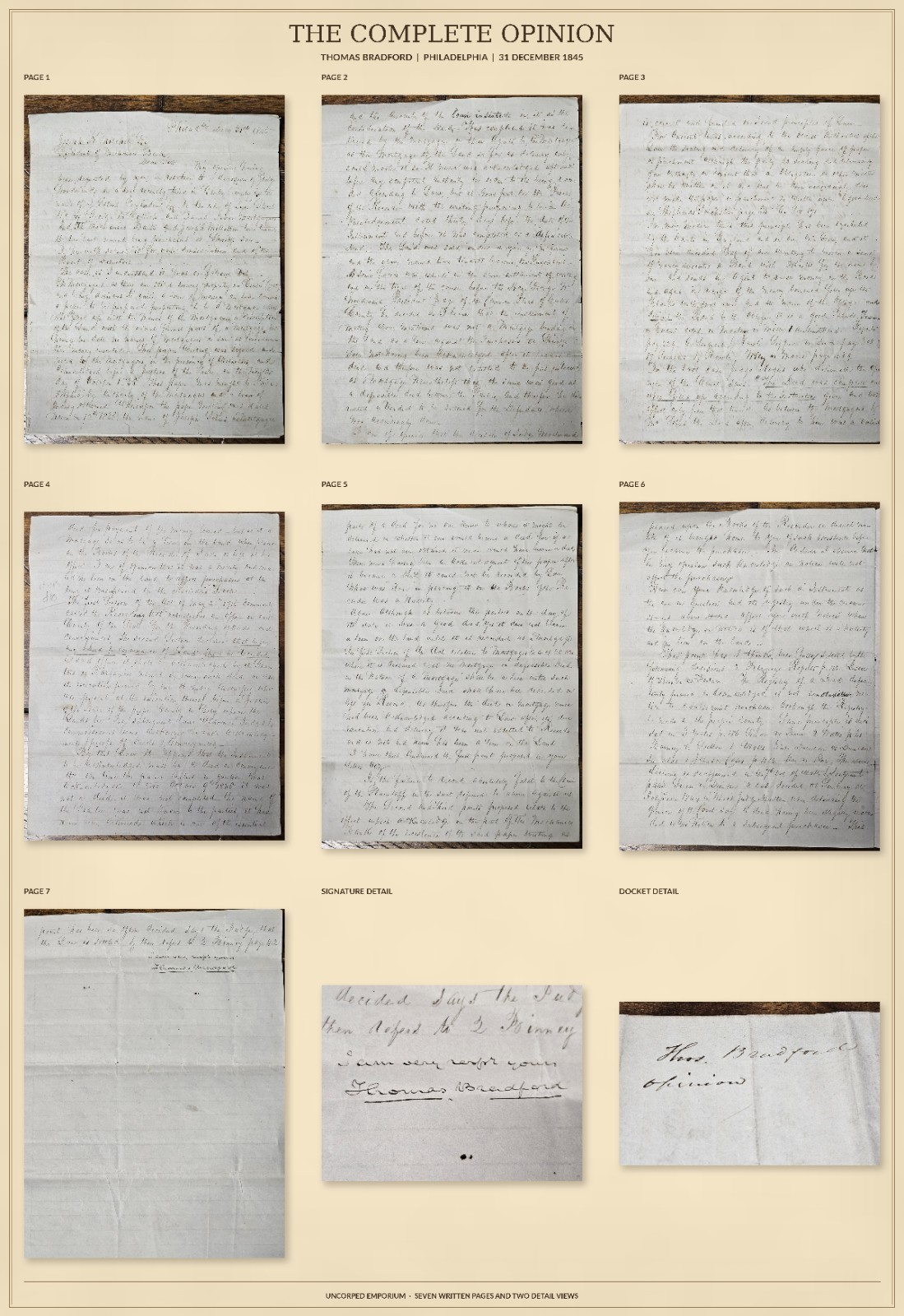
A Philadelphia bank's title to land turns on a mortgage that had been signed before its essential blanks were filled in. This substantial seven-written-page legal opinion, dated Philadelphia, December 31, 1845, bears the signature of Thomas Bradford and is addressed to Joseph B. Mitchell, Esq., President of Mechanics Bank, for consideration by him and the bank's board of directors.
The dispute arose in Centre County, Pennsylvania. George McCulloch and James Dixon had executed an incomplete mortgage instrument in connection with a proposed loan. The mortgagee's name and other essential information were later inserted, but the completed instrument was not freshly acknowledged before being recorded. Mechanics Bank and Joseph Milliken subsequently acquired the land at a sheriff's sale.
Bradford examines whether the earlier instrument could operate as a mortgage lien against those purchasers, and whether their knowledge of it would change the result. He supports the ruling of Judge George W. Woodward, calling it “correct and founded in sound principles of Law.” His argument distinguishes an obligation effective between the original parties from a legally recorded lien enforceable against later purchasers.
The opinion contains an extended discussion of execution, delivery, acknowledgment, recording, and notice, supported by English and Pennsylvania authorities and references to the recording legislation of 1715 and mortgage legislation of 1820. The opening also names Joseph Johns and Lyon, Shorb & Co.
The signer is attributed to Philadelphia attorney Thomas Bradford (1781–1851). The judge whose ruling he discusses was George Washington Woodward, later Chief Justice of Pennsylvania. Woodward had been nominated to the U.S. Supreme Court eight days before the date of this opinion; his nomination was subsequently rejected. That is historical background: this document concerns the mortgage litigation, is not nomination correspondence, and is not signed by Woodward.
Seven written pages are shown, including the signed conclusion. A docket reads “Thos. Bradford / Opinion.” This is a manuscript legal opinion, not the underlying mortgage deed. Described as a signed manuscript; the entire text is not represented as being in Bradford's own hand.
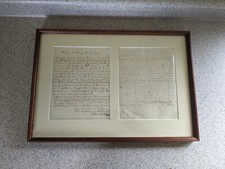
Condition: age toning, folds and creases, uneven ink fading, scattered spots, ink blots, small holes, and edge/fold tears and splits. An old pencil price notation is present. Please examine all photographs for the exact appearance and condition of the manuscript.
A detailed piece of antebellum Pennsylvania banking and legal history, with particular relevance to Philadelphia, Centre County, sheriff's sales, mortgage priority, and nineteenth-century legal practice.
Type: Manuscript legal opinion / legal correspondence
Date: December 31, 1845
Year: 1845
Era: 1800–1849
Place Written: Philadelphia, Pennsylvania
Geographic Subject: Philadelphia and Centre County, Pennsylvania
Country: United States
Language: English
Material: Paper with handwritten ink text
Signature: Thomas Bradford
Attributed Signer: Thomas Bradford (1781–1851), Philadelphia attorney
Recipient: Joseph B. Mitchell, President of Mechanics Bank
Institution: Mechanics Bank, Philadelphia
Judge Discussed: George Washington Woodward
Subjects: Banking; mortgages; deeds; recording; sheriff's sales; land title
Extent: Seven written pages, plus docketing
Format: Signed manuscript; not represented as wholly autograph
Condition: Toning, folds, fading, spots, holes, and edge/fold tears; pencil notation
Dimensions: Add measured dimensions before publishing